You have six or eight people going to Sedona, and you are staring at two browser tabs. One is a block of hotel rooms. The other is a whole house. Both look fine. Both cost more than you’d like. And the reviews for each are full of people swearing theirs was the only right answer.
There is no single right answer. There is a right answer for your group, on your dates, at your headcount. This is the honest version of that decision, with the parts most comparison pages skip: where a rental genuinely saves you money, where a hotel is genuinely the better call, and the one Sedona-specific wrinkle that tends to settle it for pickleball groups.
Start with the real question, which isn’t price
Price matters, but it is rarely the thing that makes a trip good or bad. The thing you actually remember is whether the group got to be together.
A hotel scatters eight people across four rooms, maybe on different floors. You reconvene in a lobby or a restaurant, you split the check, and everyone drifts back to their own room by nine. That is not a knock on hotels. For some trips, that separation is the point.
A whole home does the opposite. Everyone lands in one kitchen, one living room, one firepit. The morning coffee happens in the same place. The card game runs late because nobody has to leave to get to it. If the reason you are traveling together is to actually be together, that architecture is worth real money, and it is the first thing to weigh before you touch a spreadsheet.
So ask the group the honest question first: are we here to do our own things and meet up, or are we here to share one roof? The answer narrows the choice faster than any per-night number.
Running the numbers: when a rental actually costs less
Here is the part people want, minus the fake precision. A widely cited rule of thumb in the rental industry is that a whole home breaks even against hotel rooms at around three to four nights for a couple, and from the very first night once you are a group of four or more. The logic is simple: a hotel charges you per room, so more people means more rooms means a bigger bill. A rental charges one nightly rate no matter how many beds are filled, so more people means the same bill split more ways.
You do not need my numbers to run this. Do it with live ones:
- Pull the nightly total for the whole home on Airbnb and divide it by your headcount. That is your per-person, per-night figure.
- Count the hotel rooms you’d actually need. Eight adults is usually four rooms; a family with kids might be three. Multiply the room rate by rooms by nights.
- Add each side’s real extras. Hotels tack on lodging tax, sometimes a resort fee, sometimes paid parking. Rentals add a cleaning fee and a booking service fee. Put both on the table before you compare.
For two people on a quick overnight, the hotel usually wins that math. For six or eight over a long weekend, the rental usually wins it, and it is not close. Where exactly your trip lands depends on the season and your dates, so confirm current rates on both sides before you decide.
| Four hotel rooms | Whole home, sleeps 8 | |
|---|---|---|
| Who’s covered | 8 people, two per room | Up to 8, across 4 bedrooms |
| How you’re charged | Each room rate, times nights | One nightly rate, split the group |
| Typical extras | Lodging tax, resort/parking fees | Cleaning fee, service fee |
| Meals | Eat out or order room service | Full kitchen, cook or dine out |
| Being together | Reconvene in shared areas | One kitchen, one living room |
The table above is about structure, not a quote. Your actual numbers are whatever the two listings say this week.
The kitchen is the line item that quietly decides it. Eight people eating three meals a day out is a stack of restaurant checks. A full kitchen turns breakfast and a couple of dinners into groceries you split once. You will still want to book a table at one of the town’s better restaurants at least one night, and you should. But cooking even half your meals in the house is often a bigger saving than the room-rate difference itself.
Where hotels genuinely win
A fair comparison names the other side’s strengths, so here they are, plainly.
Hotels give you daily housekeeping. Someone makes the bed, swaps the towels, and empties the trash while you are out hiking, and there is no cleaning fee waiting at the end. That service is real, and for some travelers it is the whole reason to book a hotel.
Hotels give you a front desk around the clock. Something breaks at 11 p.m., you call and a person handles it. You want a late checkout, extra pillows, a restaurant recommendation, or a taxi, and it is one phone call. In a rental you are more self-sufficient; the host is reachable, but there is no lobby staffed at 2 a.m.
Hotels are simpler for one or two people. If it is a couple on a short trip, four hotel walls with room service and a pool you don’t have to maintain is often the easier, cheaper, and frankly nicer choice. Loyalty points, an on-site restaurant, and a bar you can walk back from all count too.
And Sedona has good ones. L’Auberge de Sedona sits along Oak Creek, the Kimpton Amara Resort & Spa is walkable to Uptown, and Enchantment Resort is out in Boynton Canyon. None of those are the wrong choice. They are just a different kind of trip than eight people under one roof.
Where the whole home wins
The rental’s case is the mirror image. Separate bedrooms mean the early risers and the night owls stop colliding; the couple with a toddler is not sharing a wall with the friends who want to stay up. A living room means a place to actually gather that isn’t a hotel bar. A washer and dryer means you pack lighter. Free parking on site means nobody is hunting a space or paying a valet.
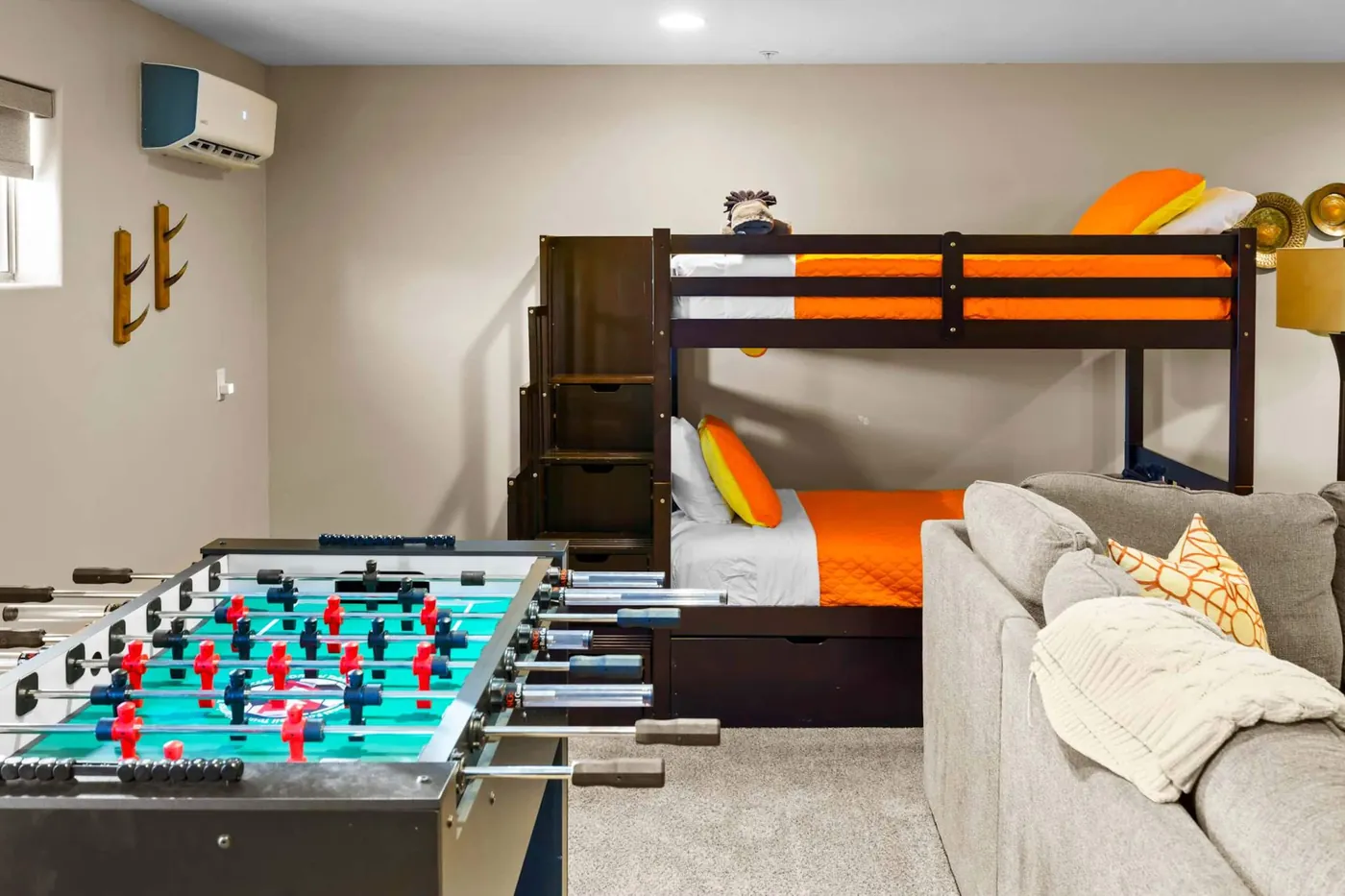
For a group of four to eight, a whole home like this one is built around exactly that. It sleeps eight across four bedrooms, two kings, a queen, and a game room with twin-over-twin bunks, with two bathrooms. There’s a full kitchen, a media lounge, a covered deck, a firepit, two outdoor soaking tubs, and free driveway parking for four cars. Everyone stays put, in one place, for less per head than the equivalent stack of rooms. If you are deep in the logistics of a bigger trip, our group trip planning guide walks through splitting costs, assigning rooms, and stocking the kitchen.
The Sedona wrinkle: the courts, the heat, and the drive
Here is where I have to be straight with you, because a couple of comparison pages get this wrong. Some Sedona resorts do have pickleball. Enchantment Resort keeps six courts, first-come and open to guests, and the Hilton Sedona Resort at Bell Rock has courts at its athletic club. So “no hotel has pickleball” would be false.
What no hotel has is a court that is private, indoors, and climate-controlled. The resort courts are shared with every other guest who wants one, and they are outdoor. In Sedona that matters more than it sounds. A July afternoon here still runs into the mid-90s, roughly ten degrees cooler than Phoenix by day but nowhere near an alpine escape, and the summer monsoon sends thunderstorms rolling in most afternoons. An outdoor court bakes at noon and closes when the storm arrives. An indoor, air-conditioned court plays at 1 p.m. in July and straight through the rain. That gap is the whole reason the home’s court exists, and it is worth a longer read on our beat-the-heat page and in the honest breakdown of a resort court versus a home court.
There is also the being-yours part. A shared court means waiting, watching the clock, and sharing with strangers. A private court on a group trip means the paddles come out whenever your group feels like it, at whatever hour, for as long as you want. Because the court is indoors and inside the house, it is quiet too, no neighbors and no complaints, which we get into on the quiet pickleball page.

One practical note that cuts both ways: Sedona is a drive-to destination. It is about 117 miles and roughly two hours from Phoenix on I-17, longer with weekend traffic. Hotels near Uptown put you steps from restaurants, which is a genuine convenience if you did not bring a car for everyone. This home sits in West Sedona, minutes from the trailheads and the grocery run, with free parking for four cars and no street parking, which is the better setup if your group is arriving in a couple of vehicles and wants to spread out rather than valet in. Neither is better in the abstract; it depends on how you are getting around.
A simple way to decide
Strip away the noise and it comes down to headcount, nights, and what you value.
For a lot of Sedona trips, the group sorts itself. Two people chasing a romantic weekend book the creekside resort and are right to. A crew of six or eight who want to hike in the morning, cook dinner together, play a round-robin after dark, and split one bill book the house and are right to. Neither camp needs to feel talked into anything. If you want to see how a full weekend actually flows in the house, the three-day itinerary lays it out, and companies running an offsite can look at the corporate retreat breakdown.
Booking this home
If the whole-home side is where your group landed, the home is on Airbnb only. It sleeps eight across four bedrooms and two baths, with the private indoor court, the full kitchen, the deck and firepit, the soaking tubs, and free driveway parking. Guests need to be 25 or older to book, check-in is 4 p.m. and checkout is 10 a.m., and it is a no-pets, no-parties, no-smoking house. If you are still weighing which platform to book on in general, we wrote a plain comparison of VRBO versus Airbnb for a Sedona rental, though the short version for this house is that Airbnb is where it lives. Check dates and book on Airbnb.
Frequently asked questions
Is a vacation rental cheaper than a hotel in Sedona?
For a couple on a short stay, usually not. For a group of four or more, a whole-home rental is typically cheaper per person from the first night, because you split one nightly rate instead of paying for several rooms. The saving grows when you cook meals in the kitchen instead of eating every meal out. Run the live numbers on both listings, extras included, to be sure for your dates.
What does a hotel do better than a rental?
Daily housekeeping with no cleaning fee, room service, and a front desk staffed around the clock. Hotels are also simpler and often cheaper for one or two people, and they come with loyalty points and on-site amenities you don’t have to maintain. Those are real advantages worth weighing honestly.
Do any Sedona hotels have pickleball courts?
Yes. Enchantment Resort has six courts open to guests, and the Hilton Sedona Resort at Bell Rock has courts at its athletic club. They are outdoor and shared with other guests, though. What a hotel can’t offer is a private, indoor, climate-controlled court that your group has entirely to itself.
How many people does the home sleep?
Eight, across four bedrooms, two kings, a queen, and a game room with twin-over-twin bunks, plus two bathrooms. It is set up for a group of four to eight who want to share one roof rather than split across hotel rooms.
How far is the home from Phoenix?
About 117 miles, roughly a two-hour drive up I-17, longer on busy weekends. It sits in West Sedona with free driveway parking for four cars and no street parking, so a group arriving in a couple of vehicles has room to land.
Can we really play pickleball in the middle of a Sedona summer day?
Yes, and that is the point of an indoor court. Sedona summer afternoons still run into the mid-90s, and monsoon storms roll in most afternoons from July into September. The home’s court is heated, air-conditioned, and lit, so it plays at noon in July and straight through the rain while outdoor courts sit empty.
Play year-round in red rock country
Sedona Pickler is a private Sedona home with its own indoor, climate-controlled pickleball court. Rally any season, any hour — heated, cooled and lit, with paddles and balls provided.
Check dates & book