
Albuquerque doesn’t need more courts — it needs a weekend like this
Albuquerque is not a city that needs to be talked into pickleball. The Manzano Mesa Pickleball Complex on Elizabeth Street SE runs 33 dedicated courts, 21 of them lighted, and it’s the biggest concentration of courts in the city — but it’s far from the only one. The Parks and Recreation department lists pickleball at more than 15 locations across town: 12 lighted courts at Ventana Ranch on the Westside, 8 at Alamosa, 8 at Lauren C. Bolles, 6 at Villela near Cherokee NE, 6 at Montgomery Park, and a mix of dedicated and blended-line courts at Pat Hurley overlooking the valley. The city has kept building, too — a 15-court addition at Manzano Mesa was part of a plan to push the complex toward 39 courts and the citywide count past 100.
The tournament calendar backs that up. The New Mexico Games holds its pickleball tournament at Manzano Mesa, with medalists qualifying for the State Games of America. The city’s Department of Senior Affairs runs an annual 50-plus tournament at the same complex that draws more than 100 players. And when the PPA Tour brought the inaugural New Mexico Open to Manzano Mesa in September 2021, organizers expected over 700 athletes. By any measure, Albuquerque is a real pickleball town.
So the case for driving 350 miles west is not “come find pickleball.” You have pickleball. The case is built on the three things even 33 courts can’t give you.
First, the courts are shared. Manzano Mesa is first-come, first-served, with play limited to an hour and a half when others are waiting — fair rules for a public facility, but it means your group’s afternoon is shaped by whoever else showed up. Second, the courts are outdoors. Albuquerque’s high-desert winter puts plenty of mornings below freezing, and spring wind is a fact of life on any open court in the metro. Third, the scenery is the scenery you already know. The Sandias are a fine backdrop. They are also the same backdrop as last Tuesday.
A private indoor court in Sedona flips all three. Nobody rotates in. The court is heated in January and air-conditioned in June, so a 6 AM game and a 10 PM game are both on the table. And between sessions you’re looking at red rock instead of your own zip code. That’s the trade, honestly stated: you’re not driving for the sport, you’re driving for total control of it, in a place that looks like nowhere in New Mexico.
The drive: a highway you already know how to drive
Every Albuquerque road-tripper has done I-40 West. That’s most of the appeal — there’s no navigation to think about for 320-plus miles. You get on the interstate, you point at Flagstaff, and the only real decision comes at the end.
The numbers: it’s about 350 miles from Albuquerque to West Sedona, which works out to 5 to 5.5 hours of actual driving at interstate speeds. Plan on six-plus with a real stop. Most of the year the clock helps you — Arizona skips daylight saving time, so from March to November you gain an hour at the state line. Leave Albuquerque at 8 AM and you can be unloading in Sedona by early-to-mid afternoon local time, with a court session before dinner.
The road itself is higher than people remember. About an hour and a half out, between Grants and Gallup, I-40 crosses the Continental Divide at over 7,200 feet — the sign comes and goes fast, but in winter that stretch catches weather. Then the road drops, runs across the Arizona high desert, and climbs again toward Flagstaff, which sits at nearly 7,000 feet. You start at 5,312 feet and finish at about 4,350, but you top 7,000 twice in between. File that under winter planning, covered below.
Here’s what’s actually worth stopping for, in order.
Gallup, about two hours in, is the trading-post capital of the route. Richardson’s Trading Post at 222 West Historic Highway 66 has been dealing in Navajo rugs, turquoise and silver jewelry, and pueblo pottery since 1913 — the store predates Route 66 itself and is still family-run. Even if you’re not buying, ten minutes among the rug stacks and pawn cases beats any gas-station stretch break. Gallup’s downtown has a handful of other longtime posts within a few blocks, so it’s an easy single stop.
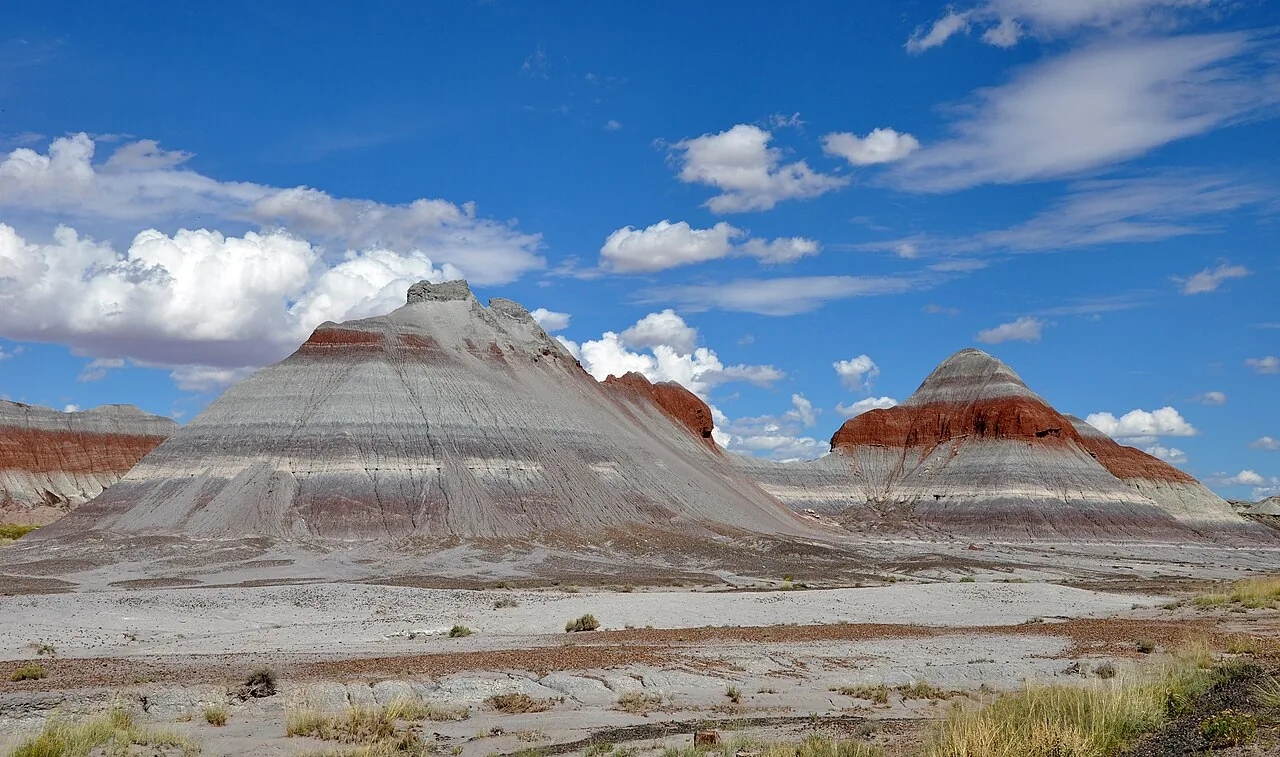
Petrified Forest National Park is the big one, and it’s absurdly convenient: the north entrance and Painted Desert Visitor Center sit directly off I-40 at Exit 311, about three hours from Albuquerque. Entry is $25 per vehicle (confirm current), good for seven days. The full park road runs 28 miles south past the Painted Desert overlooks, Blue Mesa, and the log fields, exiting near Holbrook — from there US-180 and AZ-77 put you back on I-40 having lost maybe 90 minutes to two hours all-in. If you only have 30 minutes, the Painted Desert rim stops near the north entrance still earn the exit.
Winslow is the quick photo stop. The Standin’ on the Corner Park at Second Street and Kinsley Avenue — opened in 1999 — commemorates “Take It Easy,” the song Jackson Browne and Glenn Frey wrote and the Eagles made famous. There’s a bronze figure with a guitar, a mural, and yes, a flatbed Ford parked at the curb. Five minutes off the interstate, five minutes of photos, back on the road. It’s a little goofy and everyone does it anyway.
Meteor Crater, at Exit 233 between Winslow and Flagstaff, is the stop for the science-minded half of your group. It’s a privately run site — adult admission runs about $29 (confirm current) — and it’s the best-preserved meteorite impact crater on Earth, nearly a mile across, with rim-side viewing and an indoor space museum. Open daily, roughly 8 AM to 5 PM outside of summer and longer within it. Budget an hour if you exit.
Walnut Canyon National Monument is the last easy detour, at Exit 204 just before Flagstaff, three miles south of the interstate. The Island Trail drops 736 stair-steps into the canyon past 25 cliff-dwelling rooms built into the limestone ledges — a genuinely good leg-stretcher after four-plus hours of sitting, though your knees will have opinions on the climb out. Entry is $25 per vehicle (confirm current).
Obvious advice that groups ignore: don’t do all five in one direction. Pick one, maybe two, and save the rest for the drive home — checkout is 10 AM, which puts you back at these exits with a whole afternoon to spend.
Two ways down from Flagstaff
At Flagstaff the interstate part ends and you choose your arrival.
The pretty way is SR-89A through Oak Creek Canyon — about 30 miles from Flagstaff into Sedona, 45 minutes to an hour without stops. The road runs flat through the pines, then falls off the rim in a set of switchbacks and follows Oak Creek the rest of the way down, with the canyon walls going from white to buff to red as you descend. Stop at the Oak Creek Vista overlook at the top; it’s the best free view of the day. Our full guide to the drive, including where to pull off, is at /things-to-do/oak-creek-canyon-drive/. If it’s daylight and the pavement is dry, this is the arrival to choose — after five hours of high-desert interstate, dropping into that canyon is the moment the trip changes gears.
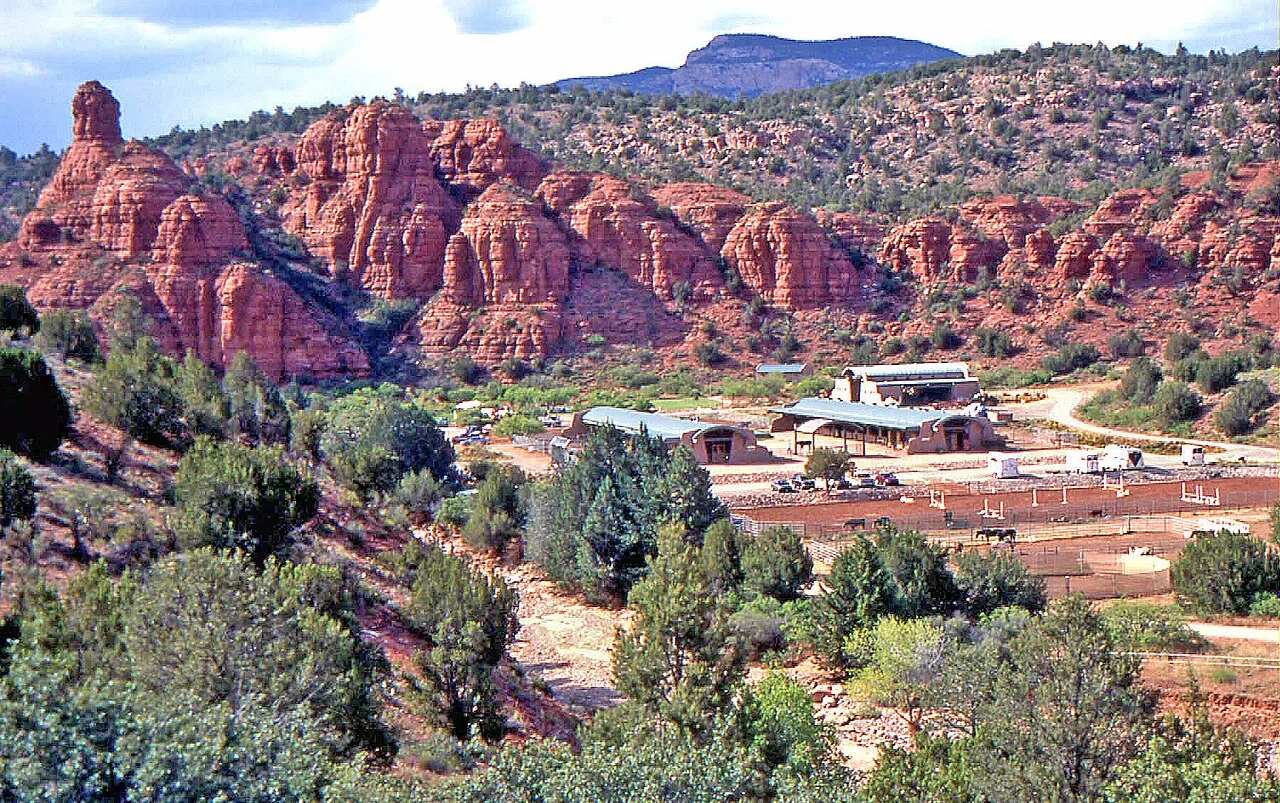
The easy way is to stay on the freeway: I-17 South from Flagstaff to Exit 298, then SR-179 north into Sedona — roughly 50 miles, similar total time, all of it wide and mild. This is the right call after dark, in winter weather, or any time the 89A switchbacks sound like more than you want at hour five. It’s not exactly a booby prize either: SR-179 is the Red Rock Scenic Byway, and it brings you in past Bell Rock and Courthouse Butte, which is a strong first look at what you drove for.
Three days that earn the miles
A workable plan for a Friday-to-Sunday run, assuming two families or a club group of up to 8.
Day one: leave Albuquerque by 8 AM, make one I-40 stop, come down Oak Creek Canyon, and check in at 4 PM. First court session before dinner — paddles and balls are already at the house, so nobody’s trip depends on remembering gear. If the group has legs left, sunset is short work: our sunset spots guide covers the reliable ones, including Airport Mesa a few minutes from West Sedona. Dinner out — see where to eat — then the hot tub.
Day two: hike in the morning, play in the afternoon. Cathedral Rock is the classic — short, steep, and worth every scramble — and the trailhead is minutes from the house. Back for lunch, then run a proper afternoon block on the court. With 8 players you can keep two-on-two games rotating for hours; if you want structure, our guide to running a round robin turns a loose group into a bracket in ten minutes. Evening is the firepit and the game room, and anyone who wants a 10 PM rematch can have one — the court is lit and climate-controlled, and because it’s fully indoors there are no neighbors to think about and no noise carrying down the street at night. That’s not a small thing; it’s the whole reason a late-night game is even possible, and it’s covered properly in our quiet pickleball page.
Day three: early court time for the diehards — the morning crew can play at 6 AM without waking anyone — then pack, check out by 10 AM, and take SR-179 south past Bell Rock on the way out. You’ll hit the I-40 corridor by early afternoon with time for whichever stop you skipped on the way in. Petrified Forest works especially well eastbound; Exit 311 comes late enough in the drive to break up the long New Mexico stretch.
What the house gives a group of 8
The Sedona Pickler is a West Sedona home built around one feature no public complex can match: a private, regulation-size indoor pickleball court, heated, air-conditioned, and lit. Paddles and balls are provided; bring court shoes.
The house sleeps 8 across 4 bedrooms — two kings, a queen, and a game room with twin-over-twin bunks — with 2 baths. In practice that’s two families (kings for the parents, bunks and the queen for the kids), or a club group of four couples’ worth of players who all get real beds. There’s a full kitchen for group breakfasts, a media lounge, a covered deck, a hot tub and outdoor soaking tubs, a firepit, and red-rock views. The driveway parks 4 cars — no street parking — which matters if your group caravans in two or three vehicles from Albuquerque.
House rules, plainly: guests must be 25 or older to book, no pets, no parties, no smoking. Check-in is 4 PM, checkout is 10 AM, and booking is through Airbnb.
For Albuquerque players specifically, the comparison writes itself. At home, your best option is a public complex with a 90-minute limit when courts are full. Here, the court is 30 seconds from your bed, the schedule is whatever your group says it is, and weather is not a variable. Nobody checks the wind forecast before a 7 AM game.
Practical notes for the I-40 crowd
Altitude: skip the worry. This is the rare Sedona trip where you come down — Albuquerque sits at 5,312 feet, Sedona at about 4,350. The ball plays close to what you’re used to and nobody needs an acclimation day. If anything, your lungs get a small vacation too.
Winter: the destination is easy, the road is the thing to respect. Sedona winters are mild, and the court is heated regardless. But I-40 crosses 7,000-plus feet twice between the cities — the Continental Divide stretch in New Mexico and the approach to Flagstaff, which averages around 100 inches of snow a year. Before a December-through-March run, check nmroads.com and az511.gov the morning you leave, carry the usual high-country basics, and take I-17 down from Flagstaff instead of the 89A switchbacks if anything is falling. Storms pass fast; a flexible departure hour solves most of it.
Summer: Albuquerque summers are hot but survivable on an outdoor court in the morning. Sedona runs similar, and it doesn’t matter — the indoor court’s air conditioning means your 2 PM slot plays exactly like your 8 AM slot. July trips work here in a way they don’t at any outdoor complex in either state.
Booking lead time: holiday weeks, spring break, and fall weekends go earliest. If your group needs specific dates — a birthday, a club trip everyone has to clear with work — book several weeks out at minimum. A group of 8 with one shared calendar should lock dates before someone’s cousin claims Labor Day.
Packing: court shoes are the one non-negotiable, since paddles and balls are covered. Beyond that, layers — high-desert mornings are cool even in warm months, and you’ll want hiking shoes, swimsuits for the hot tub, and sunscreen year-round. The full checklist is at /blog/what-to-pack-pickleball-vacation/.
The short version: you already know the highway, the stops are genuinely good, and at the end of it there’s a court with your group’s name on it for the whole weekend. For a city that’s already this deep into pickleball, that’s the missing piece — not more courts, just one that’s entirely yours.
Frequently asked questions
How far is Sedona from Albuquerque?
Which way down from Flagstaff — 89A or I-17?
Is the drive doable in winter?
What are the best stops along I-40?
Will we notice the altitude change?
Does the house actually fit two families?
Your court is 5 to 5.5 hours of driving; plan on 6+ with a real stop away
Sedona Pickler is a private West Sedona vacation home for up to 8 with its own indoor, climate-controlled pickleball court — heated, air-conditioned, and lit. Load the car, drive up, and play the moment you arrive.
Check dates & book


