
Las Vegas is one of the better pickleball towns in the West, and this page isn’t going to pretend otherwise. What Vegas doesn’t have is quiet — or a court that belongs to you alone at 10 PM in July. That’s a 4.5-hour drive east, over the Colorado River and down a long stretch of old Route 66, in a red-rock town at 4,350 feet where the loudest thing at night is your own doubles argument.
Vegas has courts. It doesn’t have this.
Give Las Vegas its due. The Plaza Hotel & Casino downtown put a full pickleball complex on its rooftop pool deck — 12 permanent courts plus a championship court, open to the public, with equipment rentals and lessons. It’s a genuinely fun place to play, and it’s also a shared amenity with posted hours and a day fee for non-guests (around $30 last we checked; confirm current). Across town, Clark County built one of the biggest public facilities in the region: the Sunset Park Pickleball Complex at 2601 E Sunset Road, with 24 dedicated courts. Most of them run first-come, first-served, a handful can be reserved for $6 an hour, and the county is already adding more because demand keeps outrunning supply. And in Henderson, Chicken N Pickle opened in November 2024 with 6 indoor courts and 8 covered outdoor courts wrapped around a restaurant — the fastest-growing pickleball chain in the country picked the Vegas valley for a reason.
It goes beyond rec play, too. The Plaza has hosted USA Pickleball Golden Ticket qualifying and runs summer leagues on that rooftop; Chicken N Pickle keeps a year-round calendar of DUPR-rated events, clinics, and tournaments. If you live in the valley and play seriously, you already know all of this — you probably have a standing game at one of these places.
So the scene is real and getting bigger. Here’s the honest problem with it, and it isn’t the courts. It’s July.
The average July high in Las Vegas runs around 104°F, stretches above 110 are routine, and in July 2024 the city hit 120°F — its hottest reading on record. On an outdoor hard court, that math is simple: you play at 6 AM or you don’t play. The first-come courts at Sunset Park fill accordingly. The indoor options are good but shared — you’re working around open-play schedules, reservation windows, and everyone else in a metro of two million-plus who had the same idea.
Now run the alternative. A private, regulation indoor court — heated, air-conditioned, lit — attached to the house you’re sleeping in. No hours. No fee. No fence line of paddles waiting for your game to end. It’s 108°F outside or it’s snowing; the court doesn’t care, and neither do you. Because the court is fully indoors, there’s also nobody to bother: no neighbors, no noise complaints, no HOA letter — the whole case for indoor play is laid out at /quiet-pickleball/ if you’ve ever had a game shut down by a grumpy fence-neighbor.
That’s the trade this weekend offers. Not a knock on Vegas — a break from it. Fewer people, darker skies, cooler air, and a court that’s yours from Friday check-in to Sunday checkout.
The drive: over the dam, down the Mother Road
The route is one of the better road trips in the Southwest, and it’s dead simple: I-11/US-93 south out of Vegas, I-40 east at Kingman, then south from Flagstaff into Sedona. Call it 280 miles and about 4.5 hours of actual driving. With the stops below, budget 5.5 to 6. The first leg now carries Interstate 11 signage between Vegas and the river, but it’s the same road locals have always called the 93 — follow signs for Boulder City, Hoover Dam, and Kingman and you can’t go wrong.
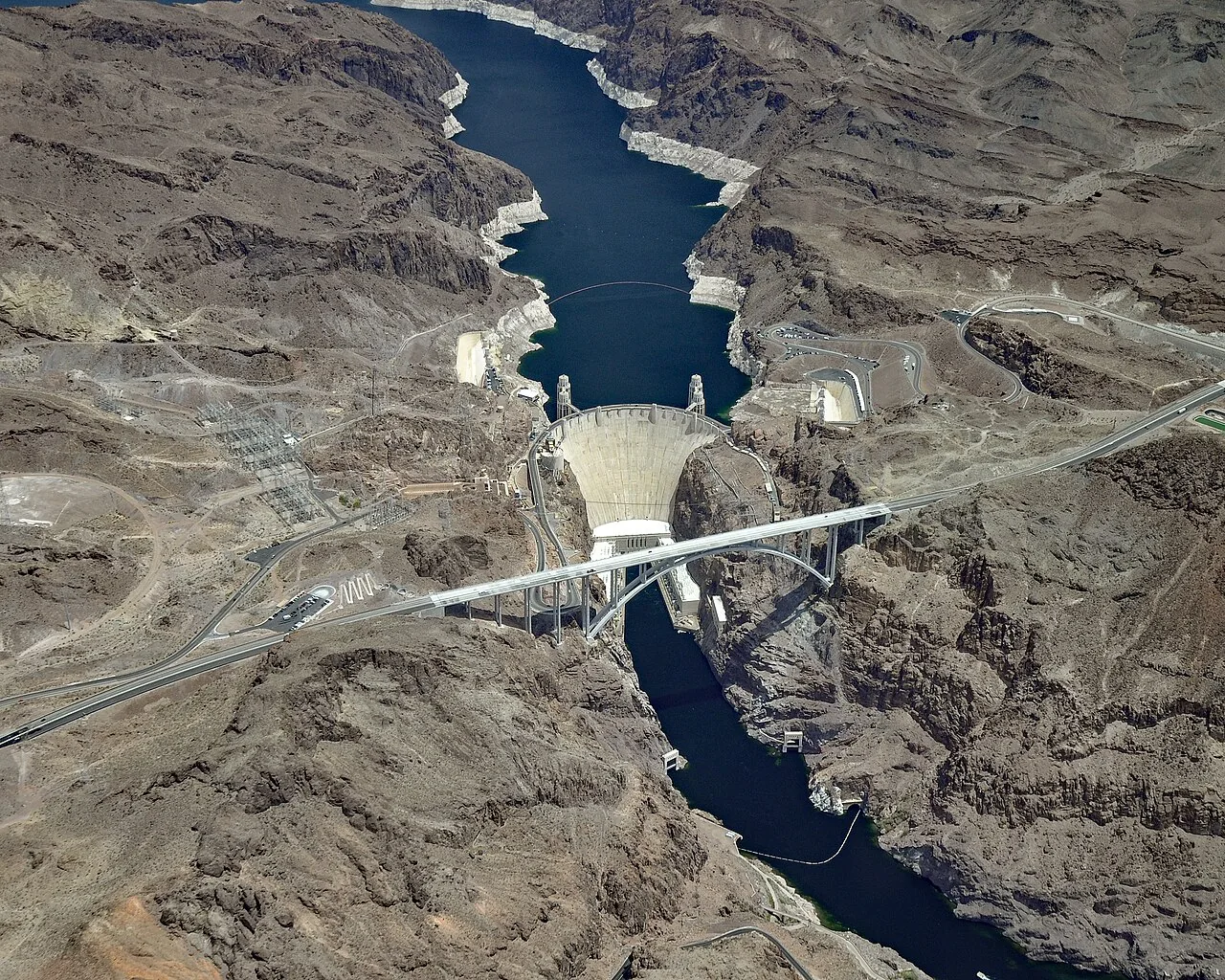
About 30 miles southeast of Las Vegas, US-93 crosses the Colorado River on the Mike O’Callaghan–Pat Tillman Memorial Bridge — the Hoover Dam bypass that opened in 2010. It’s the highest road bridge in the United States, 890 feet above the river, and here’s the thing most people miss: you can’t see the dam at all while driving across. If you want the view — and it’s the best free view of Hoover Dam there is — take the marked exit just before the bridge on the Nevada side, park, and walk the pedestrian walkway out over the gorge. Twenty minutes, no ticket, and the classic photo everyone assumes requires the dam tour.
From the river it’s a little over 100 miles of open Mojave desert to Kingman, where US-93 meets I-40. Kingman is the right fuel-and-coffee stop, and if anyone in the car has a soft spot for the old road, the Arizona Route 66 Museum sits right off the highway inside the historic Powerhouse — a 1907 electric plant that once powered the town and the surrounding mines, retired after Hoover Dam came online and reborn as a visitor center. The museum walks through everyone who ever traveled this corridor, from wagon trains to Dust Bowl migrants to the tailfin years, and the building itself is worth the stop (open daily; confirm current hours at 120 W Andy Devine Ave).
Between Kingman and Seligman, Route 66 die-hards can leave I-40 entirely and drive the longest remaining unbroken stretch of the original road, which loops north through open ranch country past the Hackberry General Store — a photogenic old gas stop crammed with route memorabilia. It adds real time, so most groups save it for a trip when nobody’s racing a check-in; the interstate covers the same ground in a fraction of it.
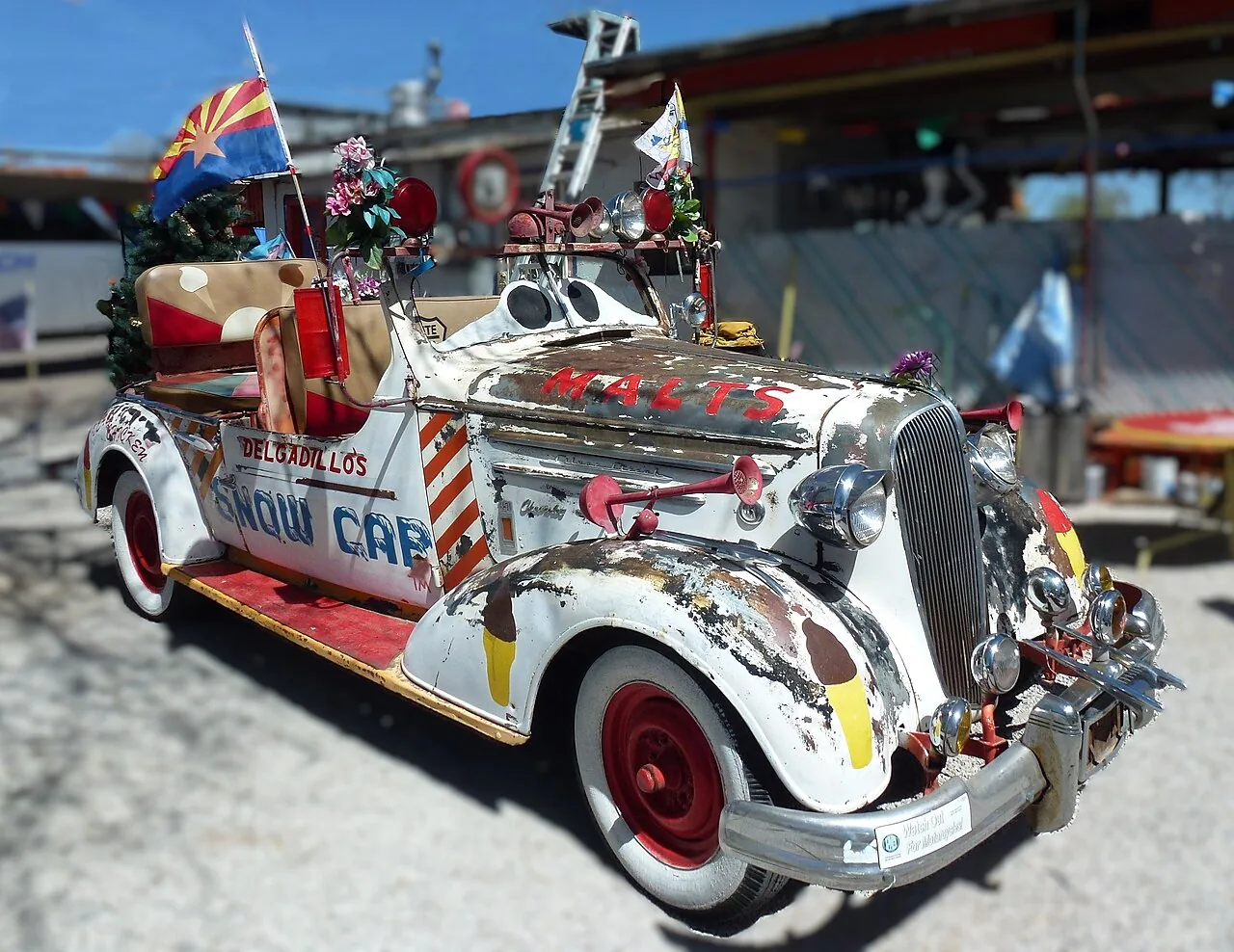
Staying on I-40, about 70 miles east of Kingman, take the Seligman exit. This little town is the reason “Historic Route 66” exists as a thing you can drive. When I-40 bypassed Seligman in 1978, the through-traffic vanished overnight. A local barber named Angel Delgadillo helped found the Historic Route 66 Association of Arizona, and in 1987 the state recognized the old alignment here — which is why Seligman calls itself the Birthplace of Historic Route 66. His brother Juan built Delgadillo’s Snow Cap Drive-In back in 1953 out of scrap lumber from the Santa Fe rail yard, and it’s still slinging burgers and soft-serve behind a front yard full of vintage cars and gag signage. It’s the best lunch stop on the route and the last unhurried stretch of the drive.
Back on I-40, it’s about an hour and a quarter to Flagstaff, and then you have a decision for the final 30 miles:
- SR-89A through Oak Creek Canyon. Shorter and slower, and the payoff is enormous: the road drops off the Colorado Plateau through a set of switchbacks and follows the creek between canyon walls the rest of the way into Sedona. It’s paved and fine for any car — just take the hairpins seriously. The full drive gets its own page at /things-to-do/oak-creek-canyon-drive/.
- I-17 south to SR-179 north. Easier grades, no switchbacks, adds roughly 15-20 minutes. SR-179 comes into Sedona through the red rocks from the south and is a designated scenic road in its own right — details at /things-to-do/red-rock-scenic-byway/.
First trip, in daylight, no trailer? Take 89A. Arriving after dark or towing anything? Take I-17/179.
One quirk worth knowing so it doesn’t bite you: Arizona doesn’t observe daylight saving time. In summer that means nothing changes — Sedona and Las Vegas read the same clock from March to November. In winter, Arizona sits one hour ahead of Vegas. So on a January trip, your 4 PM check-in is 3 PM “Vegas time” in your head, and you get the hour back on the drive home. Phones sort it out automatically at the state line; dashboards don’t.
Leave Vegas in the morning. You’ll cross the desert stretch before the worst heat, hit Seligman around lunch, and come down Oak Creek Canyon with the sun still on the walls.
Three days that fill themselves
Here’s the shape of a weekend that actual groups run, using a 4 PM Friday check-in and 10 AM Sunday checkout.
Friday: arrive, unload, play. This is the moment the drive pays off — you walk from the kitchen to a regulation indoor court and start a game while someone else is still hunting for the paddle bag. Paddles and balls are provided; you just need court shoes. Play until dinner, then take the evening outside: the firepit, the hot tub, and a sky you simply cannot get in Clark County. Sedona’s night skies are dark enough for real stargazing with the naked eye — the Milky Way, not just planets — and the guide at /things-to-do/stargazing/ covers where and when to look. For a group used to the glow of the Strip, this alone justifies the tank of gas.
A note on pacing that first evening: you’ve gained about 2,400 feet of elevation over Vegas, and most people feel it as slightly faster fatigue on court, not as anything dramatic. Drink more water than usual, expect the first few rallies to run short of breath, and it’s a non-issue by Saturday.
Saturday: red rocks in the morning, court in the heat of the day. Get out to a trailhead early — Devils Bridge is the famous one, the natural arch you can walk across, and Cathedral Rock is the short, steep scramble with the postcard payoff. Both are busiest after mid-morning, which suits you fine, because when the day warms up you head back to the house and play through the hottest hours in air conditioning — the exact hours that end play in Vegas. Book a proper dinner for the group; the rundown at /things-to-do/best-restaurants/ covers the reliable spots. Then, because the court is lit and indoors and bothers no one, play again at night. Eight players is the ideal number for a rotating doubles bracket — if you’ve never structured one, the format at /blog/how-to-run-a-round-robin/ takes ten minutes to set up and settles all arguments by Sunday.
Sunday: dawn patrol, then home. Early risers get one more session — sunrise games in a warm court while the desert wakes up out the window are the thing people talk about on the drive back. Checkout is 10 AM. Take SR-179 south out of town for one last run through the formations, pick up I-17 north to Flagstaff, and reverse the route. You’re back in Vegas by late afternoon, and in winter the time change works in your favor going this direction.
If the group wants a third full day, the itineraries on the /things-to-do/ hub stretch this to Monday without repeating anything.
What eight people actually get
A weekend like this usually means someone books a resort block: four rooms on a hallway, a shared elevator, and a group text trying to coordinate breakfast. The house replaces all of it with one address in West Sedona.
- The court: private, indoor, regulation, climate-controlled — heated in January, air-conditioned in July — and lit for night play. Paddles and balls are in the house; bring your own court shoes.
- Sleeping: 4 bedrooms for 8 people — two kings, a queen, and a game room with twin-over-twin bunks. 2 baths.
- The rest: hot tub and outdoor soaking tubs, a firepit, a covered deck with red-rock views, a media lounge, and a full kitchen, which for a group of eight is the difference between one relaxed breakfast and four separate coffee runs.
- Logistics: free driveway parking for 4 cars (there’s no street parking, so carpool the group into four vehicles or fewer). Minutes from West Sedona’s restaurants and trailheads.
Split among four couples or eight players, a house beats a hallway of hotel rooms on every axis that matters for a pickleball trip — chiefly that the court is downstairs and the schedule is yours.
Before you book
A few practical notes so the weekend goes smoothly:
- Booking is via Airbnb only, and guests must be 25+ to book. No pets, no parties, no smoking. Check-in 4 PM, checkout 10 AM.
- Book ahead for the obvious weekends. Sedona’s spring and fall are its busy seasons, and holiday weekends fill early — the private-court calendar is one house, not a resort’s inventory.
- Pack for two climates. Sedona sits at 4,350 feet — summer days run roughly ten degrees cooler than Vegas and the evenings drop further, so bring a layer for the firepit even in July. Winter days are mild but the nights are genuinely cold. The full list is at /blog/what-to-pack-pickleball-vacation/ — the short version is court shoes, more shirts than you think, and a swimsuit for the hot tub.
- Summer players: the court is air-conditioned, so the 105°F+ afternoons that end outdoor play at home are prime court hours here. Winter players: it’s heated, and the trip works exactly as well in January — just remember the one-hour time difference that direction.
- Bring the whole skill spread. A private court solves the awkwardness of mixed-level groups better than any public venue: the 4.0s can drill while the beginners rally, nobody is holding a challenge court, and the bunk-room setup makes it easy to bring adult kids or the friend who’s still learning to keep score.
- Set expectations with the group. This is the anti-Vegas weekend on purpose: no shows, no casino floor, no line for anything. The entertainment is a court that never closes, trails out the door, and a sky full of stars. Groups that want that come back annually.
The drive is 4.5 hours of genuinely good road — a record-setting bridge, the best-preserved stretch of Route 66 anywhere, and a canyon descent into red rock country. The destination is a quiet house where eight people play as much pickleball as their legs allow. Vegas will still be there Sunday night.
Frequently asked questions
How long is the drive from Las Vegas to Sedona?
Do I lose an hour driving from Nevada into Arizona?
What are the best stops between Las Vegas and Sedona?
Is SR-89A through Oak Creek Canyon hard to drive?
Las Vegas already has pickleball courts. Why drive 4.5 hours?
How many people does the house sleep?
Your court is ~4.5 hours nonstop; plan 5.5-6 with stops away
Sedona Pickler is a private West Sedona vacation home for up to 8 with its own indoor, climate-controlled pickleball court — heated, air-conditioned, and lit. Load the car, drive up, and play the moment you arrive.
Check dates & book


