
Prescott doesn’t need to be sold on pickleball. The town has a median age near 60, a park with 12 dedicated courts, a club that helped pay for them, and an indoor scene that keeps games going when the weather turns. If you play in Prescott or Prescott Valley, you already have places to play.
So here is the honest version of this page: the drive to Sedona is not about finding a court. It’s about what changes when the court is private, indoor, and attached to the house your whole family is sleeping in - and about the fact that the road between the two towns happens to be one of the best short drives in Arizona.
What Prescott players already have, and what they don’t
Prescott’s pickleball story is a good one. The Prescott Pickleball Association - a real club, formed by local players - partnered with the City of Prescott and Yavapai County to build dedicated courts at the Pioneer Park Sports Complex. The first eight opened in May 2017, and the club’s “Four More” fundraising project added four more in 2019, bringing the total to 12 dedicated outdoor courts with permanent lines and nets. Four of them are lighted, though reserving the lighted courts is limited to camps, clinics, and tournaments.
Indoors, the Prescott Indoor Pickleball Association plays at Espire Sports on Gateway Boulevard, a multi-sport complex with 14 indoor and 6 outdoor pickleball courts, plus a fitness floor and golf simulators. Between Pioneer Park, Espire, and the school gyms that host open play, the Prescott area supports pickleball at a level most towns twice its size can’t match.
That level of infrastructure exists because of who lives here. Prescott is one of Arizona’s most established retirement towns, and Prescott Valley next door has absorbed much of the area’s growth over the past two decades - which means thousands of people with flexible weekday schedules, a habit of morning exercise, and friend groups organized around a sport. Players from both towns share the same courts, the same club calendars, and the same problem every serious pickleball community eventually hits: more players than prime-time court hours.
Here’s what none of that gives you:
- A court your group has to itself for an entire weekend. Open play at Pioneer Park means paddle stacking and rotation. Great for meeting players. Not great for a family tournament or three uninterrupted hours of doubles with your regular four.
- Winter certainty. Pioneer Park sits at Prescott’s 5,400-foot elevation. January nights routinely drop below freezing, daytime highs average around 50, and most winters bring measurable snow - long-term averages run from about 13 to 21 inches a year depending on the measuring station. Outdoor court time from December through February is a coin flip.
- A place where the court, the kitchen, the hot tub, and the grandkids’ bunk beds are all under the same roof.
That last one is the real reason Prescott groups book this house. The drive is short enough to be spontaneous - you can decide on Wednesday and be playing Friday afternoon - and the house is set up for exactly the kind of multi-generation gathering that retiree pickleball families keep trying to engineer around everyone’s schedules.
The drive: 62 miles, one mountain pass, one town bolted to a hillside
There are two ways to get from Prescott to Sedona, and one of them is the whole reason to make this trip by car.
The direct way is SR-89A over Mingus Mountain: take SR-89 north out of Prescott about seven miles, pick up SR-89A east, and climb. The road runs through Prescott National Forest most of the way over the mountain - top off the tank before you start, because services are thin until Cottonwood. It crests the pass at 7,023 feet, about 1,600 feet above Prescott, then drops into Jerome through a series of 20-mph curves and a few genuine hairpins. Anyone in your car who reads on road trips should sit up front for this stretch. Jerome is roughly 34 miles from Prescott; from there it’s about 28 more miles down through Clarkdale and Cottonwood and on into Sedona. Call it 62 miles total and about an hour and a half of actual driving. Nobody does it in an hour and a half, because of what’s in the middle.
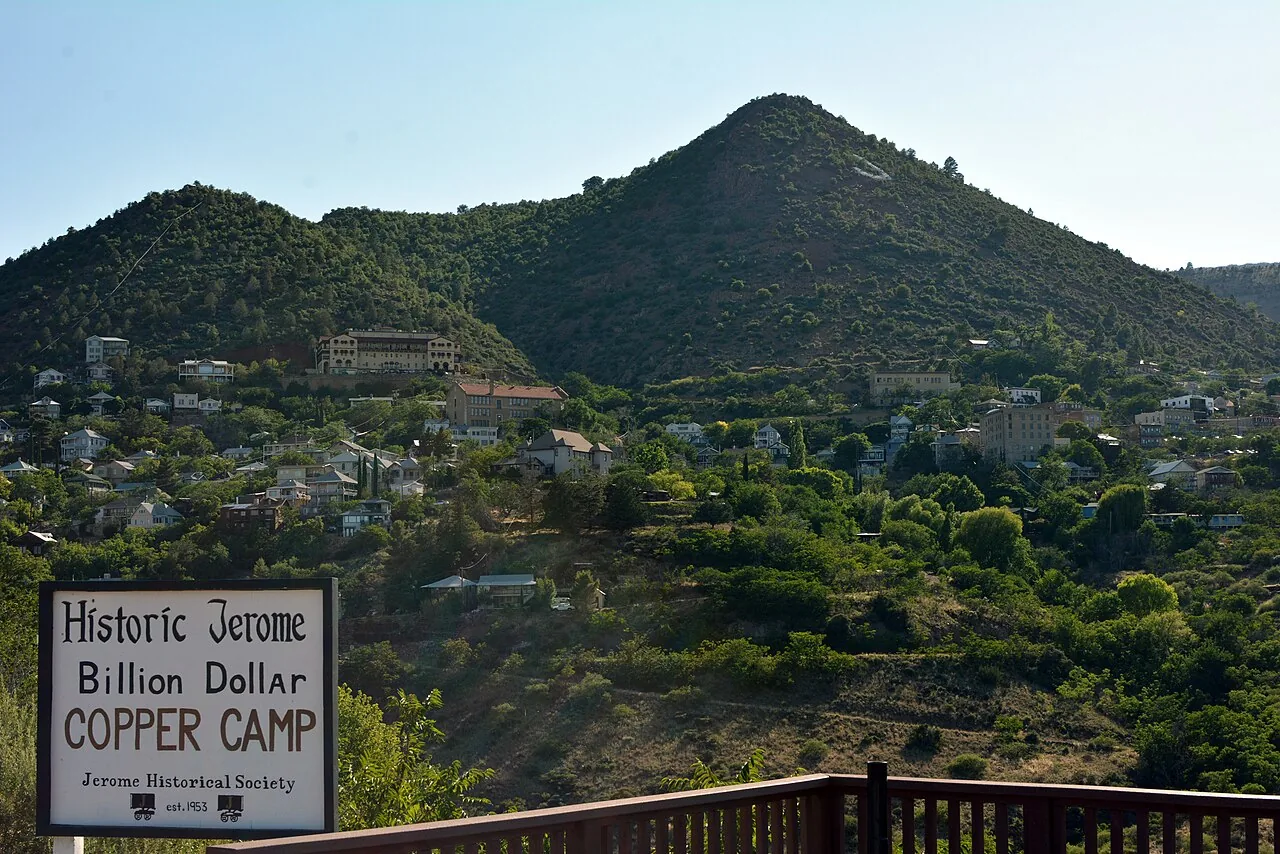
Jerome is a former copper-mining town built into the steep face of Cleopatra Hill, directly below the pass. It peaked as one of Arizona’s largest mining towns, emptied out when the mines closed, and was declared a National Historic Landmark in 1967. Today about 464 people live there, running galleries, saloons, and tasting rooms out of buildings that look like they might slide downhill any minute. It deserves more than a bathroom stop - our full guide is at /things-to-do/jerome-day-trip/, and a good pattern is 45 minutes on the drive up and a longer visit on the way home.
Below Jerome the road flattens into the Verde Valley and runs past Cottonwood. Old Town Cottonwood’s main street has turned into the social hub of Arizona wine country, with walkable tasting rooms in a historic district - covered at /things-to-do/old-town-cottonwood/. From Cottonwood, SR-89A carries you the last 19 or so miles into Sedona, with the red rocks growing in the windshield the whole way.
Two practical notes on the road itself:
- Winter storms. Mingus Mountain gets snow and ice, and the hairpin section above Jerome is no place for either. If a storm is moving through, take the lower route instead: SR-169 east to I-17, north to SR-260, into Cottonwood, then SR-89A to Sedona. It adds miles but stays out of the high country.
- Timing. Leave Prescott in the morning. SR-89A into Sedona funnels through the Y roundabouts, which back up midday on weekends, especially in spring and fall. A 9 AM departure with a Jerome stop puts you in Sedona for lunch and on the court by early afternoon.
What winter changes
This deserves its own section because it’s the strongest seasonal case for a Prescott group.
Prescott markets itself on four real seasons, and it delivers - that’s part of why people retire there. But four real seasons means outdoor pickleball takes a three-month haircut. Frost delays morning play even on clear days. Snow can close the courts outright. Wind at 5,400 feet in January is its own opponent.
Sedona sits a thousand feet lower and runs a few degrees warmer, but the point isn’t Sedona’s weather. The point is that this court doesn’t have weather. It’s a private regulation court that is indoor, heated, air-conditioned, and lit. A 7 AM game in January plays exactly like a 7 AM game in June. So does a 9 PM game after the grandkids are in bed. And because the court is fully enclosed, there’s no neighbor, no HOA, and no noise complaint to negotiate - the quiet-play case is laid out at /quiet-pickleball/ if that’s ever been a factor at your home courts.
For Prescott-area snowbirds who winter in place rather than heading to Phoenix, this is the escape valve: 90 minutes of driving buys a weekend of guaranteed court time in the middle of February. There’s a longer version of that argument in the snowbird guide to wintering near Sedona.
It also solves the family-calendar problem that winter creates. If the kids and grandkids visit over the holidays or a February school break, Prescott in winter offers them a snowy courthouse square and not much court time. Book the Sedona house instead and the gathering gets a heated court, a game room with bunks, a hot tub under cold clear skies, and red rock instead of gray. Same 90-minute drive for you; a better trip for everyone flying in.
A three-day plan for a mixed group
The itinerary below assumes what Prescott groups usually bring: some serious players, some casual ones, at least one person who would rather taste wine than hit a third ball, and possibly grandkids. The route to Sedona happens to serve all four.
Day one - Friday. Leave Prescott mid-morning, stop 45 minutes in Jerome, and get to the house by early afternoon. Unpack, then play the first session while legs are fresh - two hours of doubles, rotating in anyone who wants a game. The court has paddles and balls waiting, so nobody’s gear situation delays anything. Dinner in West Sedona, then the hot tub. If the group has an organizer, Friday night is when to set up Saturday’s bracket - the format guide at /blog/how-to-run-a-round-robin/ works for any mix of skill levels.
Day two - Saturday. Morning round robin on the court, 8 to 11, coffee on the covered deck between games. Then split the group. Players who want more court time have it - the court doesn’t close, doesn’t rotate, and doesn’t care what time it is. Everyone else has the Verde Valley, 30 minutes back down the road. The Verde Valley wine trail connects more than 25 wineries and tasting rooms across Cottonwood, Clarkdale, Jerome, Cornville, and Camp Verde; the Page Springs Road stretch in Cornville is where the actual vineyards are, along Oak Creek. If the grandkids need their own outing, Out of Africa Wildlife Park in Camp Verde is about 40 minutes from the house. Regroup for a firepit evening and night games under the court lights - and note that indoor games after dark bother exactly no one, which is not something you can say about lighted outdoor courts anywhere.
Day three - Sunday. Checkout is 10 AM, so get the last court session in Saturday night and keep Sunday morning simple: coffee, packing, and if the group wants one more stop, an easy hike on the way out - Sedona has several short, flat trails with outsized views, collected at /things-to-do/easy-hikes/. The stronger Sunday move for a mixed group is on the drive home: the Verde Canyon Railroad departs from the depot in Clarkdale, directly on your route back. It’s a roughly four-hour, 40-mile round trip to Perkinsville through a canyon no road reaches, usually departing at 1 PM - book ahead and confirm the schedule. Grandparents and grandkids rate it about equally, which is rare. You’re still home in Prescott by early evening.
If three days feels short, it is. The house books by the night, and midweek stays solve both the availability question and the Sedona-traffic question at once.
The house, for a group of eight
Sedona Pickler is a private vacation-rental home in West Sedona. The short version of what a Prescott group gets:
- The court. A private regulation pickleball court, fully indoor, heated, air-conditioned, and lit. Paddles and balls are provided; bring court shoes. No reservations, no time limits, no waiting on the fence line.
- Sleeping for 8. Four bedrooms: two kings, one queen, and a game room with twin-over-twin bunks. Two baths. The bunk room is the grandkid magnet - it sits in the game room, so the kids get their own zone and the adults get quiet.
- The rest. Hot tub and outdoor soaking tubs, a firepit, a covered deck with red-rock views, a media lounge, and a full kitchen that handles a family dinner for eight without staging.
- Logistics. Free driveway parking for four cars - no street parking, which matters if you’re caravanning from Prescott and Prescott Valley separately. Check-in is 4 PM, checkout 10 AM.
- The rules, stated plainly. The person who books must be 25 or older - grandkids and adult kids are welcome as guests, but the booker carries the age requirement. No pets, no parties, no smoking. Booking is through Airbnb.
For a multi-generation trip, the layout does the scheduling for you: early risers play at dawn, kids take the court midday, the competitive bracket runs in the evening, and nobody ever checks a reservation app.
Practical notes
Book ahead for spring and fall. March through May and September through November are Sedona’s peak seasons, and weekends go first. Prescott groups have one structural advantage here: you’re close enough to grab a midweek cancellation on two days’ notice. Winter weekends are the sleeper pick - the court doesn’t care that it’s February, and the town is quieter.
Pack for two climates. You’ll leave Prescott at 5,400 feet, cross a 7,023-foot pass, and land at 4,350. Layers for the drive and evenings, court shoes and standard gear for play - the full checklist is at /blog/what-to-pack-pickleball-vacation/. Paddles and balls are at the house, but most regulars bring their own paddles anyway.
Check the pass in winter. Before a December-through-February trip, look at the forecast for Mingus Mountain, not just Prescott and Sedona. Dry roads: take SR-89A and enjoy it. Storm inbound: SR-169 to I-17 to SR-260 gets you there on low ground, and the court will be 68 degrees either way.
Drive it both directions in daylight at least once. The view descending toward Jerome with the Verde Valley and the red rocks stacked behind it is the best free thing on this whole itinerary, and it’s gone after sunset.
The math on this one is simple. Prescott already has the players, the club, and the courts. What it doesn’t have is a house where three generations sleep under one roof and the court is 30 seconds from the coffee pot, in any weather, at any hour. That house is 62 miles away, on the far side of a mountain road you’ll want an excuse to drive again.
Frequently asked questions
How long is the drive from Prescott to Sedona?
Is SR-89A over Mingus Mountain a hard drive?
Can we actually play in winter?
Does the house work for a family trip with grandkids?
Do we need to bring paddles and balls?
What is worth doing besides pickleball?
Your court is Roughly 1.5 hours without stops; closer to 2 with a stop in Jerome away
Sedona Pickler is a private West Sedona vacation home for up to 8 with its own indoor, climate-controlled pickleball court — heated, air-conditioned, and lit. Load the car, drive up, and play the moment you arrive.
Check dates & book


