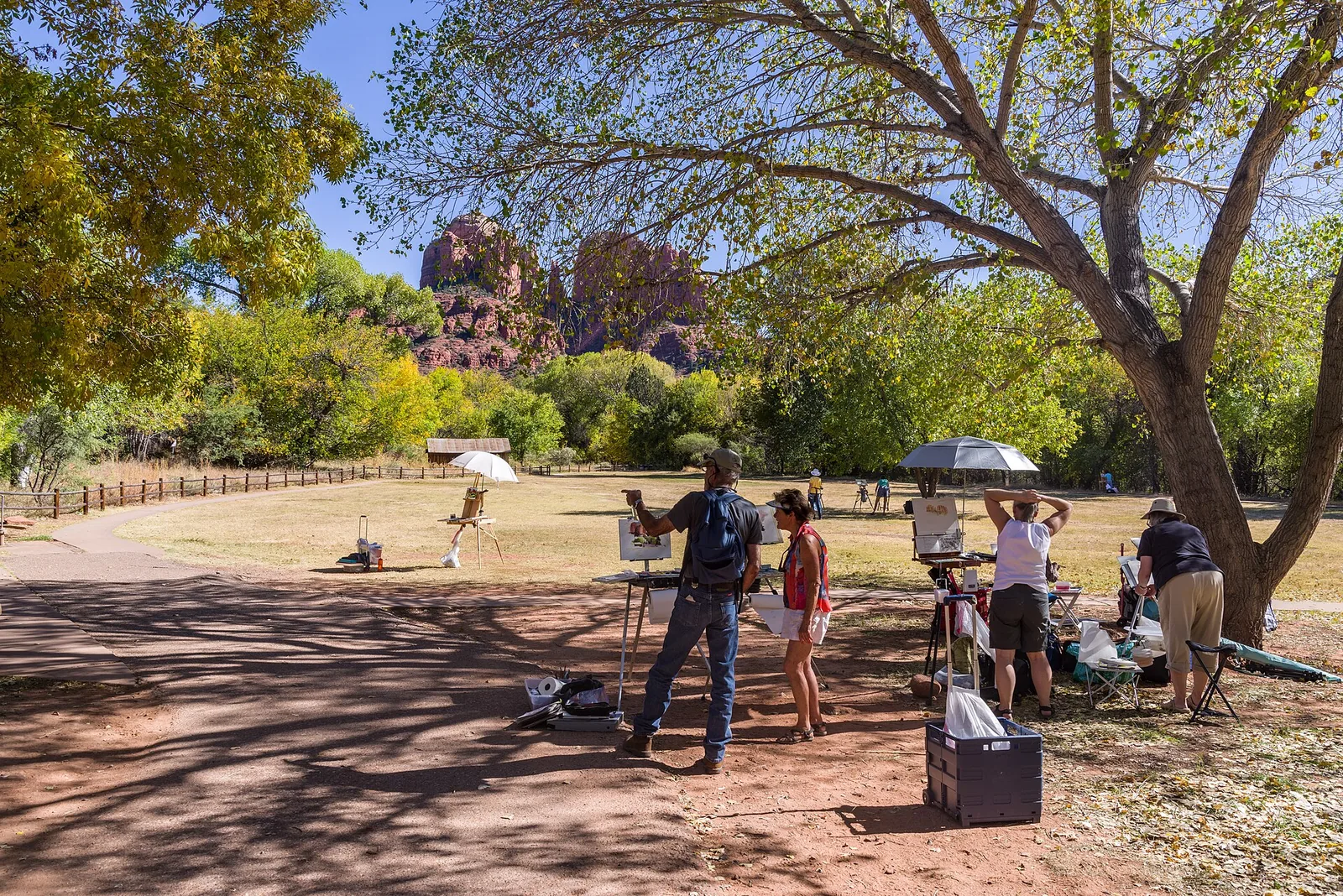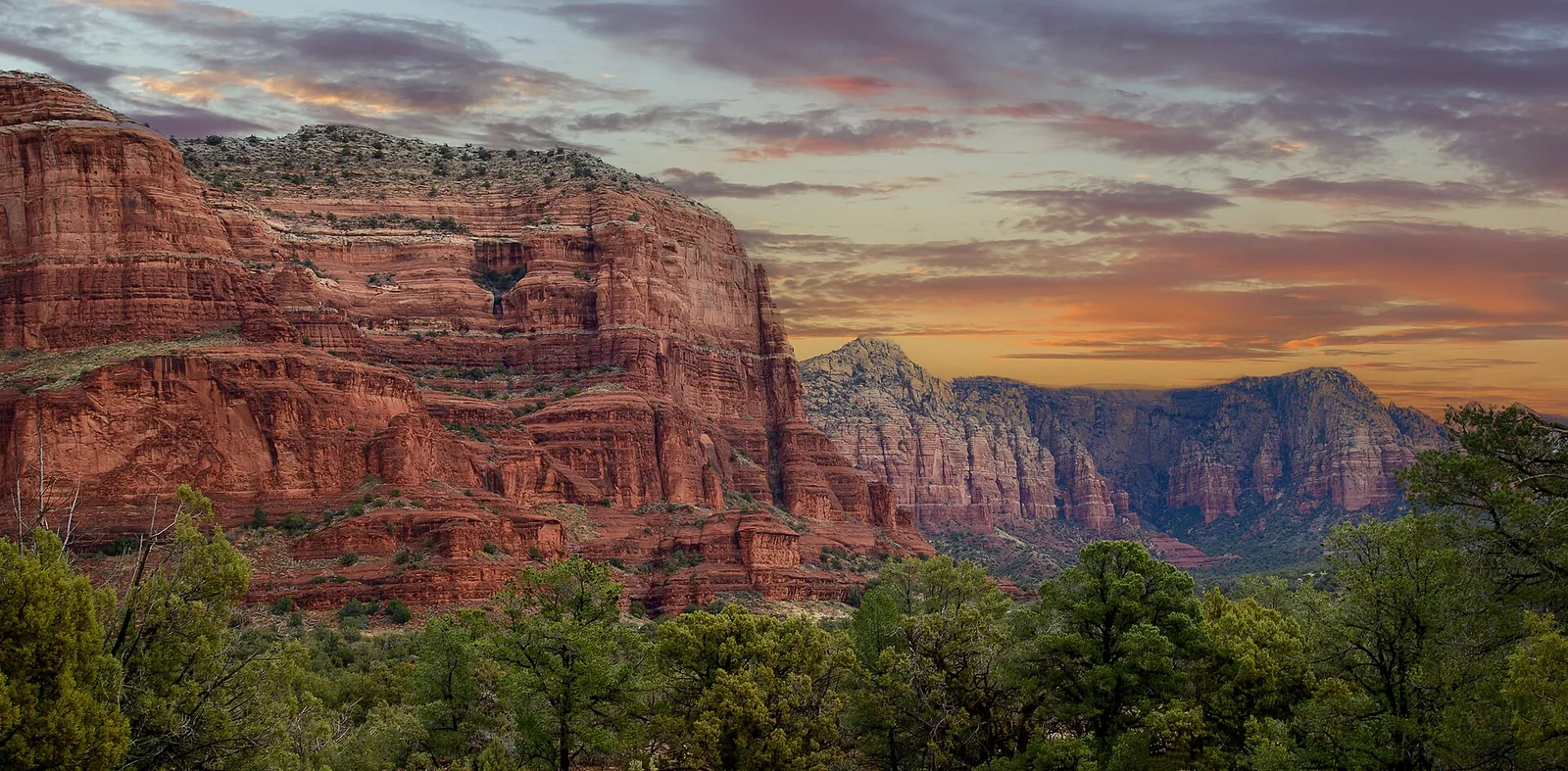
Before Sedona was a hiking town, a spa town, or a pickleball town, it was a movie town. From 1923 to 1968, film crews came back to these red rocks again and again — the Sedona Heritage Museum counts almost 100 feature films shot in full or in part in the Sedona area, along with countless commercials and smaller productions. Most of them were Westerns. John Wayne produced his first picture here. Joan Crawford strapped on a gun belt here. Elvis Presley rode in a rodeo here. For a stretch in the late 1940s, two or three movies a year were shooting among the rocks, and locals worked as extras, wranglers, drivers, and carpenters so often that the town earned the nickname Arizona’s Little Hollywood.
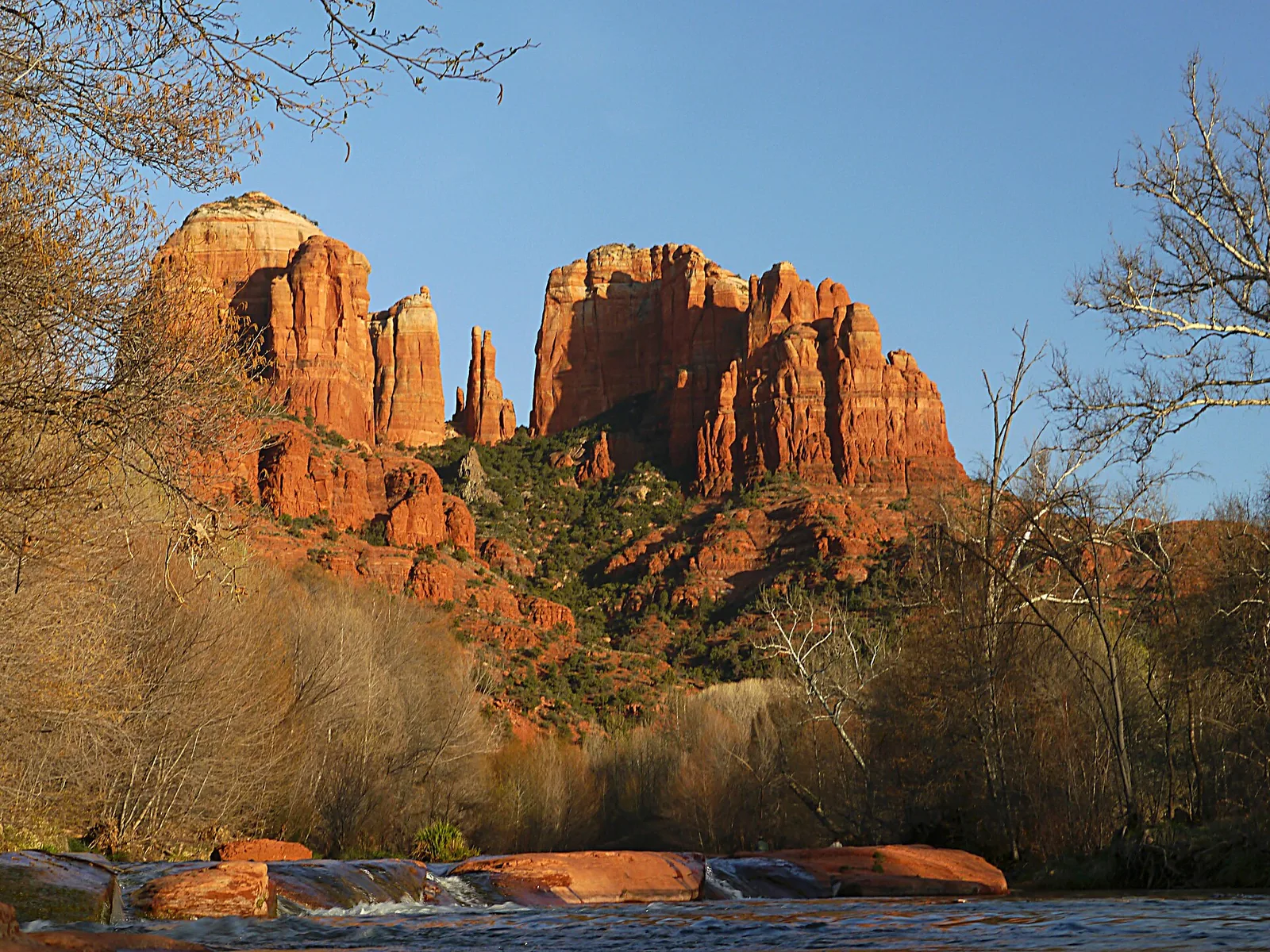
The evidence is still on the map. West Sedona has streets named Johnny Guitar, Gun Fury, and Pony Soldier — because a real Western town set stood on that ground for 13 years. One building from that set survives at the Sedona Heritage Museum. And the scenery that sold all those tickets hasn’t moved: Cathedral Rock, Coffee Pot Rock, Oak Creek Canyon, and Red Rock Crossing appear in film after film, looking almost exactly as they do from the trail today.
This guide walks the whole era decade by decade, with a verified filmography at the end — every title below is confirmed through sources like the American Film Institute catalog, IMDb, the Sedona Heritage Museum, and the Sedona visitor bureau’s official film list. If you want to stand where the cameras stood, pair this with our Sedona film locations guide.
Why Hollywood came to Sedona
Two things put Sedona on studio location lists: the scenery and the logistics.
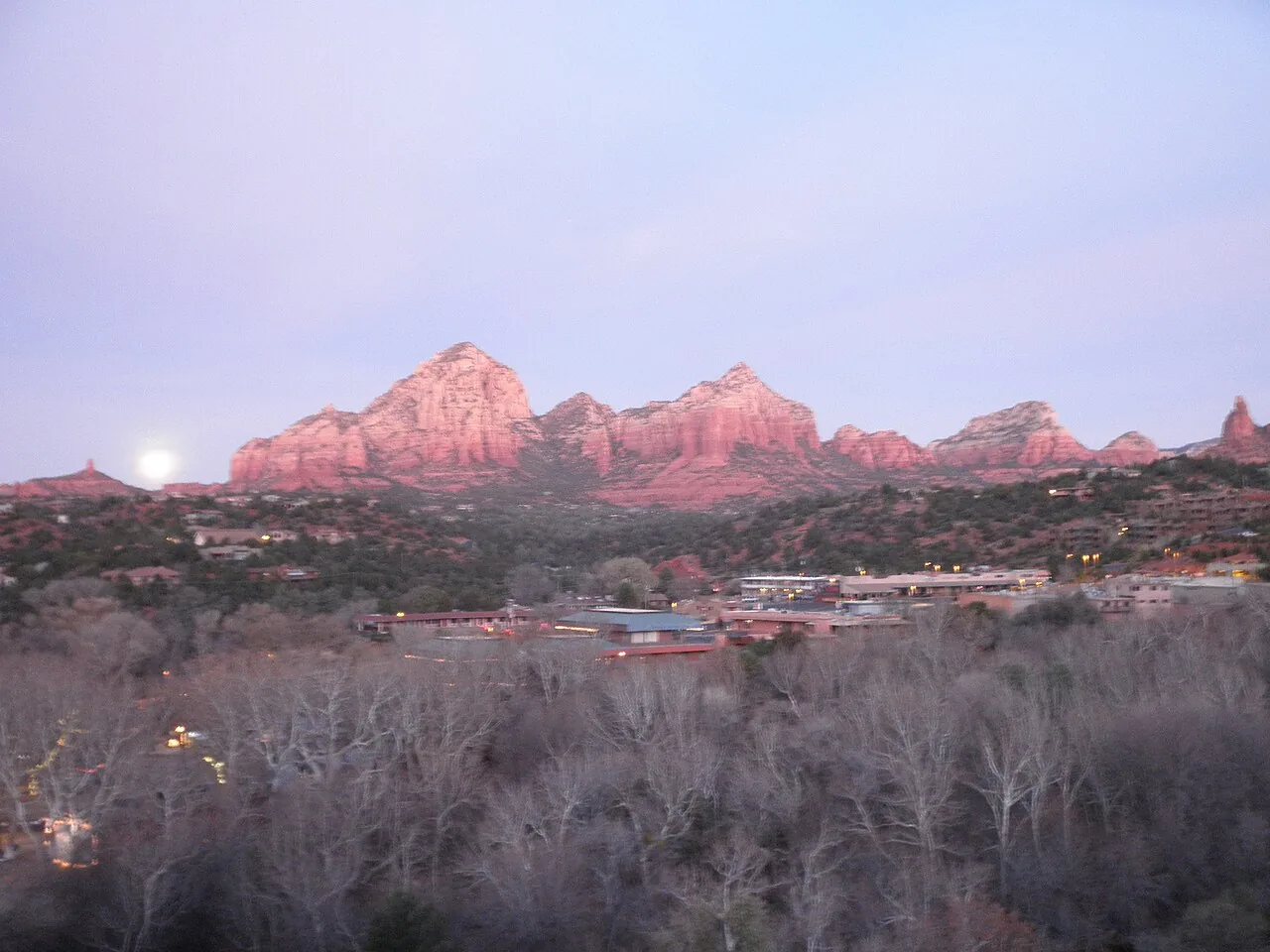
The scenery part is obvious the moment you arrive. The Sedona Heritage Museum puts it plainly: the red rock formations and pinyon-juniper landscape made an ideal setting for Hollywood’s cowboys. In the black-and-white years the buttes read as dramatic backdrops; once Technicolor took over the Western in the 1940s and 1950s, Sedona’s rust-red rock against a blue sky was a genuine special effect. Directors could point a camera almost anywhere and get a frame worth paying for.
The logistics part mattered just as much. Sedona sits roughly 500 road miles from Los Angeles — close enough to truck out a full production, far enough to look like untouched frontier. Crews could stage out of Flagstaff, about 45 minutes up the canyon, which had rail service and hotels. Compared with hauling a company to Monument Valley or Utah, Sedona was cheap and quick, and the variety packed into a few square miles — creek crossings, canyon narrows, open flats, slickrock — let one location double for half the West. In the movies, Sedona stood in for Texas, New Mexico, Wyoming, the Dakotas, and the Canadian frontier, usually without leaving a ten-mile radius.
For more on how the town itself grew up around all this, see our Sedona history guide.
The 1920s and 1930s: Zane Grey and the silent era
Sedona’s film story starts with a novelist. Zane Grey, the best-selling Western writer of his day, set his novel The Call of the Canyon in Oak Creek Canyon, and in 1923 Paramount sent a crew to film the adaptation where the story took place. The director was Victor Fleming — who would go on to direct The Wizard of Oz and Gone with the Wind — and the stars were Richard Dix and Lois Wilson. They shot in Oak Creek Canyon near the site of Mayhew’s Lodge, and The Call of the Canyon (1923) became the first film made in Sedona.
The movie itself vanished for most of a century. It was considered a lost film until a print surfaced in Gosfilmofond, the Russian state film archive, and a digital copy was presented to the Library of Congress in October 2010. Sedona’s first movie came home 87 years after it wrapped.
Grey’s fingerprints stayed on Sedona filmmaking through the early sound era. Fox brought George O’Brien here for a run of Westerns, including two more Zane Grey adaptations: The Last of the Duanes (1930) and Riders of the Purple Sage (1931), the first sound version of Grey’s most famous novel, co-starring Marguerite Churchill. O’Brien returned for Mystery Ranch (1932) and Robbers’ Roost (1932), and the visitor bureau’s filmography lists a scattering of other 1930s productions, from Smoky (1933) to the Hopalong Cassidy entry Texas Trail (1937) and MGM’s Billy the Kid (1940) with Robert Taylor.
Through this period Sedona was still a tiny farm settlement — orchards along Oak Creek, a few dozen families. Film crews were an event, and the relationship that would define the boom years was already forming: Hollywood brought money and work, and Sedona provided scenery that no backlot could fake. If you drive Oak Creek Canyon today, you’re driving through the frames of the town’s first movie.
The 1940s: John Wayne builds a town
The modern era of Sedona filmmaking starts with John Wayne. In 1944, RKO’s Tall in the Saddle brought Wayne and Ward Bond to Sedona, and the Sedona Heritage Museum credits that production with changing everything — after it, the repeat business started and movie crews became a regular feature of town life.
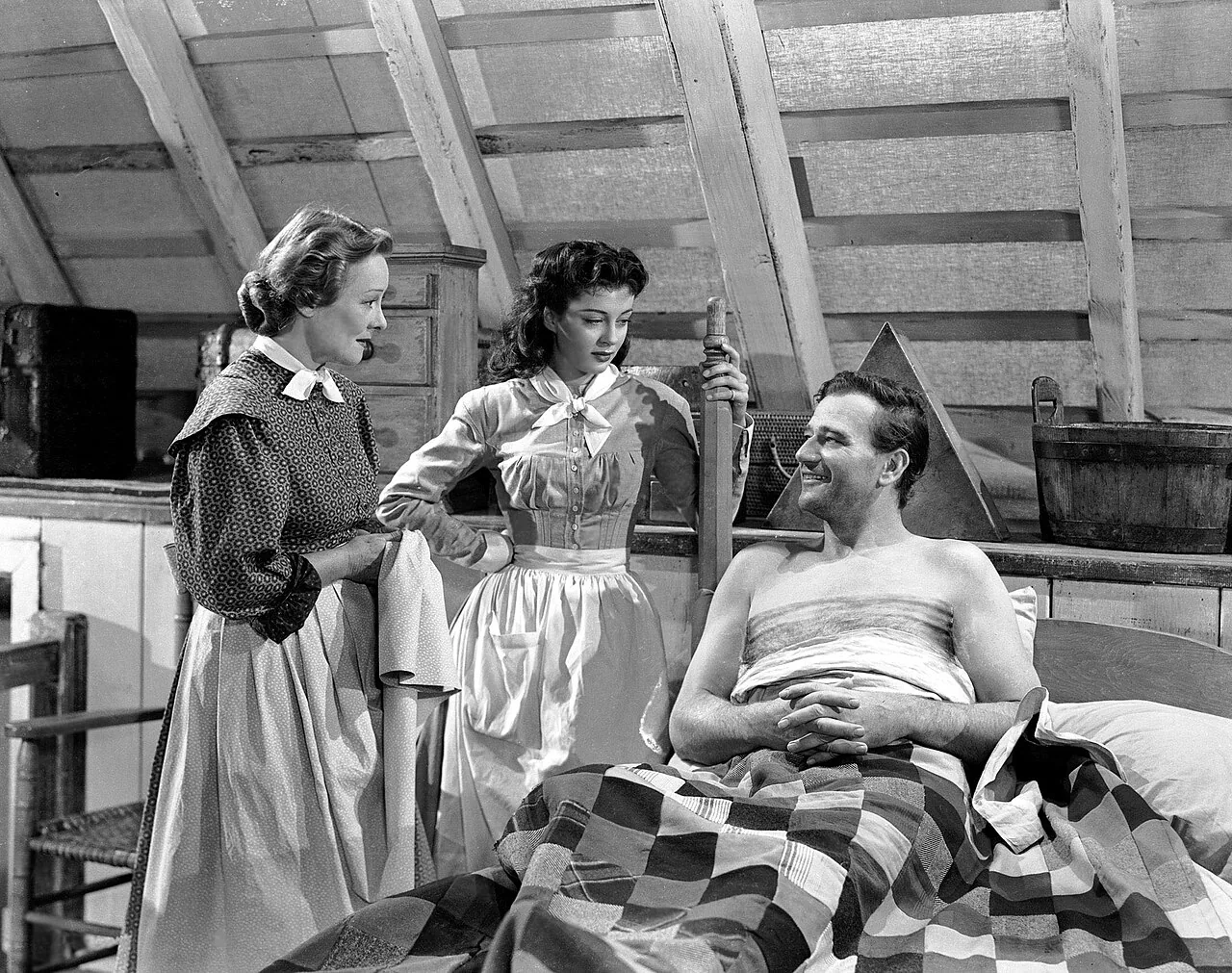
Wayne came back two years later with a bigger stake. Angel and the Badman (1947) was the first film he produced as well as starred in, a Republic picture with Gail Russell and Harry Carey about a wounded gunslinger nursed back to health by a Quaker family. Principal photography ran from mid-April through late June 1946 in Sedona and Flagstaff, with some scenes in Monument Valley. For the production, a full Western town street set went up below Coffee Pot Rock in West Sedona — and unlike most location sets, this one wasn’t torn down when the picture wrapped. A sound stage and a motel followed, and for the next 13 years, that little false-front town worked steadily in the movies.
One detail of that set still exists. The production needed a telegraph office, so Republic trucked in a century-old former railroad depot from Winona, Arizona, and dressed it for the part. The Telegraph Office outlived the rest of the set, and the Sedona Heritage Museum eventually restored it and moved it to the museum grounds at 735 Jordan Rd, where you can walk up to it today — the last standing piece of Sedona’s movie town.
The late 1940s were the busiest years Sedona’s film industry ever had. Between 1945 and 1950, 19 movies were made here — an average of two to three a year. The range was wider than pure horse opera. Desert Fury (1947), a Technicolor film noir with Lizabeth Scott, John Hodiak, and a young Burt Lancaster, was based mostly in Cottonwood — the production essentially leased the whole town, and most of its locations are in what’s now Old Town Cottonwood — with ranch and road scenes shot in West Sedona and Big Park. Blood on the Moon (1948), a moody RKO Western directed by Robert Wise and starring Robert Mitchum, took its scenic exteriors at Red Rock Crossing. The visitor bureau’s list for these years also includes California (1947) with Barbara Stanwyck and Ray Milland, Cheyenne (1947), a pair of Randolph Scott pictures, The Fabulous Texan (1947), Gene Autry’s The Strawberry Roan (1948), and Station West (1948) with Dick Powell and Jane Greer.
By decade’s end, Sedona had something almost no small town in America had: standing sets, experienced local crew hands, and a reputation on studio lots. The 1950s would spend that reputation on the most famous films of the whole run.
The 1950s: Technicolor, 3D, and the marquee years
Here’s a number that surprises people: only 18 movies were filmed in Sedona in the entire 1950s — fewer than the six-year sprint that ended the 1940s. But the decade produced the titles everyone remembers.
Broken Arrow (1950) may be the most important of them. Delmer Daves directed James Stewart as Tom Jeffords, the scout who brokers peace with Cochise, played by Jeff Chandler. Filming started June 6, 1949, and the production leaned hard on the landscape: Oak Creek Canyon, Red Rock Crossing, Bell Rock, Merry-Go-Round Rock off Schnebly Hill Road, and Little Horse Park — the open country that’s now the Chapel area. The film was a landmark for treating its Apache characters with sympathy, and it’s still one of the best ways to see mid-century Sedona in color. Drive Schnebly Hill Road or hike near Bell Rock and you can match the backgrounds shot for shot.
The same year, Paramount’s Copper Canyon (1950) put Ray Milland and Hedy Lamarr in front of Cathedral Rock — filming ran from April to early July 1949, with a set built near the formation.
Then came the 3D boomlet. Gun Fury (1953), directed by Raoul Walsh and starring Rock Hudson and Donna Reed, shot around Sedona in the summer of 1953 with Cathedral Rock, Coffee Pot Rock, and Red Rock Crossing all in frame — red rock country in stereoscopic 3D was exactly the kind of spectacle the format was invented for. Cathedral Rock has not lost a step since.
The strangest and most celebrated film of the era arrived the next spring. Johnny Guitar (1954), Nicholas Ray’s fever-dream Republic Western, starred Joan Crawford as saloon owner Vienna, with Sterling Hayden, Mercedes McCambridge, and Ward Bond. The company assembled in the shadow of Coffee Pot Rock in October 1953, and Republic built sets in Sedona including a saloon raised against the base of a cliff. Location work used Red Rock Crossing and Oak Creek Canyon. The movie flopped with American critics and was later reclaimed as a classic — it’s the single most name-checked film in Sedona’s catalog, and the town returned the favor with a street name.
The mid-decade run kept the sets busy: Burt Lancaster’s Apache (1954) used Sedona’s red buttes for the scenes where Massai hides out with Nalinla (Jean Peters); Alan Ladd’s Drum Beat (1954), Sterling Hayden’s Shotgun (1955), Joel McCrea’s Stranger on Horseback (1955), and Richard Widmark’s The Last Wagon (1956) all shot here, per the visitor bureau’s filmography.
The decade closed with a classic that shows the era already winding down. 3:10 to Yuma (1957) — Delmer Daves again, with Glenn Ford playing against type as outlaw Ben Wade opposite Van Heflin — filmed mostly around Elgin and Old Tucson in southern Arizona. The company spent just two days in Sedona, mostly at the old Western town set, in part because housing developments were spreading across the open land a Western needs. The frontier in the viewfinder was filling up with rooftops.
That was the paradox of the 1950s: the movies made Sedona famous, and the fame built the subdivisions that made the movies harder to shoot.
The 1960s: the fade and the last two pictures
The 1959 demolition of the movie town below Coffee Pot Rock is as good a marker as any for the beginning of the end. The set came down to make way for a residential community — the Sedona West subdivision — and while films kept coming, the pace slowed to a trickle. Westerns were losing their grip on the box office to television, and Sedona was becoming a destination in its own right, with an airport on the mesa and new streets spreading through the second-growth juniper.
The 1960s still produced three films worth knowing.
The Rounders (1965) brought Glenn Ford and Henry Fonda to town as a pair of aging, broke bronc busters in a comedy Western directed by Burt Kennedy. The company spent about a month in the area, shooting bronc-breaking scenes in Big Park — today’s Village of Oak Creek — and building a set at Red Rock Crossing for the farm scenes. The production hired roughly 250 locals as background actors, including rodeo performers and college band members. It was the last time Sedona hosted a film at that scale.
Then came the finale, two productions almost back to back. Firecreek (1968) paired James Stewart and Henry Fonda — Fonda’s second Sedona picture in three years — in a dark Western about a farmer-sheriff facing down a gang, shot on a town set built just west of Sedona. And Stay Away, Joe (1968) gave the era its curtain call: Elvis Presley as rodeo rider Joe Lightcloud in an MGM comedy filmed in Sedona and Cottonwood from October 9 to November 22, 1967. Presley arrived with his new wife Priscilla and his entourage for the six-week shoot, a rodeo was staged for the cameras, and the production reused the Firecreek town set west of town.
When those two films were released in 1968, nobody declared an ending — but that’s what it was. The Sedona Heritage Museum marks Firecreek and Stay Away, Joe as the close of the town’s big filmmaking era. Productions have visited since (the 1988 Robert De Niro comedy Midnight Run shot scenes in the area, among others), but the 45-year run of Sedona as a working Western backlot ended with Elvis.
The streets named after movies
Sedona did something quietly wonderful with its film history: it paved over the old set and then named the streets after the movies.
When the Western town below Coffee Pot Rock was torn down in 1959, the land became the Sedona West residential subdivision. Per the Sedona Heritage Museum, its streets carry the names of films made here — Johnny Guitar, Pony Soldier, and Gun Fury among them — and the surrounding area of West Sedona keeps the theme going with names like Fabulous Texan Way, Last Wagon, and Zane Grey Drive. Every one of those traces back to a real production: Pony Soldier (1952) starred Tyrone Power as a Mountie, The Fabulous Texan (1947) was a Republic picture with Bill Elliott, and The Last Wagon (1956) put Richard Widmark on a wagon train through this country.
It’s an ordinary, quiet neighborhood, so this is a drive-past curiosity rather than an attraction — but if you’re staying in West Sedona, you may find you’re sleeping a few blocks from where Joan Crawford’s saloon once stood.
The verified filmography
Every film in this table is confirmed as having shot in or around Sedona, through the AFI catalog, IMDb locations records, the Sedona Heritage Museum, or the Sedona visitor bureau’s official film list. Years are release years. This isn’t every production — the museum counts almost 100 — but it’s the core of the canon.
| Year | Film | Stars | What Sedona provided |
|---|---|---|---|
| 1923 | The Call of the Canyon | Richard Dix, Lois Wilson | First Sedona film; shot in Oak Creek Canyon near Mayhew’s Lodge; lost until a print surfaced in Russia in 2010 |
| 1930 | The Last of the Duanes | George O’Brien, Myrna Loy | Zane Grey adaptation; early Fox location work |
| 1931 | Riders of the Purple Sage | George O’Brien, Marguerite Churchill | First sound version of Grey’s novel; location shooting around Sedona |
| 1944 | Tall in the Saddle | John Wayne, Ella Raines, Ward Bond | The film that started the studio rush |
| 1947 | Angel and the Badman | John Wayne, Gail Russell | Wayne’s first as producer; Western town set built below Coffee Pot Rock; its Telegraph Office survives at the Heritage Museum |
| 1947 | Desert Fury | Lizabeth Scott, Burt Lancaster | Technicolor noir; mostly Old Town Cottonwood, with ranch and road scenes in West Sedona and Big Park |
| 1948 | Blood on the Moon | Robert Mitchum, Barbara Bel Geddes | Scenic exteriors at Red Rock Crossing |
| 1948 | Station West | Dick Powell, Jane Greer | On the visitor bureau list; namesake of a Sedona street |
| 1950 | Broken Arrow | James Stewart, Jeff Chandler | Oak Creek Canyon, Bell Rock, Red Rock Crossing, Merry-Go-Round Rock, Little Horse Park (now the Chapel area) |
| 1950 | Copper Canyon | Ray Milland, Hedy Lamarr | Set built near Cathedral Rock; shot spring 1949 |
| 1952 | Pony Soldier | Tyrone Power | Sedona stood in for the Canadian frontier; street named for it |
| 1953 | Gun Fury | Rock Hudson, Donna Reed | 3D Western; Cathedral Rock, Coffee Pot Rock, Red Rock Crossing |
| 1954 | Johnny Guitar | Joan Crawford, Sterling Hayden | Republic town and cliff-side saloon sets near Coffee Pot Rock; Red Rock Crossing, Oak Creek Canyon |
| 1954 | Apache | Burt Lancaster, Jean Peters | Red sandstone buttes for the hideout scenes |
| 1956 | The Last Wagon | Richard Widmark, Felicia Farr | On the visitor bureau list; street named for it |
| 1957 | 3:10 to Yuma | Glenn Ford, Van Heflin | Two days at the Sedona town set; balance shot in southern Arizona |
| 1965 | The Rounders | Glenn Ford, Henry Fonda | A month on location; Big Park bronc scenes, farm set at Red Rock Crossing, ~250 local extras |
| 1968 | Firecreek | James Stewart, Henry Fonda | Town set built just west of Sedona; one of the last two films of the era |
| 1968 | Stay Away, Joe | Elvis Presley, Burgess Meredith | Shot Oct-Nov 1967 in Sedona and Cottonwood; staged rodeo; reused the Firecreek set; the era’s finale |
See Sedona’s film history today
You don’t need a tour bus to walk through this story — most of it sits along roads you’d drive anyway.
Sedona Heritage Museum (735 Jordan Rd, Uptown) is the anchor stop. The museum preserves the Telegraph Office from the Angel and the Badman set — the only building from Sedona’s movie town still standing — and its exhibits cover the film era with posters, production photos, and stories from locals who worked the sets. The museum sits in Jordan Historical Park, an old apple farm, so you get the pioneer history in the same visit. Check hours and admission on sedonamuseum.org before you go.
The locations themselves are free and everywhere. Red Rock Crossing, with Cathedral Rock behind it, appears in Blood on the Moon, Gun Fury, Johnny Guitar, and The Rounders — the picnic area at Crescent Moon has a day-use fee, so confirm current pricing. Oak Creek Canyon carried the first film in 1923 and dozens after it. Bell Rock and the Chapel area flats show up throughout Broken Arrow. Our film locations guide matches specific movies to specific viewpoints, and the Red Rock Scenic Byway strings several of them together in one short drive.
The back roads are the deep cut. Merry-Go-Round Rock on Schnebly Hill Road was a Broken Arrow location, and the rough road out to it is best handled by a jeep tour or a high-clearance vehicle. Several tour operators in town lean into the movie history on their routes.
If you’re building a full trip around this — museum morning, locations drive in the afternoon — our Discover Sedona hub has the rest of the planning pieces.
Watch them where they were made
There’s a specific pleasure in watching these films in Sedona: the backgrounds stop being scenery and start being places you stood that afternoon. Queue up Broken Arrow after hiking near Bell Rock, or Johnny Guitar after a drive through West Sedona, and the 70-year-old frames snap into the present tense.
The media lounge at Sedona Pickler was built for exactly that kind of evening. Play a few games on the private indoor pickleball court, cook dinner, then put on a Western that was filmed a few minutes from the driveway — the house sits in West Sedona, in the same corner of town where John Wayne’s movie set once stood under Coffee Pot Rock. Arizona’s Little Hollywood makes a good double feature with a day on the court.
Frequently asked questions
How many movies were filmed in Sedona?
What was the first movie filmed in Sedona?
Did John Wayne film in Sedona?
Was Johnny Guitar really filmed in Sedona?
Why did Hollywood stop filming in Sedona?
Are any Sedona movie sets still standing?
Which Sedona streets are named after movies?
Stay where you can rally any season
Sedona Pickler is a private West Sedona vacation home with its own indoor, climate-controlled pickleball court — a short drive from the trailheads, viewpoints and restaurants in this Sedona guide. Play at sunrise or after dark, in any weather.
Check dates & book