
If you are planning a Sedona trip for two people, a hotel is probably the right call, and the end of this article says so plainly. But most of the groups we hear from are not two people. They are four friends on a pickleball weekend, or two couples splitting a long weekend, or a family of seven with grandparents and kids in tow. For that kind of trip, the vacation-home-versus-hotel question stops being about taste and becomes arithmetic. Here is the honest version of that math, specific to Sedona, including the parts where hotels genuinely come out ahead.
Start with the room count
A group of four to eight people does not fit in a hotel room. It fits in three or four hotel rooms, and that one fact drives everything else.
Take whatever nightly rate you find for a Sedona hotel you would actually want to stay in, multiply it by three or four rooms, add tax on each room, and add a resort or amenity fee per room per night if the property charges one - many do. We are not going to invent numbers here because rates swing hard by season, but the structure of the bill is the point: everything scales per room, so a group pays the same overhead three or four times over.
A house scales differently. One booking, one cleaning fee, one tax line, and the nightly cost divides across everyone under the roof. For four people the comparison is often close. For six or eight, it usually is not close at all.
There is a second cost that never shows up on a folio: the group splits up. Three rooms means three doors, possibly on different floors. Coordinating eight people through a hotel lobby every morning - who is up, who is at breakfast, who is still looking for their sunglasses - burns real vacation time. In a house, the answer to “where is everyone” is always “down the hall.”
A kitchen changes a Sedona trip specifically
Every vacation-rental pitch mentions the kitchen. In Sedona it matters more than usual, for a boring practical reason: the town’s restaurant scene, while genuinely good, is small relative to the number of people visiting it. In the busy seasons - spring, fall, and holiday weeks - waits at the popular spots are a normal part of the evening, and tables for six or eight are the hardest to get. Our restaurant guide covers where to go and how to plan around the crowds, and the honest advice in it includes “make reservations” and “eat early or late.”
A full kitchen gives a group a release valve. Breakfast for eight at a house costs a grocery run and thirty minutes, and nobody waits for a table before a morning hike. Pack lunches for the trail instead of driving back into town midday. Then spend your restaurant budget on the one or two dinners actually worth a reservation, instead of feeding eight people three times a day at menu prices.
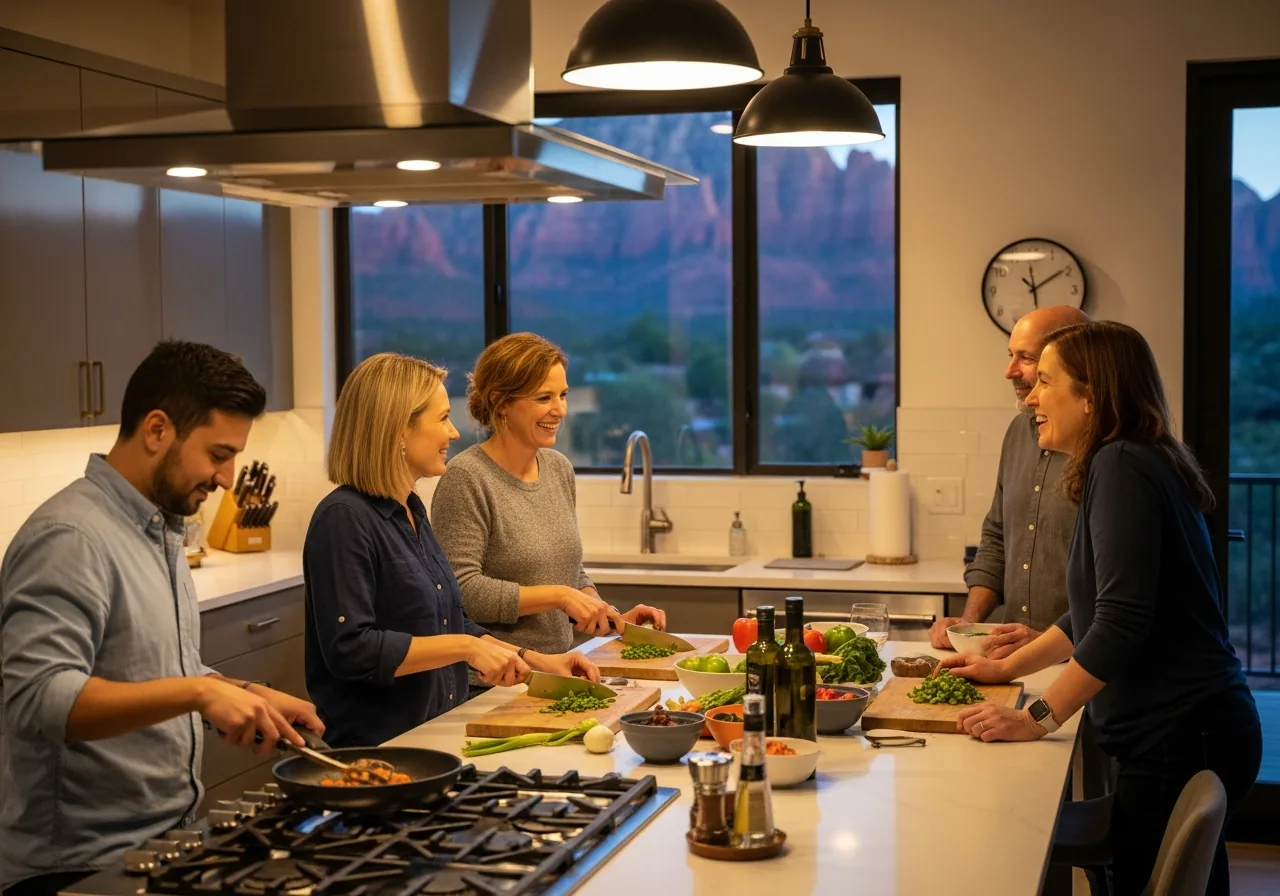
There is also the version of dinner that hotels cannot host at all: everyone cooking together. One person on the grill, two on prep, music on, nobody watching a clock. For a lot of groups that ends up being the night they remember, and it costs less than any restaurant in town.
A living room everyone actually fits in
Here is the quiet failure of the multi-room hotel plan: there is nowhere for the whole group to be together. Hotel rooms hold a bed and a chair. The lobby is public. The pool deck closes. So the group’s shared time shrinks to meals and the activity of the day, and the evenings scatter to separate rooms and separate televisions by nine.
A house has a living room, and that room is where a group trip actually happens. Cards after dinner. The trail debrief. Kids sprawled on the floor, grandparents on the couch, and no one negotiating whose room everyone crowds into. At our place that space comes with the high desert out the window, a media lounge for movie nights, and a game room with bunks that the kids claim within five minutes of arrival - but the general point holds for any decent group house: you are renting a shared room that hotels do not sell at any price.
Parking: your own driveway vs Uptown meters
Small thing until it is not. Sedona’s walkable core is Uptown, and parking there takes planning. The city runs metered parking along Main Street - the stretch of N SR 89A through Uptown - enforced 9 a.m. to 6 p.m., seven days a week, payable by card or phone app only, no cash. There are free public lots in Uptown too, a mix of all-day and three-hour options, but on busy weekends they fill, and the crunch is real enough that the city built a roughly 270-space parking garage a block off Main Street to relieve it. Circling for a spot with a full car is a known Sedona experience; our getting-around guide covers the lots, the free Sedona Shuttle to popular trailheads, and how to time it all.
Now compare the vacation-home version: you park in the driveway. At our house that means free parking for four cars at the door - which matters for pickleball groups arriving from Phoenix and Flagstaff in separate vehicles - and no valet line, no garage levels, no meter app. You still deal with parking when you go into town, but you start and end every day somewhere your car just sits, and trailhead runs at 7 a.m. begin with walking out the front door.
A quiet street vs a room above 89A
SR 89A is Sedona’s main artery. It carries most of the town’s traffic, and a large share of Sedona’s hotels sit directly on it, because that is where the commercial zoning is. A road-facing room means road noise, and the city’s own transportation planning documents describe congestion on 89A as a standing issue, heaviest midday through the tourist core.
Vacation homes sit in residential neighborhoods, blocks off the highway, where the evening soundtrack is closer to crickets than traffic. Our place is in West Sedona on a quiet street - close enough that trailheads, restaurants, and Uptown are minutes away, far enough that you sleep with the windows cracked. And because the pickleball court is indoors, the quiet runs both directions: you can play at 10 p.m. without a single neighbor knowing. We wrote up the whole noise question at /quiet-pickleball/.
Amenities no hotel offers
Hotels compete on a known list: pool, gym, spa, restaurant. All shared with strangers, all on the hotel’s schedule. A good group house competes on a different list, and the items on it are private.
The extreme case is the reason this site exists: a private indoor regulation pickleball court, climate-controlled, that your group has to itself for the entire stay. No court reservations, no waiting through other people’s games, no weather calls, no play window. Rally at 6 a.m. before the hike or at 10 p.m. after dinner. If you are building a trip around that court, the group trip planning guide walks through the whole format - who to invite, how to structure the days, how a round robin keeps eight players moving.
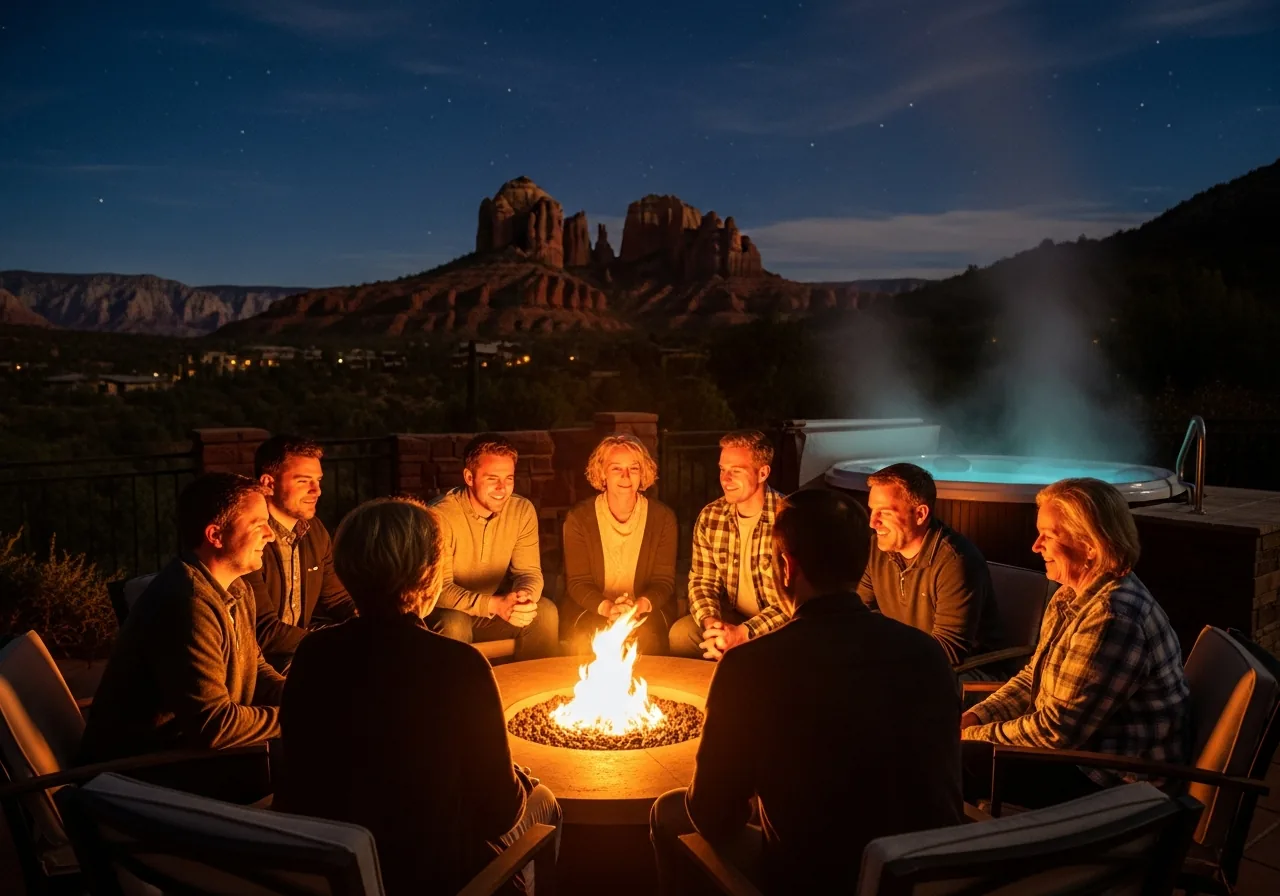
But even setting the court aside, the private-amenity list beats the hotel list for a group: a hot tub with nobody else in it, outdoor soaking tubs under the stars, a firepit for the last hour of the night, a covered deck for morning coffee with red-rock views. Sedona sits at about 4,350 feet, the air cools fast after sunset even in summer, and the sky is dark enough for real stargazing - a firepit and a hot tub are the right equipment for both.
Where hotels honestly win
This is the part most rental websites skip. Hotels are better at several things, and pretending otherwise would be selling.
One or two travelers. The group math runs in reverse: one room is one bill, and a whole house is more space than two people use. For a couple’s anniversary trip, book the hotel with the view and enjoy it.
Daily housekeeping. Nobody makes your bed at a vacation rental. Fresh towels every day, a made room every afternoon, and zero checkout chores are genuine hotel advantages. At a house, you will load a dishwasher.
Walking to dinner. If your ideal evening is stepping out of the lobby into Uptown’s restaurants and galleries and walking back after a second glass of wine, an Uptown hotel delivers that and a West Sedona house does not - you will drive ten minutes or designate a driver.
A front desk. Forgot a toothbrush at 11 p.m., need a dinner recommendation, want a late checkout - hotels staff a human for that around the clock. Rentals give you a message thread and a self-serve check-in. Fine for most people, worse when something goes sideways at midnight.
Points and status. If you are three nights from elite status, no house competes with that math.
The pattern: hotels win on service and location density. Houses win on space, cost-per-person, and privacy. The bigger the group and the longer the stay, the harder the house case gets to beat.
The honest bottom line
For one or two people, book a hotel. For four to eight, the house wins on almost every line that matters to a group: one bill instead of three or four, a kitchen that neutralizes peak-season restaurant waits, a living room where the trip actually happens, a driveway instead of a meter app, a quiet street instead of a road-facing window - and, in exactly one case in Sedona, a private indoor pickleball court that no hotel in town can match.
Sedona itself is the same either way: the red rocks, the trailheads, the two-hour drive from Phoenix. Start with our Discover Sedona hub to plan what the days look like. Then look at what the nights look like - eight people around one firepit versus eight people behind four doors - and check dates for the house. Sleeps eight across four bedrooms, guests 25 and up, no pets, no parties. The court is ready when you are.
Frequently asked questions
Is a vacation home really cheaper than hotel rooms in Sedona?
For groups, usually yes on a per-person basis, because a group of 4-8 needs three or four hotel rooms and every cost - nightly rate, tax, any resort fee - repeats per room. A house is one booking split across everyone. For one or two travelers, a single hotel room is typically cheaper. Run your own dates both ways before deciding.
Is parking really a problem in Uptown Sedona?
It takes planning at busy times. The city meters parking along Main Street (N SR 89A) from 9 a.m. to 6 p.m. seven days a week, payable by card or app only. Free public lots exist but fill on peak weekends, which is why the city added a roughly 270-space parking garage near Main Street. A vacation home gives you a driveway; you only deal with town parking when you go into town.
How far is West Sedona from Uptown and the trailheads?
Minutes by car. West Sedona sits along the same SR 89A corridor, roughly a 10-minute drive from Uptown depending on traffic, with major trailheads like those for Thunder Mountain and Airport Mesa closer still. You trade Uptown walkability for a quiet residential street and space.
Do vacation rentals work for multi-generational family trips?
They are usually the best tool for it. Grandparents get a real bedroom instead of an adjoining hotel room, kids get a bunk room, and everyone shares one kitchen and living room. This house sleeps eight across four bedrooms - two kings, a queen, and twin-over-twin bunks in the game room - with two baths.
What does a hotel do better than a rental house?
Daily housekeeping, a 24-hour front desk, walk-to-dinner locations in Uptown, and loyalty points. If those top your list - or you are traveling as a couple - book the hotel without guilt.
Can we play pickleball at night without bothering anyone?
Yes. The court at this house is fully indoors, heated, air-conditioned, and lit, so a 10 p.m. game makes no more neighborhood noise than a movie in the media room. Paddles and balls are provided; bring court shoes.
Play year-round in red rock country
Sedona Pickler is a private Sedona home with its own indoor, climate-controlled pickleball court. Rally any season, any hour — heated, cooled and lit, with paddles and balls provided.
Check dates & book


