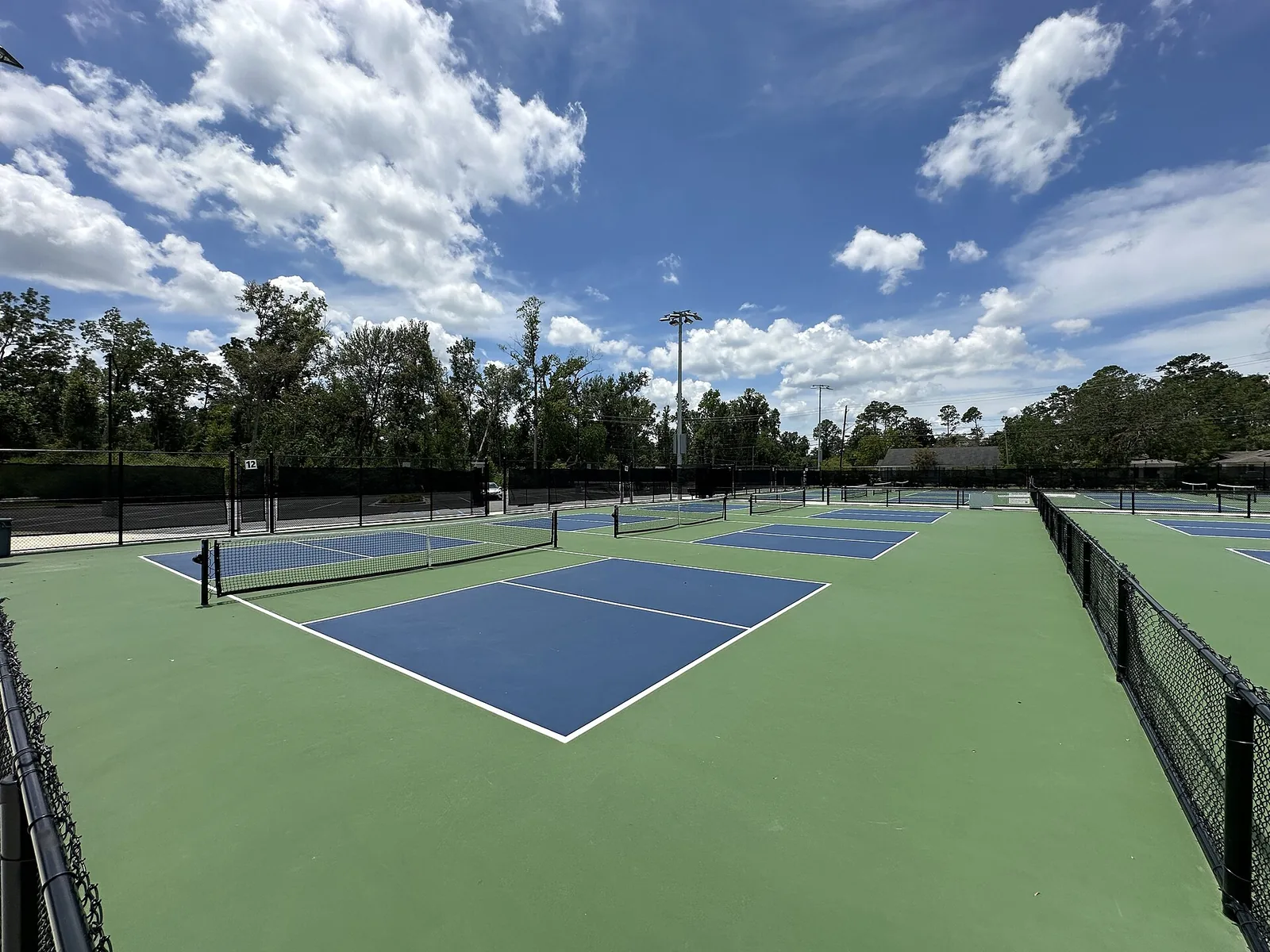
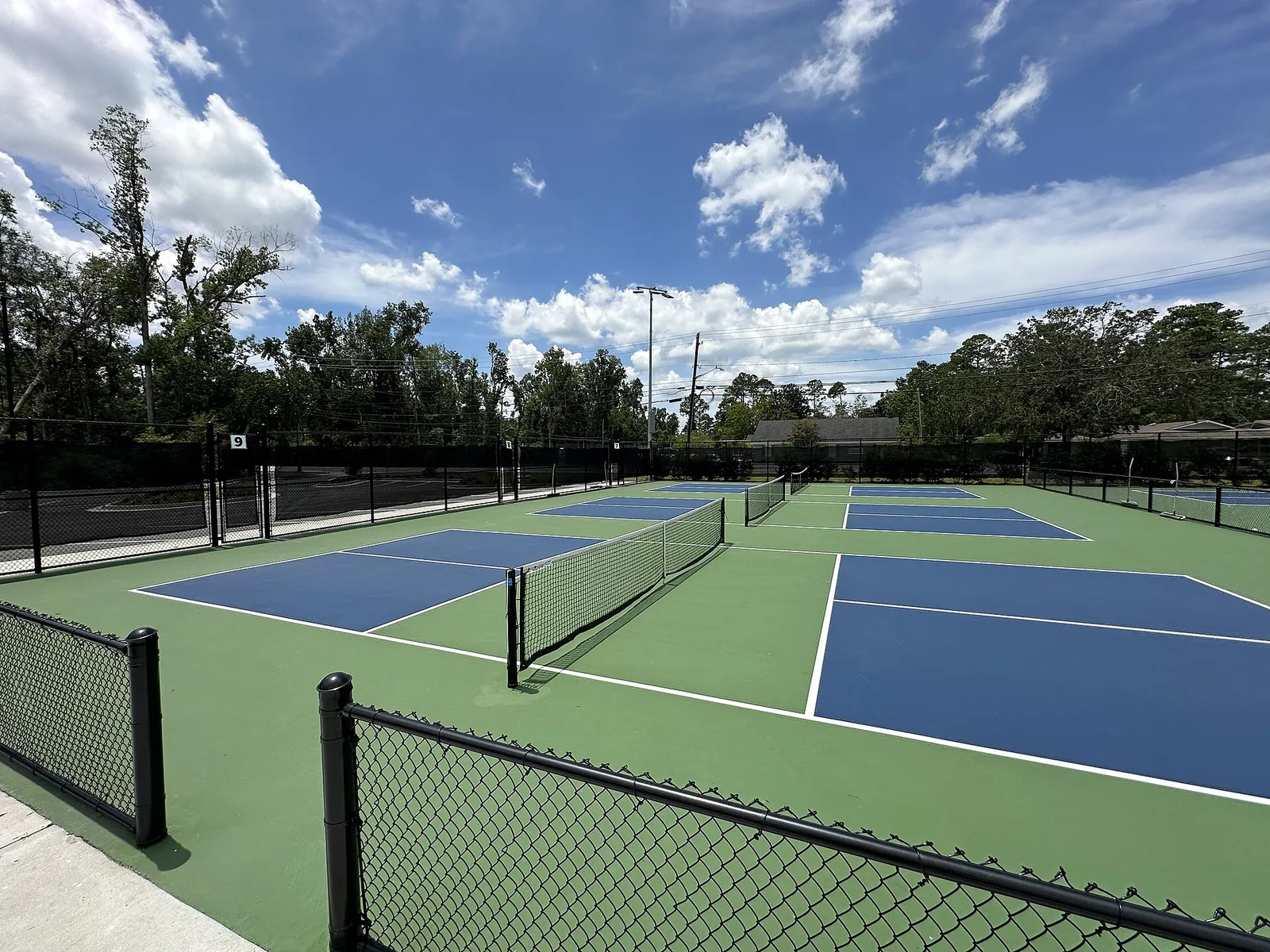
A round-robin is the most reliable way to turn a group of friends or family into an afternoon of good pickleball. Everybody plays, nobody sits around watching, and by the end the people who started as strangers across the net know each other a little. It works just as well for a club outing, a family reunion, or eight people on a trip who only want to play — and it scales down to four and up past twelve with the same logic.
The trick is doing a little setup before anyone picks up a paddle: pick the format, settle on scoring, and decide how the day ends. Get those three things straight and the afternoon runs itself. Below is how to run a round-robin for 8 players — the sweet spot for a single court — with the worked rotation table, the scoring and timing choices that matter, and quick notes for adapting it to 4, 6, 10, or 12.

What a round-robin actually is
A round-robin means everyone plays a series of short games, and the matchups rotate so you’re not stuck with the same partner or the same opponents all day. Standings come from how you did across all your games, not from a single-elimination bracket. Lose a game early and you’re still in it — you just play the next round.
For a casual group, that’s the whole appeal. There’s no “you’re out” moment, nobody drives home after losing one game, and a beginner and a strong player both get a full afternoon of pickleball. It’s the format clubs reach for when the goal is play time and good company rather than crowning a single winner.
Pick a format first
There are three common ways to run it. Decide which one fits your group before you start, because switching halfway gets confusing.
Rotating-partners “mixer”
Everyone partners with a different person each round and plays against different people too. This is the most social format and the best choice when skill levels are mixed, because strong and developing players keep getting shuffled together. By the end, you’ve played with most of the group and against most of the group. This is the one we’ll build a schedule for below.
Fixed teams or pools
Lock partners into pairs for the whole event and rotate which pair you face each round. With 8 players that’s four fixed teams playing a small league. It’s simpler to track and good if people came as couples or already know who they want to play with — but it’s less of a mixer, and a mismatched pair can get stuck losing all afternoon.
King-of-the-court
Winners move up a court (or stay on the “king” court), losers move down. With one court you can run a single-court version: winners stay and split up, challengers rotate in. It’s fast and fun but uneven — the strongest players get the most reps, the rest get fewer. Better as a warm-up game than the main event for a mixed group.
Rule of thumb: if your group’s skills are all over the map, run the rotating mixer. If everyone’s roughly even and came in pairs, fixed teams are simpler. Save king-of-the-court for when the group is competitive and doesn’t mind lopsided court time. If you’re unsure where people land, a quick read of pickleball skill ratings and DUPR helps you sort the group before the first serve.
A worked 8-player rotation (the mixer)
Here’s the part people get wrong: it’s surprisingly easy to write a “rotation” that accidentally pairs two people twice while leaving two others who never partner at all. So use a schedule that’s been checked, like the one below.
With 8 players you have two courts’ worth of people but typically one court, so you’ll play two games per round if you have the space, or run the two games back-to-back on a single court. Number your players 1 through 8. Each round has two games (Game A and Game B), each a doubles match of two partners versus two partners.
This 7-round schedule gives every player a different partner in all 7 rounds and keeps everyone playing every round:
| Round | Game A (partners vs. partners) | Game B (partners vs. partners) |
|---|---|---|
| 1 | 1 & 8 vs. 2 & 7 | 3 & 6 vs. 4 & 5 |
| 2 | 2 & 8 vs. 1 & 3 | 4 & 7 vs. 5 & 6 |
| 3 | 3 & 8 vs. 2 & 4 | 1 & 5 vs. 6 & 7 |
| 4 | 4 & 8 vs. 3 & 5 | 2 & 6 vs. 1 & 7 |
| 5 | 5 & 8 vs. 4 & 6 | 1 & 2 vs. 3 & 7 |
| 6 | 6 & 8 vs. 5 & 7 | 1 & 4 vs. 2 & 3 |
| 7 | 7 & 8 vs. 1 & 6 | 2 & 5 vs. 3 & 4 |
Read it like this: in Round 1, players 1 and 8 are a team against players 2 and 7 on one game, while 3 and 6 face 4 and 5 on the other. Pick any single player and trace them down the table — they’re paired with all seven other players exactly once across the seven rounds, and they’re on a court every round. That’s the goal: everybody plays with everybody, and everybody plays every round.
A few practical notes:
- One court? Run Game A, then Game B, then move to the next round. Seven rounds of two short games is a full, satisfying afternoon — figure two to three hours with breaks.
- Two courts? Both games in a round play at once, and the whole thing moves fast — you can be done in well under two hours.
- Short on time? Stop after Round 4 or 5. The schedule still holds up — nobody will have repeated a partner, so the standings stay fair even cut short.
- Print it. Tape the table to the fence or net post so nobody has to remember who’s next. It keeps the rotation moving without a person calling out every matchup.
Adapting for other group sizes
- 4 players: Run a 3-round mini round-robin. Round 1: 1&2 vs 3&4. Round 2: 1&3 vs 2&4. Round 3: 1&4 vs 2&3. Three games and everyone has partnered with everyone — it’s the cleanest round-robin there is.
- 6 players: With one court, two players sit each game, so build a 5-round rotation where the “sitting” pair rotates evenly. Easiest to manage with an app (below) so nobody loses track of who’s resting.
- 10 or 12 players: You’ll want two courts, or expect some sit-outs each round. Rotation gets fiddly by hand at this size — let a scheduler do the math so rest time stays even and partners don’t repeat.
For larger or repeating groups, a couple of free tools handle the math for you. Pickle Pal and PickleBracket both generate round-robin schedules, and many clubs run events on PickleballTournaments.com. Verify the current feature set before the trip, but any of them will save you from drawing brackets on a napkin. If you’re organizing a whole getaway around this, our group trip planning guide covers the logistics that surround the play itself.
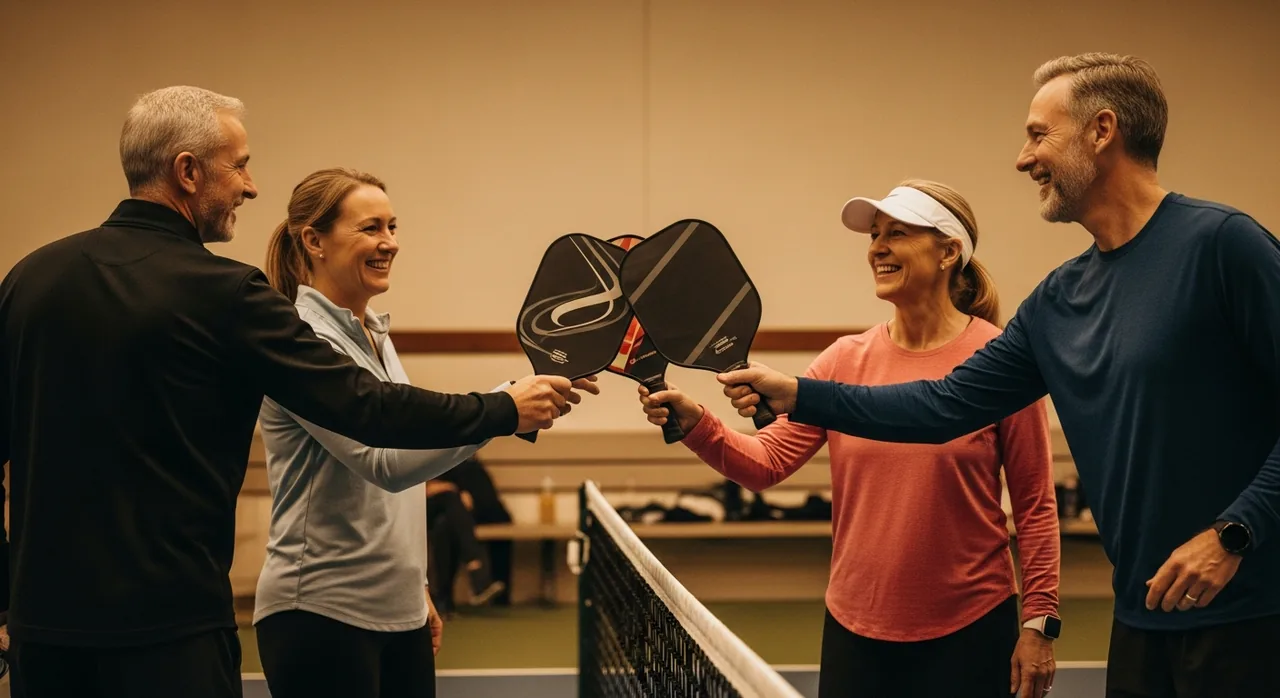
Scoring and timing
Two simple choices, made up front, keep the day smooth.
Games to 11. Standard pickleball: first to 11, win by 2, switch ends at 6. It’s familiar and decisive, but the length varies, so rounds finish at different times — which can leave one game waiting on another.
Timed rounds. Set a timer — many groups use 8 to 12 minutes per round — and play until it goes off, highest score wins, ties allowed. The big advantage is that every court finishes at the same moment, so the rotation stays in lockstep. For a social mixer with a set end time, timed rounds are usually the better call.
A middle path that works well: games to 11, but cap each round at a set number of minutes. If the timer beats the score to 11, whoever’s ahead takes the game. You get the feel of a real game with the predictability of a clock.
Whichever you choose, say it out loud before the first serve and keep a pickleball scoring cheat sheet handy for anyone still learning to call the score — it heads off most mid-game confusion.
Tracking standings
Keep it light. A clipboard or a phone note is plenty:
- After each game, both winners record their points scored (and optionally points allowed).
- At the end, total each player’s points across all rounds. Highest total is your champion.
- For a tiebreaker, use point differential (points scored minus points allowed), then head-to-head.
Because partners change every round in the mixer, individual point totals reward the players who showed up and competed all afternoon — not just whoever drew the best partner. A strong player stuck with a few developing partners can still finish near the top, which is exactly the kind of fairness that keeps a mixed group happy.
Keeping it social and inclusive
The whole point is that everyone has a good time, so a few small habits go a long way:
- Let the rotation do the balancing. Because partners shuffle, strong players carry a different teammate each round and beginners always have a steadier partner somewhere in the mix.
- Keep rounds short. Frequent rotation means more new faces and less time stuck in a blowout.
- Call it casual out loud. Say at the start that it’s for fun and the standings are a bonus. It sets the tone for the whole afternoon.
- Have a tie-break plan and a finish time so the day ends on a high note rather than fizzling.
- Mind the new players. A quick refresher on the basic rules and a scoring cheat sheet before the first serve saves a lot of mid-game confusion.
Why 8 and one court is the right size
A group of eight on a single court is close to ideal for a round-robin. Everybody plays every round, the rotation is clean, and you’re never waiting on a public court to open up or splitting the group across town. When the eight of you have one court to yourselves, the afternoon belongs to your schedule alone — you start when you want, break when you want, and finish on a timer you set.
If you want to sharpen up before the mixer, here are some drills that work on a private court, and if your group is coming together for work rather than play, our corporate retreat guide shows how the same round-robin doubles as a team-building afternoon.
Set the format, print the table, start the timer, and let the rotation do its job. The rest takes care of itself.
Frequently asked questions
How many rounds is a round-robin for 8 players?
Seven rounds. With 8 players numbered 1 through 8, a checked 7-round schedule pairs every player with each of the other seven exactly once, and keeps everyone on a court every round. If you’re short on time, you can stop after Round 4 or 5 and the standings stay fair — nobody will have repeated a partner.
How long does an 8-player round-robin take?
On a single court, plan for roughly two to three hours for all seven rounds with short breaks, since you run two games back-to-back each round. With two courts both games play at once and you can finish in well under two hours. Timed rounds of 8–12 minutes make the total length predictable.
Should we play games to 11 or use a timer?
For a casual mixer, timed rounds (often 8–12 minutes) are usually smoother because every game ends at the same moment and the rotation stays in lockstep. Games to 11 (win by 2) feel more like “real” pickleball but finish at different times. A good middle ground is games to 11 with a time cap — if the clock runs out first, whoever’s ahead wins.
How do you keep a round-robin fair when skill levels are mixed?
Use the rotating-partners mixer rather than fixed teams. Because partners change every round, strong players carry a different teammate each time and beginners always have a steadier partner somewhere in the rotation. Scoring by individual points across all rounds — not by team — means nobody’s result hinges on one lucky pairing.
Play year-round in red rock country
Sedona Pickler is a private Sedona home with its own indoor, climate-controlled pickleball court. Rally any season, any hour — heated, cooled and lit, with paddles and balls provided.
Check availability on Airbnb