Bear Mountain & Doe Mountain: A Strenuous Climb and an Easy Mesa
Here’s a deal that doesn’t come around often in Sedona: two completely different hikes that share the same parking lot. Bear Mountain is a real leg-burner — almost five miles round trip with close to 2,000 feet of climbing up exposed slickrock, the kind of hike that earns you a long nap afterward. Doe Mountain, directly across the road, is its opposite: a short, gentle climb to a flat-topped mesa with 360-degree views that families and sunset-chasers can do in under an hour. Whichever one you pick (and you can knock out both in a single day if you’re feeling ambitious), this corner of Boynton Pass Road is one of the best-value stops in the whole red rock country.
Two trails, one trailhead: why this spot is worth your time
Most Sedona trailheads give you one hike. The Bear Mountain / Doe Mountain area gives you a choice, and that’s what makes it special. You drive out Boynton Pass Road, pull into the shared lot, and then decide what kind of day you want.
Want a genuine summit challenge with a payoff most people never see? That’s Bear Mountain. Want a quick, scenic walk that ends with you standing on top of a mesa watching the light change over the whole valley? That’s Doe Mountain, literally across the street.
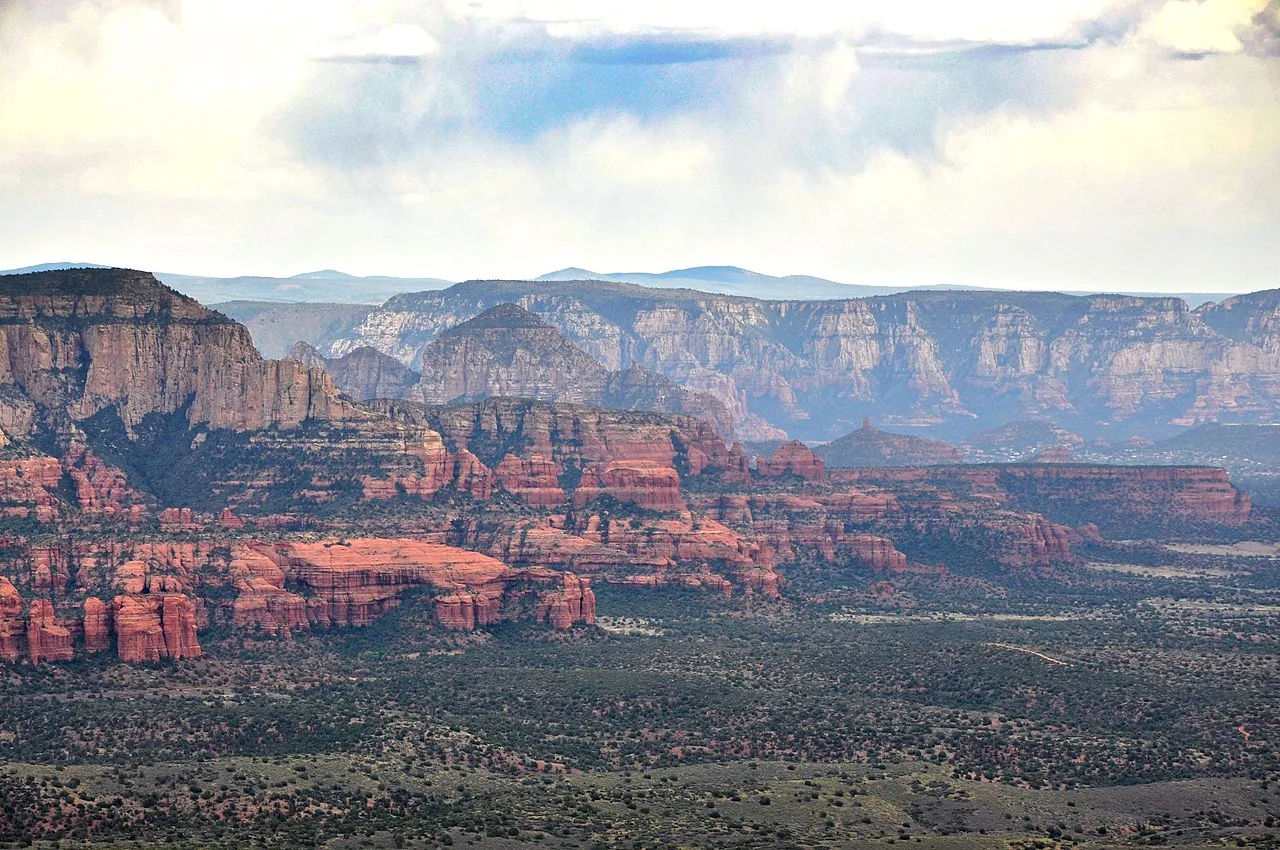
Both sit on the quieter west side of Sedona, away from the bottleneck of crowds at Devil’s Bridge and Cathedral Rock. You still need to show up early — more on that below — but the area feels less like a theme park and more like the open backcountry that drew people here in the first place. From either summit you can pick out the same cast of landmarks: Bear, Maroon, and Wilson mountains, the Cockscomb, Chimney Rock, and the mouths of Boynton, Fay, and Secret canyons. On a clear day from the top of Bear Mountain, you can see all the way to the San Francisco Peaks above Flagstaff, about 60 miles north.
The short version: Doe Mountain is the easy win, Bear Mountain is the trophy, and they’re a hundred yards apart. Few places make it that easy to match the hike to your energy level.
How to get there, parking, and the Red Rock Pass
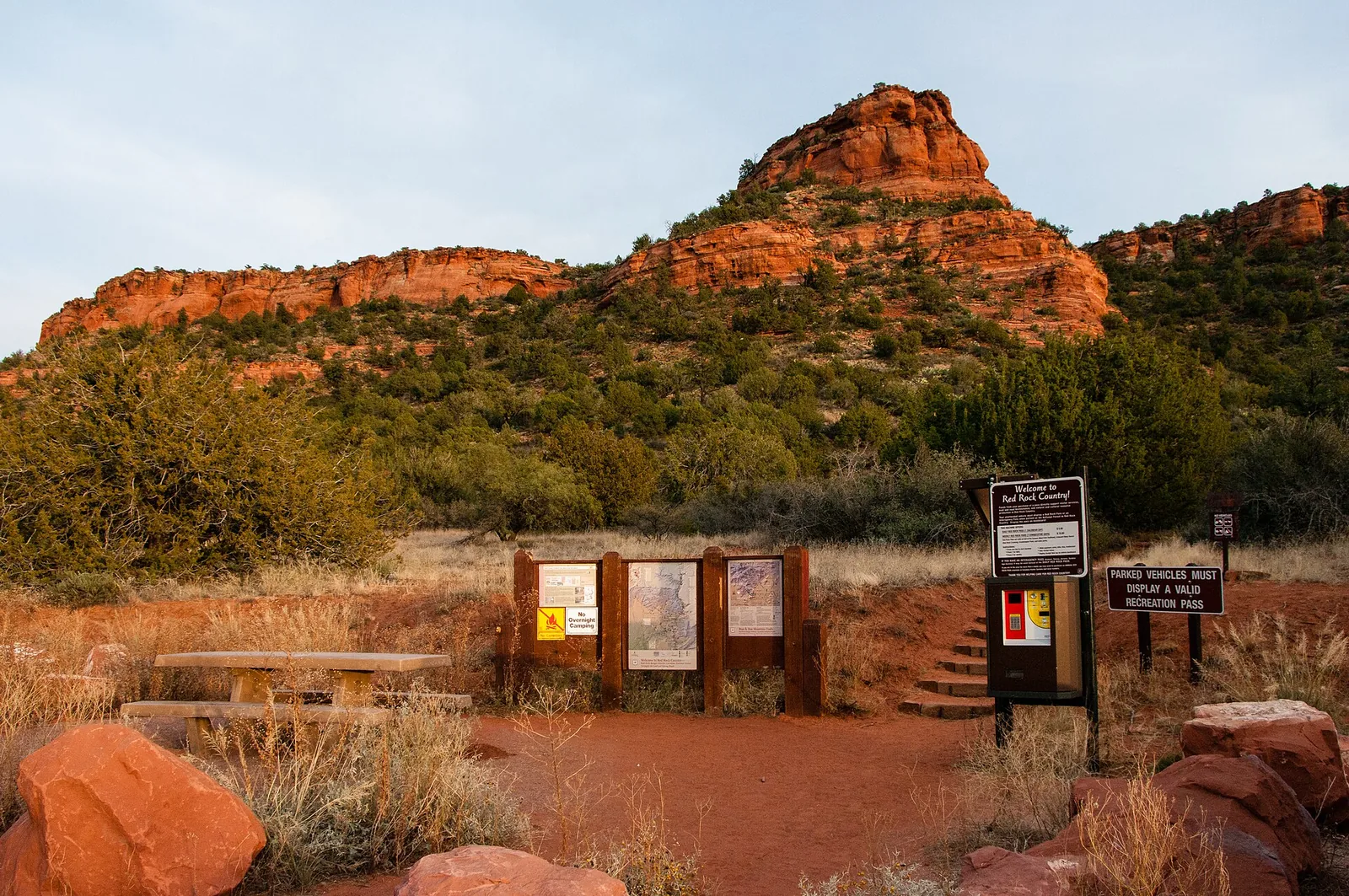
Both trails leave from the same paved lot on Boynton Pass Road (sometimes signed as Forest Road 152C), on the west side of Sedona in the Coconino National Forest.
From West Sedona, the simplest route:
- Head west on State Route 89A.
- Turn north onto Dry Creek Road.
- At the stop sign, turn left, following signs toward Boynton Canyon — the road becomes Boynton Pass Road.
- Stay on Boynton Pass Road; the shared Bear Mountain / Doe Mountain parking lot is on the left, roughly 1.5 miles past the last stop sign.
It’s about a 15-minute drive from the middle of West Sedona. The lot is small, paved, and clearly signed: Doe Mountain trailhead is on the south (left) side, Bear Mountain on the north (right). They face each other across the road. The pavement on Boynton Pass Road is fine for any car — you don’t need a high-clearance vehicle to reach this lot.
The pass you need
This is a fee site. To park here legally you need one of the following displayed in your vehicle:
- A Red Rock Pass — $5 daily, $15 weekly, or $20 annual (confirm current prices before you go; fees change).
- An America the Beautiful federal interagency pass (the annual national-parks pass), or a Senior/Access pass — any of these covers the parking and saves you buying the Red Rock Pass separately.
You can buy a Red Rock Pass at the self-serve kiosk in the lot, at Sedona visitor centers, at the Red Rock Ranger District office, at many local businesses and hotels, or online through recreation.gov ahead of time. If you already own the America the Beautiful pass, just bring it — it’s the better deal if you’re visiting multiple federal sites on your trip.
Local tip: The kiosk takes a while and sometimes only accepts certain payment types. Buy your Red Rock Pass the night before — or grab the weekly pass if you’re in town more than a day, since you’ll want it for Fay Canyon, Boynton Canyon, and other west-side trailheads too. One pass covers your whole car, not per person.
A heads-up on parking: this lot fills up early, often by 8 a.m. on weekends and through the busy spring and fall seasons. There’s roadside overflow parking along Boynton Pass Road, and that’s allowed — but if you park on the road, walk back along the pavement to reach the trailhead. Don’t cut across the open field between the road and the trail. That meadow fills with wildflowers in spring, and shortcutting tramples it and starts erosion scars that take years to heal.
Bear Mountain: the strenuous one
Let’s be honest up front — Bear Mountain is hard, and it doesn’t pretend otherwise. The Forest Service rates Bear Mountain Trail No. 54 as strenuous, and that rating is earned.
The numbers
- Distance: about 4.6 miles round trip
- Elevation gain: roughly 1,900–2,000 feet (climbing from around 4,500 feet at the trailhead to about 6,425 feet at the high point)
- Time: plan on 3.5 to 5 hours, depending on your pace and how long you linger at the top
What to expect
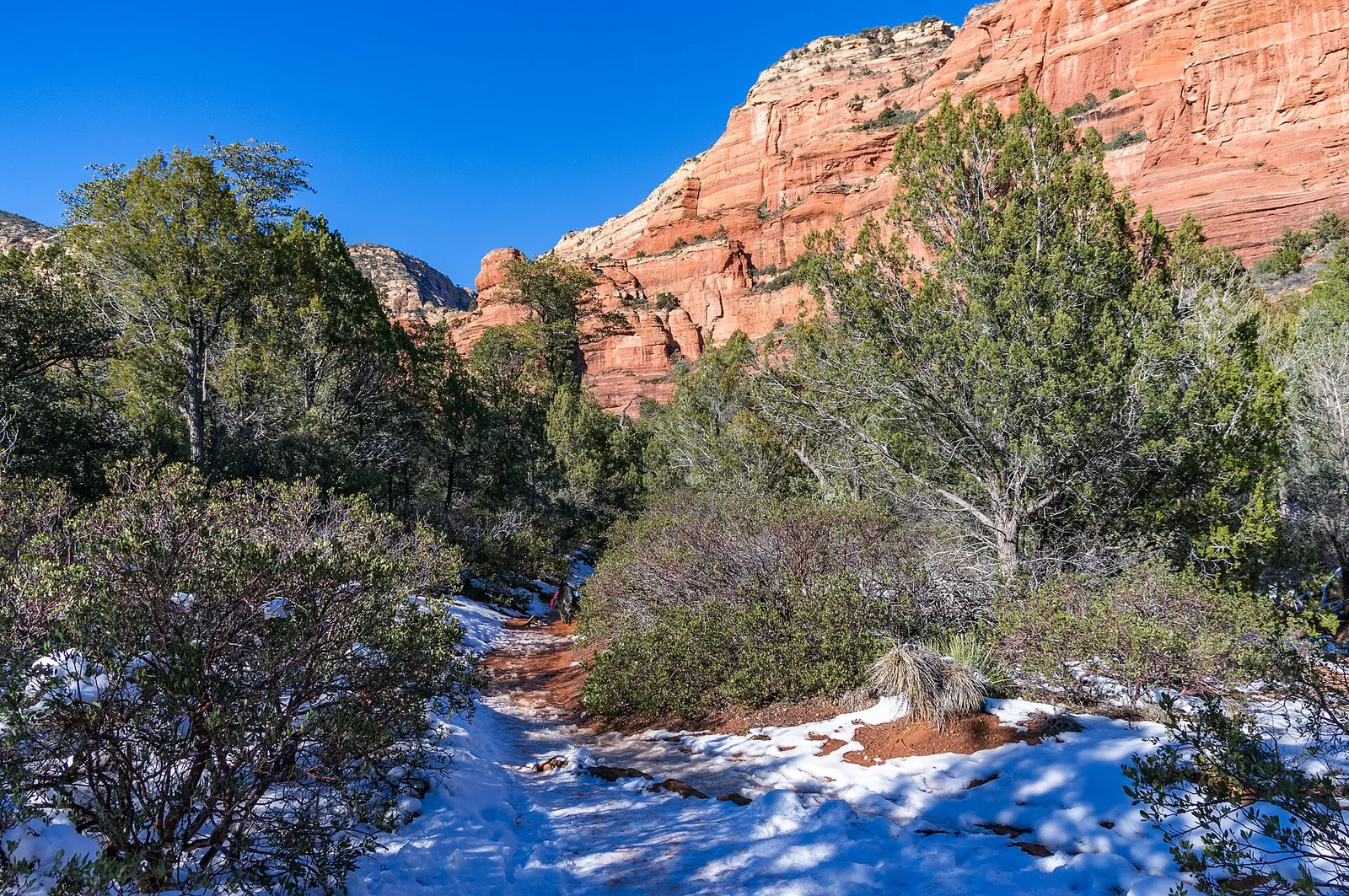
The trail starts deceptively gently across some flats, then gets down to business fast. You climb in a series of steep pitches up tilted sandstone slabs, with switchbacks linking the benches. It’s not a steady, even grade — it comes in bursts of hard climbing followed by short flats where you catch your breath, then more climbing. There are several false summits along the way, so don’t get demoralized when the “top” you’ve been staring at turns out to be just another bench with more mountain above it.
The big thing to know about Bear Mountain is route-finding. Long stretches cross bare slickrock where there’s no obvious tread, and the path is marked with white painted diamonds and dashes on the rock rather than a worn dirt trail. You have to pay attention. Lose the markers and you can wander off onto a dead-end ledge. Watch for the white paint, look ahead for the next one before you leave the last, and don’t blindly follow social trails or boot prints from people who got lost before you.
Here’s the slightly cruel twist at the very top: the actual summit is a flat, brushy mesa, and trees partly block the view up there. The best panoramas are actually on the climb — especially the final bench just before the top, where the views open up for miles in every direction. So if your legs are cooked at that last big viewpoint, you’ve already seen the best of it. The summit is a goal, not a scenic climax. Many hikers turn around at one of the upper benches, and that’s a perfectly good day.
Why people do it anyway
The reward is solitude and scale. Bear Mountain weeds out the casual crowd, so even on a busy Sedona weekend you’ll have stretches of the climb to yourself. The views back over Doe Mountain, Boynton Canyon, and the layered red rock formations get bigger and more dramatic the higher you go. It’s a hike that makes Sedona feel vast instead of crowded.
Doe Mountain: the easy mesa
Now the other side of the road. Doe Mountain Trail No. 60 is everything Bear Mountain isn’t — short, gentle, and welcoming to almost everyone.
The numbers
- Distance: about 1.5 miles round trip to the rim and back (add roughly a mile if you walk the loop around the flat mesa top)
- Elevation gain: around 400–550 feet
- Time: 45 minutes to a bit over an hour, more if you wander the rim or stay for sunset
What to expect
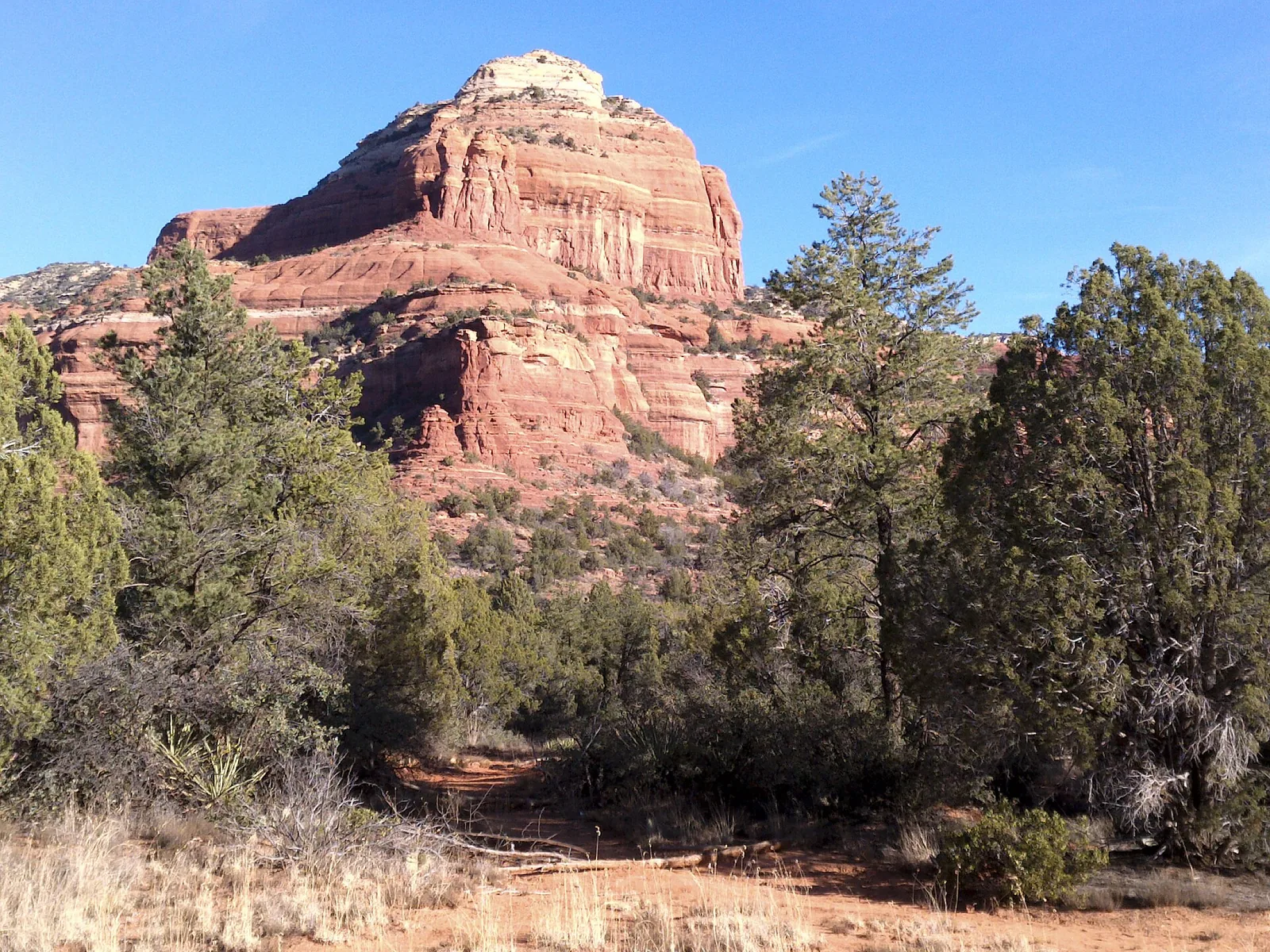
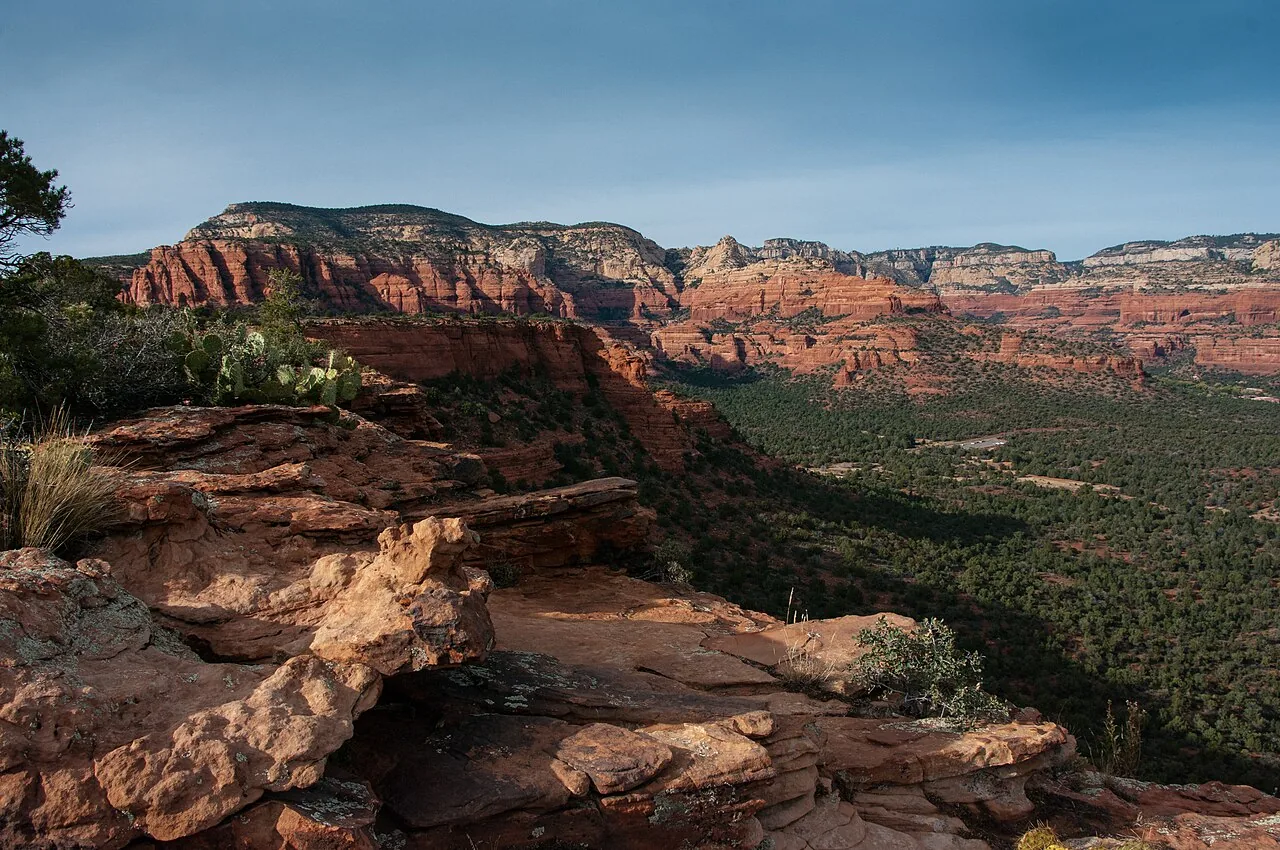
The trail switchbacks up the side of Doe Mountain at a moderate, steady grade. There’s one slightly rocky, slightly steeper stretch near the top where the path threads up through a break in the cap rock — Doe Mountain’s flat top is protected by a layer of erosion-resistant rock, which is exactly why it’s a mesa and not a peak. Once you pop over that rim, the climbing is done. You’re standing on a wide, flat tabletop maybe 400 feet above the desert floor.
Up top, a faint loop trail follows the rim around the edge of the mesa, and this is where the magic is. You get a genuine 360-degree view: Bear, Maroon, and Wilson mountains, the Cockscomb’s jagged profile, Chimney Rock, and the canyon mouths all spread out around you. There’s no single “best” spot — just walk the rim and the view keeps changing.
A word of caution that’s easy to forget on an “easy” hike: the mesa edges are unfenced cliffs. The walking on top is flat and simple, but don’t get so absorbed in your phone camera that you back off an edge. Keep kids and dogs close near the rim.
Who it’s for
Doe Mountain is the one to recommend to almost anyone — families with kids who can handle a short uphill, older hikers, people short on time, and especially anyone after sunrise or sunset light. It’s one of the best easy-effort, big-reward hikes in Sedona. If your group has mixed fitness levels, this is the trail that keeps everyone happy.
Bear vs. Doe: which one should you do?
If you’re staring at the lot trying to decide, here’s the honest comparison:
| Bear Mountain (Trail #54) | Doe Mountain (Trail #60) | |
|---|---|---|
| Distance (round trip) | ~4.6 miles | ~1.5 miles |
| Elevation gain | ~1,900–2,000 ft | ~400–550 ft |
| Difficulty | Strenuous | Easy |
| Time needed | 3.5–5 hours | 45 min – 1.5 hours |
| Route-finding | Tricky; follow white paint on slickrock | Straightforward |
| Best for | Fit hikers wanting a summit challenge | Families, sunrise/sunset, short on time |
| Shade | Very little — exposed | Very little — exposed |
| The payoff | Huge views on the climb; brushy summit | 360° mesa-top panorama |
The practical move for a lot of visitors: do Doe Mountain first, early, for sunrise, then decide whether you have the legs and the water for Bear Mountain afterward. Or just do Doe and save your energy for elsewhere — there’s no shame in that. If you only have an hour and want maximum view per minute of effort, Doe wins outright. If you came to Sedona to test yourself and earn a summit, Bear is your hike.
And if Bear Mountain leaves you completely wrung out, that’s kind of the point — that’s the evening you head back to stay at Pickler House, peel off the boots, and settle a friendly rematch on the indoor court instead of climbing anything else.
Best time of day and season
Sedona’s elevation (around 4,500 feet at these trailheads) makes for big temperature swings, and these two trails have almost no shade, so timing matters more here than on a shady canyon hike.
By season
- Spring (March–May): Prime time. Comfortable temperatures, wildflowers in the meadows below the trailhead, and long daylight. Also the busiest — lots fill early.
- Fall (late September–November): Arguably the best window. Cooler air, smaller crowds than spring, stable weather.
- Summer (June–August): Hot and exposed. Bear Mountain in particular is brutal midday in summer; the slickrock radiates heat. If you must hike then, be on the trail at first light and off it well before noon. Watch for afternoon monsoon thunderstorms in July and August — you do not want to be on Bear Mountain’s exposed upper slabs when lightning rolls in.
- Winter (December–February): Often beautiful and quiet, with crisp clear days. Bear Mountain’s upper slickrock can hold ice and snow in shaded spots, which makes the slabs genuinely dangerous — check conditions first.
By time of day
- Sunrise is the sweet spot for both: cool air, soft light, easy parking, and far fewer people. For Doe Mountain especially, sunrise on the mesa is hard to beat.
- Sunset is gorgeous from Doe Mountain’s rim — just bring a headlamp for the walk down, because it gets dark fast once the sun drops behind the rocks.
- Midday is the worst on both, for heat, harsh flat light, and the fullest parking lot.
What to bring
These trails are exposed and dry. There is no water on either, and no shade to speak of. Pack accordingly.
For Bear Mountain, treat it like the serious hike it is:
- Water — lots of it. Plan on at least 2–3 liters per person, more in warm weather. This is the single most common thing people underestimate here. Running out of water on the way down a hot, exposed slab is miserable and dangerous.
- Sun protection: hat, sunglasses, sunscreen, and ideally a long-sleeve sun shirt. There’s nowhere to hide from the sun.
- Real shoes: trail runners or hiking boots with grippy soles. The slickrock is unforgiving on smooth-soled sneakers.
- Snacks with some salt and calories for a multi-hour effort.
- A downloaded map (AllTrails, Gaia GPS, or the like). The white paint markers are good, but a GPS track is reassuring on the slickrock sections.
- A small first-aid kit and, if you might be out late, a headlamp.
For Doe Mountain, you can travel lighter — but still bring water, a hat, sunscreen, and decent shoes for that one rocky pitch near the top. Even a short exposed hike adds up in the Arizona sun.
Accessibility and dogs
Neither of these trails is wheelchair-accessible — both involve climbing on uneven and rocky terrain, and Bear Mountain crosses steep slickrock that requires hands at times. The parking lot itself is paved, but the trails are backcountry surfaces.
That said, Doe Mountain is the more forgiving of the two by a wide margin. It’s short, the grade is moderate, and the only real obstacle is the rocky step-up near the rim. Reasonably fit kids and older walkers handle it routinely. Bear Mountain, by contrast, demands real hiking ability and a head for some exposure.
Dogs are welcome on both trails but must be leashed (Coconino National Forest requires a leash here). For dogs, Doe Mountain is the better choice — it’s shorter and cooler-effort. Bear Mountain’s heat, length, and bare slickrock can be rough on paws and on dogs that aren’t conditioned for a long, hot climb. Bring water for your dog too, and remember the rock surface gets blazing hot in summer.
How to avoid the crowds
The west side of Sedona is quieter than the Devil’s Bridge / Cathedral Rock corridor, but it’s no secret anymore. The shared lot really does fill by 8 a.m. in peak seasons. Your best tactics:
- Start at or before sunrise. This solves parking and gives you the coolest, prettiest conditions. It’s the single biggest lever you have.
- Go midweek if you can. Tuesday through Thursday are noticeably calmer than weekends.
- Pick shoulder season. Late fall and early winter bring smaller crowds and great weather.
- Have a backup. If the lot is jammed and roadside overflow is full when you arrive, swing over to nearby Fay Canyon or Boynton Canyon — both are minutes away on the same road.
Doe Mountain’s short length actually helps with crowds too: people cycle through quickly, so even a moderately full lot doesn’t mean a crowded trail. Bear Mountain self-selects for fewer people simply because most visitors don’t want to climb 2,000 feet — so the higher you go, the more solitude you get.
Safety
A few things worth taking seriously on these particular trails:
- Sun and heat are the real hazard. Far more people get into trouble here from dehydration and heat than from falls. On Bear Mountain especially, turn around if you’re running low on water — the summit isn’t worth a heat emergency, and the views on the climb are the best part anyway.
- Don’t lose the route on Bear Mountain. If you can’t see the next white marker, stop and find it before continuing. Wandering off the painted route onto the slickrock is how people end up cliffed-out.
- Mind the unfenced edges on Doe Mountain. The mesa top is flat and easy, but the rim drops off sharply. Watch kids, dogs, and your own footing while you’re absorbed in the view.
- Watch the weather in summer. Monsoon thunderstorms build fast in the afternoon. Exposed slickrock high on Bear Mountain is the last place you want to be in a lightning storm. Start early and be down before storms develop.
- Slickrock + ice or rain = slippery. Wet or icy sandstone slabs are far more slippery than they look. In winter or after rain, the upper sections of Bear Mountain can be treacherous.
- Tell someone your plan, and don’t count on cell service — coverage out on Boynton Pass Road is spotty.
What to pair it with nearby
The beauty of this trailhead is how much sits within a few minutes’ drive. Make a half-day or full day of it:
- Fay Canyon — right next door on Boynton Pass Road. A flat, partly shaded, easy walk up a pretty canyon, with a side trail to a big rock arch. It’s the perfect cool-down after Bear Mountain, or an easy add-on to a Doe Mountain morning.
- Boynton Canyon — a longer canyon hike on the same road, and home to one of Sedona’s famous vortex sites near the Kachina Woman spire. From the canyon you actually get a great look back at Bear Mountain.
- Vortex sites — if the energy-and-balance side of Sedona interests you, the Boynton area is one of the best. See the vortexes guide for what’s nearby and what to expect.
- More easy options — if Doe Mountain whetted your appetite for low-effort, high-view walks, the easy hikes roundup points you to the rest of the best in town.
A realistic west-side day might look like this: Doe Mountain at sunrise, Fay Canyon for a shady mid-morning stroll, lunch back in West Sedona, and Bear Mountain saved for a fresh, cool start another morning. Stacking Bear and Doe back-to-back in one day is doable for fit hikers — just do Doe first while your legs are fresh, and commit to Bear only if you’ve got the water and the daylight.
However you split it, this little stretch of Boynton Pass Road quietly delivers some of the best hiking value in Sedona: one easy gem, one serious summit, and the same parking lot for both.
Frequently asked questions
How hard is the Bear Mountain trail in Sedona?
What's the difference between Bear Mountain and Doe Mountain?
Do I need a pass to park at the Bear/Doe Mountain trailhead?
Is Doe Mountain good for kids and sunset?
How do I find the Bear Mountain trail on the slickrock?
What's near the Bear and Doe Mountain trailhead?
Stay where you can rally any season
Sedona Pickler is a private West Sedona vacation home with its own indoor, climate-controlled pickleball court — a short drive from the trailheads, viewpoints and restaurants in this Sedona guide. Play at sunrise or after dark, in any weather.
Check availability on Airbnb