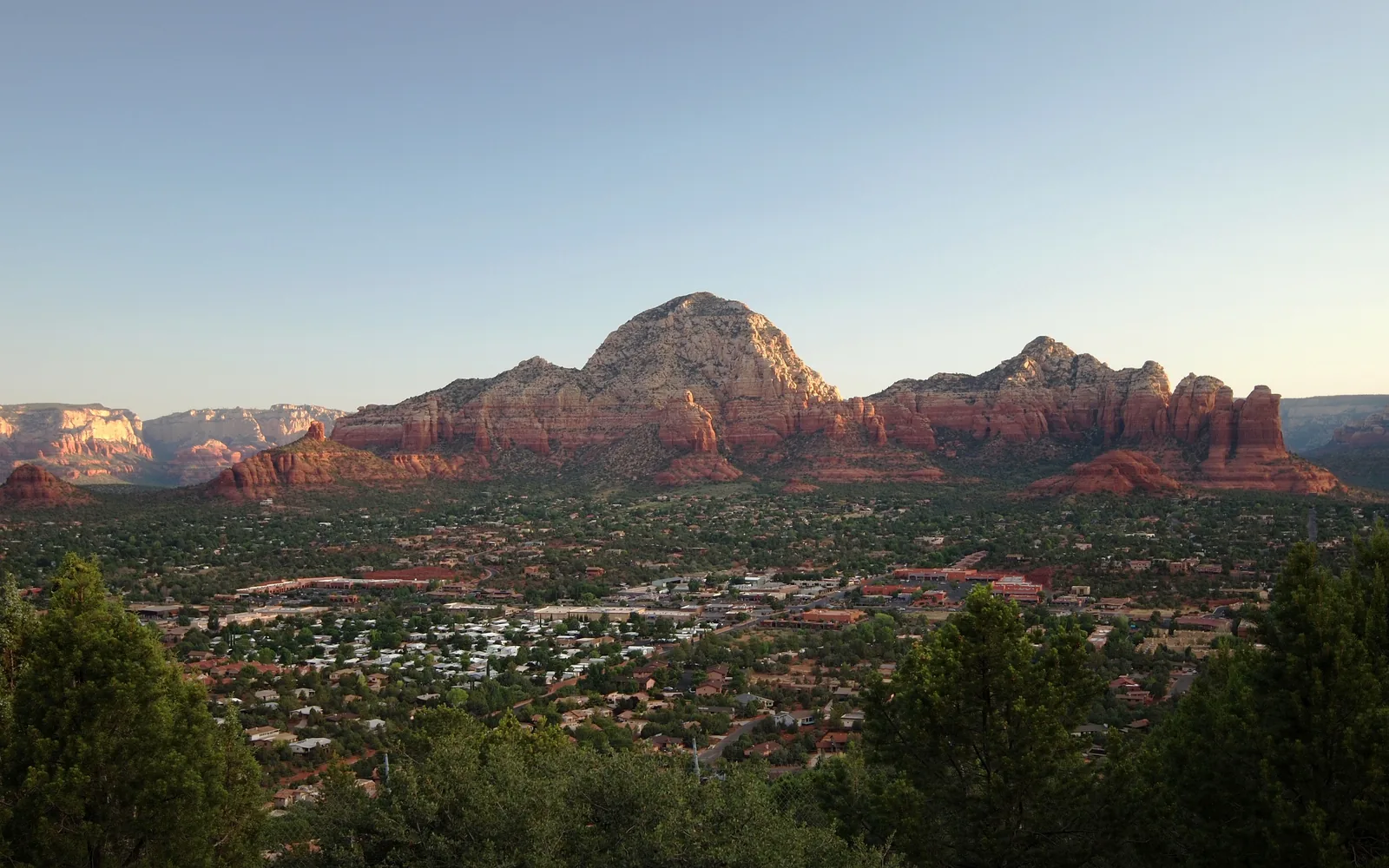
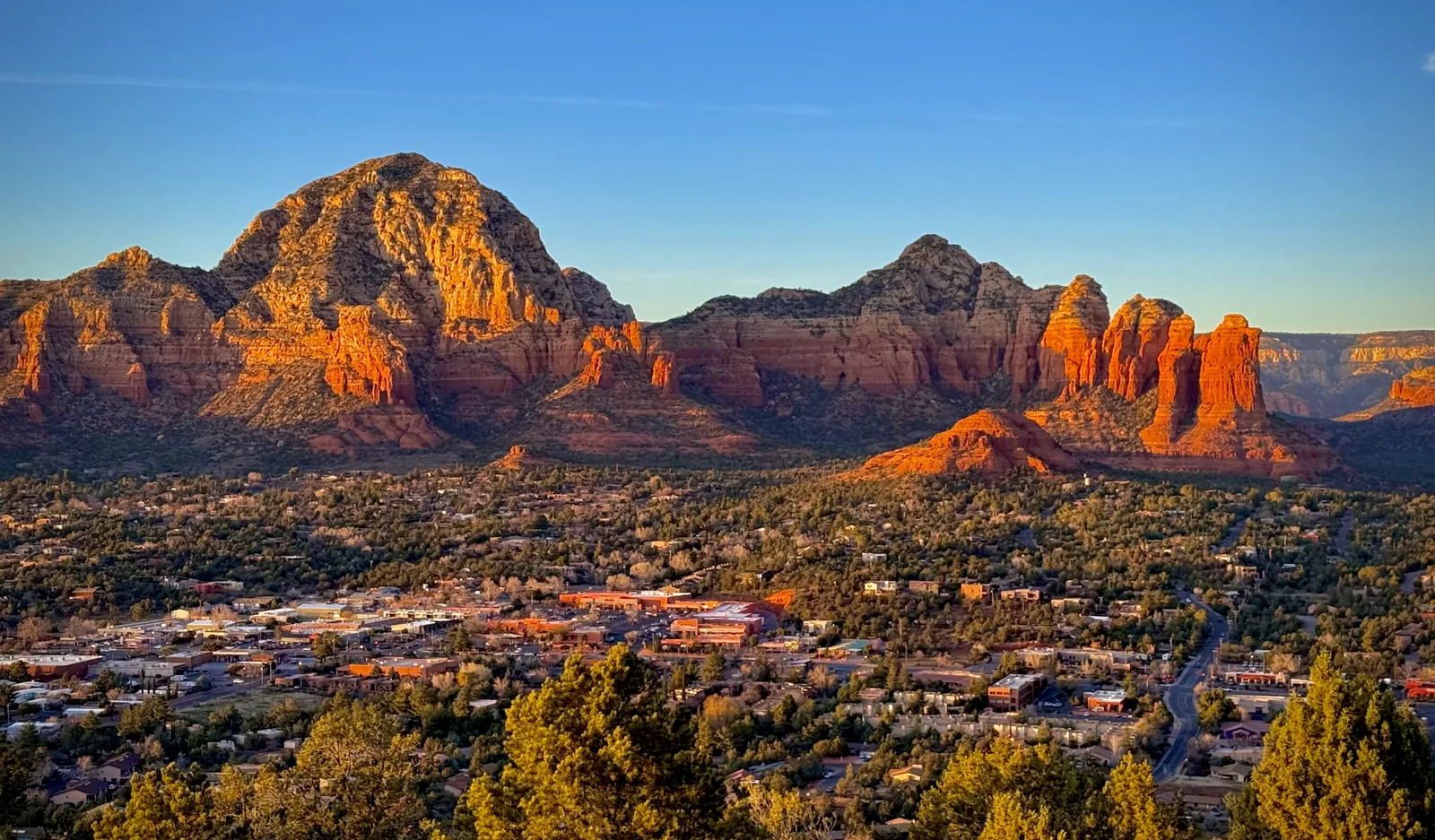
Johnny Guitar was filmed in and around Sedona, Arizona, with its indoor scenes shot afterward at Republic Pictures’ studio in California. The company began work below Coffee Pot Rock on October 19, 1953, and Vienna’s gambling hall, the film’s famous set, stood against the Nuns formation south of town.
Filming wrapped in mid-December 1953, and the movie opened on May 27, 1954. The sets came down long ago, but the rock and the views are still here. You can stand near several of the places below, and one of them is now a neighborhood with a street named for the film. Our guide to the movies filmed in Sedona covers the town’s other Westerns.
The Sedona locations at a glance
| Location | What was filmed | Visiting today |
|---|---|---|
| Little Horse Park, by the Nuns formation | Vienna’s Gambling Hall, built for the film and burned for its big night scene | Little Horse Trailhead on Highway 179; no marker |
| West Sedona, below Coffee Pot Rock | The town scenes, on Republic’s standing Western town | Now the Sedona West neighborhood; look for Johnny Guitar Street |
| West Sedona | The gang’s hideout cabin | A private part of town today; the exact site is not known |
| A tunnel on State Route 89A | The waterfall that hides the way to the hideout | The road is closed for repairs for now |
| Oak Creek | Vienna and Johnny wade the creek to escape the posse | Officials ask people to stay out for now |
| Republic Pictures, Studio City, California | Interiors, plus parts of the final scene | Now CBS Studio Center, with no public tours |
The American Film Institute catalog lists Sedona as the film’s location, and Turner Classic Movies adds Oak Creek Canyon. The detail on each site comes from Sedona Monthly’s long account of the shoot, published for its 50th anniversary in 2003, and from the research of Joe McNeill, whose book Arizona’s Little Hollywood tells the whole story.
Vienna’s Gambling Hall at Little Horse Park
Vienna’s saloon is the image most people remember from the film. Turner Classic Movies describes it as a small Western set abutting a cliff. Sedona Monthly places it close to the south side of the Nuns formation at Little Horse Park, about four miles from town. It went up for this one film, and the company ended its location work by burning the hall for the scene near the end of the story, on an evening when much of Sedona came out to watch.
That spot is easy to get close to. Little Horse Trailhead is on Highway 179, 3.6 miles past the roundabout at the Y, reached by a connector road on the left. Parking there takes a Red Rock Pass, and there are restrooms. Visit Sedona calls the rock that rises over this trail the Madonna and the Nuns.
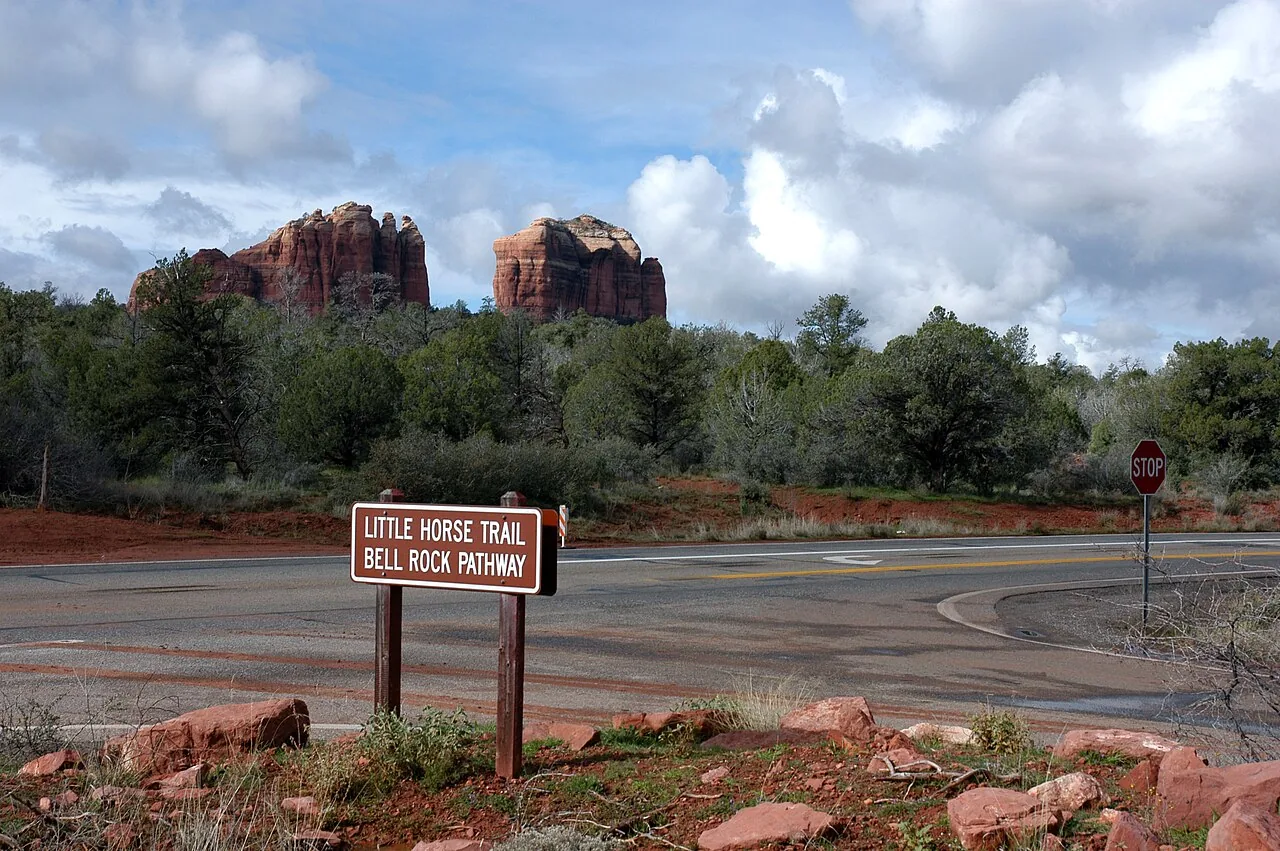
Nothing from the set is left, and there is no marker, so bring a still from the movie on your phone and match the cliff for yourself. One location researcher has placed the hall by the chapel’s parking area, on the same stretch of rock, so the exact spot is still an open question. The chapel itself was finished in April 1956, a little over two years after the film wrapped, and the Little Horse Trail runs about 2.3 miles from the trailhead to its doors. The chapel guide has that walk and the chapel’s hours.
The town below Coffee Pot Rock
Republic had a good reason to choose Sedona: it already owned a Western street here. The studio had built the set in the mid-1940s for John Wayne’s Angel and the Badman, on flats that were then called Grasshopper Flats, and left it standing for later films. Sedona Monthly suggests that this is most likely why Johnny Guitar came here. The cast and crew gathered under Coffee Pot Rock when filming began.
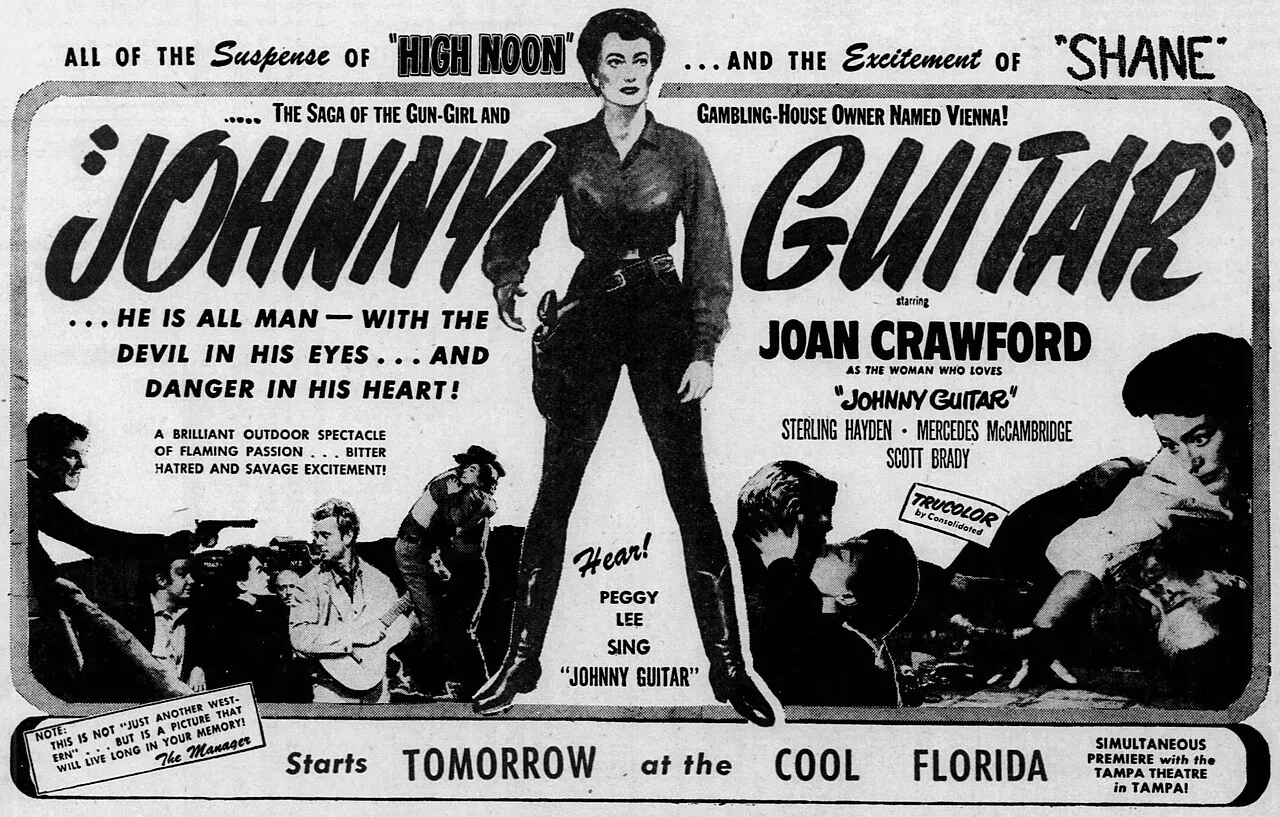
The set came down before 1960 to make way for houses, and the Sedona West neighborhood stands there now. Its street names keep the history: Johnny Guitar Street, Pony Soldier Road and Last Wagon Drive. A Sedona Historical Society marker in Uptown tells the same story. These are private homes, so enjoy it from the road. Coffee Pot Rock still rises above the rooftops, and it looks the way it does in the film.
One street carries a small mistake. McNeill notes that Flaming Arrow Way honors a movie that does not exist. A 1959 Arizona Highways story listed the Sedona-filmed Flaming Feather under the wrong name, and the street took that name from the article.
One building from the old town survives. The Telegraph Office, first a railroad depot in Winona, Arizona, was moved to Sedona as part of John Wayne’s town set. Today it sits on the Heritage Museum grounds on Jordan Road. Our film locations driving tour links it to the other stops around town.
The hideout and the waterfall
The Dancin’ Kid’s gang reaches its hideout through a waterfall, which makes for one of the oddest scenes in the film. It was also a piece of movie trickery. Sedona Monthly reports that the entrance was filmed at a tunnel on 89A, using water diverted from the Jordan farm’s irrigation ditch on Oak Creek. A Joan Crawford fan site, using a map from the Johnny Guitar Society, describes an irrigation tunnel with a fire hose set up over it to make the falls.
The hideout on the other side was somewhere else altogether, in West Sedona. The two places were edited together to look like one. Neither spot is marked today.
The Jordan farm is easier to find. Its old farmhouse and packing shed are the home of the Sedona Heritage Museum, whose collection includes a letter from a local resident, Ruth Jordan, describing Crawford’s time in town.
The cold morning in Oak Creek
One scene has Vienna and Johnny wading through Oak Creek to get away from a posse. Sedona Monthly reports that Crawford and Sterling Hayden skipped their stand-ins and went completely under the freezing water on a cold morning, and that director Nicholas Ray sent each of them back to the hotel with a bottle of brandy. Ruth Jordan’s letter describes Crawford shaking with cold and still stopping to sign an autograph on her way up the hill.
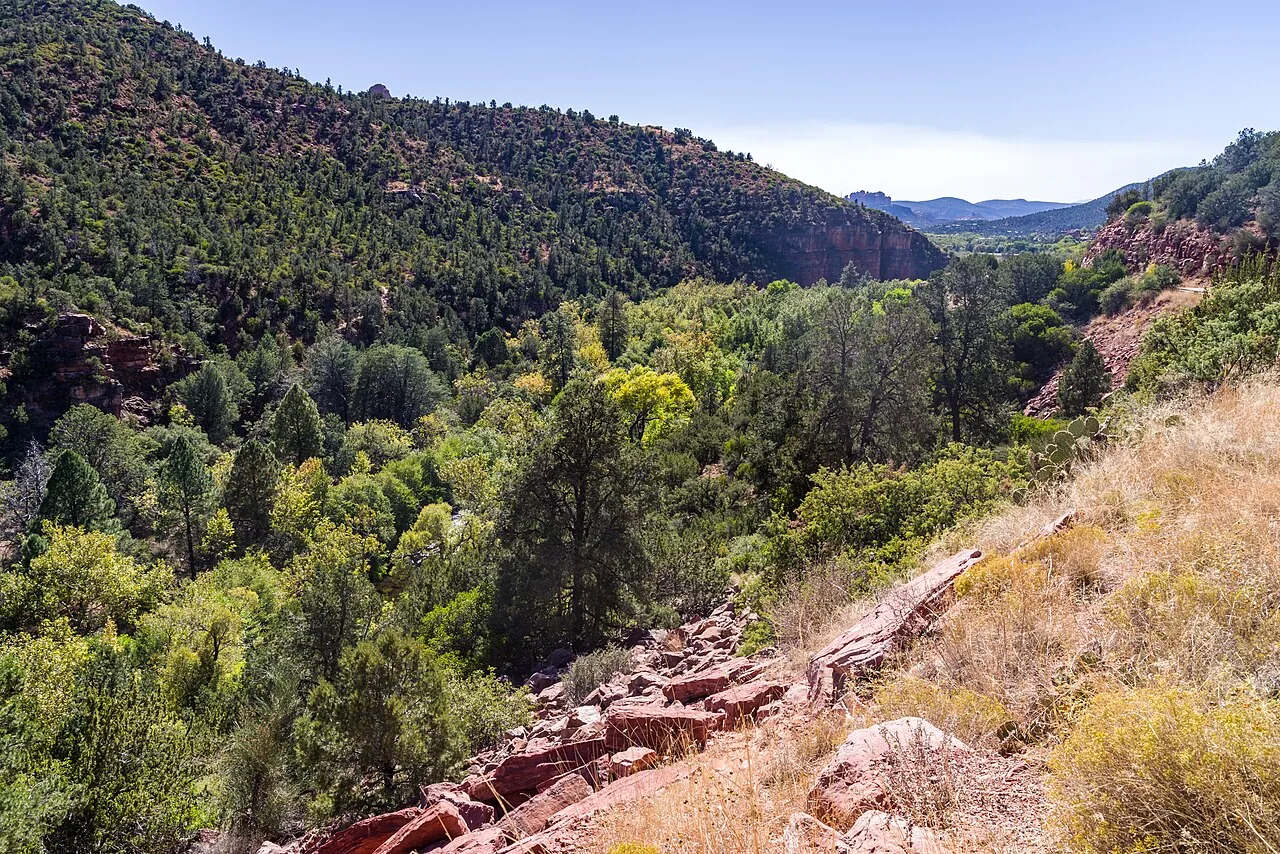
The next scene that day had Mercedes McCambridge, as Emma, addressing the posse. Her third take earned applause from the crew, and Crawford watched it from the top of the hill. Accounts of the film’s famous feud usually start there.
The canyon is closed for repairs after the November 2026 flood. When it reopens, the canyon drive guide will take you along the water.
Where the company stayed
The company of 95 was a big arrival for a town of about 1,500 people. The principal actors stayed at the Cedar Hotel on 89A, while most of the company bunked at the Sedona Lodge, a converted Civilian Conservation Corps camp on Highway 179 that served as headquarters for many film crews of that era. Ben Cooper, who played Turkey, later recalled its mess hall and the platters of pork chops and steaks piled high.
Crawford arrived early in October, before work started, and by Ruth Jordan’s account she spent those days in jeans, shopping in town and picking up her own mail, while her children played with local kids.
The feud that changed the film
Here is the story as Sedona Monthly and Turner Classic Movies tell it. On the evening after that posse speech, Ray found McCambridge’s costumes thrown across the road near their cabins. Crawford then demanded rewrites and five new scenes. Her agent flew in, the studio agreed, and much of Hayden’s dialogue went to Vienna. Sedona Monthly puts the added cost at $220,000.
That rewrite gave the movie what it is known for today, with two women carrying the conflict and the guns. Filming ran 10 days over schedule.
Why film lovers still come
American critics disliked it when it opened. French critics disagreed, and François Truffaut called it the Beauty and the Beast of Westerns. The film now sits on the Library of Congress National Film Registry, and McNeill calls it the greatest collaboration between Republic and Sedona. Its color helps, too. Republic’s own Trucolor process makes the red rocks look almost painted, and director Jim Jarmusch once called it “the only western that looks like it was shot inside a ’50s ski lodge.”
A trace of it is still underfoot in Uptown. In 2004, co-stars Ernest Borgnine and Ben Cooper came back to Sedona to press their hands into wet concrete at the first Hands Through History event, and the slabs were installed along Uptown’s streets in 2006.
A Johnny Guitar day in Sedona
Watch the film the night before, then spend a morning putting it on the map. It turns up on streaming services and for digital rental. Then try this order.
- Start at Little Horse Trailhead. Walk out far enough to get a clear view of the Nuns and picture the hall against the rock. Continue to the chapel if you have the legs for it.
- Stop at the Sedona Heritage Museum. It has a film exhibit, and you can see the Telegraph Office from the old Western town.
- Have a look in Uptown. Look for the handprints and the Historical Society marker.
- Drive through Sedona West. Find Johnny Guitar Street and take a photo with Coffee Pot Rock behind the sign. Please stay on the road.
- Finish with a view. The Sugarloaf Loop Trail sits right below Coffee Pot Rock, and you can walk it in about an hour.
Directions for that loop are on our Tall in the Saddle page, which has another good Sedona story, and our movie-night list of Sedona Westerns has more ideas.
Frequently asked questions
Where was Johnny Guitar filmed?
Where was Vienna's saloon in Johnny Guitar?
Can you visit the Johnny Guitar filming locations?
Is there a Johnny Guitar Street in Sedona?
Who starred in Johnny Guitar?
When was Johnny Guitar filmed and released?
What other movies were filmed in Sedona?
Movie night in West Sedona
A TV lounge for the film, then a court of your own the next afternoon: that is our four-bedroom place in West Sedona.
Check dates & book