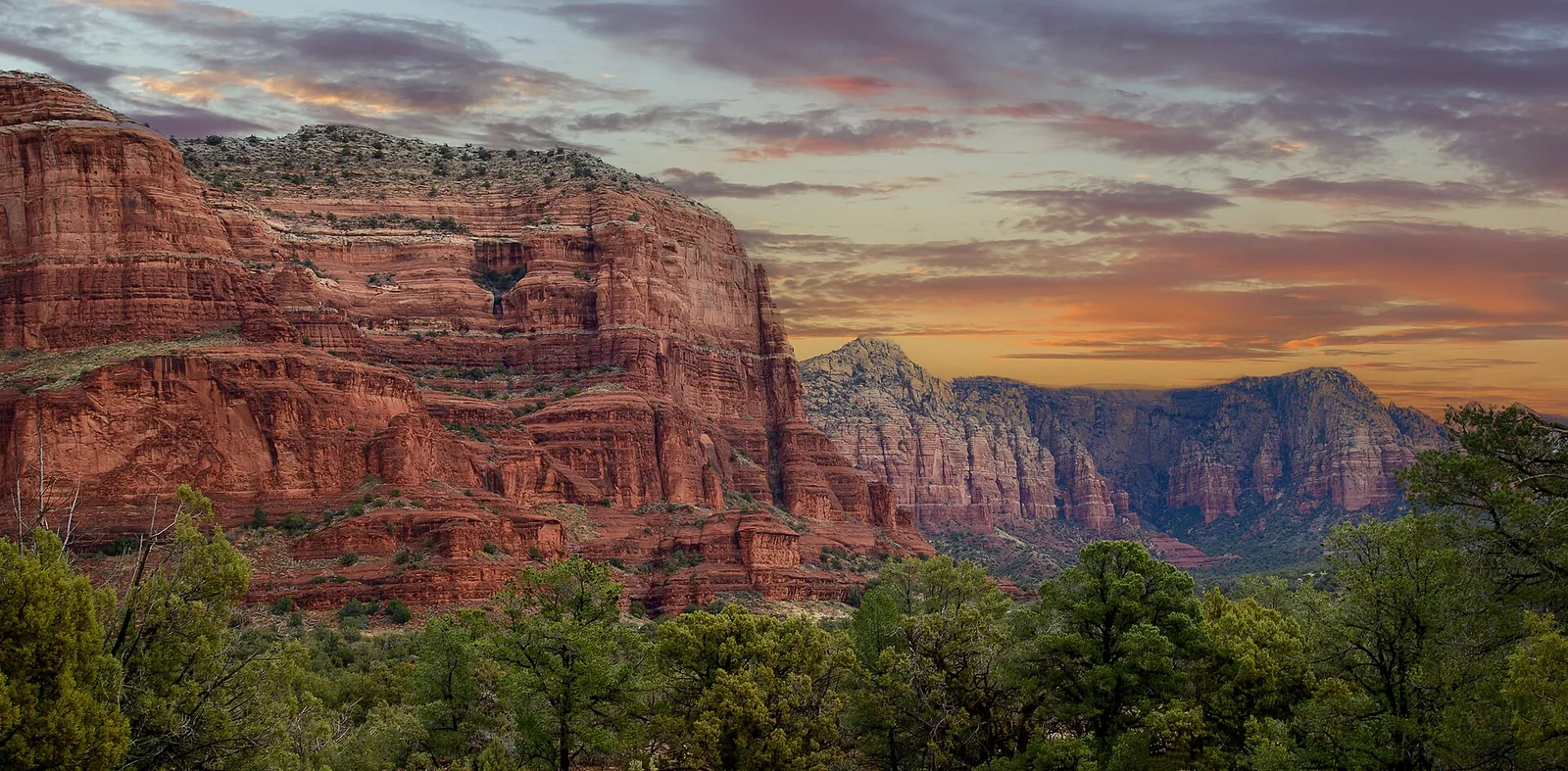
Between 1923 and the early 1970s, close to 100 feature films were shot around Sedona — enough that the town picked up the nickname Arizona’s Little Hollywood. The sets are almost all gone. The scenery is not. Cathedral Rock, Coffee Pot Rock, Bell Rock, Schnebly Hill, and Oak Creek Canyon look nearly the same today as they did when John Wayne, James Stewart, Robert Mitchum, and Joan Crawford worked in front of them, which means you can stand where the cameras stood without a tour guide or a ticket.
This guide is the map. If you want the movies themselves — which westerns to watch before your trip and what to look for in each one — start with our companion guide to the western movies filmed in Sedona. This page covers the other half: the real, visitable places, organized into a driving loop you can do in a day.
Every location below is documented — by the Sedona Heritage Museum, by film location researchers, or by the historical markers standing at the sites. Where a claim rests on a single plaque, we say so.
How this tour works
The stops form a rough loop around Sedona. You’ll start in Uptown at the museum, swing southeast to Schnebly Hill Road, run down the State Route 179 corridor past Bell Rock, cut west to Red Rock Crossing, come back through West Sedona for Coffee Pot Rock and the movie streets, detour up Dry Creek Road if you have high clearance, and finish north in Oak Creek Canyon where the whole story started.
A few practical notes before you drive:
- Time. The full loop is a solid day. If you have half a day, do the museum, Red Rock Crossing, and the West Sedona stops — they carry the most film history per mile.
- Passes and fees. Trailhead parking on Forest Service land generally requires a Red Rock Pass or an America the Beautiful pass, and Crescent Moon Picnic Site charges its own per-vehicle day-use fee. Confirm current prices at fs.usda.gov before you go.
- Vehicles. Everything except Schnebly Hill Road and Forest Road 152 is fine in a rental sedan. Those two are rough dirt; high clearance is strongly recommended, and a jeep tour covers Schnebly Hill if you’d rather leave the driving to someone else.
- Respect the neighborhoods. Two stops — the movie streets and the old western town site — are residential West Sedona. Drive through, read the street signs, take your photos from the public road, and keep moving.
One more suggestion: watch at least one of the films before you drive. Broken Arrow and Johnny Guitar are the easiest to find on streaming services, and both are packed with recognizable Sedona backgrounds. Thirty minutes of either one turns the tour from a list of pretty viewpoints into a matching game — you’ll catch yourself pointing at ridgelines all day. Several of the titles are also available through the Sedona library network if you’re planning ahead from home.
Stop 1: Sedona Heritage Museum — start here
Address: 735 Jordan Rd, Uptown Sedona. Open daily 11 AM to 3 PM, $10 adults, children under 13 free — confirm current hours and prices at sedonamuseum.org.
The museum sits in Jordan Historical Park, the old Jordan family farmstead at the top of Jordan Road, and it is the keeper of Sedona’s film history. Its film exhibit covers the western era with posters, photographs, and production lists, and the museum maintains an online “Arizona’s Little Hollywood” photo collection if you want to study up before the trip.
The reason to come in person is outside: the Telegraph Office. This small wooden building started life over a century ago as a railroad depot in Winona, northeast of Sedona, and was hauled here to become part of the western town set built for Angel and the Badman (1947), the film John Wayne produced and starred in. When the set came down, the building survived, and the museum eventually restored it and moved it to the Jordan Road grounds. It is the only piece of Sedona’s movie-set architecture you can still walk up to and touch.
Spend 45 minutes to an hour here. The exhibit gives you the full list of what was shot where, which turns every stop after this one from “nice view” into “recognize that ridge.” For the broader story of the town itself — the Schneblys, the orchards, the road-building — see our Sedona history guide.
Stop 2: Schnebly Hill Road
From Uptown, drive south through the Y roundabout onto State Route 179, cross the Oak Creek bridge, and turn left onto Schnebly Hill Road. The first stretch is passable for most cars; beyond that the road turns rough and rocky, and high clearance is strongly recommended. Our Schnebly Hill Road guide covers the driving details, viewpoints, and jeep tour options.
The film history here is thick. John Wayne’s first Sedona work was in 1944, when the crew of Tall in the Saddle came to shoot a stagecoach sequence high on Schnebly Hill — the bulk of that movie was made on a studio ranch in California, but the stagecoach ride was filmed from the overlook called Schnebly Vista, and that same vista shows up in a string of later westerns. Firecreek (1968), which put Henry Fonda and James Stewart on opposite sides of a bleak little town, also shot on Schnebly Hill, along with scenes on top of Airport Mesa back in town.
Partway up the road sits Merry-Go-Round Rock, the round, banded formation that jeep drivers treat as the turnaround prize. Location researchers place a scene between John Wayne and Gail Russell from Angel and the Badman here, and the formation is easy to identify in Broken Arrow (1950) among others.
How to see it today: if you have high clearance, drive it yourself in dry weather and expect 30 to 45 slow minutes each way. If not, the Pink Jeep and other operators run Schnebly Hill trips daily. Either way, stop at the vista, look back down at the red rock bowl below, and picture a stagecoach team taking that grade at speed with a camera truck alongside.
Stop 3: Bell Rock and the State Route 179 corridor
Back on SR 179, drive south along the Red Rock Scenic Byway toward the Village of Oak Creek. Bell Rock and Courthouse Butte rise on your left, and both formations worked steadily through the western years. They appear in Angel and the Badman (1947) — the homestead of Gail Russell’s Quaker family was built in the Chapel area with Courthouse Butte and Bell Rock in the frame — and in Gunfighters (1947) and Broken Arrow (1950). Bell Rock even did anonymous stock-footage duty, turning up as an establishing shot in B westerns like Stagecoach Kid (1949).
Two sub-stops along this stretch:
- Bell Rock pathway. Park at the Courthouse Vista or Bell Rock trailheads and walk any portion of the flat, easy path. Our Bell Rock guide has the parking details. The classic movie angle is from the north and west — the same profile the cameras used.
- The Chapel area and Broken Arrow country. Between Bell Rock and Uptown, the Chapel of the Holy Cross area marks roughly where the Angel and the Badman farm set stood, and one location researcher places Joan Crawford’s saloon from Johnny Guitar near where the chapel’s parking area sits today. Just north of here, portions of Broken Arrow were filmed in the rugged country east of SR 179 — the jeep trail and the neighborhood in that area now carry the film’s name, and the famous Broken Arrow jeep tour drives straight through it.
Nothing built remains at any of these spots. What remains is the skyline, and it is unmistakable if you’ve watched the films.
Stop 4: Red Rock Crossing and Cathedral Rock
If you only visit one location on this list, make it this one. From the Y, take State Route 89A west, turn left on Upper Red Rock Loop Road, and follow the signs down to Crescent Moon Picnic Site — about 20 minutes from Uptown. There’s a per-vehicle day-use fee at the entrance station; confirm the current amount at fs.usda.gov.
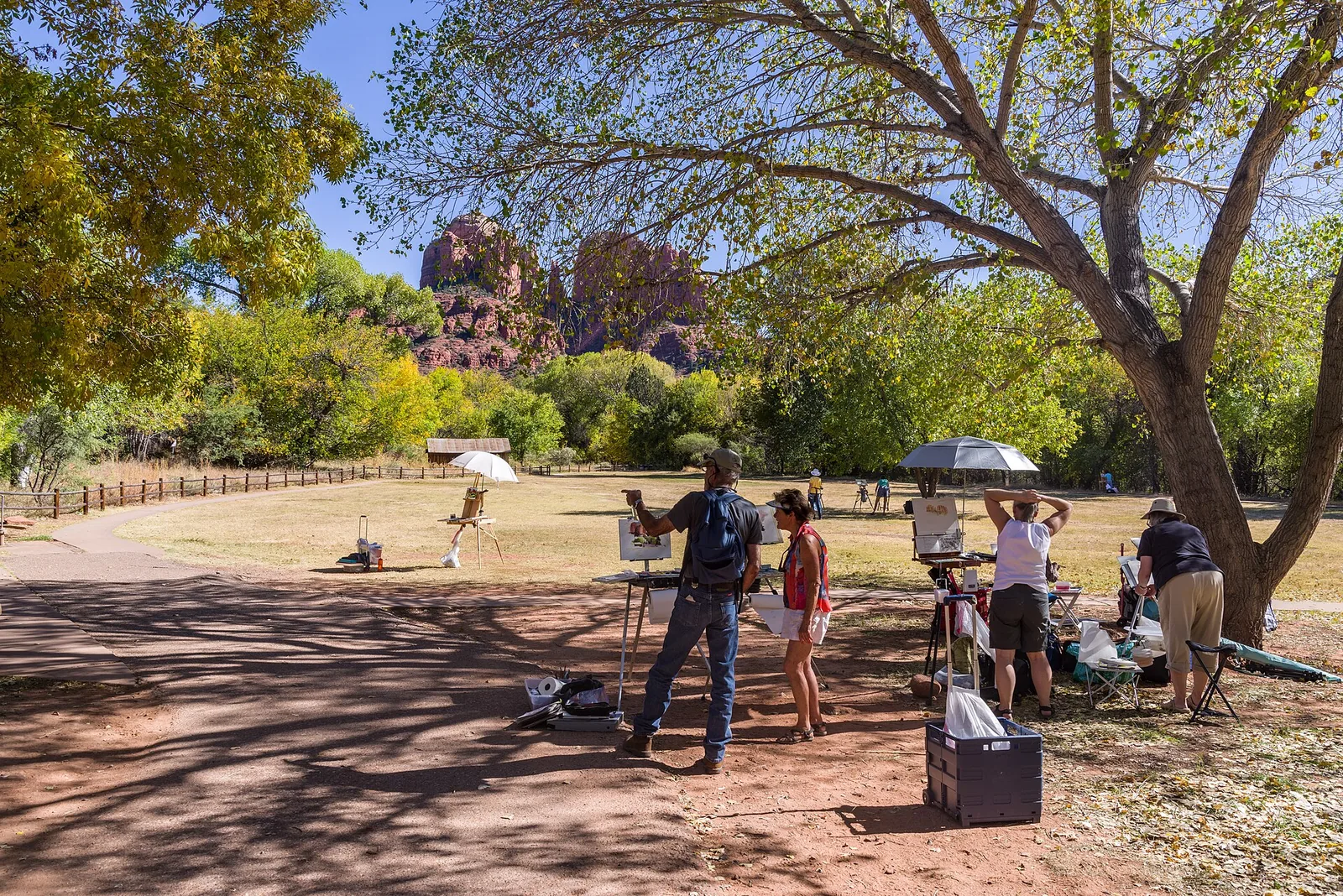
Red Rock Crossing is the stretch of Oak Creek below Cathedral Rock, and the view from the creek — water in the foreground, Cathedral Rock’s spires behind — was Hollywood’s favorite Sedona composition. The land here was a working cattle ranch dating to the early 1900s before it became a film location and, later, a Forest Service picnic area. Cathedral Rock from this side appears in a long list of westerns, including Broken Arrow (1950) with James Stewart, Blood on the Moon (1948) with Robert Mitchum, and The Last Wagon (1956) with Richard Widmark.
How to see it today: from the parking area, walk the flat creekside path east about ten minutes until Cathedral Rock lines up over the water. There are worn social paths to the sandstone shelves at the creek’s edge where the reflection shot works. No hiking required — this is the most accessible stop on the tour, and it doubles as the best picnic spot on it. If you want to climb the formation itself, that’s a separate, steeper outing from the other side; see our Cathedral Rock guide.
One planning note: this is also Sedona’s most photographed sunset location, so if you’re building a film-location day, either come midday for the history and return at golden hour, or schedule Red Rock Crossing as your final stop and let the day end here.
Stop 5: West Sedona — Coffee Pot Rock, the vanished western town, and the movie streets
Drive back up Upper Red Rock Loop Road and head east on 89A into West Sedona. Coffee Pot Rock — the formation with the spout — dominates the skyline on your left, and the flats beneath it, once called Grasshopper Flats, held the most-used movie set in Sedona history.
In 1946, John Wayne, producing Angel and the Badman, had a full western town built below Coffee Pot Rock. Republic released the film in 1947, and the town set kept working for a decade: Station West (1948) used it, and in October 1953 the cast and crew of Johnny Guitar — Joan Crawford, Sterling Hayden, Mercedes McCambridge — assembled beneath Coffee Pot Rock to shoot one of the strangest and most argued-about westerns ever made. The set’s screen career ran through 3:10 to Yuma (1957), and by the end of the 1950s it was torn down to make room for houses.
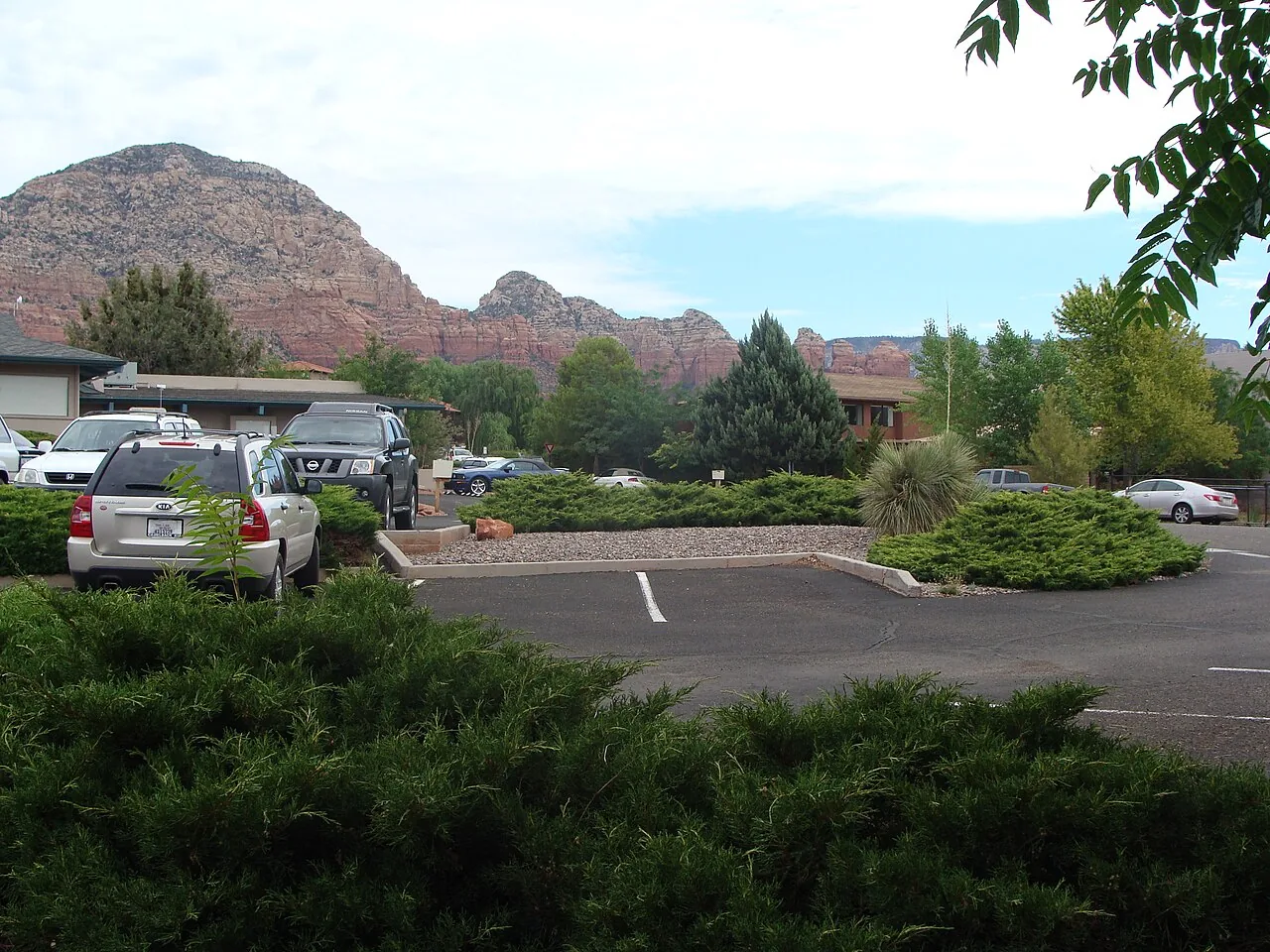
Those houses are the reason this stop still works. The subdivision that replaced the set is called Sedona West, and its developers wrote the film history into the plat map. Drive the neighborhood off Dry Creek Road and Highway 89A and you’ll pass Johnny Guitar Street, Last Wagon Drive, Pony Soldier Road, and Flaming Arrow Way — each named for a movie shot in Sedona. A school now sits near the old set location beneath Coffee Pot Rock. There is no marker on the set site itself, so the street signs are the monument.
How to see it today:
- The streets. Turn north off 89A into the Sedona West subdivision and simply drive the grid. It’s an ordinary residential neighborhood, so photograph street signs from the car or the public right-of-way and don’t linger in front of homes.
- Coffee Pot Rock up close. The Sugarloaf Loop trailhead at the end of Buena Vista Drive gives you a short, easy climb up Sugarloaf’s little summit knob with Coffee Pot Rock filling the view — the closest legal, parkable vantage on the formation the cameras once framed above the town set. It’s about a mile round trip.
Wayne left one more mark on Sedona: as producer, he had the Sedona Lodge built on Highway 179 so his cast and crew wouldn’t have to shuttle from Flagstaff every day — reportedly the only permanent complex in the country built specifically to house movie companies on location. It’s gone now, but it explains how a town of a few hundred people hosted studio productions year after year.
Stop 6: Dry Creek Road and the Van Deren Cabin
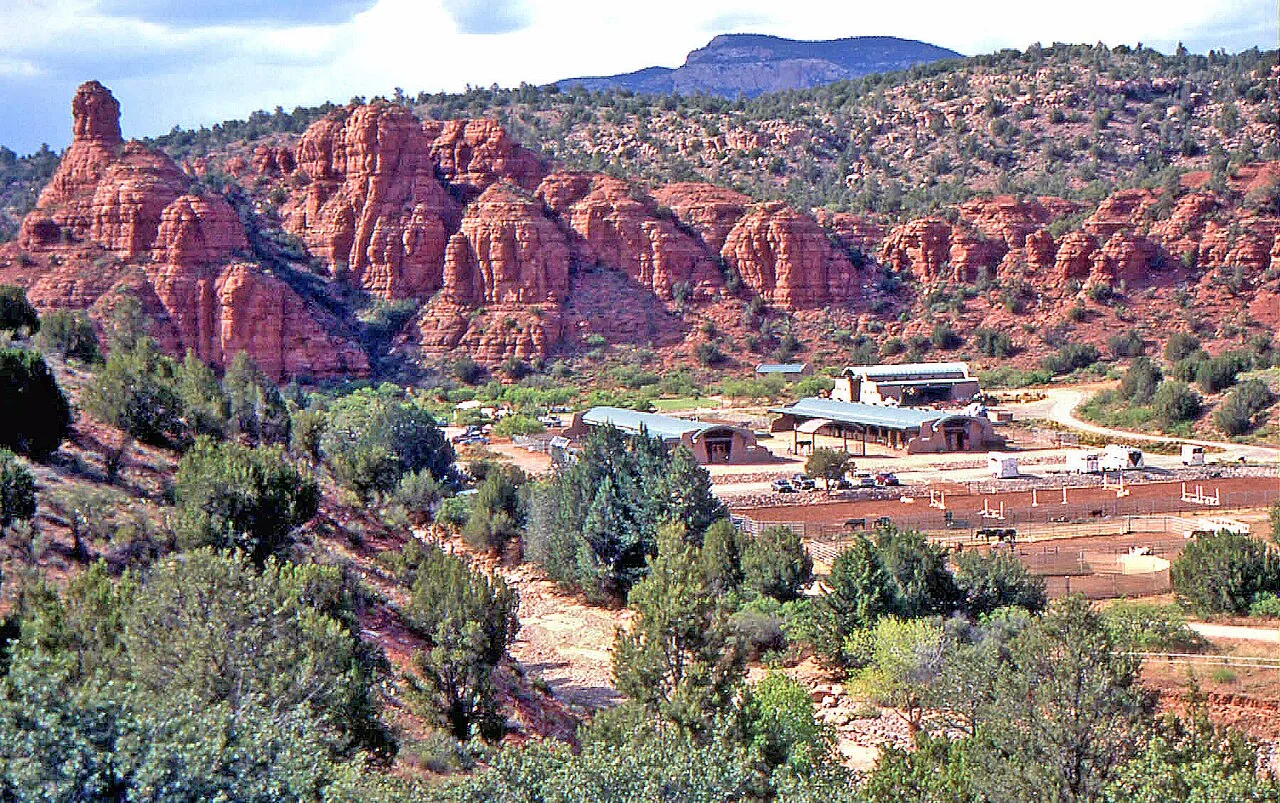
This stop is optional and vehicle-dependent, but it’s the closest thing Sedona has to a surviving film location with walls. From West Sedona, turn north on Dry Creek Road, drive about 2 miles, and turn right on Forest Road 152 — the same rough dirt road that leads toward the Devil’s Bridge area. FR 152 is genuinely rocky; high clearance is strongly recommended, and plenty of people park near the start and walk or bike in.
A short distance up FR 152 stands the Van Deren Cabin, a two-part log homestead. Earl Van Deren bought the property in 1924; the north half of the cabin came first, and he built the south half in 1930 after he married. The Forest Service later bought the small parcel around the cabin to preserve it as a historic landmark. A marker at the site credits the cabin with appearances in Riders of the Purple Sage and Blood on the Moon (1948) — the Robert Mitchum western that also used the Cathedral Rock country you saw at Stop 4. That claim rests on the local marker and area histories rather than studio records, so treat it as well-attested local history rather than gospel, and enjoy the cabin either way: a real 1920s homestead in the red rocks, weathered to exactly the look the set designers were always chasing.
The Dry Creek basin around you — Doe Mountain, Bear Mountain, the mouths of Boynton and Fay Canyons — is the same open ranch country that drew film crews west of town, and it remains the emptiest, most western-feeling landscape on this tour. Almost nothing out here has been built up since the studio era, which is exactly why it still reads as 1948 through a windshield. If you want to add a hike while you’re out here, the flat-topped Doe Mountain climb is short and the summit view covers the whole basin.
It’s worth pausing on why the filming stopped, because this basin is the answer in reverse. Sedona’s movie career ended not because the scenery failed but because the town grew into it — the western town set became a subdivision, power lines and rooftops crept into the wide shots, and by the 1970s directors needing an unspoiled frontier went elsewhere. Out on FR 152, you’re seeing what the location scouts saw. In Sedona West, you’re seeing what replaced it. The tour works because both are still there to compare.
Stop 7: Oak Creek Canyon — where it all began
Finish by driving north from Uptown on 89A into Oak Creek Canyon. Our Oak Creek Canyon drive guide covers the pullouts and picnic areas; the film history here predates everything else on this page.
In 1923, director Victor Fleming — who would go on to direct The Wizard of Oz and Gone with the Wind — brought a Paramount crew to Oak Creek Canyon to shoot The Call of the Canyon, a silent western from the Zane Grey novel, starring Richard Dix and Lois Wilson. Grey had set the novel here after visiting the canyon himself, and the production filmed near Mayhew’s Lodge, the creekside hotel whose ruins sit near the mouth of the West Fork. It was the first movie made in the Sedona area, and it showed the red rock country to a national audience for the first time.
The film itself was considered lost for most of a century. In 2010 a print surfaced in Gosfilmofond, the Russian state film archive, and a digital copy was presented to the Library of Congress — so the first Sedona movie survived after all.
How to see it today: park at the West Fork trailhead about 10 miles up the canyon — the Forest Service day-use area there is still named Call of the Canyon, which tells you exactly where you are in the story. The ruins of Mayhew’s Lodge stand near the start of the West Fork trail, and even the first half mile of that walk puts you inside the scenery Fleming shot. Arrive early; the lot fills by mid-morning most of the year.
Photography notes for a film-location day
A few practical pointers, with more in our Sedona photography guide:
- Red Rock Crossing works best in late afternoon and at sunset, when the low sun lights Cathedral Rock’s west face and the creek picks up the reflection. Midday is fine for documenting the location; golden hour is when it looks like the movies.
- Coffee Pot Rock is a morning subject. It faces roughly south-southwest, and early light models the spout without the haze that builds by afternoon.
- Bell Rock reads best from the north, along the pathway from Courthouse Vista, with Courthouse Butte stacked behind it — the same axis the establishing shots used.
- Schnebly Vista is a wide-angle spot. You’re shooting down into the Sedona bowl, so go early or late; midday flattens it.
- Shoot the street signs. Johnny Guitar Street against Coffee Pot Rock is the one photo on this tour nobody else in your feed will have.
A one-day film location itinerary
| Time | Stop | Notes |
|---|---|---|
| 9:00 AM | West Fork / Call of the Canyon | Beat the crowds; walk to the Mayhew’s Lodge ruins |
| 11:00 AM | Sedona Heritage Museum | Opens 11 AM; film exhibit + Telegraph Office |
| 12:30 PM | Schnebly Hill Road | High-clearance drive or skip to the viewpoint at the start |
| 2:00 PM | SR 179 corridor | Bell Rock pathway walk, Chapel area |
| 3:30 PM | Sedona West movie streets | Drive-through; Sugarloaf walk if legs allow |
| 5:00 PM | Red Rock Crossing | History, picnic, and stay for sunset |
Swap in the Van Deren Cabin for Schnebly Hill if your vehicle handles FR 152 but you’d rather skip the longer rough road. Either way you’ll cover a century of film history in under 40 driving miles — and if you’re coming from Phoenix, the whole tour starts just two hours from home.
Ending the day in West Sedona
The convenient thing about a film-location day is that it loops right back to where you’re staying. Sedona Pickler sits in West Sedona, minutes from the Sedona West movie streets, the Sugarloaf trailhead under Coffee Pot Rock, and the Dry Creek Road turnoff — three of the seven stops are practically in the neighborhood, and Red Rock Crossing is a 15-minute drive. Watch one of the westerns in the media lounge after dinner and you’ll recognize the skyline you spent the day driving through. And since the house’s regulation pickleball court is indoors, heated, air-conditioned, and lit, a full day chasing John Wayne’s Sedona still ends with a night match — no daylight required.
Frequently asked questions
How many movies were filmed in Sedona?
Can you still see any movie sets in Sedona?
What movies were filmed at Red Rock Crossing?
Where was John Wayne's western town in Sedona?
What was the first movie filmed in Sedona?
Do I need a 4x4 for this tour?
Is the Sedona Heritage Museum worth it for movie fans?
Stay where you can rally any season
Sedona Pickler is a private West Sedona vacation home with its own indoor, climate-controlled pickleball court — a short drive from the trailheads, viewpoints and restaurants in this Sedona guide. Play at sunrise or after dark, in any weather.
Check dates & book