
Most towns are named after a general, a railroad executive, or whatever the place looked like from a wagon seat. Sedona is named after a woman who cooked for strangers, ran a general store out of her front room, and never asked for the honor. The name itself isn’t Spanish, isn’t Navajo, isn’t Apache — it was invented from scratch in a Missouri farmhouse in 1877 by a mother who just liked the sound of it.
The whole story fits in a few pages, it’s all documented, and it’s better than most of the legends people invent about this place. Here it is.
A name made up in Missouri
On February 24, 1877, Amanda Miller of Gorin, Missouri gave birth to a daughter and named her Sedona Arabella Miller. Amanda’s other children carried ordinary names for the era — Minnie, Edward, Noah, Edna, John, Goldie — and then there was Sedona, a word that existed nowhere else. When people asked where it came from, Amanda’s answer never changed: she made it up because she thought it sounded pretty.
So when you hear that “Sedona” is an old Spanish word, or a Native American term for something poetic, you can politely set the record straight. The Sedona Heritage Museum is direct about it: the name is neither. It’s one mother’s invention, coined 25 years before it landed on a map and about 1,600 miles east of the red rocks.
The girl herself mostly went by “Dona.” She grew up in a strict Methodist household, studied at the local academy, learned languages and piano, and taught school briefly after graduating. Around age 20 she met Theodore Carlton Schnebly — T.C. to nearly everyone — a young man who ran a hardware store in town with his brothers. They married despite her parents’ objections, which were religious: the Millers were Methodist, and T.C. was a Presbyterian. That rift never fully healed, and it mattered later, because when the young couple decided to move west, they left with less family support than most pioneers could count on.
Why Oak Creek, of all places
The pull came from T.C.’s brother Ellsworth, who had moved to the Oak Creek country of the Arizona Territory on his doctor’s advice — the dry air was the standard prescription for lung trouble in that era. Ellsworth wrote home describing a valley with deep grass, clear air, and more game and fish than anyone could use. It worked. T.C. went out first, bought 80 acres of homesteaded land with an orchard from Frank Owenby along Oak Creek, and started farming.
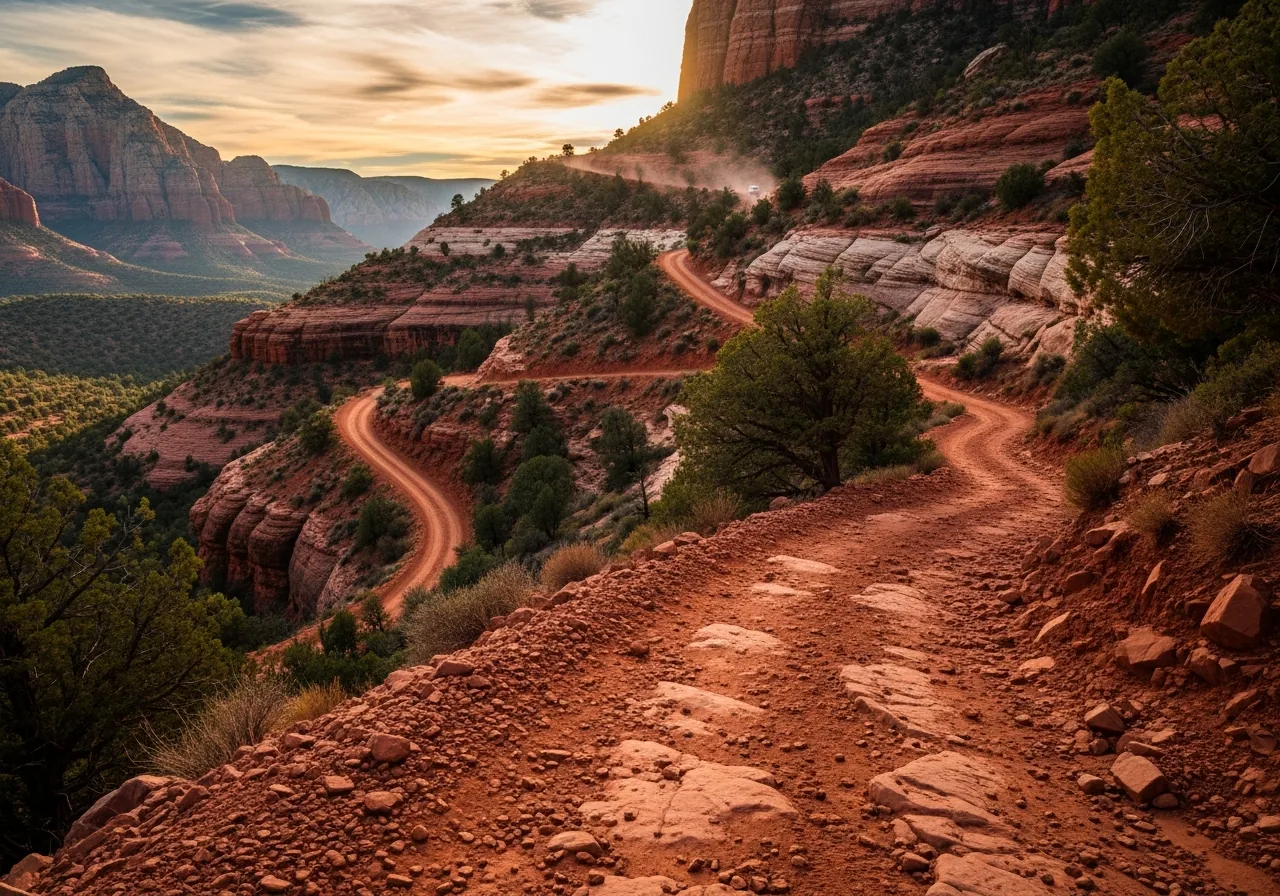
The commute for his produce tells you what the region was like then. T.C. hauled fruit and vegetables by wagon up to Flagstaff, sold them, and hauled goods back down. The route was so bad that the Schneblys eventually hired crews to blast and grade a better wagon road up the canyon wall to the plateau. That road still exists. It’s called Schnebly Hill Road, and today people drive it in rented Jeeps for the views, mostly without knowing they’re on a produce route from 1902.
In 1901, T.C. sent for his family. Sedona boarded a train with two small children and everything the family owned, bound for the mining boomtown of Jerome — the nearest rail stop of any consequence, clinging to the side of Cleopatra Hill across the Verde Valley. T.C. met them there, loaded the family and possessions onto a wagon, and drove them the last stretch to Oak Creek. They arrived at their new home on October 12, 1901.
The house that was a hotel, a store, and then a post office
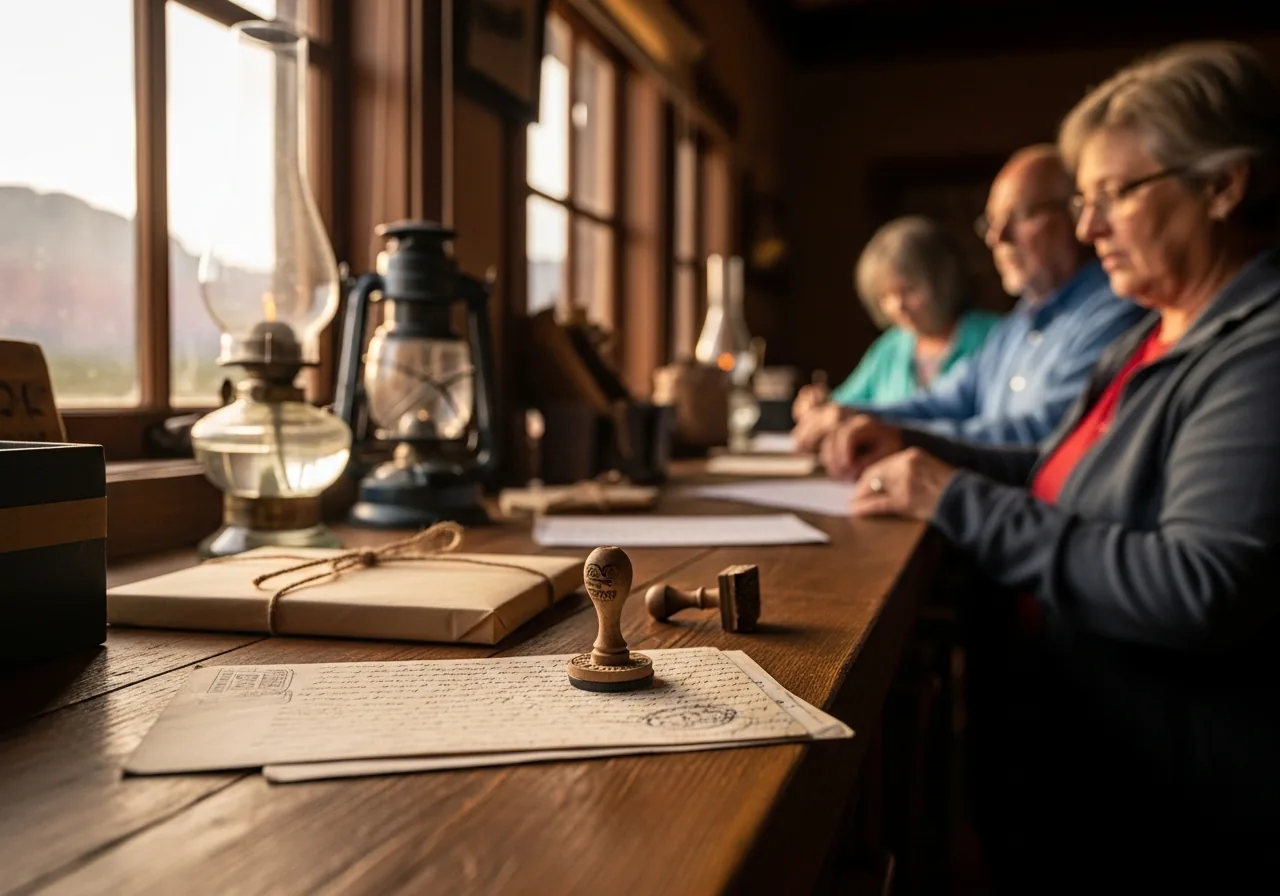
The Schneblys built a two-story house near the creek, which immediately became more than a house. It was the area’s first hotel and its general store, because at the turn of the century there were only about 15 homesteading families scattered through the region, and nobody else was offering either service. Guests paid no more than a dollar a day for room and board. Sedona did the cooking for everyone under the roof, raised her children, helped on the farm, made soap, and canned fruit and vegetables from the orchard.
It’s worth pausing on how small this world was. When the post office opened in 1902, the community counted roughly 55 residents. The social center of the extended canyon community wasn’t even here — it was a spot called Red Rock, the midpoint between Indian Gardens and the rest of the Verde Valley. What we now call Sedona was a handful of farms strung along a creek, connected to the outside world by one rough road and a lot of patience.
Mail was the problem. Without a post office, letters meant a long wagon trip. T.C. saw the need, wanted the job of postmaster, and wrote to the Postmaster General in Washington, D.C. to petition for a post office — to be housed in his hotel, with himself running it.
He needed a name for it.
Two rejections and a suggestion
T.C.’s first two proposals were the obvious ones: Schnebly Station and Oak Creek Crossing. Washington turned both down. The Postmaster General’s office at the time wanted short names — the Sedona Heritage Museum describes it as a preference for one-word names that would fit cleanly on a cancellation stamp, and two-word entries like “Oak Creek Crossing” didn’t make the cut.
That’s when Ellsworth — the brother whose letters had brought the family west in the first place — offered the line the whole town is built on: why don’t you name it after your wife?
T.C. submitted “Sedona.” On June 26, 1902, the name was approved, the post office opened in the Schnebly hotel, and a made-up word from a Missouri farmhouse became a place on the map of the Arizona Territory.
What happened to the Schneblys
The family’s story after 1902 is not all postcard material, and it’s worth knowing because it explains why the town’s founding family barely appears in it for 25 years.
In June 1905, the Schneblys’ five-year-old daughter Pearl was killed in a riding accident on the family land. They buried her in the front yard. Sedona fell into a deep depression, and the family left Arizona for Missouri hoping a return home would help her recover. They later farmed near Boyero, Colorado, where money was tight and T.C.’s health declined — until a doctor recommended Arizona for his lungs, the same prescription that had sent Ellsworth west decades earlier.
In 1930 they came back to the town that carried her name. There was nothing left of their old homestead. They rented a small one-room house on Jordan Road, and the founders of Sedona went to work for their neighbors: T.C. helped Walter Jordan in his orchards, and Sedona helped Ruth Jordan with cooking, cleaning, and three children. During the Depression she washed and ironed uniforms for the Civilian Conservation Corps boys at ten cents a shirt.
She spent her later years teaching Bible classes and quietly saving money to build a chapel. The Wayside Chapel off Highway 89A was completed in 1950 and dedicated to her. She died of cancer that same year, on November 13, 1950. T.C. outlived her by almost four years. Both are buried in Cooks Cedar Glade Cemetery off Airport Road, and Pearl’s remains were eventually moved there to rest beside them.
In 1994 the city unveiled a bronze statue of Sedona Schnebly by local sculptor Susan Kliewer in front of the Sedona Public Library on White Bear Road — the town’s first public art project. If you want to look the namesake in the eye, that’s where she stands.
Sedona then vs. Sedona now
The gap between the town Sedona Schnebly knew and the one you’ll visit is hard to overstate, so here are the plain numbers.
In 1902, Sedona was about 55 people, one store, one hotel, and a new post office, reachable by wagon road. The first telephone directory, in the mid-1950s, listed 155 names. Parts of the area didn’t have electricity until the 1960s. Hollywood found the red rocks early — film crews started shooting here in 1923, and Westerns kept coming for decades (that history has its own guide) — but the town itself stayed small, unincorporated, and split between two counties until it finally became a city in 1988. Sedona has been an incorporated city for less time than most of its visitors have been alive.
Today about 9,700 people live here and roughly 3 million visit each year. And yet the geography Sedona Schnebly knew is intact. Oak Creek still runs past the old homestead sites. The wagon road her family built still climbs to the rim. The town’s first industry — putting up travelers — is now its main one.
Where to touch the history in person
Reading the story is one thing; standing in it is better, and most of it is minutes from the house.
- The full history trail. Our Sedona history guide covers the whole arc — from the Sinagua people through the homestead era to the movie years — with the specific stops: the Sedona Heritage Museum (which sits on the old Jordan farmstead, where Sedona Schnebly worked in the 1930s), the Schnebly statue at the library, and the Wayside Chapel.
- Go further back than 1902. People were building here roughly 800 years before the first homesteaders arrived. The Sinagua cliff dwellings and rock art at Palatki and Honanki are a short drive from West Sedona and make the pioneer era look recent.
- See where the train stopped. Jerome, the copper boomtown where Sedona Schnebly stepped off the train in 1901, is now a hillside of galleries, saloons, and mining ruins about 45 minutes away — one of the best half-day trips from Sedona.
- Drive the family road. Schnebly Hill Road is rough past the first mile and best in a high-clearance vehicle or on a Jeep tour, but you’ll be driving the actual route the Schneblys built to get their fruit to Flagstaff.
- Follow the creek. The Oak Creek Canyon drive traces the water that made settlement possible here in the first place — the orchards, the swimming holes, the whole reason 15 families were living in this valley by 1900.
It’s a good story to carry around town. The next time someone at the trailhead tells you “Sedona” is an ancient word for red earth, you’ll know better: it’s a mother in Missouri, a dollar-a-day hotel, two rejected postmarks, and a brother-in-law with a good idea.
Frequently asked questions
Who is Sedona, Arizona named after?
Sedona is named after Sedona Arabella Miller Schnebly (1877–1950), an early pioneer who settled along Oak Creek with her husband T.C. Schnebly in 1901. When T.C. applied to open the area’s first post office in 1902, he named it after his wife, and the post office name became the town’s name.
What does the name Sedona mean?
Nothing — and that’s the real answer. It isn’t Spanish or Native American. Sedona Schnebly’s mother, Amanda Miller, invented the name for her daughter in 1877 and said she made it up because it sounded pretty.
What names were rejected before Sedona was chosen?
T.C. Schnebly first proposed Schnebly Station and Oak Creek Crossing. The Postmaster General’s office rejected both — accounts from the Sedona Heritage Museum say the office favored short, one-word names that fit a cancellation stamp. His brother Ellsworth suggested using his wife’s first name instead, and “Sedona” was approved on June 26, 1902.
When did Sedona become a city?
Much later than most people guess. The community dates to 1902, but Sedona remained unincorporated — split between Coconino and Yavapai counties — until it incorporated as a city in 1988.
Where can I see the Sedona Schnebly statue?
The bronze statue by sculptor Susan Kliewer stands in front of the Sedona Public Library on White Bear Road in West Sedona. It was unveiled in 1994 as the city’s first public art project. The Sedona Heritage Museum in Uptown covers the rest of the family’s story.
How big was Sedona in 1902 compared to today?
When the post office opened in 1902, about 55 people lived in the area. The 2020 census counted 9,684 residents, and the city hosts roughly 3 million visitors a year.
Play year-round in red rock country
Sedona Pickler is a private Sedona home with its own indoor, climate-controlled pickleball court. Rally any season, any hour — heated, cooled and lit, with paddles and balls provided.
Check dates & book


