Stargazing in Sedona: A Dark-Sky Guide
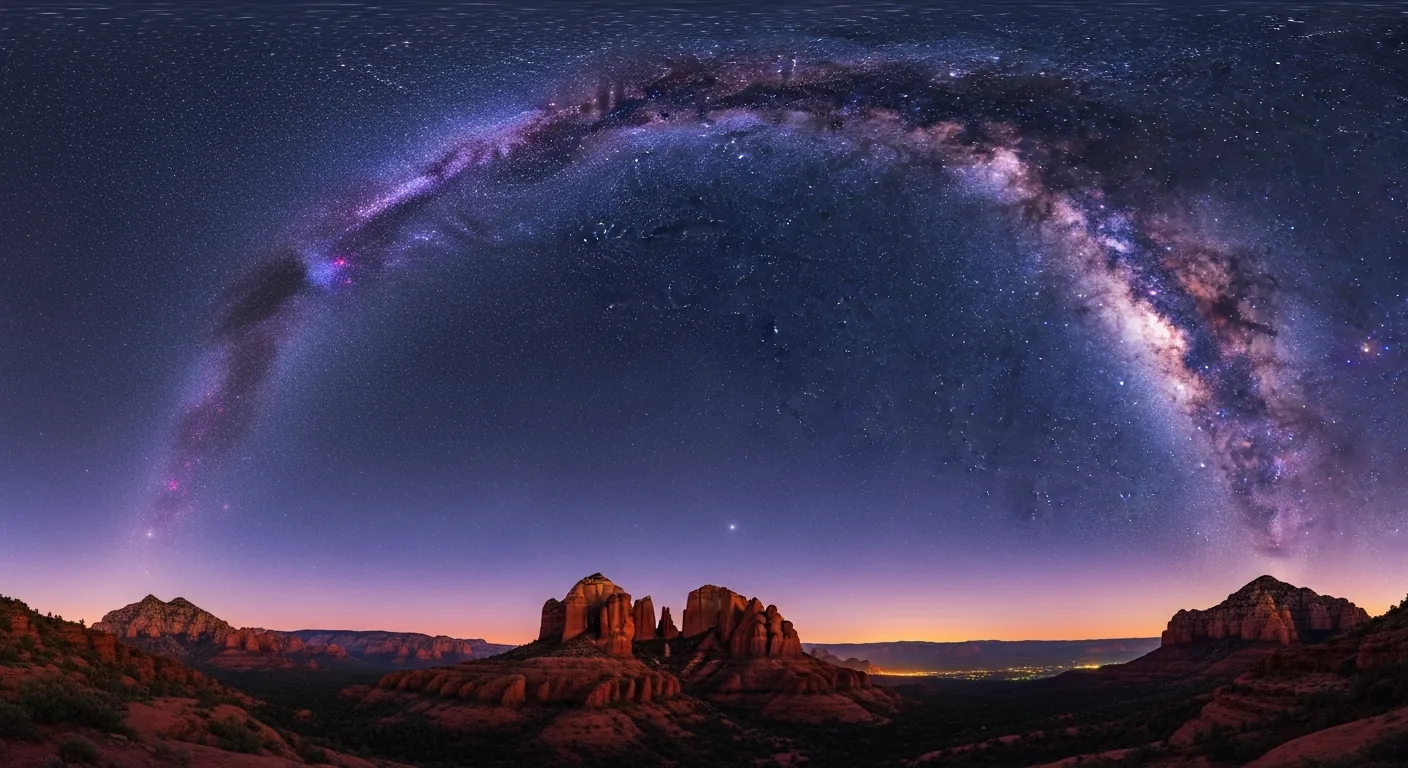
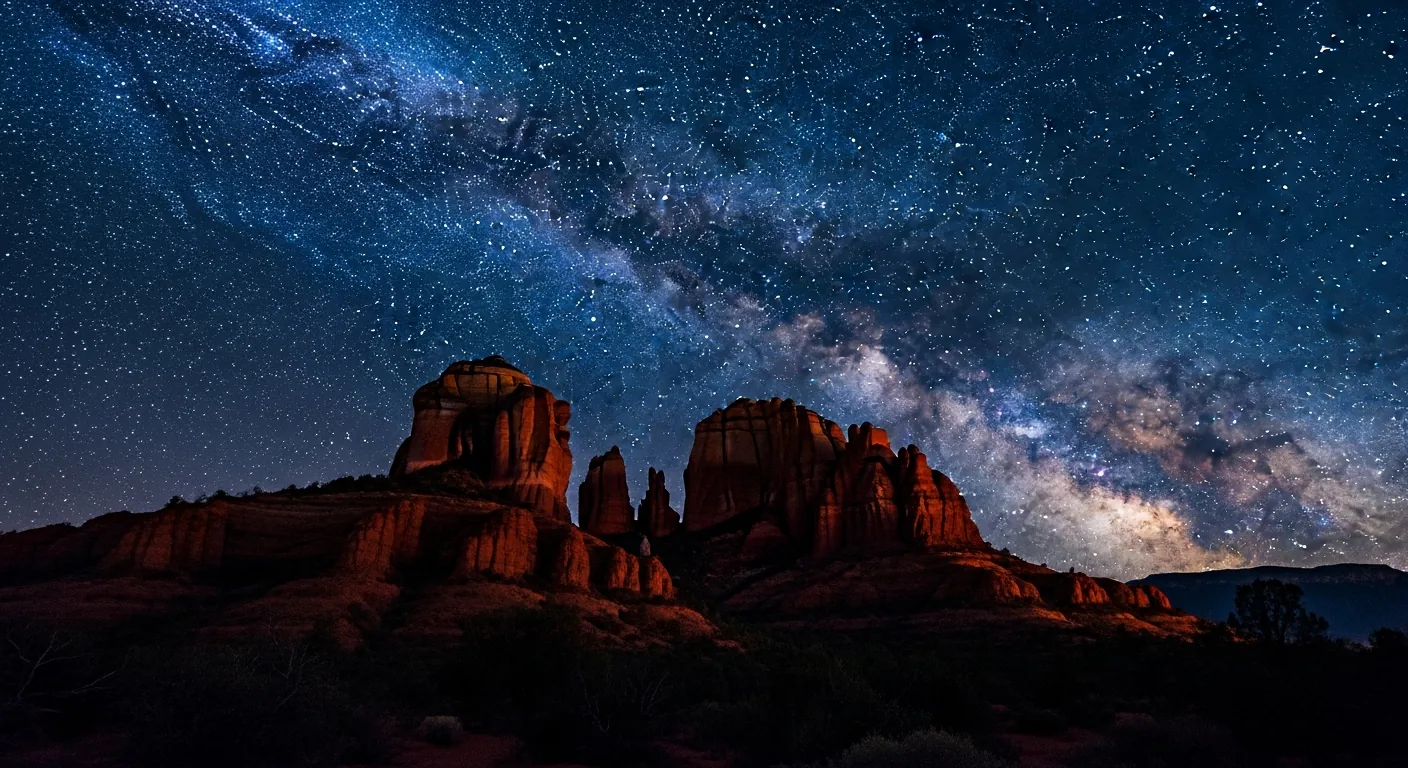
Most people come to Sedona for the red rocks and forget that the show keeps going after sunset. On a clear, moonless night out here, the Milky Way doesn’t just appear — it sprawls across the sky like spilled sugar, bright enough to throw a faint shadow. Sedona is a certified International Dark Sky Community, which means the darkness overhead isn’t an accident; the town fought for it and writes it into law, and you get to reap the reward with nothing but your own two eyes.
Why Sedona’s Night Sky Is So Good
Sedona earned its designation as an International Dark Sky Community from DarkSky International (then the International Dark-Sky Association) in 2014 — the eighth community in the world to get it. That’s not a marketing slogan. It’s the result of a strict outdoor lighting ordinance the city first put on the books back in 2001, which requires that exterior lights be fully shielded so they point down at the ground instead of leaking up into the sky, and that they use warm color temperatures that cause less sky glow. The town has even gone a step further than most dark-sky communities, adopting rules that require existing non-compliant properties to retrofit their lighting to be dark-sky compliant.
What this means for you, the visitor, is simple: you don’t have to drive two hours into the middle of nowhere to see a sky full of stars. Sedona itself stays dark. Combine that with high desert elevation (the town sits around 4,350 feet), low humidity, and close to 300 clear days a year, and the conditions are about as good as you’ll find anywhere accessible by paved road in the Southwest.
On a genuinely dark night here you can expect to see:
- The Milky Way’s core, the bright bulge near the constellation Sagittarius, when it’s in season (more on timing below)
- Thousands of individual stars instead of the few dozen you’d get from a city
- Planets like Venus, Jupiter, and Saturn when they’re up, often bright enough to spot before full darkness
- Major constellations, the occasional satellite tracking overhead, and shooting stars on any given night
- Meteor showers during peak nights like the Perseids in August and the Geminids in December
A Quick, Honest Reality Check
Stargazing is free, low-effort, and genuinely spectacular here — but it isn’t foolproof. The single biggest variable is the moon. A bright full moon washes out the faint stuff (especially the Milky Way) almost as effectively as city lights would, so the calendar matters more than the location. The second variable is your own eyes: it takes a full 20 to 30 minutes in the dark for your night vision to fully kick in, and one glance at a phone screen resets the clock. Plan to be patient.
The other honest note is comfort. Desert nights get cold fast, even after a hot day, and the good viewing happens late, after the sky is fully dark. You’ll be sitting still for a while. Dress like it’s two seasons later than the afternoon felt, and you’ll have a far better time.
When to Go: Season, Moon, and Time of Night
Milky Way Season
If your main goal is to see the bright core of the Milky Way arcing overhead, aim for roughly April through October. The galactic core climbs highest and stays up longest in the summer months — late May through August is the sweet spot. In April it appears low and late in the night; by September and October it shows up earlier in the evening but sinks quickly, so your window shortens.
Outside of those months you can still have a fantastic night of stargazing — winter skies bring crisp, steady air and famous constellations like Orion — you just won’t get the dramatic core of the galaxy. Winter’s tradeoff is colder temperatures and the chance of a closed road or two at higher elevations.
Plan Around the New Moon
This is the tip that separates a good night from a forgettable one. The darkest skies come around the new moon, when the moon isn’t in the sky at all. A good rule of thumb is to target the window from a few days before to a few days after the new moon, or any night when the moon sets early or rises late. Check a moon-phase calendar before you commit to a date. If you’re locked into a trip during a bright moon, don’t despair — just go earlier (before moonrise) or later (after moonset), and lean on bright planets and constellations rather than the Milky Way.
Best Time of Night
Full darkness — what astronomers call astronomical twilight ending — typically lands somewhere around 1.5 to 2 hours after sunset, depending on the season. That’s when to be in position. Many of the best Milky Way views come later still, well after 10 p.m. in summer, once the core has climbed higher. Star tours are timed around this, which is one quiet argument for letting a guide handle the logistics.
| Month range | Milky Way core | Best viewing window | Notes |
|---|---|---|---|
| Nov–Mar | Not visible / very low | After full dark, early evening fine | Coldest; great constellations, steady air |
| April | Visible, low and late | Pre-dawn hours | Core just returning; plan around new moon |
| May–Aug | High and bright | ~10 p.m. onward | Peak season; warmest, most comfortable nights |
| Sep–Oct | Visible, sinks early | Soon after dark | Shortening window; pleasant temperatures |
Where to Go: Best Stargazing Spots
You have two broad choices: stay close to town at an easy-access spot, or drive out a bit for darker, more remote skies. Here are the reliable options, from easiest to most involved.
Airport Mesa
The Airport Mesa overlook is the most convenient dark-ish vantage point in Sedona — you can drive most of the way up Airport Road and park near the top. It’s elevated, with big open views, and it’s a five-minute drive from West Sedona. The catch is that it’s also the town’s most popular sunset spot, so it’s busy in the early evening; the crowds usually thin out once the sky goes fully dark. There’s a paved parking lot at the top (a Red Rock Pass is required to park there) and a smaller pullout partway up that fills early. It’s a great low-commitment option if you just want to step outside and look up.
Two Trees Observation Area
Out on the West Sedona plateau, the Two Trees area is an open field with low vegetation and a wide view toward the Mogollon Rim, well away from the brighter parts of town. It’s dark and open enough that Sedona’s local astronomy clubs — the Sirius Lookers and the Astronomers of Verde Valley — use it as a regular meeting spot, which is about the best endorsement a stargazing site can get. If a public star party is happening, this is often where you’ll find it.
Baldwin Trail / Red Rock Crossing
The Baldwin Trail is a roughly 1.6-mile loop near Red Rock Crossing, and it delivers one of the most photographed night scenes in Sedona: the stars wheeling around the dark silhouette of Cathedral Rock. It’s a genuinely beautiful foreground, which is why astrophotographers love it.
A few logistics worth knowing. The famous Crescent Moon Picnic Site (also called Red Rock Crossing) charges its own day-use fee — around $8 per vehicle as of recent posting, and the Red Rock Pass is not valid there. More importantly for stargazers, that picnic site closes in the evening (8 a.m. to 8 p.m. in summer, 8 a.m. to dusk the rest of the year), so it’s not where you set up after dark. The Baldwin Trailhead on the other side of the creek is the access point night-sky shooters generally use; it requires a Red Rock Pass to park. If you go, scout the trail in daylight first so you’re not navigating uneven ground in the dark.
Schnebly Hill Road / Merry-Go-Round Rock
For darker, more remote skies, Schnebly Hill Road climbs up into the high country east of town. Merry-Go-Round Rock sits along this road and offers a dramatic, open horizon far from any lights. Be warned: Schnebly Hill Road is a rough, rocky, high-clearance dirt road — it is genuinely hard on a normal passenger car, and you do not want to be feeling your way down it in the dark in a low rental sedan. If you have a capable high-clearance or four-wheel-drive vehicle and you’ve driven the road in daylight, the reward is some of the best naked-eye darkness near town. If not, skip it or book a guided tour or jeep tour instead. (For the daytime scenic version of this drive, see the Schnebly Hill Road guide.)
| Spot | Drive from West Sedona | Vehicle needed | Pass / fee | Best for |
|---|---|---|---|---|
| Airport Mesa | ~5 min | Any | Red Rock Pass to park | Easy access, quick look |
| Two Trees | ~10 min | Any | None typical for roadside | Open sky, astronomy clubs |
| Baldwin Trail / Red Rock Crossing | ~15 min | Any | Red Rock Pass (Baldwin TH) | Cathedral Rock foreground, photos |
| Schnebly Hill / Merry-Go-Round | 20+ min on rough road | High-clearance / 4WD | Red Rock Pass | Darkest remote skies |
Local tip: You don’t necessarily need to go anywhere at all. Because the whole town is dark-sky compliant, a spot with an open view away from a few nearby porch lights — a quiet trailhead pullout, a dark backyard, or an open patio — can deliver a genuinely good Milky Way night. If you’re staying somewhere with a private outdoor space and a clear patch of sky, give your eyes half an hour to adjust before you decide you need to drive anywhere. (And if the night turns cold, it’s an easy walk back inside to warm up — at our place that means trading the stars for a late rally on the indoor court.)
Passes and Fees
Most of Sedona’s trailheads and overlooks sit on Coconino National Forest land, and parking at a developed trailhead or recreation site requires a Red Rock Pass. As of recent posting, the day pass runs about $5, a weekly pass about $15, and a grand annual pass about $40. You can buy them at visitor centers, many local shops, and self-serve kiosks at the larger trailheads.
A few things to keep straight:
- The Red Rock Pass covers most Forest Service trailheads, including the Baldwin Trailhead and the Airport Mesa lot.
- It does not cover Crescent Moon Picnic Site / Red Rock Crossing, which charges its own separate day-use fee.
- A federal America the Beautiful interagency pass (the $80 national-parks-and-federal-lands pass) is accepted in place of a Red Rock Pass at most Forest Service sites — if you already own one, display it instead.
- Prices and rules change. Confirm current fees on the Coconino National Forest website or at a visitor center before you go.
If you’re parking roadside at an undeveloped pullout rather than in a developed lot, a pass often isn’t required — but signage varies and enforcement is real, so when in doubt, buy the day pass. It’s cheap insurance.
Guided Star Tours
If you’d rather have a professional point a serious telescope at the sky and tell you what you’re looking at, Sedona has well-established, long-running tour companies that do exactly that. Both of the main operators run at a dark-sky observing site out in the Village of Oak Creek / Big Park area, roughly a 20-minute drive south of central Sedona, and both use the local dark skies rather than fighting them.
- Evening Sky Tours — A family-friendly outfit (geared to ages 6 and up) that shows guests a half-dozen or more celestial objects through powerful telescopes — galaxies, star clusters, nebulae, planets, and the Milky Way when it’s visible — over a session that runs around an hour and a half. They operate year-round.
- Sedona Stargazing Tours — One of the longest-running operators in town, established in 2002, with professional astronomers, custom-built telescopes, and laser pointers used to trace constellations across the sky. They cap their groups small (a handful of guests per telescope) for a more personal experience.
A guided tour is worth considering if you want to actually see the rings of Saturn or the bands of Jupiter (which you won’t with the naked eye), if you’re traveling with kids, or if you simply don’t want to deal with passes, rough roads, and night driving. Tours run on a schedule timed to darkness and the moon, fill up in peak season, and are weather-dependent. Prices and availability change seasonally, so book ahead and confirm directly with the operator. I’m deliberately not quoting exact prices here because they move — check the company’s own site for current rates and the next available clear night.
What to Bring
You can stargaze with literally nothing but your eyes, but a little gear makes a long, cold night much more pleasant.
- Warm layers. This is the one people regret skipping. Even summer desert nights cool off sharply once the sun is down, and you’ll be sitting still. Bring more than you think you need — a jacket, long pants, maybe a hat. In winter, full cold-weather gear.
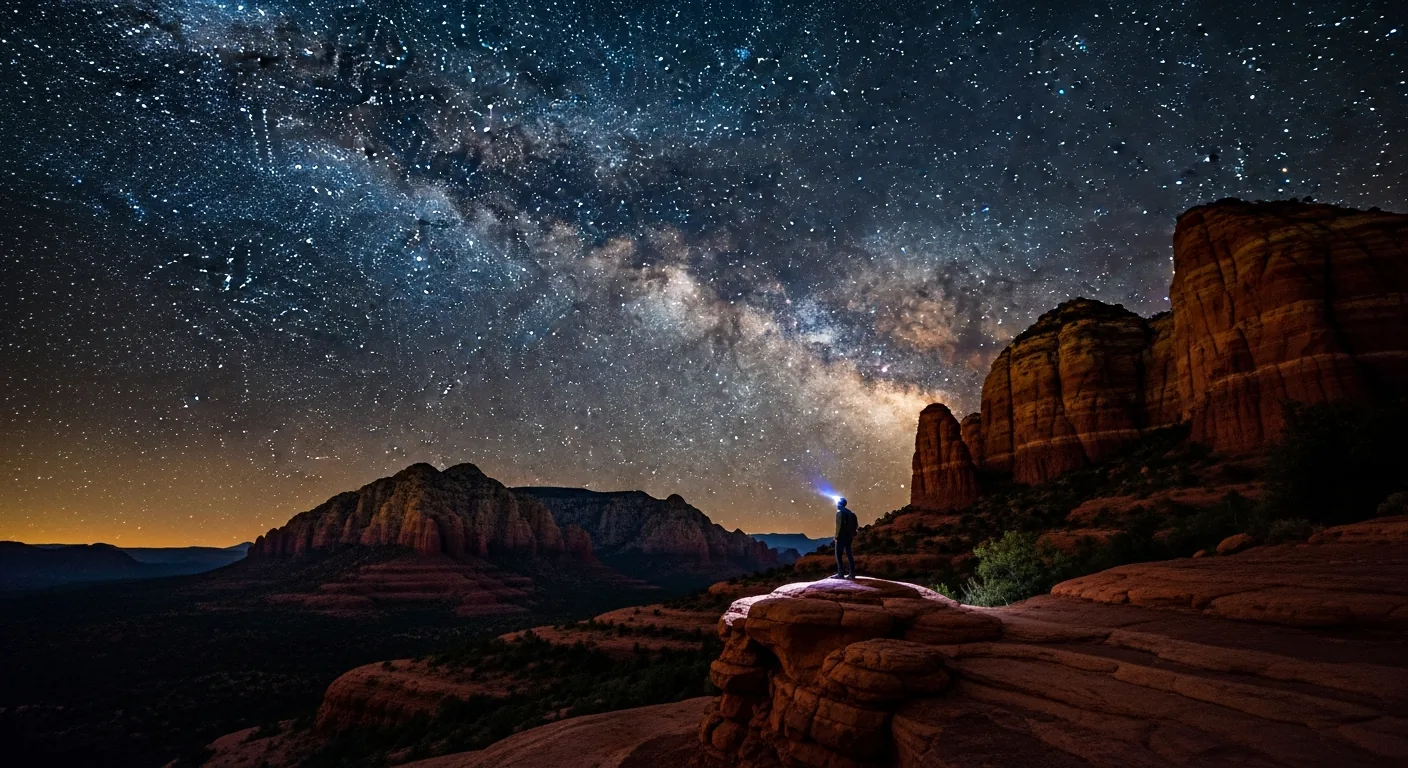
- A red flashlight (or red mode on your headlamp). White light destroys your night vision instantly and wrecks it for everyone near you. Red light lets you see your feet and your gear without resetting your eyes. Many headlamps have a red setting; if not, a piece of red cellophane over a regular light works.
- A blanket or low chair. Looking straight up gets uncomfortable fast. A reclining camp chair or a blanket to lie on saves your neck.
- Water and a snack. Even at night, the desert is dry.
- A planetarium app. Apps like SkyView or Stellarium will identify what you’re looking at and tell you where the planets and Milky Way are. Set the screen to its dimmest red/night mode.
- Binoculars. Underrated for stargazing. A decent pair reveals the moons of Jupiter, star clusters, and far more stars in the Milky Way than the naked eye.
- Sturdy, closed shoes. Trail surfaces are uneven and there’s wildlife. No flip-flops.
Astrophotography Basics
You don’t need a thousand-dollar setup to come home with a Milky Way shot — many recent phones can do a surprisingly good job in night mode if you keep them still. But a few fundamentals apply whether you’re shooting on a phone or a full camera:
- Use a tripod. Long night exposures demand a steady camera. Even a small tabletop tripod or a phone clamp on a rock beats handheld.
- Shoot during the new moon, away from any light. The Baldwin Trail with Cathedral Rock as a foreground, or any spot with an interesting dark silhouette against the sky, makes a far stronger image than a plain sky.
- Manual settings (for a real camera): a wide-open aperture (low f-number), a high ISO (start around 3200 and adjust), and an exposure of roughly 15–25 seconds. Longer than that and the stars start to streak as the Earth rotates.
- Focus manually on a bright star or distant light. Autofocus fails in the dark.
- Give yourself time. Composition in the dark is slow. Scout your foreground in daylight if you can.
- Be courteous. Keep your screen dim and red, and don’t light-paint other people’s foregrounds.
If serious night photography is your thing, also peek at the photography spots guide for daytime compositions you can scout and then return to after dark.
Accessibility
Stargazing is one of the more accessible activities in Sedona because the best version of it doesn’t require a hike. The Airport Mesa upper lot is paved and reachable by car, and you can take in a huge swath of sky from at or near the parking area without walking far. Two Trees and roadside pullouts on the West Sedona plateau also let you stay close to your vehicle.
The guided tours generally operate from a fixed observing site with telescopes brought to you, which can be a good fit for travelers who can’t manage uneven trails — confirm specifics with the operator when you book. Avoid Schnebly Hill and any trailhead requiring a night hike if mobility is a concern; the ground is rough and unlit.
How to Avoid Crowds
Stargazing is naturally less crowded than daytime hiking simply because most visitors are at dinner. Still, a few moves help:
- Skip Airport Mesa at sunset if peace is your goal — it’s the busiest spot in town at golden hour. Arrive after full dark and the crowd will have largely cleared out for the truly dark part of the night.
- Go on a weeknight rather than a weekend if you can.
- Aim for the new-moon window — ironically the best nights for darkness aren’t the most crowded, because casual visitors don’t track the moon.
- Have a backup spot. If a pullout is full, move on; there’s plenty of open sky to go around.
Safety
A dark sky means a dark ground. Take it seriously:
- Scout in daylight. Know where you’re parking and walking before the sun goes down.
- Watch your footing. Uneven rock and loose sand are everywhere. This is where a red light and closed shoes earn their keep.
- Mind the wildlife. Rattlesnakes are most active in warm weather and can be out at dusk and into the night; javelina and coyotes are around too. Stay on solid ground, don’t reach into rock crevices, and keep food sealed.
- Don’t drive rough roads in the dark. Schnebly Hill especially. If your vehicle isn’t suited to it, don’t attempt it at night.
- Tell someone your plan, and don’t rely on cell signal — coverage drops off quickly outside town.
- Drive carefully on the way home. Wildlife crosses roads at night, and Sedona’s dark roads can be disorienting.
What to Pair It With
The beauty of stargazing is that it’s the perfect end to a full day, since it happens after everything else closes. Spend your day on the rocks and your night under the stars:
- Catch the day’s last light at a sunset spot first, then stay put as the sky darkens — the transition from alpenglow to stars is a show in itself.
- Pair a Cathedral Rock area daytime visit (Cathedral Rock is one of Sedona’s signature hikes) with a return to nearby Red Rock Crossing / Baldwin Trail after dark.
- If you’re chasing energy as well as photons, several of the vortex sites double as quiet, open-sky spots once the crowds leave.
However you do it, the formula is the same: pick a dark night near the new moon, dress warm, give your eyes time to adjust, and look up. Sedona makes the rest easy. When you’re ready to plan a place to come back to and warm up after a cold night under the stars, you can book the house.
Frequently asked questions
Do I need to leave town to see the Milky Way in Sedona?
When is the best time of year to stargaze in Sedona?
Why does the moon phase matter so much?
Do I need a pass to stargaze at Sedona trailheads?
Are there guided stargazing tours in Sedona?
What should I bring stargazing?
Stay where you can rally any season
Sedona Pickler is a private West Sedona vacation home with its own indoor, climate-controlled pickleball court — a short drive from the trailheads, viewpoints and restaurants in this Sedona guide. Play at sunrise or after dark, in any weather.
Check availability on Airbnb