Phoenix to Sedona is about 116 miles and right around two hours if you drive it straight through. That is the whole problem with the drive: it is short enough that most people treat it as a commute, put their head down on I-17, and pull into Sedona having seen nothing but truck lanes and their own dashboard. Which is a waste, because this particular stretch of interstate has more worth stopping for than almost any two-hour drive in Arizona — a pie institution that has been feeding travelers since 1918, a rest area people genuinely rate as a destination, an experimental desert city, a five-story cliff dwelling, a spring-fed sinkhole, and one of the larger petroglyph sites in the Verde Valley. All of it sits within a few minutes of the highway.
You should not stop at all of them. Do that and your two-hour drive becomes a seven-hour day. The better approach: know what each stop actually is, pick the two or three that fit your crew, and skip the rest without guilt. Here is everything worth pulling over for, in order heading north, plus the one decision that matters most — how you drive the final stretch into town.
Rock Springs Cafe — Exit 242, Black Canyon City
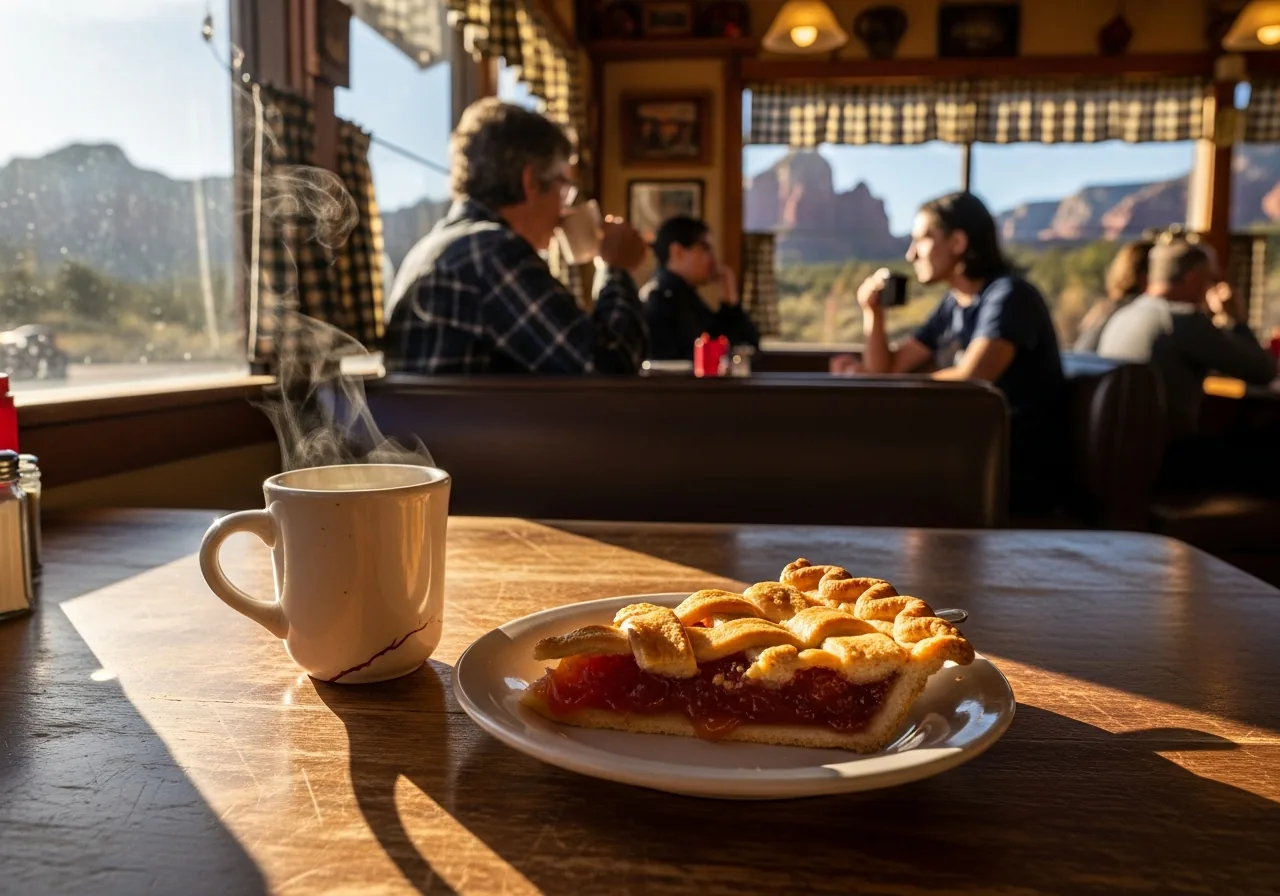
About 45 minutes out of central Phoenix, Rock Springs Cafe is the first stop and the easiest call on this list. It has operated at Black Canyon City since 1918, back when this was a stage stop on the old Black Canyon Highway, and it survives on one thing: pie. The bakery turns out around 21 varieties — cream, fruit, and specialty pies — and on holiday weekends the line tells you everything about its reputation. Locals drive up from Phoenix just for this, with no intention of continuing to Sedona.
The move depends on your timing. If you left Phoenix early, stop for breakfast — the cafe opens at 7 AM daily and does a full menu, not just dessert. If it is mid-morning, get a slice, or better, buy a whole pie to go. A boxed pie rides fine for two hours, and showing up to a vacation rental with a Rock Springs pie is a strong opening move for any group trip. Hours run 7 AM to 8 PM daily, but confirm before building a meal stop around them.
One practical note: Exit 242 is also a sensible fuel stop. Gas gets sparser and pricier as you climb, so if the tank is below half, deal with it here.
Sunset Point Rest Area — milepost 252
Ten miles past Black Canyon City, I-17 climbs hard out of the desert floor, and at milepost 252 you hit Sunset Point — a rest area with bidirectional access that is worth a stop even if nobody in the car needs one. It sits on the edge of a long drop with a sweeping view west over the Bradshaw Mountains, and ADOT put $7.5 million into renovating it in 2023: rebuilt restrooms, new ramadas, better sidewalks and lighting. It has since been ranked among the best public rest stops in the country, which sounds like a joke until you have stood at the overlook.
This is a ten-minute stop, not an hour. Walk to the railing, take the photo, let the dog use the pet area, and get back on the road. If you skipped Rock Springs to make time, Sunset Point lets you stretch without losing more than a few minutes. Over a million people a year stop here, and on a clear evening heading southbound the name earns itself.
Arcosanti — Exit 263, Cordes Junction
Just past Cordes Junction, a small sign points to Arcosanti, the experimental town architect Paolo Soleri began building in 1970 to test his idea of “arcology” — architecture and ecology as one system, a dense car-free town instead of sprawl. Fifty-plus years on, it is still under construction, still lived in by a small community, and still casting the bronze wind bells that fund the project. The buildings — cast-concrete vaults and apses facing the high desert — look like nothing else in Arizona.
Here is the honest read: Arcosanti is worth it, but only if the logistics line up. The site sits about three miles down a dirt road from Exit 263 (fine in a sedan, just washboarded in spots), and the way to see it is a one-hour guided tour — you cannot really wander on your own. As of this writing the visitor center runs Thursday through Sunday, 9 AM to 5 PM, with tours at 9:30, 11:00, and 2:00; reservations are recommended because tours fill. Check arcosanti.org before you commit, because if you roll up on a Tuesday you will see a locked gallery and a nice view. If a tour time works, it is one of the strangest, most memorable hours you can add to this drive. If not, skip it and save it for the drive home.
Montezuma Castle — Exit 289, Camp Verde
This is the headliner. Two miles off Exit 289, Montezuma Castle National Monument protects a five-story, 20-room dwelling built by the Sinagua people into a limestone cliff about 900 years ago — one of the best-preserved cliff dwellings in North America, and it has nothing to do with Montezuma. Early settlers guessed wrong on the name and it stuck.
What makes it perfect for a road trip is the effort-to-payoff ratio. From the parking lot, a flat, paved third-of-a-mile loop takes you under the cliff face with full views of the structure, shaded by big Arizona sycamores along Beaver Creek. You cannot climb into the dwelling — that ended in 1951 to protect it — but you do not need to. Thirty to forty-five minutes covers it, including the small visitor center. The monument is open daily 9 AM to 4:45 PM; admission is $10 for adults 16 and older, free for kids 15 and under, and the same ticket covers Tuzigoot National Monument near Cottonwood for a week (confirm current fees at nps.gov). If you make exactly one stop on this drive with kids in the car, make it this one. We wrote a full guide at /things-to-do/montezuma-castle/.
Montezuma Well — Exit 293
Six road minutes north of the Castle exit, most people blow past Exit 293 and miss the quieter half of the monument. Montezuma Well is a detached unit of Montezuma Castle — a huge limestone sinkhole fed by underground springs that keep it full year-round, with cliff dwellings tucked into the rim and the remains of irrigation ditches the Sinagua dug to farm with its outflow a thousand years ago. Descendant communities still consider it a sacred place, and it feels like one.
Two things make the Well an easy add. First, it is free — no entrance fee, unlike the Castle. Second, it is genuinely uncrowded; on a weekday you might share the rim trail with a handful of people. The trade-off: it sits four miles off the interstate, and the walk includes a short but real set of stairs down toward the water. Count on 30–45 minutes. Castle plus Well make a tidy 90-minute history block — but if you only have time for one, the Castle is the more dramatic sight.
Crane Petroglyph Heritage Site (V-Bar-V) — Exit 298, then 2.8 miles
The last stop before Sedona is the one that takes actual planning. The Crane Petroglyph Heritage Site — long known as V-Bar-V, after the ranch brand — protects more than 1,000 petroglyphs across 13 panels of sandstone, the largest known petroglyph site in the Verde Valley. Some panels appear to track the seasons; docents from Friends of the Forest are usually on hand to point out what you would otherwise walk right past. It sits 2.8 miles southeast of I-17 Exit 298 on Forest Road 618, a short paved detour in the opposite direction from Sedona.
The catch is access. The site is only open Friday through Monday, 9:30 AM to 3 PM — and in summer (late June through August) hours shift earlier, roughly 9 AM to 2 PM. It is closed Tuesday through Thursday, no exceptions. You will also need a Red Rock Pass, $5 per vehicle per day from the machine on site. Check the Coconino National Forest page at fs.usda.gov for current days and hours before you route around it. The walk from the parking area is a flat half-mile or so each way. If your drive lands on an open day, this is the sleeper hit of the whole list — a thousand years of rock art, twenty minutes from your check-in.
The arrival: SR-179 or the long way down 89A
Every stop above is optional. This decision is not, because you have two ways to cover the last leg into Sedona, and they end the drive very differently.
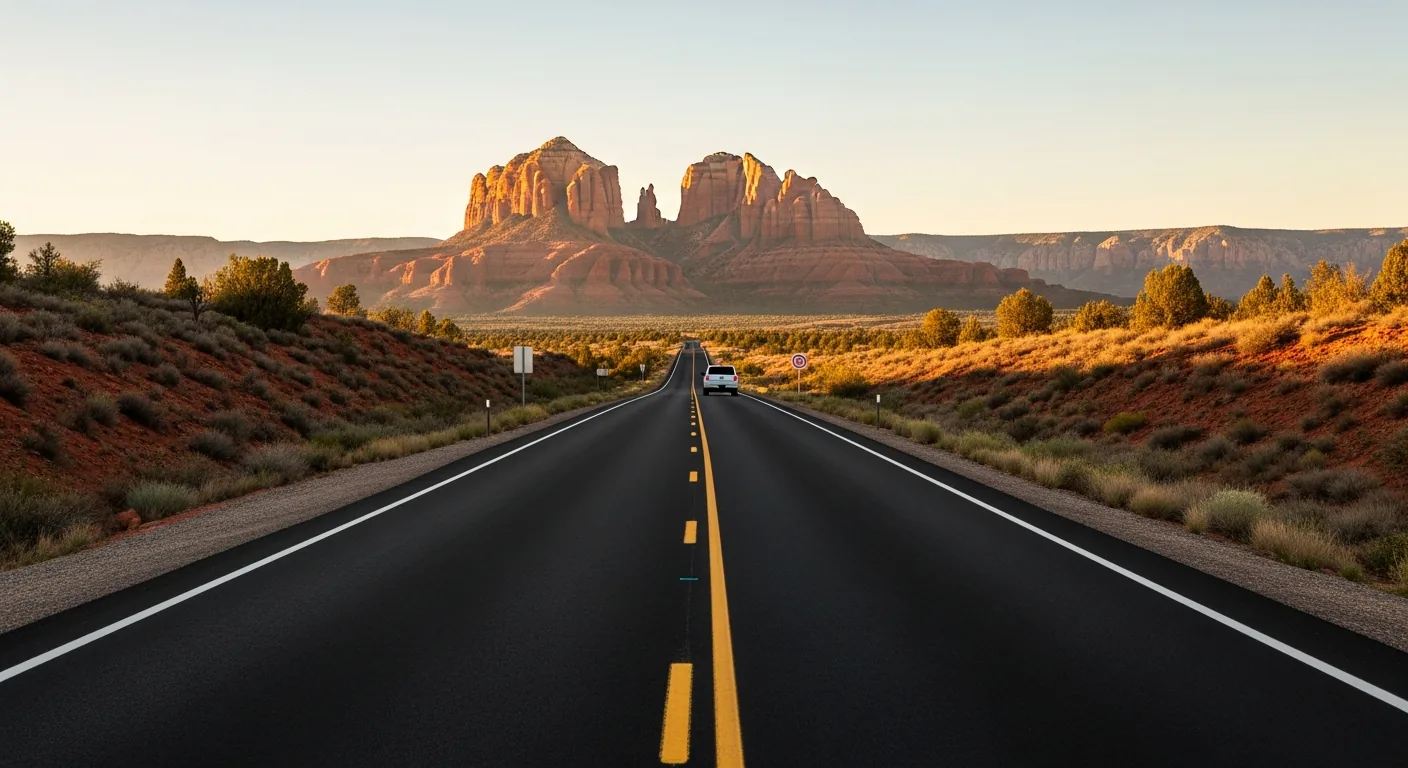
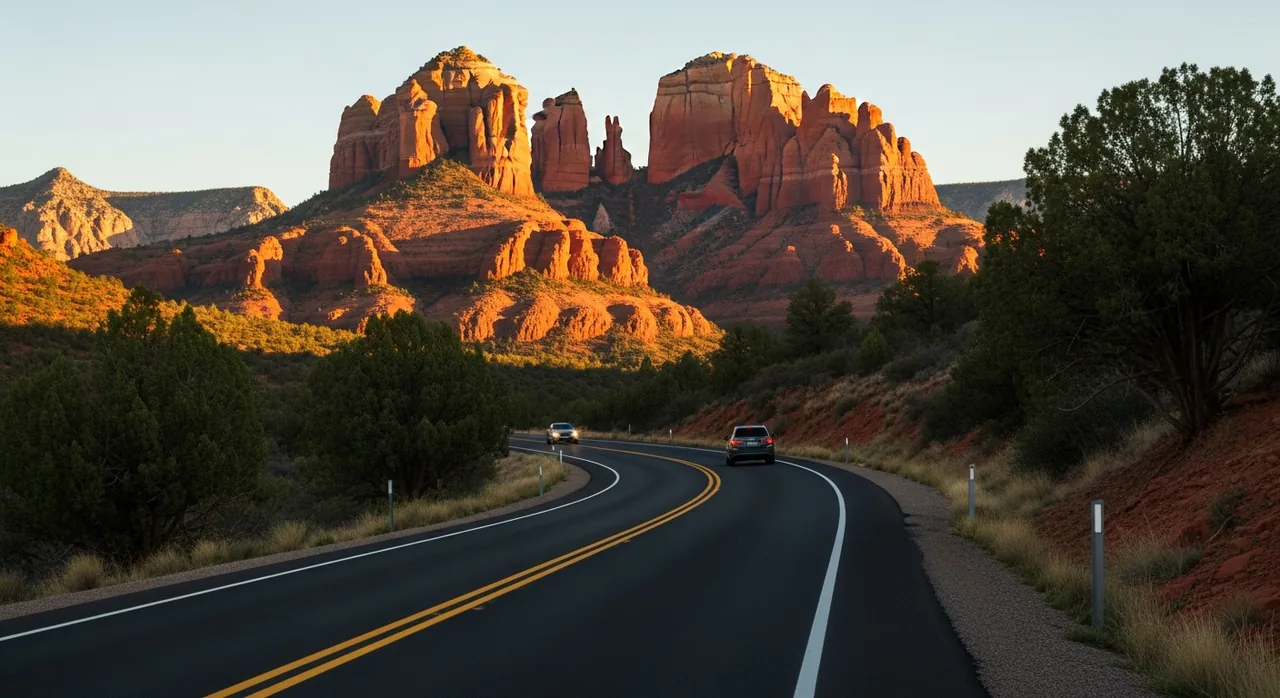
The default — and the right call for a first trip — is Exit 298 onto SR-179 North. After about seven miles of high desert, the road crosses into Coconino National Forest and becomes the Red Rock Scenic Byway, a 7.5-mile stretch that was named Arizona’s first All-American Road in 2006. It is the front-door arrival: Bell Rock and Courthouse Butte fill the windshield as you come through the Village of Oak Creek, and the red rock builds with every mile until SR-179 meets SR-89A at the “Y” in the middle of Sedona. There are pullouts and viewpoints the whole way — use them rather than braking mid-lane, which people genuinely do here. Our stop-by-stop guide to the byway is at /things-to-do/red-rock-scenic-byway/.
The alternative is to stay on I-17 another 40 minutes past Exit 298, climb to the top of the rim, and take Exit 337 to SR-89A South, which drops into Sedona from the north through Oak Creek Canyon — about 25 miles of ponderosa forest, switchbacks, and creek-side canyon walls, passing Slide Rock State Park on the way down. It is a beautiful road and we cover it in the Oak Creek Canyon drive guide, but as an arrival route it is the wrong order of operations: it adds real mileage, the switchbacks crawl behind one nervous driver, and ADOT has guardrail work in the canyon during 2026 that can pinch traffic to one lane (check az511.gov before choosing it). The smarter play: arrive on SR-179, then drive Oak Creek Canyon as its own outing — or use it as your exit if you are looping home through Flagstaff.
Which stops for which trip
A quick sort, since nobody stops everywhere:
| Your situation | Stop at | Skip |
|---|---|---|
| Kids in the car | Rock Springs (pie), Montezuma Castle | Arcosanti, the Well |
| History-minded, no rush | Castle, Well, Crane petroglyphs (Fri–Mon) | Sunset Point |
| Design and architecture people | Arcosanti (book the tour), Sunset Point | The Well |
| Racing a 4 PM check-in | Sunset Point only | Everything else |
| Pickleball group trip | Rock Springs to-go pie, one history stop | The rest — save court time |
That last row is real advice. If you are coming up with a group for a court weekend — the kind of trip we mapped out in the pickleball weekend from Phoenix post — the drive is the appetizer, not the meal. One pie stop, one 40-minute history stop, and get to Sedona with your legs fresh. The full Phoenix getaway guide covers the summer math too: when Phoenix outdoor courts are unplayable by 9 AM at 110°F, Sedona at 4,350 feet runs meaningfully cooler, and an indoor, air-conditioned court does not care what the thermometer says either way.
The short version of this whole guide: the Phoenix-to-Sedona drive will let you skip everything, and two hours later you will be there. But budget one extra hour and you get century-old pie and a 900-year-old cliff dwelling; budget three and you can add rock art or an experimental city. Few interstates give you that much per exit. Pick your stops, take SR-179 in, and let the last 7.5 miles do what they were designated to do.
Frequently asked questions
How long is the drive from Phoenix to Sedona without stopping?
About 116 miles and right around 2 hours from central Phoenix via I-17 North and SR-179. Weekend and holiday traffic on SR-179 into Sedona can add 20–30 minutes, so leave margin if you have a check-in time.
Is the Phoenix to Sedona drive difficult or scary?
No. I-17 is an ordinary interstate with one long climb north of Black Canyon City, and SR-179 is a well-maintained two-lane road with roundabouts. The only real switchbacks are on SR-89A through Oak Creek Canyon, which you only drive if you choose the northern arrival.
Do I need a Red Rock Pass for the stops on this drive?
Only for the Crane Petroglyph Heritage Site (V-Bar-V), where it runs $5 per vehicle per day from the on-site machine. Montezuma Castle charges its own $10-per-adult entrance fee, Montezuma Well is free, and Rock Springs, Sunset Point, and the Red Rock Scenic Byway pullouts cost nothing.
Can I visit Montezuma Castle and Montezuma Well on the same stop?
Yes — they are two units of the same national monument, off I-17 Exits 289 and 293, about 15 minutes apart by car. Plan roughly 90 minutes for both. Note the $10 Castle admission does not apply at the Well, which is free.
Is Arcosanti worth the detour?
If a tour time lines up, yes — the one-hour guided tour of Paolo Soleri’s experimental town is unlike anything else on the route. But it has been operating Thursday–Sunday with a few tour times a day, three miles down a dirt road, so check arcosanti.org and reserve first. Without a tour, there is not much to see.
Which arrival route is better, SR-179 or 89A through Oak Creek Canyon?
Arrive on SR-179 — the 7.5-mile Red Rock Scenic Byway ends the drive with the best red-rock views and no extra mileage. Save 89A and Oak Creek Canyon for a separate outing once you are in Sedona, or drive it on your way out toward Flagstaff.
Play year-round in red rock country
Sedona Pickler is a private Sedona home with its own indoor, climate-controlled pickleball court. Rally any season, any hour — heated, cooled and lit, with paddles and balls provided.
Check dates & book