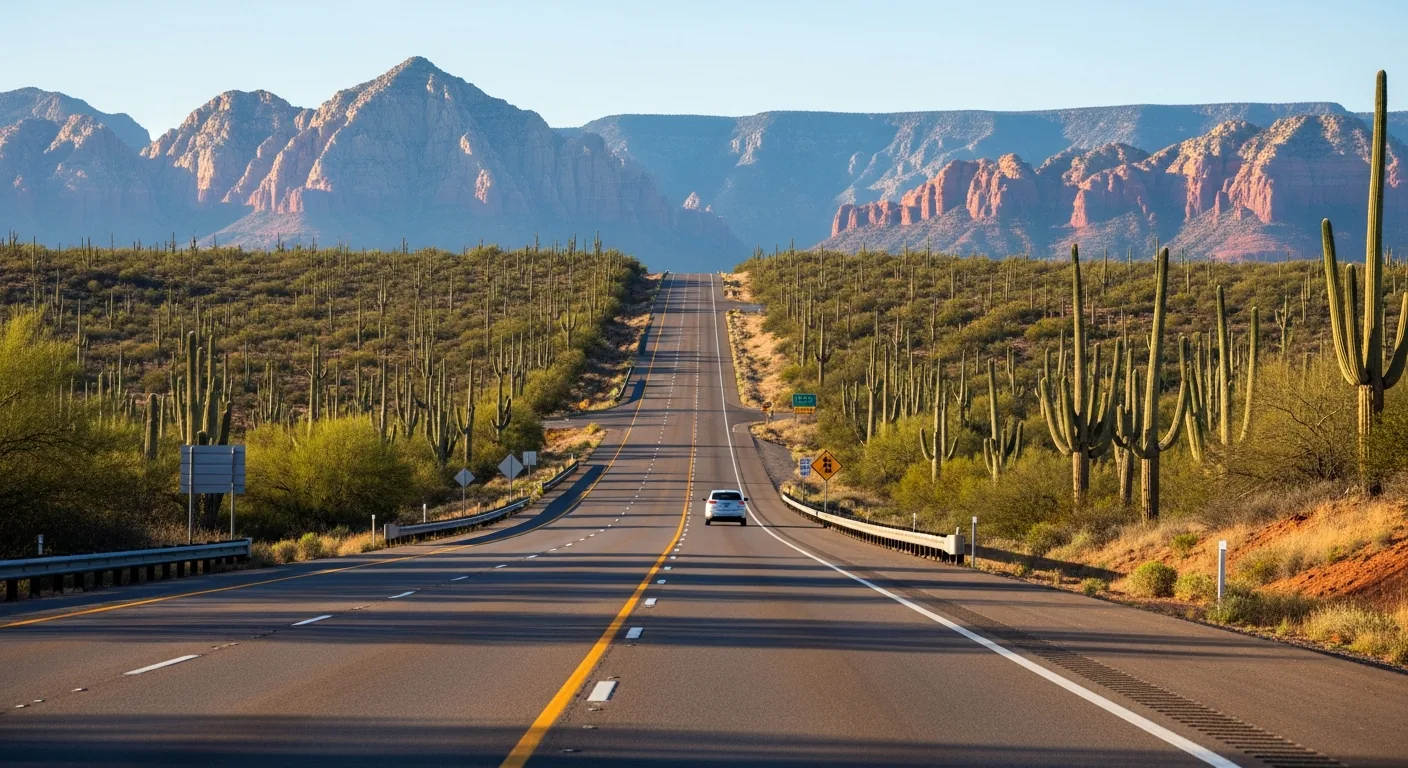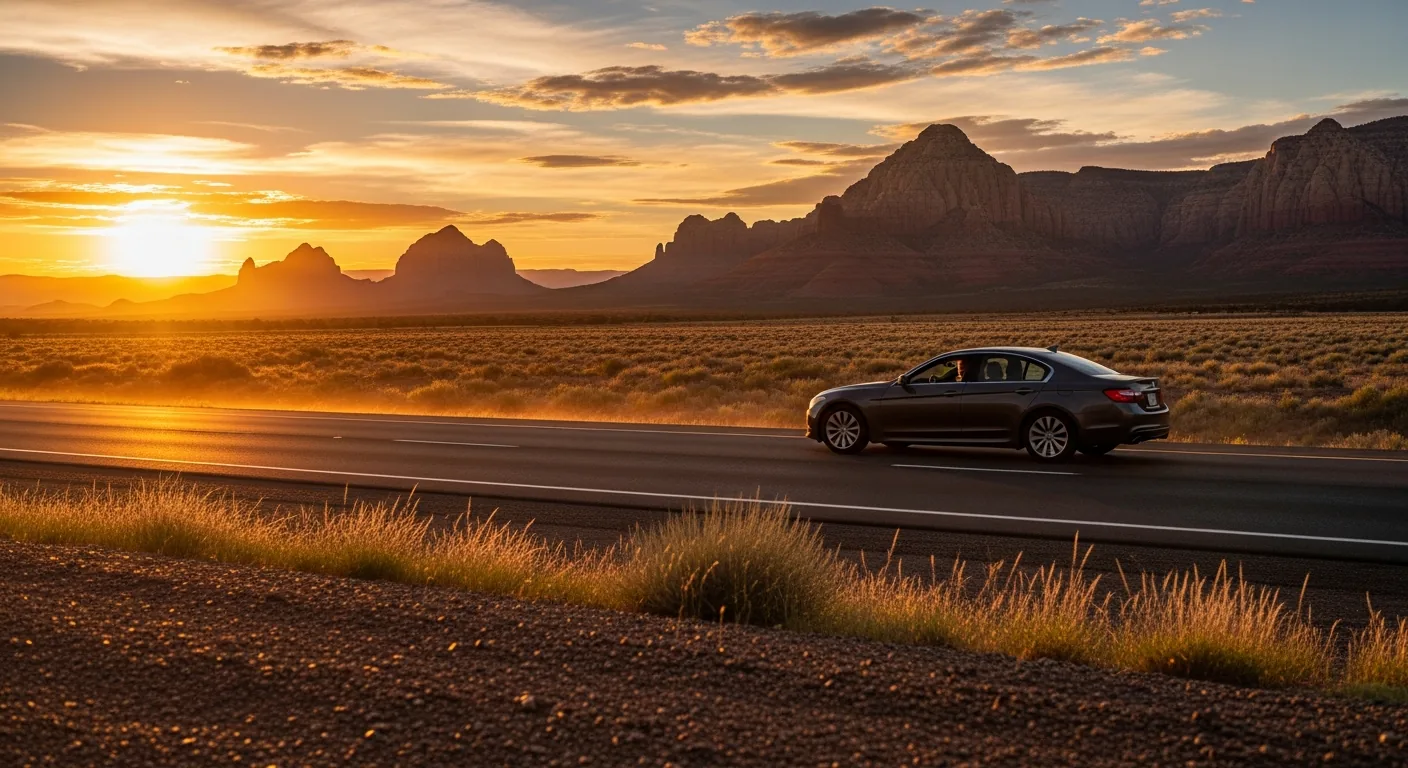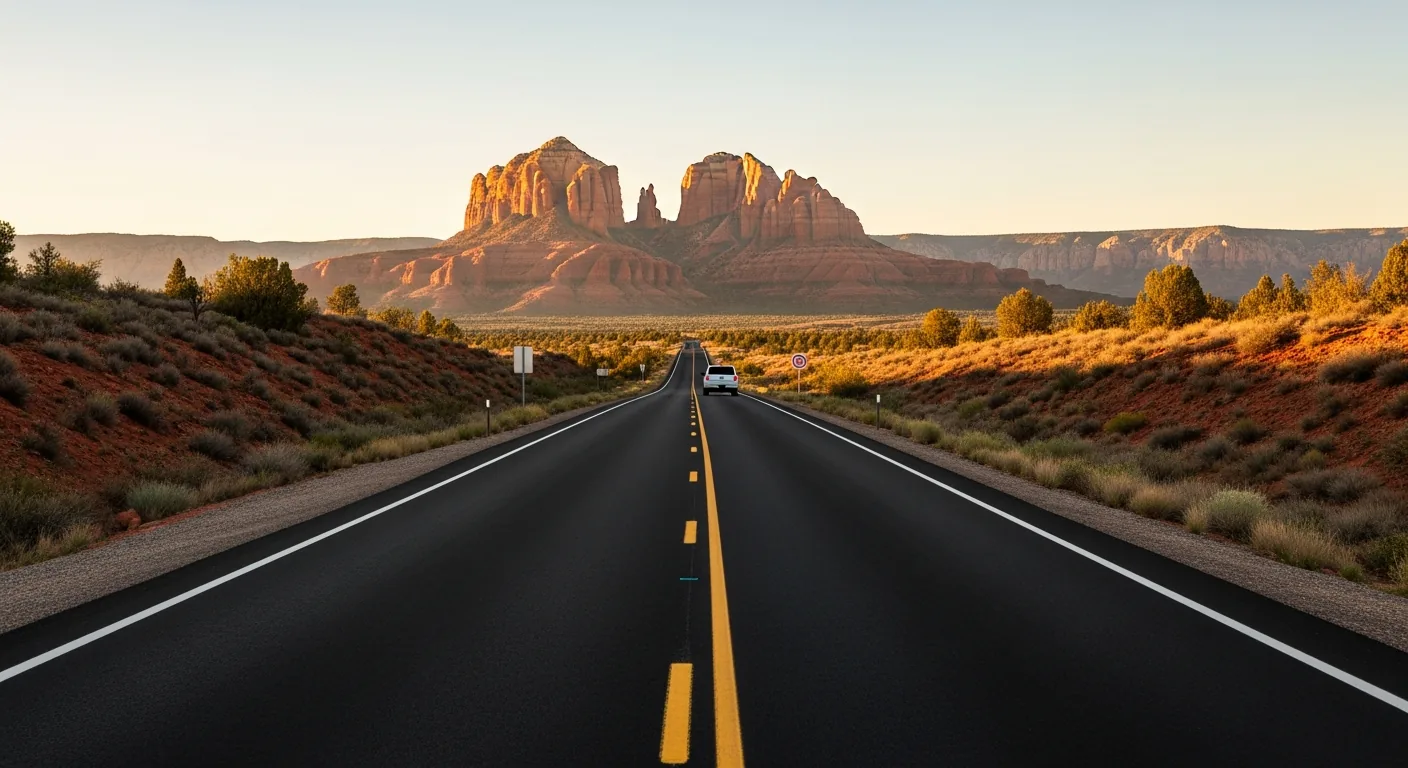
If you play pickleball in Las Vegas, you don’t need anyone to explain what a getaway is for. You live in the city other people get away to. The lights, the crowds, the noise, the 24-hour everything — that’s Tuesday. Which is exactly why a weekend in Sedona works so well for Vegas players: it isn’t more of what you have. It’s the opposite of it, about 280 miles and four and a half hours down the road.
This is a road trip guide for a specific kind of trip: you, plus up to seven friends or family members, driving from Las Vegas to a vacation rental in West Sedona with a private indoor pickleball court, and spending two or three nights playing whenever you feel like it — with the high desert out the window during the day and one of the darkest legally protected night skies in the country overhead after sunset. If you want the condensed version of what makes Sedona work as a destination for Vegas players, the Las Vegas getaway page covers it. This post is the long version: the route, the stops worth making, the one clock quirk that trips people up, and how to shape the weekend once you arrive.
Why leave a city that has everything
This trip is not an escape from bad pickleball. Las Vegas has plenty of courts, plenty of players, and a real scene. If all you wanted was a game, you wouldn’t drive 280 miles for it.
What Vegas doesn’t have is quiet. Or elevation. Or a sky dark enough to show you the Milky Way. Sedona sits at about 4,350 feet, surrounded by red sandstone formations and national forest, in a city that has regulated outdoor lighting since 2001. In 2014, the International Dark-Sky Association named Sedona the world’s eighth International Dark Sky Community — a designation the city earned with an actual lightscape management plan, not a tourism slogan. Step outside after dinner and the difference from a Strip-adjacent sky is not subtle.
The elevation matters in summer too. In July, Las Vegas averages a daily high around 103°F, while Sedona averages around 93°F — roughly ten degrees cooler, and noticeably better in the shade and after dark. And because the court you’re driving to is indoors with air conditioning, the outdoor temperature stops being a factor in your pickleball plans entirely. That’s the trade: you give up room service and get back silence, stars, and a court that’s yours alone for the whole stay.
The route: US-93 to I-40, about 280 miles
The drive is straightforward and genuinely good, which is not something you can say about every 4.5-hour haul in the Southwest. You’ll take US-93 (now overlapping Interstate 11) south out of Las Vegas, pick up I-40 east at Kingman, ride it across northern Arizona to Flagstaff, and drop down to Sedona from there. Total distance is about 280 miles; figure roughly four and a half hours of actual driving, plus whatever you spend at the stops below.
Here’s how it breaks down.
Las Vegas to the Hoover Dam bypass bridge — about 30 miles. Half an hour out of town, US-93 crosses the Colorado River on the Mike O’Callaghan–Pat Tillman Memorial Bridge, the arch bridge that opened in October 2010 to carry traffic that used to crawl across the top of Hoover Dam itself. The roadway sits about 900 feet above the river. You won’t see much from the car — the road has walls — but there’s a pedestrian walkway with a full view of Hoover Dam, and it’s worth the short detour if anyone in your group hasn’t stood on it. Park on the Nevada side and walk out. Fifteen to twenty minutes covers it.
The bridge to Kingman — about 70 miles. US-93 runs southeast through open Mojave Desert to Kingman, Arizona, about 103 miles total from Las Vegas. Kingman is your practical stop: gas, food, restrooms, and the best quick dose of Route 66 history on the drive. The Arizona Route 66 Museum sits inside the historic Powerhouse building at 120 W. Andy Devine Avenue — a former electrical generating plant built between 1907 and 1911. The visitor center is free; the museum itself charges about $10 for adults (confirm current hours and pricing before you go, especially with Route 66 centennial updates underway in 2026). If you’re keeping the schedule tight, even a gas-and-coffee stop in Kingman puts you at roughly the one-third mark.
Kingman to Seligman — about 74 miles on I-40. Seligman is the stop people remember. This little town calls itself the Birthplace of Historic Route 66, and it has the receipts: after I-40 bypassed Seligman in 1978 and the town started dying, local barber Angel Delgadillo and his brother Juan founded the Historic Route 66 Association of Arizona, and in 1987 they persuaded the state to designate the old road as historic — the first stretch of Route 66 anywhere to get that protection. Juan’s Snow Cap Drive-In, which he built from scrap lumber and opened in 1953, is still serving burgers and soft-serve behind one of the most photographed storefronts on the Mother Road. Twenty to thirty minutes here is plenty: stretch your legs, grab a shake, take the photos.
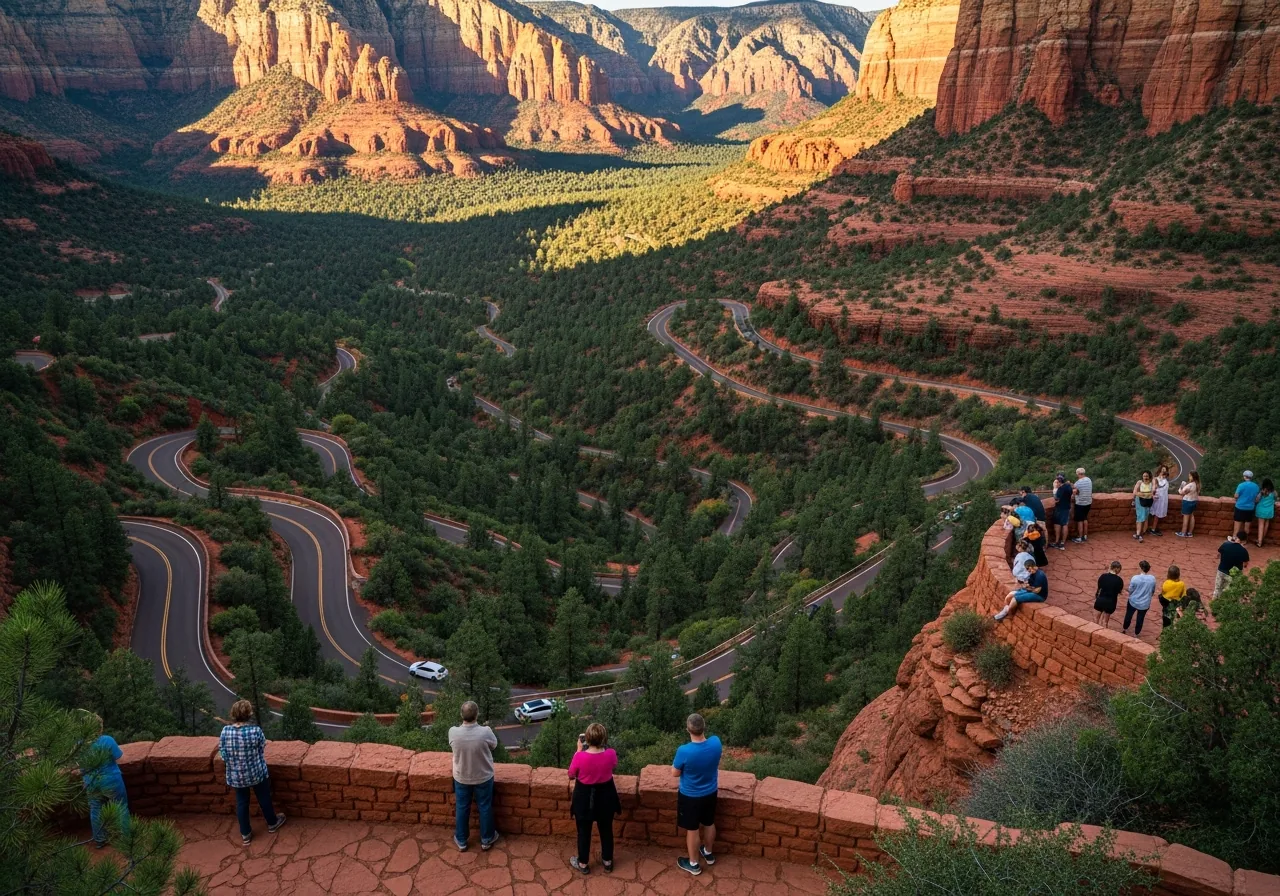
Seligman to Flagstaff to Sedona — about 105 miles. Back on I-40 east, it’s a little over an hour to Flagstaff. From there you have two ways down to Sedona, and the choice matters. The scenic route is AZ-89A south through Oak Creek Canyon — about 30 miles total, including roughly 14 miles of canyon where the road drops through switchbacks under pine and red rock walls. It’s one of the better short drives in Arizona, and if you’re arriving in daylight, take it. If you’re arriving after dark, or towing anything, or your driver is running on fumes, take I-17 south to AZ-179 instead — it’s a few minutes longer but wider and straighter, and 179 rolls into Sedona past the red rock formations anyway. You can always drive Oak Creek Canyon as its own outing during the stay.
The clock quirk: Arizona doesn’t do daylight saving
One thing catches Vegas visitors every time, so here it is plainly. Arizona does not observe daylight saving time. Nevada does.
In summer — roughly March through early November — that works out to no difference at all: Las Vegas on Pacific Daylight Time and Arizona on Mountain Standard Time read the same clock. Drive over in July and your phone won’t change.
In winter, Las Vegas falls back and Arizona doesn’t move, so Sedona runs one hour ahead of Vegas. Leave Las Vegas at 3 PM on a January Friday and you’ll arrive around 8:30 PM Sedona time, not 7:30. It only matters for two things: check-in timing and dinner reservations. Build the extra hour into your winter planning and you’re fine.
What the opposite of the Strip actually looks like
What did you drive four and a half hours for? Three things.
Quiet. West Sedona at night is quiet in a way that takes a day to adjust to. No traffic hum, no music bleeding through walls, no crowd noise. Anyone who plays public courts back home knows the flip side too — pickleball is a loud sport, and outdoor courts near houses generate real friction. An indoor court removes the problem in both directions: nothing gets in, nothing gets out. There’s a whole case for indoor pickleball as the answer to the noise problem, and it’s half the reason this house exists.
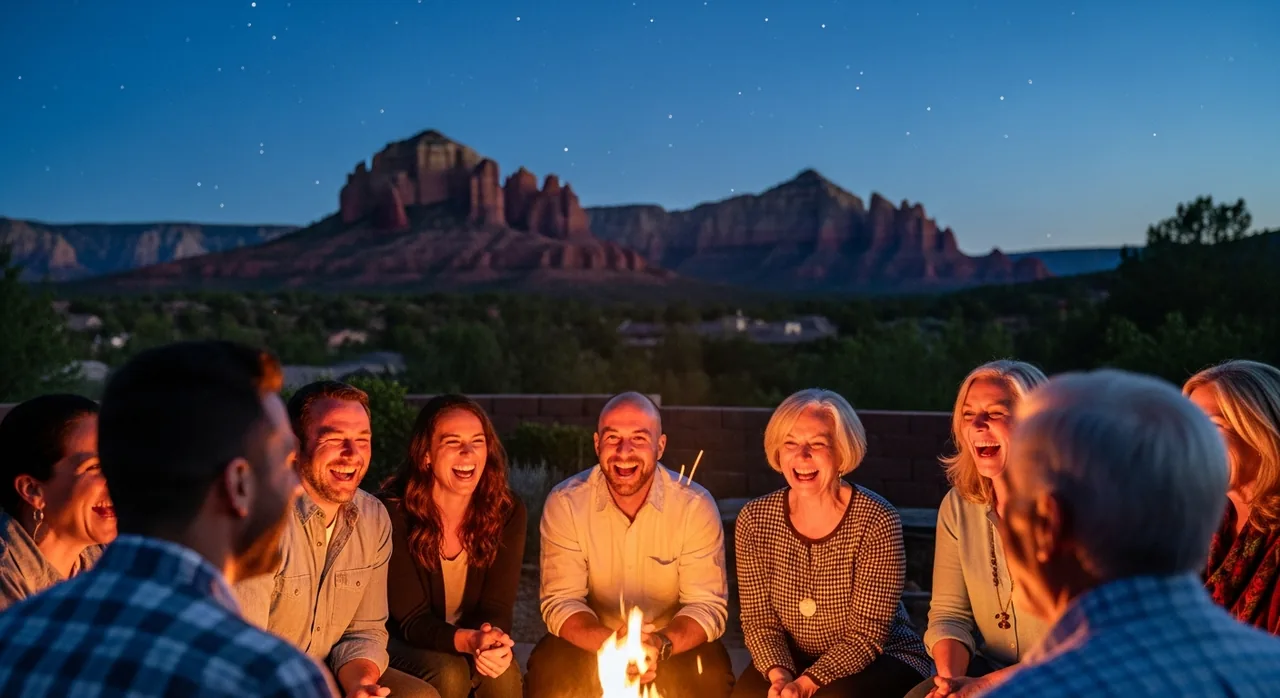
Dark skies. This is the part Vegas can’t offer at any price. Sedona’s dark-sky designation means the city actively limits light pollution, and on a clear moonless night you can see the Milky Way from town. Bring binoculars if you have them; you don’t need a telescope for it to land. The stargazing guide covers the best viewing spots and timing, but the honest answer is that the firepit in the backyard works fine.
Your own court. Not court time. Not reservations. A private, regulation, indoor pickleball court — heated, air-conditioned, and lit — attached to the house you’re sleeping in, available to your group and nobody else for the entire stay. At 6 AM before the hikers wake up. At 10 PM after the stars come out. During a monsoon downpour in August or a snow flurry in January. Paddles and balls are already there.
The two-night version
Here’s a shape that works, assuming a Friday afternoon start. Adjust for winter’s extra hour.
Friday. Leave Las Vegas by 2 or 3 PM, make the bridge and a quick Kingman stop, skip Seligman this direction, and take I-17/179 into Sedona after dark. Check-in is at 4 PM, so the house will be ready. Unload, cook something simple, and play your first games that night — this is where the indoor court sells itself.
Saturday. Morning is for red rock. You don’t need a hard hike to get the postcard views — a couple of the easier Sedona trails deliver plenty in under two hours, and at 4,350 feet, flatlanders from Vegas (elevation about 2,000 feet) will feel the thinner air more than they expect. Lunch in town, then an afternoon block on the court while the day is hottest. With eight players you have four-on-the-sideline rotation, which is exactly the format a round robin was built for. Evening: grill, firepit, stargazing. That’s the whole day and it’s a good one.
Sunday. Early games for whoever wants them, a proper breakfast — Sedona does breakfast well — and checkout at 10 AM. Take 89A up through Oak Creek Canyon in daylight this time, stop in Seligman for the Snow Cap and the photos, and you’re back in Las Vegas by late afternoon with the whole evening ahead of you.
The three-night version
Two nights works, but it’s tight, and you’ll feel the drive on both ends. If your group can swing Thursday-to-Sunday or Friday-to-Monday, the third night changes the trip. You get a second full day: one day for a bigger outing — a longer trail, a drive, a spa afternoon for the non-players — and one day left unscheduled around the court. Groups consistently underestimate how much they’ll play when the court is twenty steps away and free; a third night lets the pickleball breathe. There’s a fuller weekend itinerary on the blog if you want a day-by-day template to argue about in the group chat.
What to pack that Vegas players forget
The full packing list for a pickleball trip is its own post, but three Vegas-specific notes:
Layers, even in summer. You’re gaining about 2,300 feet of elevation. Sedona summer evenings around the firepit drop into temperatures that feel like a different season than a Vegas summer night, and winter mornings are genuinely cold. Nobody regrets the hoodie.
Court shoes, not just sneakers. Paddles and balls are provided at the house, but bring non-marking court shoes for the indoor surface. Running shoes on an indoor court is how ankles get rolled.
Hiking footwear with actual grip. Sedona’s red rock is grippier than it looks when dry and slicker than it looks when wet. Trail runners are enough for the easy trails; casino-floor sneakers are not.
Logistics for a group of eight
The house sleeps eight across four bedrooms — two kings, a queen, and a bunk room with twin-over-twin bunks — with two baths. The driveway holds four cars, and there’s no street parking, so a group of eight coming from Vegas should plan on two to four vehicles and carpool accordingly. Guests must be 25 or older to book, and the house rules are simple: no pets, no parties, no smoking. Check-in at 4 PM, checkout at 10 AM. Booking is through Airbnb only — see the listing for available dates.
One last thought. Vegas players don’t need convincing that a weekend away is worth it — you watch other people take theirs fifty-two weekends a year. The counterweight to a city built on noise and neon is four and a half hours away: red rock, a protected dark sky, and a court that belongs to your group alone from check-in to checkout.
Frequently asked questions
How long is the drive from Las Vegas to Sedona?
About 280 miles and roughly four and a half hours of driving via US-93/I-11 south to Kingman, then I-40 east toward Flagstaff. With stops at the Hoover Dam bypass bridge, Kingman, and Seligman, most groups spend six to seven hours door to door.
Is there a time change between Las Vegas and Sedona?
In summer, no — Arizona skips daylight saving time, so Mountain Standard Time matches Pacific Daylight Time and the clocks read the same. In winter, Sedona runs one hour ahead of Las Vegas. Plan winter arrival times and dinner reservations with that extra hour in mind.
Which way into Sedona should we drive, 89A or I-17?
If you arrive in daylight, take AZ-89A south from Flagstaff through Oak Creek Canyon — about 30 miles, with roughly 14 miles of canyon switchbacks and some of the best scenery of the whole drive. Arriving after dark or with a tired driver, take I-17 south to AZ-179 instead; it’s wider, straighter, and only slightly longer.
Can we really play pickleball at night or in bad weather?
Yes — that’s the point of the house. The private court is indoors, lit, heated, and air-conditioned, so a 10 PM game in January or a mid-monsoon game in August works exactly like a 10 AM game in April. Paddles and balls are provided; bring non-marking court shoes.
Is Sedona actually good for stargazing?
Yes, and it’s official: Sedona was designated the world’s eighth International Dark Sky Community in 2014 and regulates outdoor lighting citywide. On a clear, moonless night you can see the Milky Way from town — something no amount of money buys in Las Vegas.
How many cars should a group of eight bring?
The house has free driveway parking for four cars and no street parking, so plan two to four vehicles. Two SUVs is the comfortable answer for eight people with paddles, coolers, and hiking gear.
Play year-round in red rock country
Sedona Pickler is a private Sedona home with its own indoor, climate-controlled pickleball court. Rally any season, any hour — heated, cooled and lit, with paddles and balls provided.
Check dates & book