Every group that shares a pickleball court needs one decision before the first serve: who plays next? The answer is a format, and picking one takes about a minute. This guide covers the ones groups use most, from King of the Court and ladders to rotating mixers and a pro-league tiebreaker you can borrow, with the players and courts each one needs and how much court time it gives each person.
How to pick a format for your group
Three questions settle most of it. How many people came? How many courts do you have? And does your group care more about equal play or about a little competition? A family of eight on a vacation court has a different answer from a club night with 24 people and six courts.
The table below sorts the common formats by those questions. Each one gets its own chapter further down, with the steps for running it. If you only have a minute, the short version goes like this. On one court, use a written rotation when equal play matters and winners stay when your group wants to compete. On three or more courts, use King of the Court. Over a whole season, use a ladder league.
| Format | Players and courts | Good for |
|---|---|---|
| Rotating mixer | 4 to 16 players, 1 to 4 courts | Even play and new partners |
| King of the Court | 2 or more courts, best on 3 or more | Mixed levels and fast games |
| Winners stay | About 6 to 12 on one court | A small group that likes to compete |
| Four on, four off | 8 on one court | The simplest even play |
| Popcorn | Any number, any courts | A social night with no chart |
| Fixed teams | Even numbers of players | Couples and league nights |
| Ladder league | A club, over weeks | Season-long play |
| Dreambreaker | Two teams of four, one court | A short final game |
A few examples may help. Four couples on a vacation court can start with a rotation chart, so that everyone plays with everyone, and then try winners stay after dinner. A family with kids and grandparents should use four on, four off with short games, since nobody has to keep track of anything and everyone gets the same turns. A club night with 24 people and six courts is the natural home of King of the Court, since it sorts a big group by level with no planning at all. And a group of five or six friends can use a short table and stop whenever they like.
Names cause a lot of the confusion here. The same format can be King of the Court at one park and Up and Down the River at the next, and clubs in Britain, Canada and the United States all use these words a little differently. When you join a new group, ask what happens to the winners and what happens to the partners after each game. Those two answers tell you more than the name does.
Whatever you pick, say it out loud before anyone serves, along with the score you are playing to and when the session ends. Keep it simple enough that everyone can follow it. If half your group is new to the game, have our beginner's guide to rules and scoring handy on a phone, because a few basics will come up in the first game.
Rotating partners, the even-handed default
In a rotating mixer, a chart tells each person who to play with and against in every round. You change partners each time, your results follow you rather than your team, and nobody has to remember who sat out last. It is the format most clubs reach for at a social, because strong and newer players keep getting mixed together and nobody is knocked out.
The work is all in the chart. Numbering people and working out the pairs by hand goes wrong quickly, usually around the fourth round, when two people find they have played together twice while two others have not met at all. So we built a free round-robin generator that prints a checked chart for groups of 4 to 16 on up to four courts. Names are optional, and it can add score boxes to the printout.
For particular group sizes, we have also written out the tables with notes on running them. Eight people have their own 8 player round-robin. Groups of five, six or seven on a single court can use our five, six and seven player tables, and a bigger gathering can use a pair of charts for 10 or 12 players.
A mixer asks for one small thing: everybody has to stay for the whole session, or the chart stops working as written. When someone leaves early, print a new chart for the people still there and keep going. To rank players at the end, have each person add up the points their teams scored and use point difference to break ties. Some groups skip the standings entirely, which is fine too.
How King of the Court works on several courts
King of the Court is the format with the most energy, and the rules fit on an index card. Rank your courts from bottom to top, with the top one called the King's or Queen's court. Each court plays a short game. The winners move up a court, the losers move down, and the next game starts as soon as everyone has walked over.
Two courts need a rule of their own. The winners on the top court have nowhere to climb, so they stay. The losers on the bottom court have nowhere to fall, so they stay too. On every court in between, two people arrive from above and two from below.
Most groups have the winners split up when they arrive, one at each end, so each person has a new partner in every game. This keeps one strong pair from riding a streak up to the top and sitting there all night. Some social groups let winners stay together, which is friendlier for couples and slower at sorting people by level. Pick one and say which.
Running King of the Court
- Rank the courts and name the top one
- Put four players on each court, by level or at random
- Start a timer for 8 to 12 minutes, or play to 11
- Winners move up and split, losers move down and split
- Repeat until the session ends and name the top player
Use a timer if you can. Games to 11 finish at different times, which leaves people waiting on the slowest court. With a shared timer of 8 to 12 minutes, every court changes at once. When it sounds, finish the rally, and whoever is ahead has won. A club in Ottawa breaks a tie by playing one more rally. A club in British Columbia gives the win to the side that reached the tied score first. Either rule works if everybody knows it in advance.
To name a winner at the end, the simplest way is to crown whoever finishes on the top court. Another is to have each person keep a running total of their points. People play different numbers of games only when there are more players than spaces, so a group that exactly fills its courts can compare totals without any fuss.
A worked example on three courts
The rules are easier to follow with real numbers, so take a group of 12 on three courts. Call the courts Bottom, Middle and Top, and put four people on each, at random or by level. Everyone plays for 10 minutes. When the alarm sounds, finish the rally, and whoever is ahead has won. Then look at the table below to see who goes where.
| Court | Who plays here next | Who comes from where |
|---|---|---|
| Top | Winners from Top and winners from Middle | Two stay, two climb |
| Middle | Losers from Top and winners from Bottom | Two drop, two climb |
| Bottom | Losers from Middle and losers from Bottom | Two drop, two stay |
Each court now has two pairs that have just arrived from different places. To split partners, one person from each pair teams up, and the other two team up against them. So on the Top court, one winner from Top partners one winner from Middle, against the other two. That one step keeps the session mixing, and it means a player has to keep winning with a new partner to stay at the top.
Walk through what happens to one person. Dana starts in the Middle and wins, so Dana climbs to Top. Dana loses there and drops back to Middle, then wins again and returns to Top. After six rounds Dana may have played on two courts with six partners, and that is what a good session looks like. A newer player tends to settle in the Bottom and Middle courts, playing close games against people at a similar level, and gets a real chance to climb on a good day.
The same pattern fits any number of courts. With four, you add one more middle court. With two, there is no middle: winners from the lower court go up, losers from the upper court come down, and the other two pairs stay where they are. Two courts sort people more slowly, and that is why we say the format runs best on three or more. If you have 13 to 15 people, seat the extras on a bench behind the Bottom court and use the funnel described further down. Every person still gets regular games, and the group only needs one timer and one person watching it.
King of the Court on a single court
With one court there is no ladder to climb, so the format becomes a line. It often goes by the name challenge court. The winning pair stays on, the losing pair walks to the back of the line, and the next pair steps up. A group of 6 to 12 suits it well: a smaller group barely has a line, and a larger one spends too long waiting.
Without a limit, one good pair can keep the court for a long time, and that takes the fun out of it for everyone holding a paddle on the bench. So most groups set one. The common rule is three games in a row, after which all four people come off, and the next four go on. Short games help as well. A club in England starts its sessions with games to 7, then plays to 9 from then on.
You also have a choice to make about partners. If winners stay together, a pair builds up a streak, which suits people who came to compete. If they split, each winner takes one of the two challengers as a new partner, and that mixes the group far better. For family groups and friends who mostly want to play, we like the split version with a three-game limit. A player then gets a real shot at staying on, with a changing cast of partners and no one stuck on the bench.
Keep the line fair with a paddle stack. Each pair sets its paddles down in the order they came off, and the two paddles at the front of the line go next. Nobody has to remember anything or argue about it. If your group has an odd number, the single player waiting joins the next person who comes off the court, and they go up as a pair.
How much court time each format gives
People often say that winners-stay formats give more court time to the strongest players, and we wanted a number to go with that. So we wrote a small program to count it. The setup is eight players on one court, for eight games, which is about two hours at 15 minutes a game. With eight games and four players in each, there are 32 places to fill, so an even split gives each person 4 games.
| Format | Two strongest players | Two weakest players |
|---|---|---|
| Rotation chart, stopped after 8 games | 4.0 games | 4.0 games |
| Four on, four off | 4.0 games | 4.0 games |
| Winners stay, three-game limit | 4.6 games | 3.5 games |
| Winners stay and split | 4.8 games | 3.3 games |
| Winners stay together, no limit | 4.9 games | 3.3 games |
Two formats come out even because they don't depend on who wins. In a rotation chart and in four on, four off, your game count is fixed before the session begins. The three winners-stay versions tilt toward stronger players, by somewhere between one and one and a half games out of eight on average. That is a real difference, and it is also smaller than many people guess. A three-game limit brings the gap down by nearly a third.
The average hides how much one session can vary. In the two versions with no limit, a single player can sometimes play all eight games, and another can play only two. With a three-game limit, the range in our runs narrowed to between two and six. A newer player who draws a late spot in the line and then loses the first game can spend a good part of the morning on the bench, so a limit is worth having.
So here is how we would use this. For families and groups with a wide range of levels, start with a chart or four on, four off, so nobody needs to think about court time at all. Save winners stay for a group of similar players, or for the last hour, when everyone has already played plenty and a bit of competition is welcome.
Up and Down the River and its cousins
Up and Down the River is the same idea as King of the Court, and the name describes the motion: players float up and down through the courts during a session. PlayPickleball lists Up River, Down River, Ladder, Waterfall and Queen of the Court as other names for it. You will hear all of them at public courts, and it pays to ask for the details before you play.
Apps draw finer lines between the variations, which is worth knowing if your club uses one. Pickleheads, an app many organizers use, sorts them this way. Up and Down the River is a seeded format for larger groups with mixed levels, where top players move up and bottom players move down. Claim the Throne is the classic version, in which winners move up, losers move down and partners split each round. Cream of the Crop shifts court placement by results, and wins on higher courts earn more points. Gauntlet seeds players by skill and adjusts each round, so people on a winning streak meet tougher opponents as they go.
Another distinction comes from PickleNow, which separates moving as a pair from moving as an individual. In the second version, winners and losers each move alone, which creates more movement across a large group. One more variation keeps the same partner all night and moves the pair up and down, combining a ladder with a fixed team.
All of these need more than one court, and they run best on three or more. If your numbers run over, one neat fix is what a club in England calls the funnel: the losers of the bottom court step out to the waiting line, and people from the line step onto the bottom court. Everyone waiting then enters at the bottom and climbs from there.
Who starts on which court
Your first round of a court-climbing format needs a starting order, and you have two ways to get one. The first is by level. Clubs that use ratings put higher-rated players at one end and lower-rated players at the other, so the opening games are close. Some clubs run their top court at the highest number and others call it Court 1, so check which end is up before you start walking.
The second way is at random, and it is usually the better choice for a casual group. Draw numbers, or have everybody stand in a circle and count off by the number of courts. Since the winners climb and the losers drop in every game, players will sort themselves out after a few rounds, and nobody has to tell a friend that they were placed on the bottom court.
If you do want to seed by level and your friends have never had a rating, a rough ranking is enough. Ask each person to place themselves as newer, comfortable or strong, then balance from there. Our skill ratings page explains what the common numbers mean if the group wants something firmer.
One tradition is worth stealing for any group that is new to all this. The Chilliwack club in British Columbia draws playing cards for partners at the start of each match on a court. The two players with black suits play together, and the two with red suits play together. A deck of cards is cheap, and it settles the question before anyone can argue.
Ladder leagues for a club
A ladder league takes the climbing idea and stretches it across weeks. Every player or team holds a numbered position, usually starting from a rating, a self-reported level or a random draw. You move up by beating someone above you, and you move down by losing to someone below you. Your place on the ladder is your standing, and in the challenge version it can run for as long as people keep playing.
Organizers can structure one in a few ways. Some run many up-and-down games on one match day. Some move players once after each week's session. Others let players arrange their own matches by challenging people nearby. Some ladders limit how far you can reach, such as three spots above your own position.
The challenge version needs one rule above all: a deadline. Pickleball.com suggests giving a challenged player 7 to 14 days to accept and schedule the match, or the challenge goes to the challenger automatically. Without it, a player can sit on a high spot by being hard to reach. Some leagues also shuffle positions from time to time or ask for a minimum number of matches, so a person who stops playing doesn't block the people below.
A ladder league suits a club, since it needs a season and somebody to keep the list. For a group on a long weekend, the single-session version is the one you want, and the chapters above cover how to run it. Clubs starting from scratch can keep the ladder on a shared spreadsheet or use one of the league apps, and they can run it alongside open play. If you are visiting Sedona, our page on Sedona's public courts covers the city's courts at Posse Grounds Park and the drop-in sessions there.
Popcorn and other random draws
Popcorn is the lowest-effort way to mix a group. Everybody gets a number. Each round, a phone app or an organizer draws fresh random matchups and calls them out. Players go where they are told, play a short game, and come back for the next call. One English club runs its games at 8 to 10 minutes, and it asks everybody to keep quiet while the numbers are read.
The appeal is that nobody needs a chart, and it copes with any number of players or courts. People can also come and go between rounds, which a printed chart can't handle. Since the pairs are random, though, you may get some lopsided games, so Popcorn works best with players at about the same level. A plain draw can also pair two people twice in one evening, which nobody much minds at a social.
For a no-tech version, try the count-off that PlayPickleball describes. Everyone stands in a circle before each round and counts off by the number of courts. All the ones go to Court 1, all the twos to Court 2, and so on, and each court works out its own teams. A timer or a game to 11 ends the round, and the group gathers in the circle again. It takes under a minute and needs nothing but a voice.
Scramble is a close relative. Pickleheads uses the word for a format in which four or five players share a court and play with every partner on that court, and then the whole group rotates. It involves less walking than Popcorn and gives you a few games in a row with the same small group, so it suits people who like to settle in. The term gets used in other ways too. Some writers use scramble to mean any partner rotation, so check before you sign up.
“Our family had so much fun being able to play whenever we wanted to.”
Karen from Mesa, Arizona, August 2026
Fixed teams for couples and league nights
Plenty of people came to play with one particular partner, and a format can respect that. In a fixed-team format, each pair stays together for the session and plays a series of other pairs. It is the natural fit for couples, for friends who play together every week, and for a league night where the results belong to the pair.
The simplest version is a small round robin in which every team plays every other team once. With four pairs on one court, that takes six games. With five pairs on two courts, it takes five rounds, and one pair rests each round. With six pairs on two courts it takes eight rounds. We wrote those last two out, round by round, in our post on 10 or 12 players.
A larger event can use pools. Pool Play places teams into small groups, each group plays its own mini round robin, and the top pairs can then go on to a short bracket. Pickleheads also offers a format it calls Shuffle, in which fixed teams face different opponents each round, without trying to play everyone. Chilliwack runs a version with a promotion at the halfway mark: the pair with the most wins moves up a grouping for the second round, and the pair with the fewest moves down.
The one thing to watch for is a lopsided pair. With fixed teams, two people who are both newer can lose every game, and they have no new partner coming along to change their luck. If your group has a wide range, pair strong players with newer ones when you set the teams, or play a fixed-team game for only part of the day. For the positioning side of playing with one partner all afternoon, read our doubles positioning tips the night before.
Mixed doubles formats
Some groups want each team to be one man and one woman, and that takes one extra step in the setup. Pickleheads offers a format called Mixed Madness, built so that each team has one player from each of two groups. PickleNow describes the same thing in a social version, with the schedule pairing a man and a woman each round whenever it can.
You can do this without an app. Number one group 1 to 4 and the other group A to D. Round one plays 1 and A against 2 and B on the first court, with 3 and C against 4 and D waiting or on a second court. In round two, keep the numbers where they are and slide the letters along by one, so that 1 plays with B and 2 plays with C. After four rounds everyone has partnered each person from the other group once. It is a simple pattern to run from a scrap of paper.
Couples often ask to be kept apart for a change, and this pattern can do that. Give each couple the same position, so 1 and A are a couple, 2 and B are a couple, and so on. Skip the round where the letters line up with their own numbers. In the remaining three rounds, nobody partners their own spouse, and everyone still meets three new partners.
In Major League Pickleball, the same mixing runs through the whole team match. Each match has a women's game, a men's game and two mixed games, which is a handy pattern for a group that wants a team contest. Set up two teams of two women and two men, play those four games, and use the Dreambreaker in the next chapter if the teams split them two games each.
Paddle stacks and open play rules
Open play at a public court runs on its own rules, and they differ from one park to the next. A visitor who knows the main systems will fit in faster. The paddle rack is the most common. If the courts are full, you place your paddle in the rack to save your place, and the first paddles in line take the next open court.
From there, courts usually run one of two ways. In four on, four off, all four players leave after a game and the next four take the court. Winners and losers often put their paddles in separate racks, with a marker showing which rack gets the next game, which spreads people around when it is busy. In two on, two off, the winners stay on but split up, and two new players join them as partners.
Cromer, a club in England, runs a tidy version called Paddles Up. Paddles go down in groups of four, two on the left and two on the right, and players whose paddles are stacked together form a team. After a game, winners set their paddles on a Winners' Bench and runners-up on a second bench, one paddle on the left and one on the right. Partners land on opposite sides, so they play against each other next time. A marker ball shows which group goes next, and the people in that group get up and move it when they take the court.
Some places use a whiteboard instead. Each game gets a box with four names, and the next full box plays. If you would rather not play with the people already listed, you can put your name in a later box, though you can't skip ahead. The basic courtesy is the same everywhere: look around before you step on, ask how the place does it, and be ready to play when your turn comes. Our group trip planning guide has more on playing public courts with a group.
A Dreambreaker for your group
The Dreambreaker comes from Major League Pickleball, where it settles a team match tied at two games each. It is a singles game with a twist: every player on each team takes part. A group of friends can borrow it for a short final game that gets everyone on their feet.
Here is how it works. Make two teams of four and have each team write down its playing order. The game is singles, using rally scoring to 21, win by 2. The first player from each team plays four rallies, then the second steps in for four, then the third, then the fourth, and the order repeats until a team wins. Every rally scores a point, so the score keeps climbing and the game moves quickly.
Running a Dreambreaker
- Split into two teams of four and write down each playing order
- Play singles with a point on every rally
- Change players on both sides every four rallies
- Keep the same order all the way through
- First team to 21 wins, and the winning margin must be 2
The order is the fun part. League captains reveal their lineups in sequence, and the choices can turn a game, since a team wants its best player on court at the end. For friends, some gentle gamesmanship over who goes first adds a lot of laughter.
Two tips for a friendly version. If you'd like less running, play it on half the court, along the centerline, the way skinny singles does. And if you want a shorter finish, play to 15 instead, which is another common number for rally scoring. In the pro rules, the point that ends a game must be won on serve, which makes the ending tense, though a friendly group can skip that and play it straight through. A format this quick is a good one to play last, since it takes everyone 10 or 15 minutes and sends the whole group to dinner talking about the same few rallies.
Scoring choices that shorten a format
The score you play to matters as much as the format, because it sets how long people wait. A casual doubles game to 11, won by two points, usually runs somewhere between 15 and 25 minutes. On one court with eight players, that means a person who comes off may sit for most of an hour. Shorten the game and everyone gets more turns.
You have three good tools for that. The first is a lower target: 7 or 9 points instead of 11, keeping the usual serving and scoring rules. The second is a timer, usually 8 to 12 minutes, with the higher score winning when it sounds. Timers are especially handy on several courts because all the games end together. The third is rally scoring, where a point goes up on every rally no matter who served. Most of those games go to 15 or 21, and one guide puts the time savings at about 30 percent.
| Scoring | About how long | Use it when |
|---|---|---|
| Side-out to 11 | 15 to 25 minutes | Everyone is on court at once |
| Side-out to 7 or 9 | Shorter | There is a line to keep moving |
| Timer | 8 to 12 minutes | You have several courts |
| Rally to 15 or 21 | About 30 percent less than side-out | Your group likes a steady clock |
For a group format, we would use games to 11 only when everybody is on court at once, as with a chart on enough courts or four on, four off. As soon as there is a line, drop to 9 points or switch to a timer. And if you are short on time, a good habit is to decide on the last game in advance. Say something like "next game is the last at 11:30," so nobody is surprised when it ends. For a quick reminder of how the score is called, the scoring cheat sheet is phone-sized, and it will head off most questions from newer players.
Whichever you use, keep it the same for the whole session, since changing the target partway makes any running point totals meaningless. If you do want to change, start a new set of standings at that point and call it a second round.
Keeping newer players in the game
A group of friends is rarely one level, and the format can do a lot to keep everyone happy. A rotating mixer is the easiest answer. Partners change every round, so a newer player spends much of the day on a team with somebody stronger, and a strong player gets to play with everyone. Adding up each person's own points also helps, since nobody's result rides on one partner.
Level play is the opposite approach, and it can work well for a bigger group. A club in Ottawa puts its most advanced players on one court, its beginners on another and everyone else in between. Winners move up and split, losers move down and split, and over a session players settle where they belong. People generally play closer games this way. It helps to say at the start that you can move between courts at any time, so nobody feels placed.
On a single court, try a head start for a mismatched game. Before the serve, give the newer team two or three points on the score. It is a small thing, it needs no special rules, and it keeps the stronger team working for its win. Another option is to ask strong players to play with a rule of their own, like hitting only to the middle or only with their backhand. People usually take it in good humor if you frame it as a challenge rather than a handicap.
Keep the sessions short, too. Two hours with breaks is a good amount for a mixed group, especially if someone is new to the sport or has been sitting in a car. The routine in our warm-up guide takes a few minutes, and an hour of drills on a private court can do a newer player as much good as a few games.
“The game room with bunkbeds was a dream come true for our kids and our family had a blast playing pickleball on the indoor court.”
Victoria from Corona, California, June 2026
Small numbers and side games
Not every game day has a full court's worth of people, and not everyone waiting wants to sit still. With three players, cutthroat lets everyone play at once: one person plays against two, the rotation moves around after each side-out, and each player keeps an individual score. With two, skinny singles uses half of the court along the centerline, which keeps the running down and gives you lots of practice at the kitchen line. We cover both, with the details, in our rotation post for one court.
Those two also make good side games. If a family has four people playing and two waiting, the pair waiting can warm up with some dinks off the court, using a line on the floor as a net. Anyone waiting for a long time should stay warm, drink some water, and take a turn keeping score or running the timer. Giving the people waiting a small job makes the wait feel shorter.
Children have their own format needs. Younger players do well with lower targets and shorter games, so try games to 5 or 7 and let them serve from closer in until they can reach the other side. An adult and a child make a good team in a mixer, and a family round where each child picks their partner gives them some say in the day. When kids lose interest, let them go, since a short happy session beats a long grumpy one.
And when your group gets tired of playing for points, drop the score for a while. Play a game in which only dinks count, or one in which the third shot must be a soft drop. Some groups like a rally challenge, seeing how many shots in a row the whole court can keep in play. These games go easy on everyone's legs and make people laugh.
Running a session with little effort
Someone has to run the session, and that person should still get to play. The trick is to do your work ahead of time and let the format run itself. A few minutes the night before is enough. Pick the format, write down who is coming, print a chart if you need one, and decide when you will stop. Then send it to the group so that people arrive knowing the plan.
Decide who is in charge of the rules, too. When a question comes up in the middle of a session, one person should be able to make the call in a few words and move on. That person does not need to be the strongest player or the one who knows the rulebook best. A friendly group mostly wants someone who will keep the games moving and make sure everyone gets their turn.
Post what people need to know where they can see it. Tape a copy of the chart to the fence or net post of every court, or take a picture and put it in your group chat. A whiteboard works well for a running score. Name a timekeeper who changes each round, so that the job isn't always yours. Use a phone alarm loud enough to carry across the courts.
A simple habit keeps things moving: have everyone report the result on their way to the next game, not after it. Most delays in a session come from people drifting off between games, and the fix is to make the next court the place you go to talk. Build in a water break after every third or fourth round, say it in advance, and start again on time. A large group does well to report scores at one central spot, as Main Court's organizer guide suggests.
Finally, plan for what you can predict. Somebody will arrive late, somebody will leave early, and somebody will need to sit out a round. Decide now what happens: a late arrival waits until the end of the current round, and an early departure means a new chart or a substitute from the bench. For a bigger event, keep a few extra balls on hand and a way to reach everyone.
The night before game day
- Pick the format and the scoring
- Write down who is coming and number them
- Print one chart per court, if you use a chart
- Send the plan to the group
- Charge a phone for the timer
A weekend of formats on one court
Eight people with one court and a free weekend can try a lot of formats. Using a different one each session keeps things fresh, and it spreads the competition around so that the same two people don't win everything. This is our plan for a two-night weekend for eight at Sedona Pickler.
Friday evening is for arriving, so keep it light. Play four on, four off with games to 9, and shuffle the teams each time. It takes no planning, it gets everyone's legs moving after the drive, and it lets people see how each other play. Newer players can use this first session to remember the rules, and nobody needs to keep score beyond the game in progress.
Saturday is the big day. Start with a rotation chart in the morning while the group is fresh, and use the generator to print it. Eight players on one court take 14 games to cover every partner, so split that over two sessions, with a hike in the middle. After dinner, try winners stay and split, with a three-game limit and games to 9. Our weekend itinerary has ideas for what to do between sessions.
- Friday eveningFour on, four off, games to 9, teams shuffled each game
- Saturday morningRotation chart, first seven games, then a hike
- Saturday afternoonRotation chart, last seven games, points added up
- Saturday nightWinners stay and split, three-game limit
- Sunday at 8Skinny singles warm-up, then a Dreambreaker, top scorers as captains
- Before 10Showers, packing and checkout
An early Sunday game makes a good finale before checkout. Name the top two scorers from the Saturday chart as captains, and let them choose their teams in turn. Warm up with skinny singles for 15 minutes and then play a Dreambreaker to 21. It should take about 15 minutes, so you can run a rematch with a new order if the first game was close. Afterward, settle the arguments about the results from the soaking tubs.
A longer stay gives you room for more. Add a fixed-team afternoon so that the couples get a turn, or a half-day with no scoring at all, just games and drills. Leave some time without any format. Some of the best games happen when two people wander down to the court after dinner with no plan and find two more who had the same idea.
The court at Sedona Pickler
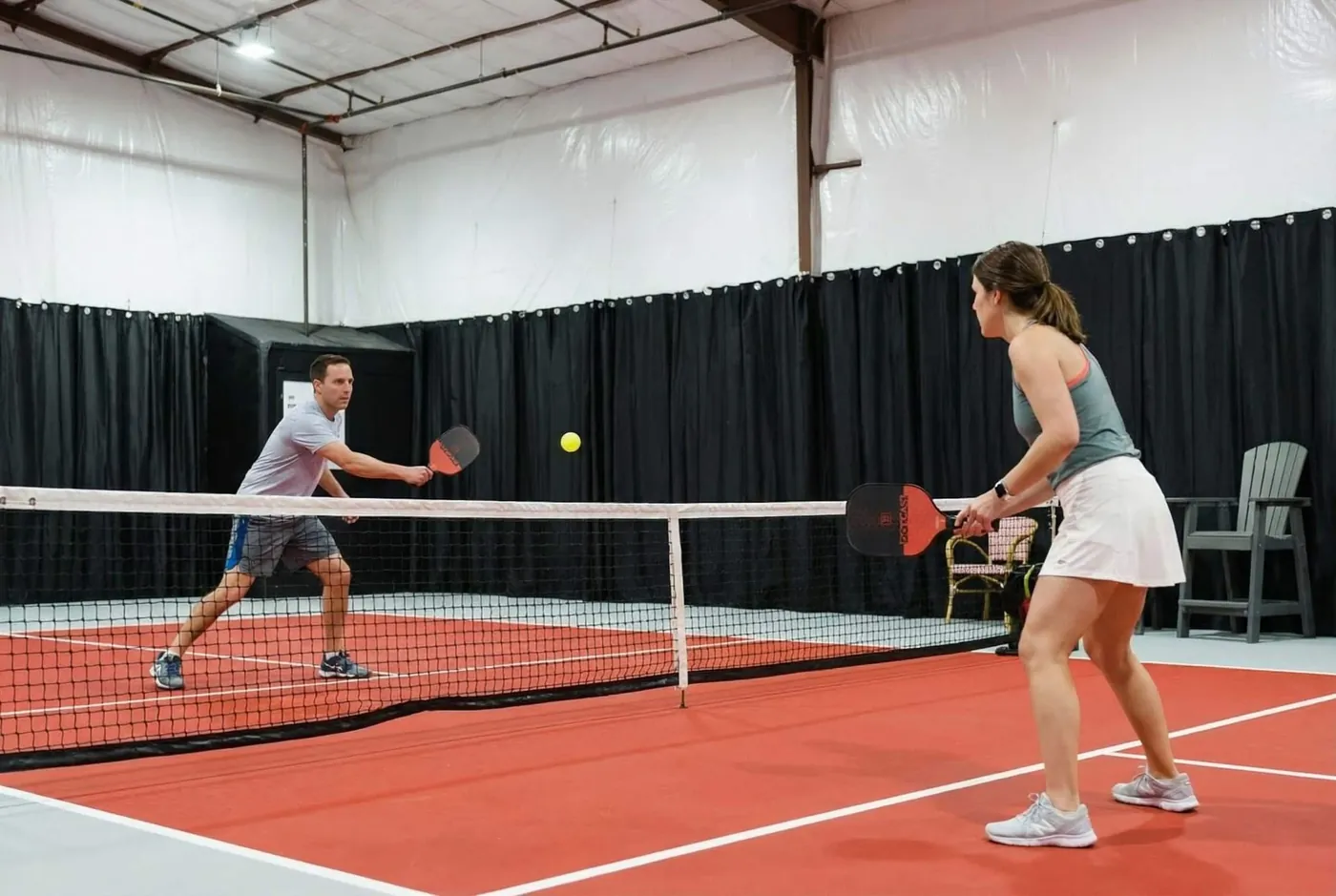
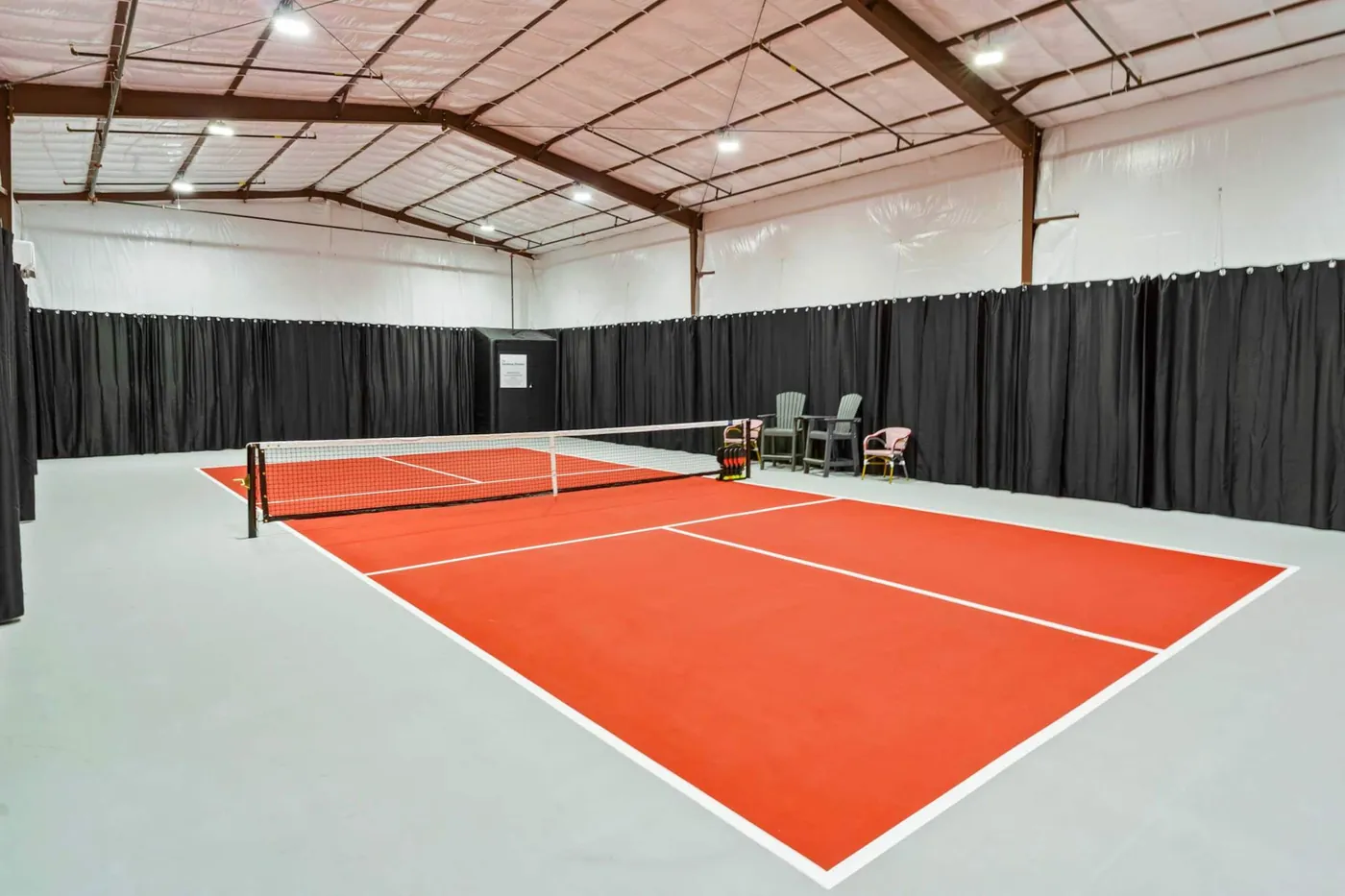
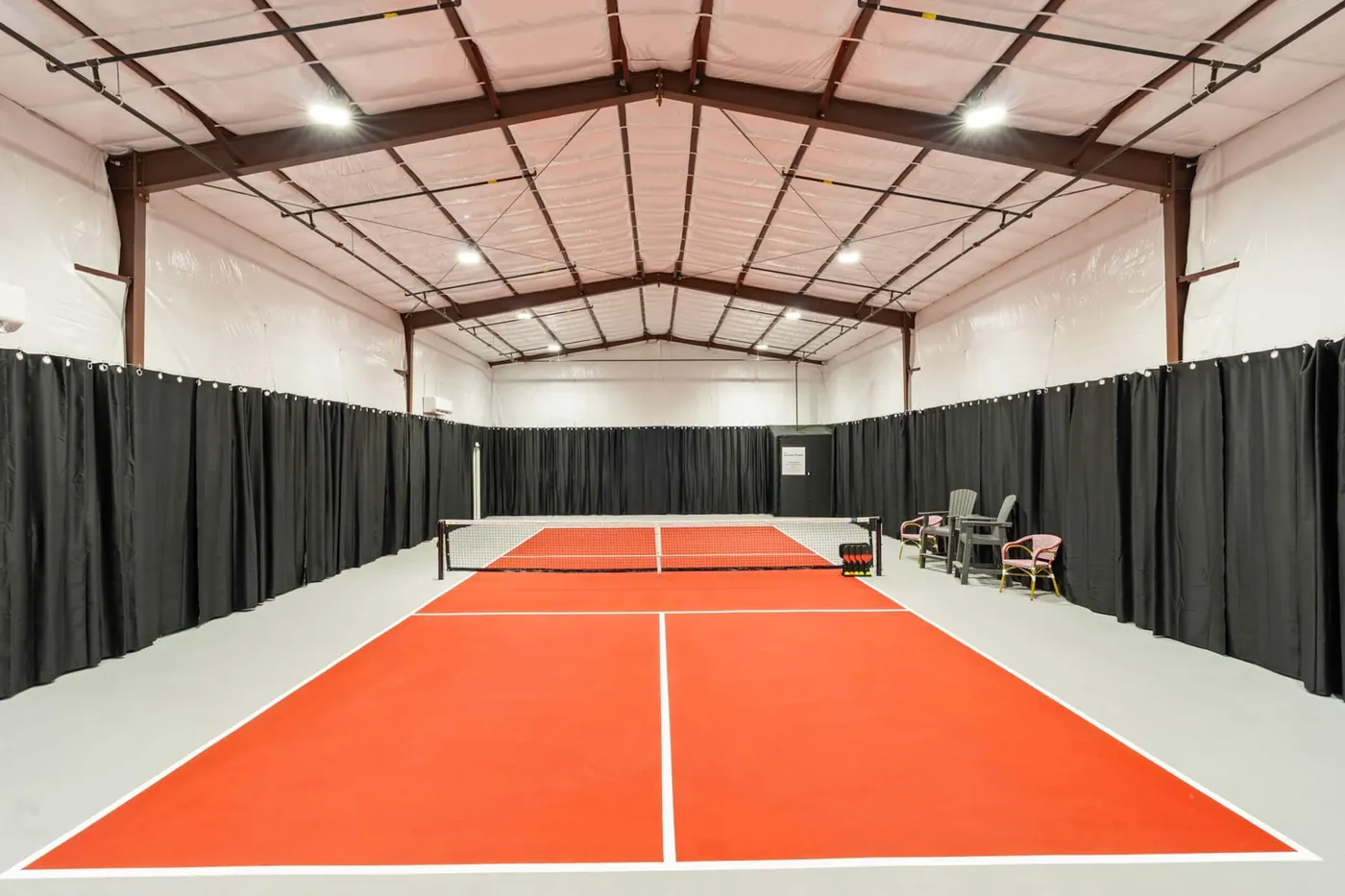
We wrote this guide because formats come up all the time on a private court, where a group has the place to itself and has to decide how to use it. The court at Sedona Pickler was built by Brian and Joanna Stoll inside a separate steel building beside the West Sedona house. It is indoors, with air conditioning, heat and bright lights, so you can play on a January morning before sunrise or a July night after dark.
The house has paddles and balls, and you bring your own court shoes. It has four bedrooms and sleeps eight, a good size for a group running a chart with everyone on hand. With no other group waiting for the court, a game can go on for as long as the group wants, and there's no need for a paddle stack unless your own group wants one.
“If you are a fan of pickleball you will really enjoy the indoor court that has AC blasting a cool 68 degrees.”
Erin, a guest in July 2026
There is plenty to do off the court, too. Between games, people drift to the foosball table, the big TV in the lounge, or the covered deck's fire table, with the two soaking tubs a few steps away. West Sedona's trailheads, restaurants and shops are a few minutes away by car. A format day pairs nicely with a morning hike, and our guide to things to do in Sedona has plenty of ideas.
If your group grows past eight, or you would like more courts for a ladder session, Posse Grounds Park is a short drive away, with eight free lit courts and a schedule of drop-in play. Our comparison of a private court and Posse Grounds sets the two side by side.
What to bring on game day
Very little equipment will run any of these formats. The list below is what we would pack for eight people. A printed chart still beats a phone in many ways, because everyone can read it at once and it doesn't go to sleep. Tape earns its place too, since you'll want to fasten that chart to a post or a wall. Bring a pen for scores, and some spare balls.
A deck of cards takes up almost no room and handles the partner draw for any format. A small whiteboard is a luxury, and it pays off when a group wants to keep running totals over two days. Everyone should have water close by, and it helps to bring a sweatshirt to put on between games, because it's easy to cool down while you wait.
Before you leave home, agree on your format for the first session, and send it to the group. People play better when they know what's coming, and you won't lose 20 minutes of court time to a friendly debate about the rules. Once you get to the court, keep things simple and let the first game start on time. You can argue about the rules at dinner.
In the bag for game day
9 itemsYour ticks stay in this browser only.
Questions people ask
What is King of the Court in pickleball?
King of the Court is a format where courts are ranked from bottom to top. After each short game the winners move up one court and the losers move down one, and most groups split partners for the next game. The winners on the top court stay there, and the losers on the bottom court stay there. It also goes by Queen of the Court and Up and Down the River.
Can you play King of the Court on one court?
Yes. The winning pair stays on, the losing pair goes to the back of the line, and the next pair steps on to challenge. Most groups set a limit, usually three games in a row, so a strong pair does not hold the court all afternoon. It suits about 6 to 12 players, and games to 7 or 9 keep the line moving.
What is the difference between King of the Court and a ladder?
In a single session the two names often mean the same thing: winners climb a row of courts and losers drop. A ladder league is different. It runs over weeks, players hold a numbered position, and they move by challenging or beating people near them. If someone at your club says ladder, ask whether they mean tonight or the whole season.
What is the fairest pickleball format for a group?
A written rotation, because everyone gets an equal share of games and a steady change of partners. Our free generator prints one for groups of 4 to 16 on up to four courts. Four on, four off is also even on court time, and it is easier to run, though it gives you fewer new partners unless you reshuffle the teams.
How does a Dreambreaker work?
A Dreambreaker is a singles game between two teams of four. It uses rally scoring to 21, win by 2, and each team's players take turns in a set order, with a new player stepping in every four rallies. Major League Pickleball uses it to settle tied matches, and it works well as a short final game for a friendly group on any court.
What format works best for mixed skill levels?
A rotating mixer, because strong and newer players keep getting paired together and nobody is sent to wait for long. If your group is big enough for three or more courts, King of the Court also works well, since players settle near others at their level after a few games. Adding up each player's own points gives you fair standings.
How long should each game be in a group format?
Most casual doubles games to 11 run somewhere between 15 and 25 minutes. For a format with a line of people waiting, shorten it: play to 7 or 9, or play to a clock of 8 to 12 minutes and let the higher score win when it sounds. Timed games also let every court change at the same moment.
Which format suits eight players on one court?
Eight fits one court well, because four play and four rest. A rotation chart gives everyone an equal number of games and a new partner each time. Four on, four off is the simplest. Winners stay with a three-game limit adds some competition. We like starting with the chart and finishing with a Dreambreaker between two teams of four.
Sources
Facts in this story were checked in November 2026 against the sources below. Event dates, prices, hours and schedules change, so confirm anything you plan around.
- PlayPickleball - Types of pickleball rec play
- Cromer Pickleball - Game play court rotations
- Skedge - King of the Court format
- Pickleheads - How round robins work, and the formats
- PickleNow - Pickleball game formats
- Pickleball.com - What is a ladder league
- Luna Sol Sports - Challenge ladder rules
- The Dink - Minor League Pickleball format explained
- DUPR - What is a Dreambreaker
- City View Pickleball - Game play
- Chilliwack Pickleball Club - Play formats
- Pickleball.com - Rally scoring vs traditional scoring
- Pickleball Union - How long does a pickleball game last
- Main Court - How to run a pickleball round robin