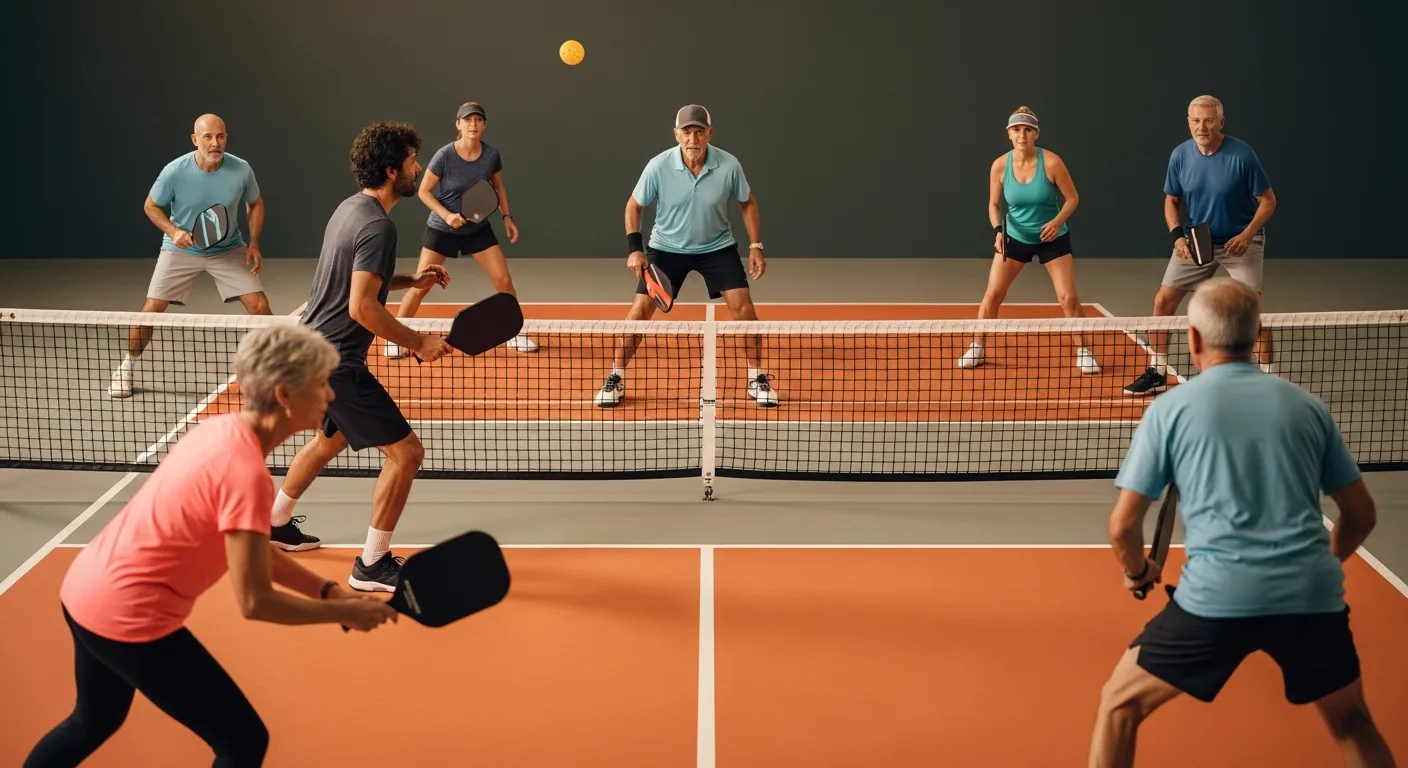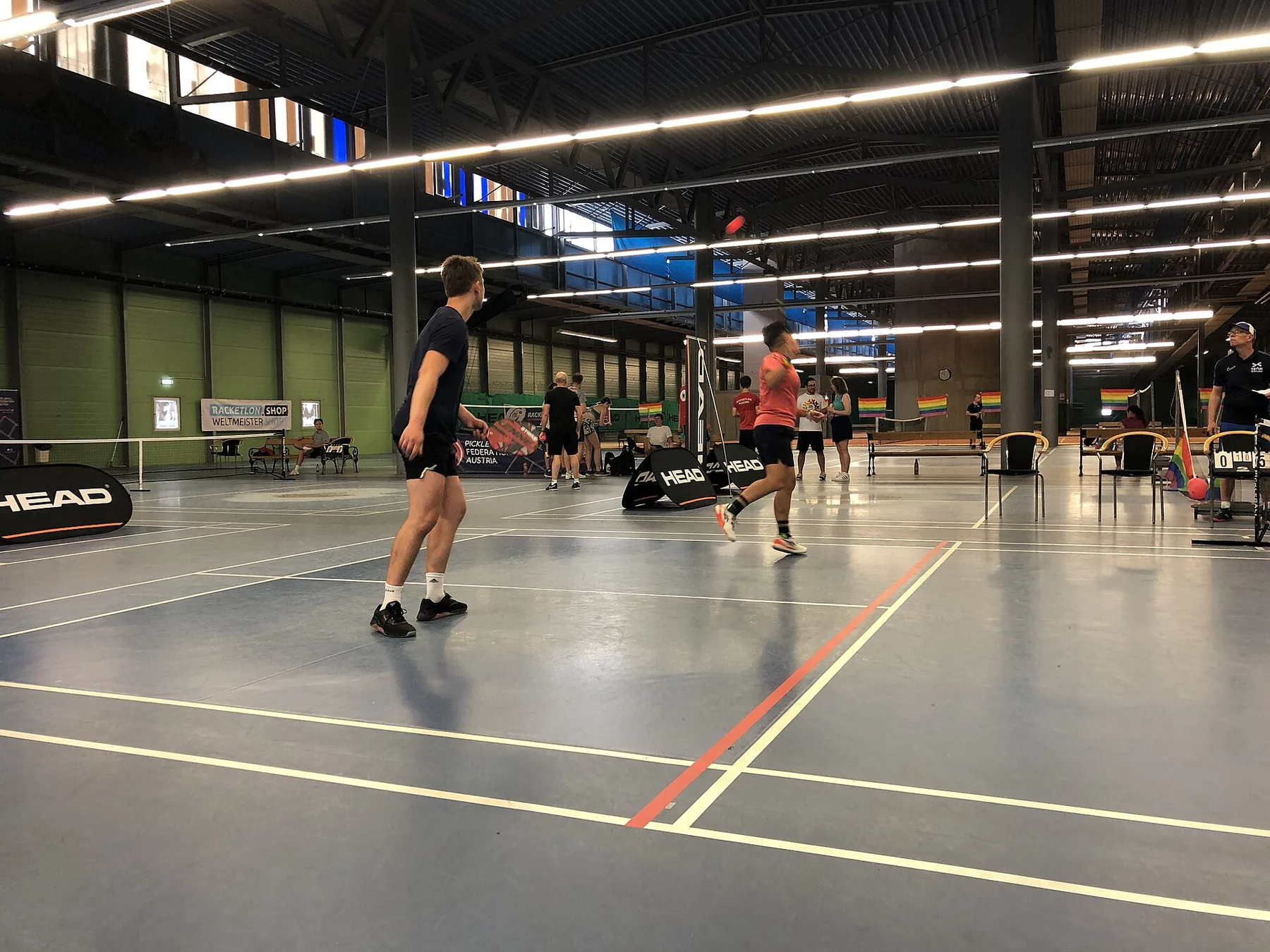
Two courts and a dozen friends sounds simple until the second round, when someone asks who is up next and five people answer at once. A written chart settles that for the whole session. This post gives you checked charts for 10 and 12 players, with the rounds where everyone comes out even, a version that keeps couples on opposite teams, and the timing to plan your morning around.
Why this group size needs a chart
Two courts hold eight players at a time. Bring ten and two people rest each round. Bring twelve and four people rest. That sounds easy to manage by eye, and for the first round or two it is. Then the questions start. Who rested last time? Have these two played together already? Why has Sam been on Court 1 three times in a row?
There is a lot to track. Ten players make 45 possible partner pairs, and twelve players make 66. Each game uses only two of those pairs, so it takes a lot of careful moves to work through them without repeats and without leaving someone on the bench too long. A good chart handles the moving around and lets the group get on with playing.
These charts do three things. They keep game counts within one of each other at every stage, so you can stop whenever you run out of time. They keep rests short and share them around. And they avoid repeat partners until the very last round, when the arithmetic sometimes requires one.
If your group is another size, our free generator will print a chart for groups of 4 through 16 players and up to 4 courts, with names on it if you want them. The charts in this post come straight from that same tool, so a 10 player chart printed there will match the table here. We wrote this post for what the tool can't tell you: where to stop, how to run the morning, what to do with the people resting, and how to handle a couple who would rather not play together.
Reading the charts
Give each person a number at the start and have them keep it all session. Each row is one round. Under Court 1 and Court 2 you will see the two games for that round, written with the partners side by side. So 5 and 10 vs 7 and 9 means players 5 and 10 are a team, playing against the team of 7 and 9. The last column lists the people resting.
At the end of a round, everybody checks the next row and walks to their court. Nobody needs to call out names, and nobody needs to remember anything except their own number. For a group that doesn't know each other well, write the names next to the numbers at the top of the sheet, or use the generator's name boxes and print it that way.
A word on which court is which. Court number doesn't mean rank in these charts, and nothing moves up or down based on who won. If your group would like the winners to climb, that is a different format, and our guide to game formats for groups covers it. Here, the only job of the court number is to tell you where to stand.
Draw the numbers out of a hat or hand them out in any order you like. Unless you are using the couples version, it makes little difference who gets which number, so a shuffle takes the question off the table. The chart treats every player the same, and it doesn't try to balance teams by skill. If you have a wide range of levels in your group, read the chapter on splitting by level before you start.
Before the first round
- Hand out numbers and write the names beside them
- Tape one copy to each court, or share a photo with the group
- Agree on a timer or a score to play to
- Name a timekeeper and a scorekeeper for round one
- Start the clock when both courts are ready
The table for 10 players
This is the full chart for ten players on two courts. It takes 12 rounds, with two games in each round and two people resting. Copy it, print it, or take a photo of it on your phone. If you plan on playing the whole thing, plan on 150 minutes or so at a brisk pace, and more with breaks.
| Round | Court 1 | Court 2 | Rest |
|---|---|---|---|
| 1 | 5 & 10 vs 7 & 9 | 1 & 4 vs 3 & 8 | 2, 6 |
| 2 | 1 & 2 vs 4 & 8 | 5 & 6 vs 7 & 10 | 3, 9 |
| 3 | 4 & 5 vs 7 & 8 | 2 & 6 vs 3 & 9 | 1, 10 |
| 4 | 1 & 9 vs 3 & 5 | 2 & 8 vs 6 & 10 | 4, 7 |
| 5 | 1 & 3 vs 6 & 7 | 2 & 10 vs 4 & 9 | 5, 8 |
| 6 | 3 & 4 vs 8 & 10 | 1 & 7 vs 2 & 5 | 6, 9 |
| 7 | 1 & 5 vs 4 & 6 | 3 & 7 vs 8 & 9 | 2, 10 |
| 8 | 1 & 6 vs 9 & 10 | 2 & 4 vs 5 & 7 | 3, 8 |
| 9 | 2 & 7 vs 3 & 10 | 5 & 9 vs 6 & 8 | 1, 4 |
| 10 | 1 & 8 vs 2 & 9 | 3 & 6 vs 4 & 10 | 5, 7 |
| 11 | 4 & 7 vs 6 & 9 | 1 & 10 vs 5 & 8 | 2, 3 |
| 12 | 2 & 3 vs 5 & 6 | 1 & 8 vs 7 & 10 | 4, 9 |
Look at any one player and you can see how the session will feel. Player 1 starts on Court 2 alongside player 4, plays again in round 2, rests in round 3, and rests once more in round 9. Most people will play several rounds and then get one off, which leaves time to grab water and talk without getting cold.
You will see that the chart moves people between the courts. If your two courts are next to each other, it hardly matters. If one has a better surface or more shade, everyone gets some time on it.
Keep a copy somewhere dry and easy to see. A sheet in a plastic sleeve taped to the net post works well, and in wind, a clipboard is better than tape. Our scoring cheat sheet is handy to print alongside it if some of your players are new to calling the score.
What the 10 player table gives you
We checked this chart with a separate script. Every round has exactly eight players on court and two resting, and nobody is listed twice in a round. After the full 12 rounds, all 45 pairs have partnered at least once.
Nobody rests two rounds in a row, at any point in the chart. With a 12-minute round, the longest anyone sits is about 12 minutes plus the walk.
Partners don't repeat until late. From round 1 through round 11, nobody partners the same person twice, and only in the last round do three pairs repeat: 1 and 8, 5 and 6, and 7 and 10. The numbers force this: the 12 rounds hold 48 partner slots, and only 45 pairs exist, so three of those slots have to be second helpings. If you stop after round 11 or earlier, there are no repeats at all.
Opponents move around too, though less evenly than partners. Over the full run, any two players face each other between one and four times, because every player has nine or ten games with two opponents in each and only nine other people to meet. Everyone plays against everyone at least once. A pair of friends who want a rematch will probably get one.
All of this holds whatever level your players are, because the chart ignores who wins. Results don't change who you play next, so the person keeping score has one job and doesn't need to work out the next game.
“The house was so comfortable for all 8 of us.”
Erin, a guest in July 2026
Where to stop with 10 players
A chart for 12 rounds is a plan, and it should bend to fit your day. Courts close, lunch gets booked and knees get tired. You can stop this chart after any round and still be fair to within a single game, but two stopping points are especially clean, because all ten players have played exactly the same number of games.
| Stop after | Games each | Pairs partnered |
|---|---|---|
| Round 5 | 4 | 20 of 45 |
| Round 10 | 8 | 40 of 45 |
| Round 12 | 9 or 10 | 45 of 45 |
Round 5 is the short session. Everyone has played four games, with four different partners, and it takes about an hour with timed rounds. It suits a group that is warming up on the first day of a trip, or one with a court booked for just 60 or 90 minutes. Twenty of the 45 pairs will have partnered by then.
Round 10 is the one we would pick for most groups. Everyone has played eight games with eight different partners, there are no repeats, and it takes about two hours with a timer. Forty of the 45 pairs have partnered by then. If you have a couples night in mind, this is also the round that makes the couples version work, which we cover further down.
Say your stopping point out loud before you start, if you know it. People pace themselves differently for 60 minutes than they do for two and a half hours. If you aren't sure how long you will have, aim for round 10 and treat rounds 11 and 12 as a bonus. And if time runs out somewhere else, say after round 8, some players will have one game more than others, and the scoring chapter shows how to compare them.
The table for 12 players
Twelve players on two courts is a bigger job, since a third of the group sits out in any round. The full chart runs 17 rounds. Most groups won't play it all in one go, but we have written it all out so you can stop wherever suits you, or spread it across two sessions.
| Round | Court 1 | Court 2 | Rest |
|---|---|---|---|
| 1 | 3 & 7 vs 8 & 10 | 1 & 6 vs 11 & 12 | 2, 4, 5, 9 |
| 2 | 2 & 11 vs 9 & 10 | 1 & 4 vs 5 & 8 | 3, 6, 7, 12 |
| 3 | 5 & 9 vs 7 & 12 | 2 & 3 vs 4 & 6 | 1, 8, 10, 11 |
| 4 | 1 & 10 vs 6 & 11 | 2 & 8 vs 3 & 12 | 4, 5, 7, 9 |
| 5 | 4 & 8 vs 6 & 9 | 2 & 12 vs 5 & 7 | 1, 3, 10, 11 |
| 6 | 1 & 11 vs 3 & 5 | 4 & 10 vs 7 & 9 | 2, 6, 8, 12 |
| 7 | 3 & 6 vs 5 & 12 | 2 & 9 vs 8 & 11 | 1, 4, 7, 10 |
| 8 | 1 & 7 vs 6 & 8 | 3 & 4 vs 5 & 10 | 2, 9, 11, 12 |
| 9 | 2 & 4 vs 9 & 11 | 1 & 12 vs 7 & 10 | 3, 5, 6, 8 |
| 10 | 2 & 5 vs 6 & 10 | 3 & 11 vs 7 & 8 | 1, 4, 9, 12 |
| 11 | 1 & 3 vs 4 & 12 | 5 & 6 vs 8 & 9 | 2, 7, 10, 11 |
| 12 | 1 & 2 vs 4 & 7 | 9 & 12 vs 10 & 11 | 3, 5, 6, 8 |
| 13 | 5 & 11 vs 8 & 12 | 2 & 6 vs 3 & 10 | 1, 4, 7, 9 |
| 14 | 1 & 9 vs 3 & 8 | 4 & 11 vs 6 & 7 | 2, 5, 10, 12 |
| 15 | 4 & 9 vs 10 & 12 | 1 & 5 vs 2 & 7 | 3, 6, 8, 11 |
| 16 | 6 & 12 vs 7 & 11 | 1 & 8 vs 2 & 10 | 3, 4, 5, 9 |
| 17 | 4 & 5 vs 10 & 11 | 1 & 6 vs 3 & 9 | 2, 7, 8, 12 |
This chart has a different feel from the one for ten. Four people are off each round, which makes for good social time and a real rest between games. Players generally get a round or two on and then a round off. In a long session, this suits anyone who likes a real rest between games, and it gives the group time to watch each other play and cheer.
If you have a third court available, though, you should use it. Twelve players on three courts all play at once, with nobody resting and every pair partnered in just 11 rounds. Our generator will print that chart for you, and there is no reason to rest four people if there's an open court nearby.
A 17-round morning is also a lot to ask of the people running it, so make it easy for them. Pass the timer and the score sheet to the resting players each round, so no one person is stuck with the job. Take a proper break around round 6 or round 9, with water and some food, and restart when people are ready. A few stretches from our warm-up and injury guide help at the restart, when legs tend to feel it most.
What the 12 player table gives you
The same script checked this chart. Every round has eight players on court and four resting, nobody is listed twice, and over the full 17 rounds every one of the 66 pairs partners at least once. Game counts stay within one of each other at every stage, from the first round to the last.
Rests come more often here. Across the full chart, nobody rests more than two rounds in a row. Through round 15, nobody rests more than one. So for most of a session, a player sits for one round and is back on court for the next. With a 12-minute round, a two-round rest comes to about 25 minutes, which is long enough to drink some water and watch a game, but not so long that anyone cools off completely if they keep a jacket handy.
Repeat partners come only in the last round. Through round 16, nobody partners the same person twice. In round 17, two pairs repeat: 1 and 6, and 10 and 11. Seventeen rounds hold 68 partner slots, 66 pairs exist, and so two have to go twice. Stop at round 16 or earlier and you will see no repeats at all.
Any two players face each other at least once and no more than three times over the full run. For a club, this makes the chart a good way to mix people who don't usually play together, and new members tend to enjoy it, since they get to meet the whole group in a single session.
As with the chart for ten, nothing depends on who wins. The chart doesn't balance teams by level, and on any given round you may see two strong players partnered against two newer ones. Over 15 or 17 rounds these things even out.
Where to stop with 12 players
With 12 players, every third round is a clean stopping point. Rounds 3, 6, 9, 12 and 15 each leave all twelve people on the same number of games. That gives you a lot of flexibility, and it means you will rarely be far from a fair place to stop.
| Stop after | Games each | Pairs partnered |
|---|---|---|
| Round 3 | 2 | 12 of 66 |
| Round 6 | 4 | 24 of 66 |
| Round 9 | 6 | 36 of 66 |
| Round 12 | 8 | 48 of 66 |
| Round 15 | 10 | 60 of 66 |
| Round 17 | 11 or 12 | 66 of 66 |
Round 6 gives everyone four games and takes roughly 75 minutes with timed rounds. It makes a good weeknight club session, or a warm-up for a tournament day. Round 9 gives everyone six games in a little under two hours, which makes a solid club session.
Round 12 and round 15 are for a full morning or a day at the courts. Round 12 gives eight games in about two and a half hours. Round 15 gives ten games in about three hours, with no repeat partners and no player resting twice in a row. By then 60 of the 66 pairs have partnered, and it's the point we would call the end of a really full session. The last two rounds are there for the group that wants to say everyone has partnered everyone.
A club that plays weekly can also use the chart across several weeks. Play rounds 1 to 6 this week and rounds 7 to 12 next week, keeping the same numbers. As long as the same twelve people turn up, the chart carries on as written, and every member gets a mix of partners over the month. If the group changes from week to week, print a new chart for each session instead.
How long the session takes
A simple sum tells you the length of a session: number of rounds times minutes per round, plus changeover time and breaks. The table uses two round lengths. Twelve minutes is a 10-minute timed game plus two minutes to change courts. Twenty is a rough figure for games to 11, once you allow for the slower game on the second court and the walk over.
| Players and stop | At 12 min a round | At 20 min a round |
|---|---|---|
| 10 players, round 5 | 1 hr | 1 hr 40 min |
| 10 players, round 10 | 2 hr | 3 hr 20 min |
| 10 players, round 12 | 2 hr 24 min | 4 hr |
| 12 players, round 6 | 1 hr 12 min | 2 hr |
| 12 players, round 9 | 1 hr 48 min | 3 hr |
| 12 players, round 12 | 2 hr 24 min | 4 hr |
| 12 players, round 15 | 3 hr | 5 hr |
| 12 players, round 17 | 3 hr 24 min | 5 hr 40 min |
The guide numbers vary a good deal. Pickleball Union puts a typical recreational doubles game to 11 at 15 to 25 minutes. Clubs that time their games often use 8 to 12 minutes: Cromer in England uses 8 to 10, and City View in Ottawa uses 12 with a 3-minute break. Main Court suggests 8 to 10 minutes for a round robin, with the leading score winning when time is called.
Add a little for real life. A water break at round 5 or 6 takes 5 to 10 minutes, and a group that started late will start late again after the break. A two-hour court booking is tight but workable at 12 minutes a round. It gives you exactly 10 rounds, a clean finish for ten players. Twelve players reach round 9 with some time left over for the water break.
For a big group, the cost of a slow changeover adds up fast. Over 15 rounds, two extra minutes a round adds half an hour. So post the chart where everyone can see it, have people look ahead to the next round while resting, and start the next round on time, even if one person is still tying a shoe. The people on court will soon get the idea.
If you're booking courts in advance, round up, because a clean finish is worth more than two extra games. Book a little extra time and use any spare minutes for a final round of winners against winners.
Timed rounds or games to 11
On two courts, we strongly prefer a timer. Both games start together and both end together, so the next round starts on time for all eight players and the people resting. With games to 11, one court may finish in 12 minutes and the other in 25. Four people then stand around waiting, and the whole session creeps along at the pace of the slowest game in each round.
When the timer goes off, finish the point being played, and the team ahead wins. Ties happen, and it helps to decide ahead of time what happens then. City View in Ottawa plays one more rally. Another way is to record the tie and move on, since a chart like this doesn't need a winner to work out who plays next. If you are adding up points for standings, a tie takes care of itself.
A middle path, which some groups prefer, is a game to 11 with a clock on it. Play the usual game, and if nobody has reached 11 when the 10 or 12 minutes are up, the team in front takes it. People get the feel of a proper game, and the session stays on the clock. A lower target helps too: games to 9 finish sooner, so the gap between the courts shrinks.
A rally-scoring game is another option if your group likes it. Because every rally scores, game length becomes more predictable, and most rally games go to 15 or 21. Rally scoring also changes the feel, and new players sometimes find it easier to follow because the score always moves. If your group is split, keep the traditional scoring for this session, since a chart's a poor place to learn a new scoring system at the same time.
A phone will do for a timer if someone can hear it. Over two courts, a loud alarm or a clap and a shout from the timekeeper does the job. Pass the phone to a resting player each round. They know who's up next because they're looking at the chart anyway.
A sample morning for 10 players
Here is how a morning might run if you have two courts from 9 until noon and ten people. Ask everyone to arrive by 9 and use the first 15 minutes for warm-ups and a few easy rallies. Hand out numbers while people are hitting, and tape up the charts. At 9:15, start round 1. Timed games of 10 minutes, with two minutes to walk over, take you through round 5 by 10:15.
Stop there for water and a snack, since everyone has now played four games. It's a good time to read out the points so far, if your group is keeping them, and to let anyone with a stiff knee sit out a round. Then start round 6 at about 10:25. Five more rounds bring you to round 10 at about 11:25, with every player on eight games and no repeat partners.
- 9:00Warm up, hand out numbers and tape up the charts
- 9:15Rounds 1 to 5, a 10-minute game and a 2-minute walk each
- 10:15Water, snacks and the first look at the points
- 10:25Rounds 6 to 10
- 11:25Add up the points
- 11:35A final game or a Dreambreaker for fun
That leaves you about 25 minutes before noon. You could play a final between the top four players, with the others cheering, or a short Dreambreaker, or you could simply keep playing rounds 11 and 12 until the time runs out. Everyone gets a good morning's play, and nobody has to rush off the court.
A club evening with twelve people works much the same way. From 6 to 8, warm up for 10 minutes, then play rounds 1 to 9 with one short water break at round 6. Everyone gets six games, and you finish on time with a fair result.
Setting up the courts
A few minutes of setup will save you a lot of confusion later. Number the courts if they aren't numbered already. A strip of tape on the post will do it. Check which ends are which, and tell people which way the court numbers run, so that no one walks to the wrong net at the start of round 1.
Print the chart large enough to read from a step or two away, and tape one to each court. The generator prints score boxes and a separate score sheet when you tick the option, and it can add names. Put a third copy where people rest, so they can look ahead. Then take a photo of it and drop it into the group chat, for anyone who wants it on their phone.
Courts next to each other bring up a small question: what happens when a ball rolls in from next door? Agree on the answer before you start. Most friendly groups simply call out, stop the point, and replay it. Ask players to send stray balls back when the point is over, and to walk behind a court rather than across it. These are the sort of small courtesies that keep two courts running smoothly.
Think about what the resting players will sit on. A bench or some folding chairs near the net post of each court keeps them close and ready, and it also gives them a good view of the game. Water and a few extra balls can go in the same place. In winter or in early morning, have everyone bring an extra layer. In a dry climate like Arizona's, you will need more water than you think, even in cool weather.
Last, decide who is running things in case a question comes up. It need not be a big job. One person simply has the last word on the chart and the clock, and it can pass to someone else at the break. A group of friends may never need them, but a club with new members will be glad to know who to ask.
Printing a chart with names on it
Numbers work fine, and a printed chart with real names works better, especially for a group that hasn't played together before. Our generator does this in about a minute. Choose 10 or 12 players and 2 courts, and it shows the same chart you see in this post. Type the names into the boxes, or paste a whole list into the first box and let it fill in the rest. The chart then redraws with people's names in place of the numbers.
A few options are worth a look before you print. The rounds control lets you pick your stopping round, so the printed chart ends where you plan to end. Shuffle mixes who gets which spot, which is handy if your group has played the same chart before. The minutes control changes the time estimate on the page and leaves the games alone. And a tick box adds score boxes to the printout, with a separate sheet for adding up points at the end.
Don't shuffle if you are using the couples version, because the pairs on that list depend on the exact numbers. Instead, enter the names in order so that each couple lands on one of the listed pairs. Set the rounds to 10 for ten players or 15 for twelve, then print.
If you want to send the chart ahead of the session, the copy link button gives you an address for that exact setup, without the names, which stay in your own browser and are never sent to us. Your group can open the link on a phone and see the same rounds. Print one copy for each court and one for the bench, and bring a spare, because someone always wants to take one home.
What the resting players do
Rest is built into these charts, and in a group of twelve, four people sit out in each round, so a little planning here pays off. It helps if the people who are resting have something useful to do. The natural jobs are running the timer, writing down the scores, and fetching balls. A small rota, or simply passing the clipboard along, keeps anyone from being stuck with it.
With 12 players, four people rest each round, which is enough for a game of their own if you have a third space. On a spare court, the four can play a short game to 5. These mini-games keep people warm and give the newer players some extra time with the ball, and they don't count toward anything.
Otherwise, stay warm and stay near. A resting player who wanders off to the car holds everybody up at the start of the next round. Sip some water, put on a jacket, and take a look at the chart for your next game. If you've been sitting for two rounds, some leg swings and a walk around the court will get you ready. You'll enjoy your next game more.
The bench is also where people get to know each other. These charts mix the group, and the people resting are often the ones who haven't met yet. Introduce the new member, watch your partner's serve, and pass on a kind word or a tip.
For a family or a mixed-age group, older kids can take on the timer and score sheet with some pride. It keeps them involved during the rests, and they get to shout at the grown-ups when the time is up.
“After hiking or pickleball, the outdoor tubs and firepit remain big hits.”
Hannah from La Grange, Kentucky, May 2026
Keeping score when game counts differ
Many groups don't keep score across a session, and that's a fine way to play. If yours does, every player totals the points their side won in each game they played. The highest total wins, with point difference as the tiebreak. Because partners change, individual totals reward steady play rather than one lucky pairing.
This only works cleanly when everyone has played the same number of games. So the easiest way to get fair totals is to stop where game counts match: round 5 or 10 for ten players, or round 3, 6, 9, 12 or 15 for twelve. Then you can compare totals straight across the group, and nobody has to do any division.
If you stop anywhere else, some players will have one game more than others, and a straight total will favor them. The fix is to compare average points per game. Divide each player's total by their games played, and compare those. Here is a small example with two players at the end of the full 12-round chart for ten.
| Player | Points and games | Average per game |
|---|---|---|
| Player 1 | 88 points in 10 games | 8.8 |
| Player 2 | 81 points in 9 games | 9.0 |
Player 2 has fewer points in total and still comes out ahead on the average, which is the fair result. With timed games, you will get a mix of scores like 9 to 7 at the buzzer, and points work well for these. Some clubs count wins instead, as Rnkd and Main Court both describe, with point difference as the tiebreak. Wins are simple, but they can leave several players tied on the same record, so you might use points anyway if your group wants one clear winner.
A printed score sheet from the generator gives each player a line. Or make your own with numbers down the side and rounds across the top. Have people call out their score to the person resting at the clipboard as they leave the court. At the end, the person with the best head for numbers adds it up, usually with several people looking over their shoulder and helping.
Late arrivals and early departures
A printed chart assumes the same group all the way through, and a real group rarely cooperates. People get stuck in traffic or have to leave for an appointment, and someone's knee has had enough by round 8. The fix isn't difficult. Finish the round you're on, change to a chart for the new number, and carry on from there.
The generator makes this quick. Open it on a phone, change the player count, and you have a new chart in seconds. If you can't get online, a resting player can fill the empty spot until the next round where game counts match.
| Players on 2 courts | Rounds to partner everyone | Games each | Longest rest |
|---|---|---|---|
| 9 | 9 | 8 | 1 round |
| 10 | 12 | 9 or 10 | 1 round |
| 11 | 14 | 10 or 11 | 2 rounds |
| 12 | 17 | 11 or 12 | 2 rounds |
| 13 | 20 | 12 or 13 | 2 rounds |
Going from ten down to nine is a lucky move, since nine players on two courts have a tidy chart: 9 rounds, eight games each, and only one person resting per round. Going from ten up to eleven takes you to 14 rounds. Three people rest per round, and the rest can run to two rounds in a row. For any of these, start the new chart at round 1, and give anyone who just rested a number that plays in that round.
The standings need one small adjustment. Once the group has changed, compare by average points per game rather than by total. A person who left at round 8 can still have a fair average, and someone who came late isn't punished for it. If you only care about the fun of it, skip all this and carry on.
The best way to handle the problem is to plan for it ahead of time. Ask people to tell you when they have to leave, before you start. If you know that one of your twelve has to go at round 6, you can choose to finish the first chart at round 6, when everyone is even, and start a new one for eleven players. Nobody's numbers are out of balance, and nobody feels bad for leaving.
Splitting the group by level
A full mixer puts everyone with everyone, and that is its charm. It also means a strong player will sometimes be partnered with a beginner against two other strong players, and for a competitive group, that can get frustrating. If your ten or twelve players fall into two clear levels, you have a better option: give each level its own court.
Ten players split nicely into two groups of five, and twelve split into two groups of six. Each group runs its own table on its own court. The one-court rotation post has these written out. Five players take 5 games, with each person playing 4 and resting 1, and partnering every other player once. Six players take 9 games for a shorter session, or 15 for the full set.
Splitting this way has some real advantages. Games tend to be closer, nobody is carried, and each group can play at its own pace. To keep a bit of movement, swap the top player or two from the lower court with the bottom player or two from the upper court at the halfway point. That gives you a rough ladder, with something to play for. For a fuller version of that idea, see King of the Court in our guide to game formats.
A mixed day can give you the best of both. Play a full mixer for the first hour, so people get to know each other. Then, take a break and split by level for the second hour. Newer players often enjoy the chance to win a few points against people their own level, and stronger players get to hit hard for a while. If you aren't sure where people stand, the DUPR explainer gives you a quick way to sort them.
Be kind about how you do this. It helps to call the courts something neutral, such as Court A and Court B, or even by the names of two nearby trails. And let people choose for themselves where they'd like to play, whenever you can. Most people place themselves pretty accurately, and they're happier when it was their call.
Couples who would rather play apart
Some couples love playing together, and others would rather be on different teams. These two charts handle the second group neatly, which we found when we looked at which pairs had not yet partnered at each stopping point.
Take the chart for ten players and stop after round 10. By then, exactly five pairs have not partnered, and those five pairs use all ten numbers, with no overlaps. So if your group is five couples, assign each couple one of those pairs of numbers. Every person then plays eight games with eight different partners, and none of those partners is their own spouse. The twelve-player chart does the same thing if you stop after round 15, with six pairs, so six couples can play ten games each.
| Group | Stop after | Give each couple one pair of numbers |
|---|---|---|
| 5 couples, 10 players | Round 10 | 1 and 10, 2 and 3, 4 and 7, 5 and 8, 6 and 9 |
| 6 couples, 12 players | Round 15 | 1 and 8, 2 and 10, 3 and 9, 4 and 5, 6 and 12, 7 and 11 |
Couples will still meet across the net. Every one of these pairs faces each other at least once in the rounds played, and some face each other three times. A little friendly rivalry at home never hurt anyone.
Your group doesn't have to be all couples for this to help. If one couple wants to stay apart, give them one of the pairs on the list and fill the other numbers however you like. And it works for any two people who should stay on opposite teams: a parent and child who argue on court, for example, or two strong players whose partnership would be unfair to everyone else.
You can use this the other way, too. If couples would like to finish together, play on through rounds 11 and 12 for ten players, or rounds 16 and 17 for twelve. Those are the rounds that bring these pairs together for the first time, which makes a pleasant finish to a morning of playing apart.
Fixed partners on two courts
Sometimes the group is a set of pairs, and the pairs want to stay together. Ten players make five teams and twelve make six, and each team can play every other team once. These schedules are much shorter than a mixer, since there are far fewer matchups to get through. The generator doesn't cover fixed teams, so we worked these two out and checked them here.
Five teams on two courts fit perfectly into 5 rounds. Each round has two games, and one team rests. Every team plays 4 games, and no team rests more than once.
| Round | Court 1 | Court 2 | Rest |
|---|---|---|---|
| 1 | A vs B | C vs D | E |
| 2 | A vs C | B vs E | D |
| 3 | A vs D | C vs E | B |
| 4 | A vs E | B vs D | C |
| 5 | B vs C | D vs E | A |
Six teams on two courts take 8 rounds, with each team playing 5 games. Two teams rest in most rounds, and no team rests twice in a row. The last round has just one game, which you can make the feature match, with everyone else watching.
| Round | Court 1 | Court 2 | Rest |
|---|---|---|---|
| 1 | A vs B | C vs D | E, F |
| 2 | A vs E | B vs F | C, D |
| 3 | A vs C | B vs D | E, F |
| 4 | C vs E | D vs F | A, B |
| 5 | A vs F | B vs E | C, D |
| 6 | C vs F | D vs E | A, B |
| 7 | A vs D | B vs C | E, F |
| 8 | E vs F | open | A, B, C, D |
At 12 minutes a round, five teams need about 60 minutes and six teams about 96. A group with more time can play games to 11, since the numbers are so small. Or play the whole thing twice, in which case a team can take a real rematch against whoever beat them the first time. To name a winner, use the win count, then point difference, then head to head.
With fixed partners, a pair on a losing run can have a long morning. If your group is happy to set the teams, put one stronger player with one newer one. Otherwise, play with the partners you came with and don't take the results too seriously. If you'd like to turn this into a proper event, add a short final between the top two teams at the end. A read through our doubles positioning tips helps a team that will spend the whole morning together.
Other formats for this group size
A chart isn't the only way to run ten or twelve people on two courts, and you may want a change of pace partway through a long day. Our full guide to game formats goes through these one at a time. Here is how they fit this particular group.
On two courts, King of the Court still runs, though with fewer rungs on the ladder. The winners on the lower court move up and the losers on the upper court move down. With more than eight people, you need a way to bring in the people who are waiting. The usual method: the losing pair on the lower court sits out, and the next two people waiting take their place. Players then climb from there. It's lively and fast. Just remember that winners will play a bit more than others.
Popcorn works too, with numbers drawn at random each round, usually by an app. It gives you something different each time, and it copes easily if people come and go. Since it doesn't guarantee an even share of rests, it's a good choice for a casual evening and a poor choice if you plan on keeping score.
And if you have twelve, a three-court chart beats any of these if you can find one more court. Ask the park, or check whether the next court over is free for a couple of hours. Twelve players on three courts get every pair partnered in just 11 rounds, nobody rests, and at 12 minutes a round it takes a little over two hours.
For a big finish after a long morning, try a Dreambreaker between two teams. With twelve players, run it with two teams of six. It's singles with a change of player every four rallies, and our guide shows how to run it.
Playing this in Sedona
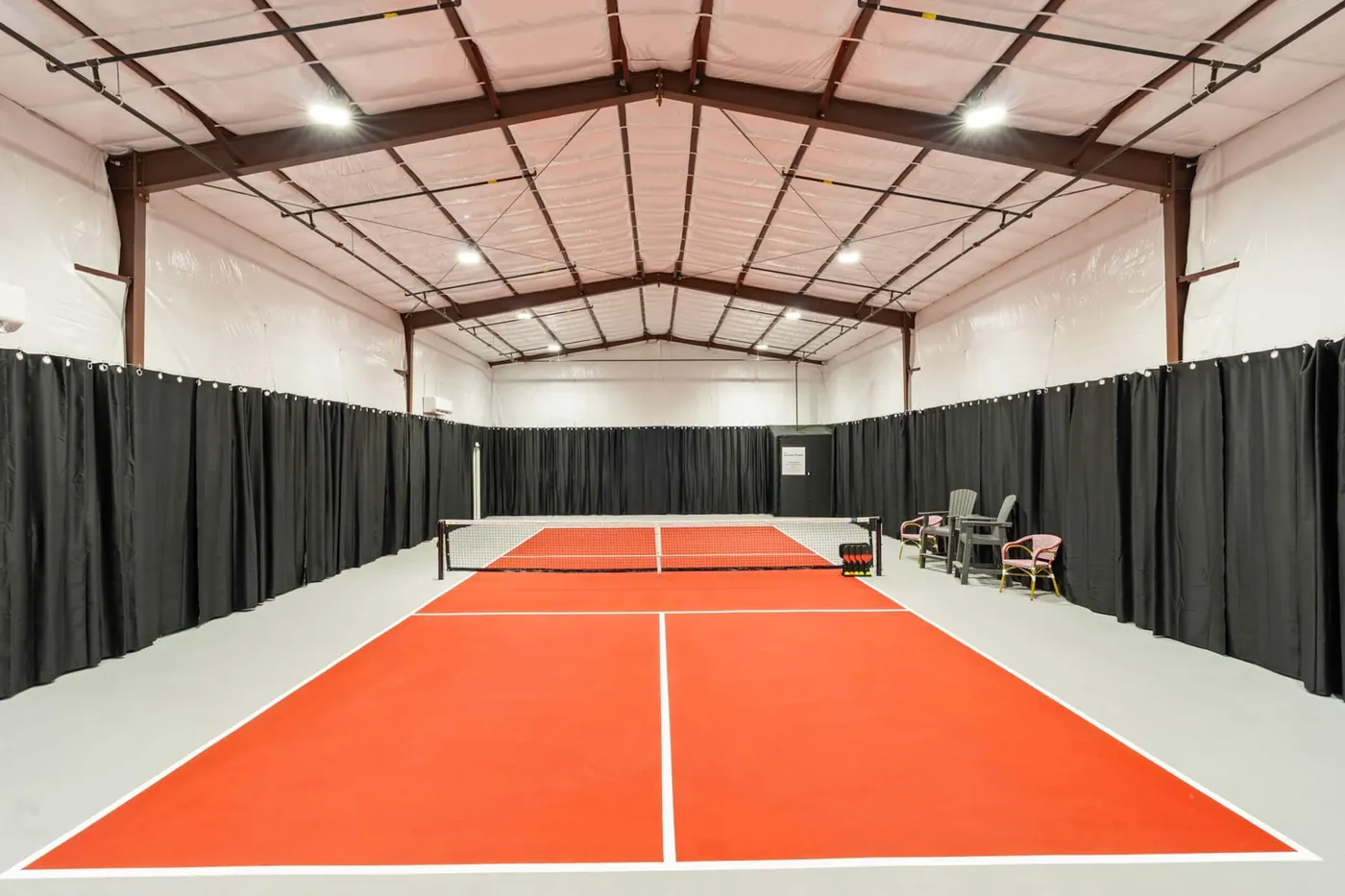
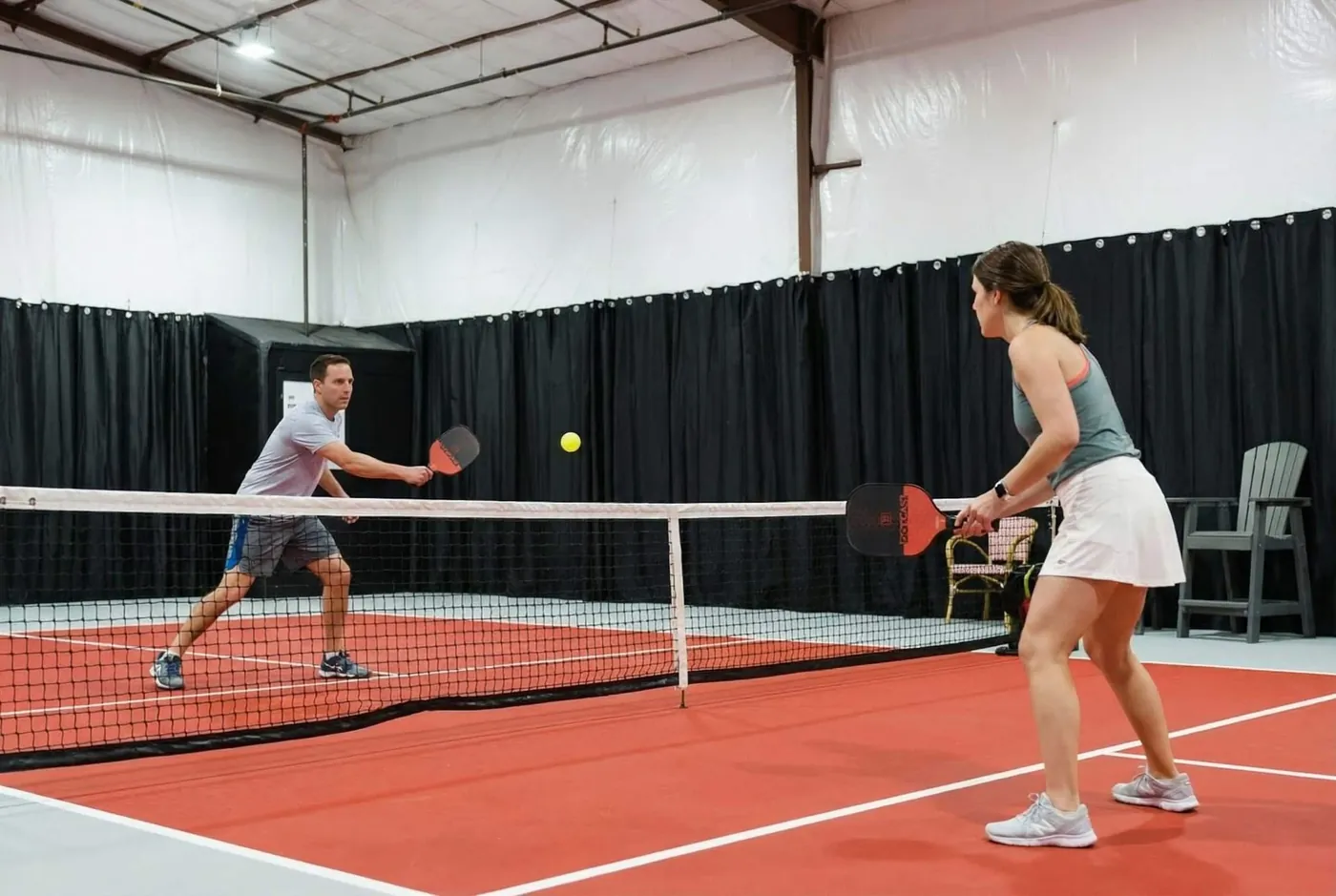
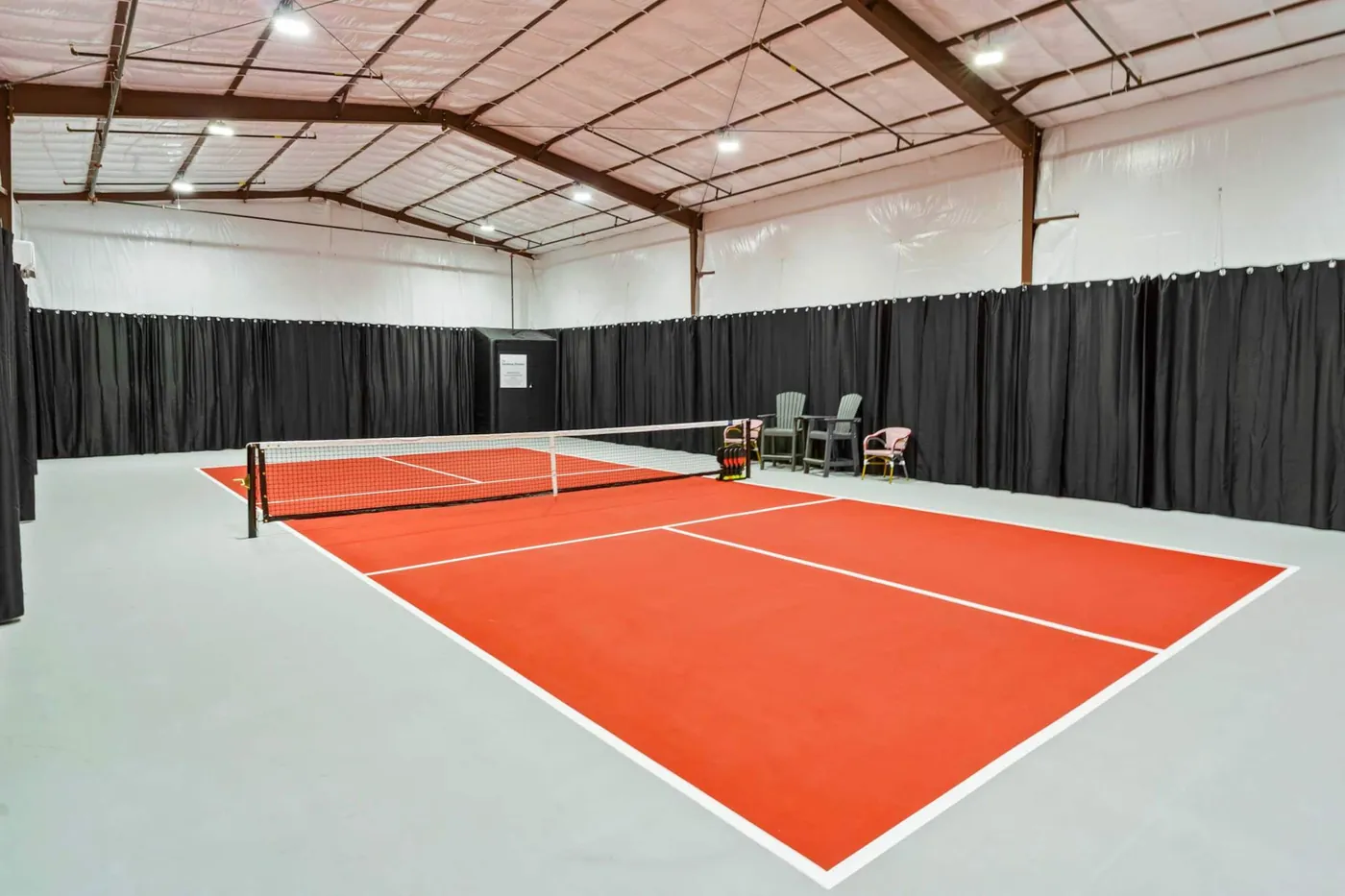
Our house in West Sedona sleeps eight and has one private indoor court, which Brian and Joanna Stoll built next to it. A group of eight fits it well, and the eight-player chart covers it. On one court, it runs as 14 games with four people on at a time.
For a bigger session in town, the city's Posse Grounds Park has eight lit public courts that cost nothing and can't be reserved, and our page on where to play in Sedona has the details. A group of eight staying at the house can meet up there with friends or a local club for a morning on two courts, then head back for a quieter game on their own court in the afternoon. There's no booking at the park, so go early on a weekend, and be ready to share.
On a club trip, you could warm up with the eight-player chart at the house, spend a morning on the public courts with anyone else in town, and leave time for the red rocks. Planning help is in our group trip guide, and the weekend itinerary shows how to fit in a hike and a good dinner.
The court at the house is indoors with heat, air conditioning and bright lights, so a session can start before breakfast in winter or after sunset in summer. Paddles and balls are provided, and guests bring court shoes. The rest of the group can be in the tubs on the deck, or at the foosball table in the bunk room, until it's their turn.
“Our family had so much fun being able to play whenever we wanted to.”
Karen from Mesa, Arizona, August 2026
How we checked these charts
It is surprisingly hard to write a rotation like this by hand, and easy to get it subtly wrong. So we didn't write these by hand. The 10 and 12 player tables come straight out of the engine that drives our generator, which searched for schedules ahead of time, and the tables are stored in a file on the site.
Two scripts that share no code with that engine then counted everything. One goes through every setup the generator offers, 52 in all, at each of the 816 rounds you could stop on, and confirms the promises above: everyone plays within one game of everyone else, no two people partner a second time until the final round, and a full run covers every pair. It found no faults when we ran it on November 5, 2026. The other is the counter we wrote for our one-court rotation post, and its counts of games, partners and opponents agree.
A third small script, written for this post, checked the things that are specific to it. It found the even stopping points, proved that the couples lists use every number exactly once and that those pairs never partner before the stop, and worked through the fixed-team schedules. A program filled in the tables above from those results, so nobody typed them by hand.
One thing these checks can't tell you is whether your group will have a good time, or how long your games will really take. Those depend on your people and how they play. Start with a chart, use a timer, keep it friendly, and change whatever isn't working. If you find a mistake in anything here, we'd like to hear about it, since these charts are meant to be used by real people on real courts.
For the morning of the session
8 itemsYour ticks stay in this browser only.
Questions people ask
How many rounds does a round robin take for 10 players on 2 courts?
Twelve rounds, if you want every player to partner all nine others at least once. Each round has two games, so eight people play and two rest, and nobody rests two rounds in a row. Over the full run each player gets 9 or 10 games. If you have less time, stop after round 5 or round 10, when game counts are equal.
How many rounds does a round robin take for 12 players on 2 courts?
Seventeen rounds to partner everyone. Each round uses eight players and rests four, and nobody rests more than two rounds in a row. Over the full run each player gets 11 or 12 games. That is a long session, so most groups stop after round 6, 9 or 12, at which point everyone has played the same number of games.
How long does a 10 or 12 player round robin take?
At 12 minutes a round, walk included, 10 rounds take about two hours, and 15 rounds take about three. Add a water break or two. Games to 11 run longer, about 15 to 25 minutes each, and the courts will finish at different times, which is why we suggest a timer for this size of group.
Can couples be kept apart in a pickleball round robin?
Yes, with these charts. For 10 players, give each couple one of these number pairs: 1 and 10, 2 and 3, 4 and 7, 5 and 8, or 6 and 9, and stop after round 10. For 12 players, use 1 and 8, 2 and 10, 3 and 9, 4 and 5, 6 and 12, or 7 and 11, and stop after round 15. No couple partners in those rounds.
How do you score a round robin when players have different game counts?
Stop at a round where everybody has played the same number of games, then compare total points. If you play the full chart, some players will have one game more than others, so use points per game instead. Divide each player's total by their games played. Point difference makes a good tiebreak.
What should players do when they rest?
Keep them useful and warm. One resting player can run the timer and another can write down scores. With 12 players, four people rest each round, which is enough for a short game of their own if you have a third space. Otherwise they can stretch, drink some water and check the chart so they are ready for the next round.
What if an eleventh player shows up or someone leaves?
Finish the round you are playing, then change charts. Open our free generator, set the new player count and courts, and print a fresh chart. Eleven players on two courts take 14 rounds to partner everyone, and nine players take 9. Carry the scores over as an average per game, so the change doesn't help or hurt anyone.
Can Sedona Pickler host a round robin for 12 players?
The house sleeps eight and has one private indoor court, so these two-court charts are built for a club or a public park. A group of eight fits our court well, with its own chart. For a bigger Sedona session, Posse Grounds Park offers eight lit public courts at no charge, first come, first served. A few friends in town can join you there.
Sources
Facts in this story were checked in November 2026 against the sources below. Event dates, prices, hours and schedules change, so confirm anything you plan around.
- Sedona Pickler - Round-robin generator
- Main Court - How to run a pickleball round robin
- Pickleheads - How round robins work
- Rnkd - Complete organizer's guide
- PlayPickleball - Types of pickleball rec play
- Cromer Pickleball - Game play court rotations
- City View Pickleball - Game play
- Pickleball Union - How long does a pickleball game last
- USA Pickleball - Rules
- Pickleball.com - Rally scoring vs traditional scoring
Cover photo: SET04SARAH2024 / Wikimedia Commons (CC BY-SA 4.0) · Resized.