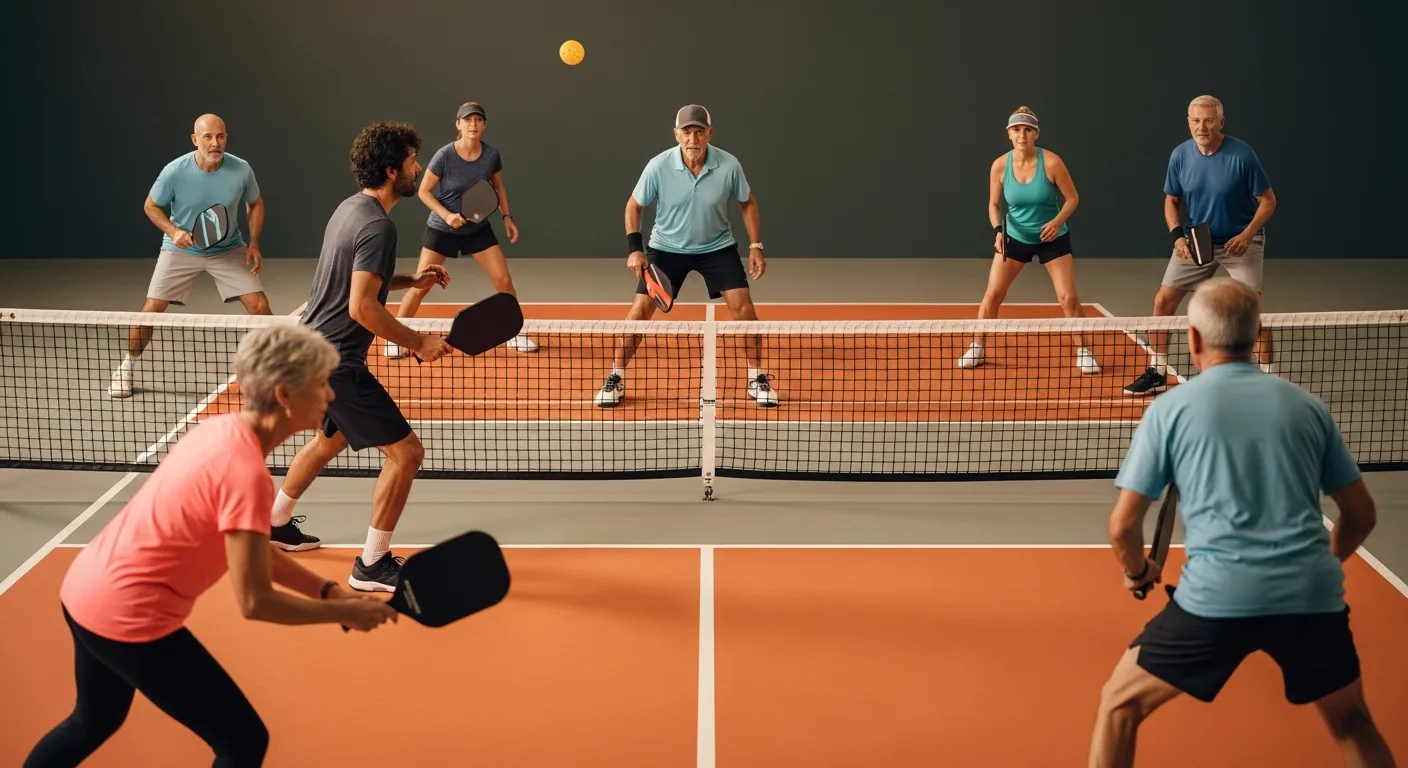
Four players fill a pickleball court, and eight make a neat round-robin. Five, six or seven need one more thing, a written order for who plays and who rests. These tables give you that order for a single court, so everyone plays the same number of games, nobody waits long, and the group can stop keeping track in their heads.
Why in-between groups need a written rotation
Doubles takes four people. Bring five and one person rests every game. Bring six and two rest. Bring seven and three rest. That is the whole puzzle, and it is a pleasant one to have, because it means you brought enough friends to make a trip of it.
Most groups start by winging it. The usual first idea is winners stay on, which is fun for the strongest team and slower for everyone else. The next idea is next person up, which works for two or three games until somebody asks who has sat out the most and nobody can remember. By the fourth game, two people have played together twice, one person has rested twice, and a friendly argument has started.
A written rotation settles all of that before anyone picks up a paddle. A good one does three things. It gives every player the same number of games. It spreads the rest evenly, so everyone gets regular breaks. And it moves the partners around, so that by the end of the session you have played with most of the group and against the rest.
The tables in this post were built for one court, which is what most vacation homes, driveways and small clubs have, and what we have at Sedona Pickler. We ran each one through a small program that counted every game, partner and rest, and the last chapter shows the results. If you have a group of exactly eight, our 8 player round-robin has its own table, and there the two games in each round run back to back. For a bigger group, we have charts for ten or twelve people on a pair of courts and an overview of other ways to run a group session.
A note on what follows: these are schedules for friends and family having a good time. They use the standard game, and nothing here changes how pickleball is played. If you want a refresher on the rules, keep our beginner's guide to rules and scoring open on someone's phone.
How to read the tables
Every table in this post uses the same layout. Each player gets a number. Each row is one game. "2+5 vs 3+4" means players 2 and 5 are partners against players 3 and 4, and the last column tells you who rests during that game. When the game ends, everyone looks at the next row and goes where it says.
The numbers are just seats at a table, so hand them out however you like. Drawing them at random is the easy way and it avoids any feeling that someone set it up. We suggest pulling numbers from a cup and writing the names beside them on a phone or a sheet of paper that sits by the court. If your group has couples, kids or a wide range of skill, read the chapters on those before you draw, because a little planning in how you hand out the numbers goes a long way.
Before the first serve
- Pick the table that fits your group size and your time
- Draw numbers and write the names down where everyone can see them
- Agree on the game length and how you will keep score
- Warm up together for a few minutes
- Play the first row and move down the list
Each row is one game of normal doubles. USA Pickleball's standard is a game to 11, win by 2, with only the serving team able to score, and that is what we assume unless you choose something shorter. The chapter on shorter games gives you options if the group is large or the afternoon is short.
One small habit keeps things moving. Have the people resting call out the next game as the current one ends, so that the four players on deck are already walking over with their paddles. It saves a surprising amount of time across a session, and it gives the people on the bench a job.
You will also notice that we talk about games rather than rounds. Many round-robin charts talk about rounds because clubs have several courts going at once. With one court, only one game happens at a time, so a game is the unit that matters, and it is the unit you will count when you plan your afternoon.
The rotation for five players
Five is the neatest group of the three, and this table is the one we would frame if we framed these things. Five games, one player resting in each, and the rest moves straight down the list.
| Game | Teams | Rests |
|---|---|---|
| 1 | 2+5 vs 3+4 | 1 |
| 2 | 1+3 vs 4+5 | 2 |
| 3 | 2+4 vs 1+5 | 3 |
| 4 | 3+5 vs 1+2 | 4 |
| 5 | 1+4 vs 2+3 | 5 |
Here is what that gets you. Each player plays 4 games and rests 1. Each player partners every other player exactly once, and plays against every other player exactly twice. There is no way to make it more even than that, because every pair of people gets precisely the same treatment. This kind of arrangement is rare in schedules. Five happens to be a number where it works out perfectly.
The rest is also as gentle as it can be. Nobody sits for more than one game in a row, and at a normal pace that means a rest of about 15 to 25 minutes before you are back on. That is long enough to get some water and catch your breath, and short enough that you stay warm.
One thing to watch: a player can play four games in a row. Player 5, for example, plays games 1 to 4 and then rests in game 5. If your group has someone who prefers to pace themselves, give them number 2 or 3, which puts their rest in the first half of the set.
At 15 to 25 minutes a game, this set takes roughly 75 minutes to two hours. One pass through the table makes a good morning or evening on its own. If you are still fresh at the end of it, the next chapter shows how to keep going.
Playing a second set with five
When five players want more than one pass through the table, the easy answer is to draw numbers again and start over. Partners will repeat, since you have already partnered everyone once, but the combinations change. You will face different pairs than you did before, and that keeps the second set from feeling like a rerun.
There is one thing to arrange when you redraw. The player who rested in the last game of the first set has just had a break, and the four others have just finished playing. So the rested player should not draw number 1, because number 1 rests in the first game of the new set and would end up sitting twice in a row. The simplest fix is to have that player take number 5 for the next set, or any number other than 1, and let everyone else draw from what remains.
Two passes make 10 games, and each player plays 8 and rests 2. At an easygoing pace that is about two and a half to four hours of pickleball, which is a lot for most recreational players in a single sitting. We would split it, with one set before lunch and one after, or one set in the morning and one in the evening. Playing the second set after a break also means nobody plays eight games on tired legs.
If you like a competitive finish, run the first set for fun and use the totals to seed the second. Give the top scorer and the lowest scorer numbers 1 and 3, since 1 and 3 partner in game 2. Nothing else about the schedule changes, and the strongest player and the newest player get some time on the same side of the net early on.
A group of five can also take the second set as a chance to try something different on the shots. Pick one skill for the set, such as the third-shot drop or dinking at the kitchen line, and agree to go for it even when it costs a point. Everyone improves, and the scoreboard takes itself a bit less seriously.
The short rotation for six players
Six is a common size for a group trip: three couples, say, or a family with older kids. With two people resting every game, you want a table that keeps the rests short and moves everyone around. This one takes nine games.
| Game | Teams | Rests |
|---|---|---|
| 1 | 1+3 vs 2+6 | 4, 5 |
| 2 | 1+6 vs 3+4 | 2, 5 |
| 3 | 1+4 vs 2+5 | 3, 6 |
| 4 | 2+4 vs 3+5 | 1, 6 |
| 5 | 2+3 vs 5+6 | 1, 4 |
| 6 | 1+4 vs 3+6 | 2, 5 |
| 7 | 2+5 vs 4+6 | 1, 3 |
| 8 | 1+2 vs 4+5 | 3, 6 |
| 9 | 1+5 vs 3+6 | 2, 4 |
Each player plays 6 games and rests 3. Nobody rests for more than 2 games in a row, and nobody plays more than 3 in a row, so everyone gets regular breaks without going cold. Each player partners all five of the others at least once. Six games and five possible partners means one partner has to repeat, and this table repeats the same three pairs: 1 and 4, 2 and 5, 3 and 6. Those pairs play together twice.
That repeat turns out to be useful, because you get to decide who it falls on. If you have three couples who enjoy playing together, give each couple one of those number pairs. If you have three strong players and three newer ones, pair them across those numbers so the newer player gets two games alongside someone who can help. If everyone would rather mix freely, draw at random and let the repeat fall where it may.
At 15 to 25 minutes a game, nine games take a little over two hours at the quick end and close to four at the slow end. For most groups, that is a full session. If you want it to fit in a morning, the chapter on shorter games will bring it down without changing a line of the table.
Every game leaves two players on the bench together, which is more fun than it sounds. Those two can keep score, take the odd photo or head for a cold drink. Over the nine games, each resting pair changes often enough that you end up chatting with most of the group as well as playing with them.
“The house was so comfortable for all 8 of us.”
Erin, a guest in July 2026
The full rotation for six players
If your group has the time, the 15 game table has every pair partner exactly twice. It is long, so treat it as two sessions rather than one.
| Game | Teams | Rests |
|---|---|---|
| 1 | 1+2 vs 3+4 | 5, 6 |
| 2 | 2+6 vs 3+5 | 1, 4 |
| 3 | 1+6 vs 2+4 | 3, 5 |
| 4 | 3+6 vs 4+5 | 1, 2 |
| 5 | 1+3 vs 2+5 | 4, 6 |
| 6 | 1+5 vs 4+6 | 2, 3 |
| 7 | 1+3 vs 2+4 | 5, 6 |
| 8 | 2+3 vs 5+6 | 1, 4 |
| 9 | 1+4 vs 3+6 | 2, 5 |
| 10 | 2+6 vs 4+5 | 1, 3 |
| 11 | 1+4 vs 3+5 | 2, 6 |
| 12 | 1+6 vs 2+5 | 3, 4 |
| 13 | 2+3 vs 4+6 | 1, 5 |
| 14 | 1+5 vs 3+4 | 2, 6 |
| 15 | 1+2 vs 5+6 | 3, 4 |
Each player plays 10 games and rests 5. Nobody ever rests twice in a row, which is the best part of this table, because you are never off the court for more than one game. Nobody plays more than 3 in a row, either. And every possible pair partners exactly twice, so by the end, you have played two games beside each of the other five people.
The natural place to split is after game 8, when the set is a little more than half done. At that point, everyone has played 5 to 6 games. Stop for lunch, then come back for the last seven. If you are at the house for a long weekend, you can also spread it over two days, with the first half on arrival evening and the second half the following afternoon.
The full table works well as a house tournament, because the math is so even. Every player has the same number of games and every partnership happens twice, so nobody can say they were stuck with a tough draw. If you want a trophy moment at the end, this is the one that stands up to scrutiny, and the chapter on keeping score shows how to run the numbers.
Plan the time ahead. At 15 to 25 minutes a game, 15 games comes to nearly four hours at the quick end. Most groups will want shorter games for this one, and we would suggest playing to 9. Your legs will thank you on the trail the next morning.
The short rotation for seven players
With seven, four play and three rest in each game. A good table keeps the waits short, and it turns the three on the bench into a little social club of their own. This one takes seven games.
| Game | Teams | Rests |
|---|---|---|
| 1 | 3+7 vs 5+6 | 1, 2, 4 |
| 2 | 1+4 vs 2+3 | 5, 6, 7 |
| 3 | 2+5 vs 6+7 | 1, 3, 4 |
| 4 | 1+2 vs 3+6 | 4, 5, 7 |
| 5 | 1+3 vs 4+7 | 2, 5, 6 |
| 6 | 2+4 vs 5+7 | 1, 3, 6 |
| 7 | 1+6 vs 4+5 | 2, 3, 7 |
Each player plays 4 games and rests 3. Nobody rests more than 2 games in a row, and nobody plays more than 3 in a row. Each player has four different partners in the four games, so no partnership repeats. With seven games, there are only 14 partner slots to go around and 21 possible pairs, so seven pairs will not partner at all in this short version. Those seven are 1 and 5, 1 and 7, 2 and 6, 2 and 7, 3 and 4, 3 and 5, 4 and 6.
You can use that list. If a couple would rather play apart for the day, give them one of those pairs. If two friends have been looking forward to teaming up, give them a pair of numbers that is not on the list, and they will partner once during the set.
The balance of playing and resting is the one thing to be open with your group about. Four games on and three games off means more time on the bench than the other tables, and that is a fair trade for bringing seven people. It helps when the people resting have somewhere comfortable to go between games, and the chapter on sit-outs has some ideas.
At 15 to 25 minutes a game, seven games run from about an hour and 45 minutes to just under three hours. A timer or a shorter game helps more here than with smaller groups, because it brings each person's wait down too. With games to 7, the rests in this table become a pleasant break.
The long rotation for seven players
The longer table for seven takes 14 games, and it is the one to choose if you want everyone to partner everyone. Think of it as an all-day event with a long lunch in the middle, or a two-day tournament.
| Game | Teams | Rests |
|---|---|---|
| 1 | 1+5 vs 3+6 | 2, 4, 7 |
| 2 | 1+6 vs 2+7 | 3, 4, 5 |
| 3 | 2+4 vs 3+5 | 1, 6, 7 |
| 4 | 4+5 vs 6+7 | 1, 2, 3 |
| 5 | 1+7 vs 2+6 | 3, 4, 5 |
| 6 | 2+7 vs 3+4 | 1, 5, 6 |
| 7 | 1+4 vs 5+6 | 2, 3, 7 |
| 8 | 2+4 vs 5+7 | 1, 3, 6 |
| 9 | 1+3 vs 6+7 | 2, 4, 5 |
| 10 | 2+5 vs 3+7 | 1, 4, 6 |
| 11 | 1+6 vs 3+4 | 2, 5, 7 |
| 12 | 1+5 vs 4+7 | 2, 3, 6 |
| 13 | 2+3 vs 4+6 | 1, 5, 7 |
| 14 | 1+2 vs 3+5 | 4, 6, 7 |
Each player plays 8 games and rests 6. Nobody rests more than 2 games in a row, and nobody plays more than 3 in a row. Every pair of players partners at least once, and seven pairs partner twice. Those seven pairs are 1 and 5, 1 and 6, 2 and 4, 2 and 7, 3 and 4, 3 and 5, 6 and 7.
Split it after game 7. Half the table before lunch and half after gives each player 3 to 5 games in the first session. It also gives the group a natural break to compare scores. If you are spreading it across two days, game 7 is also a good place to stop for the evening and pick up in the morning.
As with the 15 game table, the length is the thing to plan around. At 15 to 25 minutes a game, 14 games runs about three and a half hours at the quick end, and it can stretch well past five at the slow end. We would play to 9 or use a timer for this table, and we would take a real break in the middle rather than pushing through.
The reward is a set that feels complete. By the end of it, each of your seven has stood beside every other person in the group and has played against all of them too. For a family reunion or a group of friends who do not see each other often, that may be the best thing about it, since a game of doubles is a good way to catch up with someone you have not seen in a while.
How long each rotation takes
A recreational doubles game to 11 usually lasts 15 to 25 minutes, and that is the range most pickleball guides give. Beginners can finish faster, since their rallies are shorter, though they tend to give that time back sorting out the score and the serving order. Evenly matched players with long rallies can take longer. Add a minute or two between games for people to change places.
| Table | At 15 minutes a game | At 25 minutes a game |
|---|---|---|
| Five players, 5 games | 1 h 15 min | 2 h 05 min |
| Six players, short, 9 games | 2 h 15 min | 3 h 45 min |
| Six players, full, 15 games | 3 h 45 min | 6 h 15 min |
| Seven players, short, 7 games | 1 h 45 min | 2 h 55 min |
| Seven players, long, 14 games | 3 h 30 min | 5 h 50 min |
Use the low number if your group plays quickly and the high number if they like long rallies and long breaks. Rest breaks tend to stretch as a day goes on, so treat the end of the table as something you can reach tomorrow if you need to. A 12 minute timer changes the picture a good deal: the 15 game table comes down to about 3 hours, and the 7 game table to under an hour and a half.
It also helps to look at how the time feels from each player's side. A group of five spends four-fifths of the session on the court. A group of six spends two-thirds. A group of seven spends four-sevenths, a bit more than half. So if your group of seven wants to feel like they played a lot, plan on the 14 game table with shorter games, rather than the 7 game table played slowly.
A private court changes the math in one nice way. Nobody is waiting behind you, there is no booking block to finish inside, and the lights stay on. If a set runs long, you can pause it, have dinner and finish after. Karen from Mesa put it well after her family's stay.
“Our family had so much fun being able to play whenever we wanted to.”
Karen from Mesa, Arizona, August 2026
Shorter games for bigger groups
The easiest way to shorten any table is to shorten the games. You do not need to change the rotation at all. Pick one of these before the first serve and stick with it for the whole set, so that everyone's score is measured the same way.
Play to 7 or 9, win by 2. This is the simplest choice, and everyone already understands it. Games get noticeably shorter, and the score means about the same thing. Busy clubs often do this when courts are full, and a one-court rotation with three people waiting is much the same situation.
Set a timer for 10 to 12 minutes. When it goes off, finish the rally and whichever team is ahead wins. Timed games make the schedule completely predictable, which is handy if you have dinner reservations. They also make the end of each game a bit more exciting. About 12 minutes per game, including the changeover, is a good figure to start with.
Try rally scoring. In rally scoring, whichever team wins the rally gets the point, no matter who served. Traditional scoring gives points only to the serving team, and that is where a lot of game time goes. A rally scoring game to 11 takes about 8 to 14 minutes. Rally games are often played to 15 or 21 in league formats, so be sure everyone agrees on the target, and agree too on whether a game point needs to be won on your own serve.
Whichever you choose, keep warm-ups short and side changes quick. Three to five minutes of dinks and serves before the first game is plenty, and after that the players coming on can loosen up on the sideline during the last few points of the game before theirs.
One word about mixing formats: if you switch partway through the set, totals stop being comparable. That is fine if nobody is keeping score. If you are running a tournament, finish the table the way you began it.
Keeping score across the whole rotation
You do not have to keep score, and many groups never do. But if your group likes a winner, these tables make it simple, because every player plays the same number of games. That means you can add up points and compare them directly.
Here is the method. After each game, write down the score for both teams. Each player then gets the points their team scored in that game. At the end of the set, add up each player's points. The highest total wins. If two players tie, the one with the bigger point difference, meaning points scored minus points given up, takes it.
Points work better than wins for a group like this. A player who loses three close games 11 to 9 has had a better day than one who won a blowout and lost two others badly, and the point totals show it. Wins are also harder to compare in a rotation, since your record depends a lot on who you drew as partners.
| Game | Player 3 plays with | Running total |
|---|---|---|
| Game 1 | Player 4, scores 11 | 11 |
| Game 2 | Player 1, scores 8 | 19 |
| Game 3 | Rests | 19 |
| Game 4 | Player 5, scores 11 | 30 |
| Game 5 | Player 2, scores 6 | 36 |
The example above uses made-up scores to show how a five player set might look for player 3, who rests in game 3. It takes about ten seconds per game to record, and the people resting can do it, which gives them something useful to do between games.
If you are playing timed games, totals still work, as long as every game has the same time limit. Your score will be lower than in a game to 11, and that is fine because it applies to everyone.
A rest does not count against anyone. Round-robin guides make this point, and it holds here too: a game you sit out neither helps nor hurts you. Because every table gives each player the same number of rests, you do not even have to think about it.
For a house tournament, add a final. When the table ends, the top two scorers partner against the next two, in one game to 11, with everyone else calling the score and offering advice nobody asked for. It gives the session a proper ending, and the rest of the group gets to watch the best game of the day.
Balancing strong and newer players
Skill gaps are normal on a group trip. You may have a club regular and a first-timer in the same house, and both of them should go home happy. A rotation helps by itself, since the first-timer partners the club regular at least once in every table except the seven player short one, and you can do better by handing out numbers with some thought.
Start by sorting the group into stronger and newer players. It does not need to be precise, and our guide to pickleball skill ratings has more detail if your group is curious. In a group of six with three of each, the short table is ideal. Give the number pairs 1 and 4, 2 and 5, 3 and 6 to one stronger and one newer player each. Those pairs partner twice, so each newer player gets two games with the same helper, and that kind of repeat lets a partnership start to click.
In a group of five, the table already treats everyone the same way, so numbers matter less. Everyone partners everyone once. What you can change is the order. A newer player who holds number 2 or 3 rests early, which helps if they tire fast.
Some games will still be lopsided, and a small handicap fixes most of them. If two strong players end up against two newer ones, start the newer team at 3 or 4 points. This is an old trick among friends, and no rule stops you. You can also agree that strong players hit to the newer player's forehand or keep the third shot soft. Those small kindnesses tend to make for longer rallies and more fun for all four people.
Use the set as a chance to teach as well. When a newer player is on the bench, have them watch one thing, such as where the stronger players stand when the ball is at the kitchen. Our guides on doubles positioning and drills for a private court have plenty more for the off hours, and on a private court nobody is waiting for you to finish.
Couples, kids and special requests
Most family preferences can be handled by how you hand out numbers, without touching the table.
Couples who want to play together should look at the six player short table, where three pairs partner twice. In the five player table, every pair partners once, so a couple plays one game together and two games against each other. Couples who would rather stay on opposite sides of the net for the sake of a peaceful dinner can take a pair from the never-partner list in the seven player short table.
Kids are a particular pleasure in a rotation, because the schedule gives them a turn without anyone having to argue for it. Pair younger players with a patient adult when you can, and let them skip a game if they would rather be somewhere else. If a child drops out for a while, you can treat their slot as a rest and bring in a resting adult, then put things back when they return. Scores will not be exactly even after that, and for a family game, nobody will mind.
“The game room with bunkbeds was a dream come true for our kids and our family had a blast playing pickleball on the indoor court.”
Victoria from Corona, California, June 2026
Someone with a sore shoulder or a tricky knee can also work around the table. They can play every other game they are scheduled for and swap with whoever is resting, or take the easier side of the court. A group that plans for this usually finds that the person is happier playing fewer games than sitting out altogether. Our warm-up and injury prevention guide covers the common sore spots.
And some people will want a day off. They might prefer a hike or an hour in town while the others play. That is the beauty of having several tables to choose from. If seven becomes six for the afternoon, you switch tables and carry on. The next chapter shows how.
When someone arrives late or leaves early
Group trips rarely stay the same size all weekend. Someone's flight lands late, someone has a call to take, and someone wants to go see the Grand Canyon. The tables handle this well, as long as you switch between them at the end of a game.
When the group size changes, finish the current game. Then move to the table for the new number of players, draw or assign numbers, and start from the first row. That is all there is to it. For a short absence you can patch a game or two, but when the group size changes for the rest of the day, switching tables is cleaner.
When you reassign numbers, take care of whoever has played the most. Give those people numbers that rest early in the new table, so they get a break first. In the six player short table, numbers 4 and 5 rest in game 1. In the seven player short table, it is numbers 1, 2 and 4. In the five player table, it is number 1. The newcomer, who is fresh, should be on court right away.
Score totals need a small adjustment when people have played different numbers of games. Instead of adding up total points, divide each player's points by the number of games they played. Their average per game is a fair way to compare a player who played 10 games with one who played 6, and on a phone calculator it takes only a moment.
The same approach works when two people want to play singles for a while, or when someone needs to leave for dinner reservations before the others. You can also stop any table at any time. The standings are good at any point as long as you use averages. Nobody needs to finish a set just because it is written down. It is a plan for having fun, and you can put it down the moment it stops being one.
What to do during a sit-out
A sit-out is a good part of the day if you plan for it. One game off is about right for a drink of water and a chat. Two games off leaves time for something more. Let's take the short breaks first.
If you are resting for one game, stay courtside. Keep the score sheet, call the next game, and give the players a second opinion only if they ask for it. Calling lines is the job of the players on the court, so the sitters can leave that to them. A cold bottle of water and a seat are all you need. Some people use the time to watch how the better players move, and it is surprising what you notice from the side.
If you are resting for two games, the rest of the house is yours. The court has its own building on the property, so it is an easy walk over. There is a covered deck with a gas fire table and two freestanding soaking tubs, and the bunk game room has foosball and a TV. The kitchen is well set up for making sandwiches for the group, and that is a job that makes you very popular by the end of the set.
“After hiking or pickleball, the outdoor tubs and firepit remain big hits.”
Hannah from La Grange, Kentucky, May 2026
Just keep an eye on the clock, or have someone text the group when it is time to come back. If you are playing a table with long rests, like the seven player short table, you may want to agree on one rule: when your game is next, you are on the court and warming up before the current game ends.
Consider running a side contest for the people on the bench. Foosball is an obvious one. So is a quiet competition to guess the final score of the game in progress. It keeps the three people resting connected to what is happening on the court, and it gives everyone something to talk about at dinner.
Sit-outs are also the time to stretch. Ten minutes on a bench cools the legs quickly, and a little movement now saves you some stiffness in the first few points of your next game. The next chapter is about exactly that.
Warming up again after a long sit
After two games off, a couple of minutes of easy movement gets you ready to play again, and it helps most for anyone who does not play often.
Start moving before the game ahead of yours ends. Walk around, swing your arms, do some easy side steps and a few lunges. When you step on the court, trade a few soft dinks with your partner while the other team changes sides. Agree as a group that every game can start with a minute of easy shots.
Our court is air-conditioned and heated, and it stays comfortable no matter what is happening outside. Guests have told us it holds at about 68 degrees. That is pleasant when you are playing and can feel cool when you have been sitting, so bring a light layer in summer and winter alike. It is a small thing that makes those second and third games feel better.
“If you are a fan of pickleball you will really enjoy the indoor court that has AC blasting a cool 68 degrees.”
Erin, a guest in July 2026
Sedona sits at about 4,350 feet, so visitors from sea level may feel the air a little on the first day. Drink more water than you think you need, and take the first session easier than you would at home. Our guide to pickleball at altitude has more on this, including how the ball behaves.
Finally, leave something for tomorrow. Eight or ten games in a day is a lot if you are used to playing twice a week. If you have planned a hike for the morning, the short tables are the wiser choice for the evening before. There is a good list of options in our guide to easy hikes if the group's legs are feeling the games, and the soaking tubs on the deck are a fine way to end any day of play.
Games for three players or two
Some of the best pickleball on a trip happens when most of the group has gone off somewhere and two or three people wander over to the court. You do not need a rotation for that. You just need a format that works with fewer than four.
Three players can play cutthroat, which also goes by the name Australian pickleball, and it is a close cousin of Canadian doubles in tennis. One player stands on one side of the net and two on the other. The solo player can hit anywhere on the far side, while the team of two must keep the ball in the half of the court where the solo player served from. The other half on the solo side counts as out for that rally. When the receiving team wins a rally, everyone rotates clockwise, so each player takes a turn alone. Each person keeps their own score, and the game runs to 11.
Two players can play full singles, but for many people a full court is a lot of running, especially at altitude. That is where skinny singles comes in. You play one on one, on half the court, using the centerline as a sideline, so the lane is 44 feet long and 10 feet wide. All the normal rules and scoring apply. USA Pickleball has an official version called mini-singles, with its own rules for which half you use based on your score. For a casual game, you can keep it simple and pick a lane.
Skinny singles is also a great way to work on soft shots, since there is less ground to cover and more reason to place the ball carefully. Many players use it to sharpen up their doubles. And if a third person joins, you can rotate in every game: the winner stays, the loser sits. For a casual hour, that works fine.
These small games also solve a common trip problem, which is the person who wakes up at 6 am and wants to play. With an indoor court that is lit and quiet, two early risers can get in an hour before the house wakes up. See our notes on indoor and outdoor play for the differences you will notice on the ball and the footing.
A weekend of rotations on one court
Here is how a table or two might fit into a long weekend in Sedona. This plan assumes a group of six and arrival on Friday, and it adjusts easily for five or seven. Check-in is after 4 pm and checkout is before 10 am. In between, the court is yours.
- Friday eveningSettle in and play a short set after dinner, to 7 or 9
- Saturday morningHike while the air is cool, with a coffee stop on the way back
- Saturday afternoonThe first half of the 15 game table, to game 8
- Saturday eveningDinner out, then the fire table on the deck
- Sunday morningA red rock outing or a slow breakfast at the house
- Sunday afternoonThe last seven games and a final for the top four
- Monday morningA quick game of skinny singles for anyone packed early
The rhythm is the point. Sedona has a lot to see, and a good trip mixes both. The morning goes to the red rocks, the warm part of the day goes to the court, and the evening goes to dinner. Our pickleball weekend itinerary lays out this pattern in more detail, and it pairs well with these tables.
For the mornings, choose by your group's energy. Bell Rock and the easier hikes leave plenty in the tank for an afternoon of games. Guests have told us the free Sedona Shuttle stop at the high school park-and-ride is about a mile away on 89A, which makes trailhead parking one less thing to think about. Evenings are for the Sedona restaurants, about 10 to 15 minutes away by car, or for the BBQ grill on the property if the group would rather stay in.
If your group is seven and you want everyone to partner everyone, swap in the 14 game table and split it after game 7. If you are five, run one set on Friday, one on Saturday and one on Sunday, redrawing numbers each time. If the weather is doing anything interesting outside, the court does not care. It is the one part of the plan that never changes.
The last game of the weekend tends to be the one people talk about, so it is worth making an occasion of it. Announce the final standings over breakfast, hand out something silly for a trophy, and take the group photo on the court while everyone still has the energy to smile.
What to set up before the trip
A little preparation before you leave home will make the first session run smoothly. None of this takes long, and most of it can be done in the group chat.
Decide on the table by group size and how much time you want to play. If you are not sure, start with the short table. You can always continue into a second set, and it is easier to add games than to stop halfway through a long table that someone has their heart set on finishing.
Next, ask people what they are hoping for. Some groups want a serious tournament with a real winner. Others want gentle games and a lot of laughing. Both are fine, but it helps to know before you get there, because it decides whether you bother with a score sheet. If two people want to play hard, they can always add a singles match in the evening.
For the first session
7 itemsYour ticks stay in this browser only.
The paddles and balls are provided at the house, so most people will not need to pack any gear beyond shoes. If you have a favorite paddle, bring it, and our guide on what to pack for a pickleball vacation covers the rest. A group of beginners might also read how to choose a paddle ahead of time, just for the fun of knowing what they are holding.
Bedrooms are another thing to sort out in advance, since it saves a discussion at the door. Couples will usually want the king and queen rooms, and the bunks are a favorite with kids. The planner below lets you try out who goes where and copy the result to send to the group.
Room planner
Who sleeps where
Two king rooms, a queen room and a bunk game room: eight places in all. Type names in, copy the plan and paste it into the group chat. Nothing leaves this browser.
How we checked these tables
It is easy to write a rotation by hand that accidentally pairs two people twice and leaves others out, so we did not write these by hand. A small program searched for schedules that met our rules, and a second part of it counted every game in the finished tables and reported the results. Those counts are below.
| Table | Each player | Each pair partners |
|---|---|---|
| Five players, 5 games | Plays 4, longest rest 1 game | Once |
| Six players, short, 9 games | Plays 6, longest rest 2 games | 1 or 2 times |
| Six players, full, 15 games | Plays 10, longest rest 1 game | 2 times |
| Seven players, short, 7 games | Plays 4, longest rest 2 games | 0 or 1 times |
| Seven players, long, 14 games | Plays 8, longest rest 2 games | 1 or 2 times |
The rules were simple. Everyone plays the same number of games in a table. Nobody rests more than 2 games in a row. Partnerships should be spread as evenly as the numbers allow. Apart from the five player table, nobody plays more than 3 games in a row, so nobody gets worn out while friends wait.
A few of these results come from arithmetic rather than choice. Six players in nine games have 18 partner slots between them, and there are 15 possible pairs, so three pairs have to repeat. Seven players in seven games have 14 partner slots and 21 possible pairs, so seven pairs cannot partner at all. Those are limits of the numbers, and no table can get around them.
Opponents are a little less even than partners in the longer tables, since the program put partners first. In the 15 game table, for example, two players will face each other between 3 and 5 times. For a friendly session, nobody will notice, and we chose to get the partners exactly even and let the rest fall where it did.
If you want to make your own, there are good free tools. Round-robin apps like the one Pickleheads offers can build rounds on the fly, and they let you mark players unavailable as people come and go. The tables here have one thing going for them: they need nothing but a saved photo on a phone.
Have a group that does not fit? Mix and match. Use these for the group you have, and use our 8 player round-robin when the eighth person arrives. And if you would like to try them on a court of your own, with the air-conditioning on and nobody waiting behind you, we would love to have you. Our group trip planning guide is a good next read.
Questions people ask
How do you rotate 5 pickleball players on one court?
Number the players 1 to 5 and play 5 games. In each game one player rests and the other four play doubles, and the rest moves down the list. Each player plays 4 games and partners every other player exactly once. The table in this post gives the exact pairings, so you can read them off a phone.
How many games does a 6 player rotation take on one court?
Nine games if you want a session of a couple of hours, or 15 games for the full set. In the 9 game table each player plays 6 games and partners all five others at least once. In the 15 game table each player plays 10 games and partners every other player exactly twice.
How do you rotate 7 pickleball players on one court?
Three players rest each game. The 7 game table gives each player 4 games with 4 different partners, and it is a good fit for an afternoon. The 14 game table gives each player 8 games and partners everyone at least once. Split that one across two sessions, with a meal in between.
How long does a pickleball rotation take?
Recreational doubles to 11 usually takes 15 to 25 minutes a game, so 5 games is about 75 minutes at the quick end and 15 games is close to 4 hours. Playing to 7 or 9, or setting a 10 to 12 minute timer, shortens that a good deal without changing who plays with whom.
How do you keep score when players sit out?
Each player adds up the points their team scored in the games they played. Because every table gives each player the same number of games, those totals are fair to compare. Use point difference as the tiebreak. If someone leaves early, compare average points per game instead of the total.
Can couples play together or apart in a rotation?
Yes, by choosing numbers. In the 9 game table for six players, the pairs 1 and 4, 2 and 5, and 3 and 6 partner twice, which suits couples who like playing together. In the 7 game table for seven players, seven pairs never partner, so a couple who prefer to play apart can take 1 and 5.
What happens if a player arrives late or leaves early?
Finish the game in progress, then move to the table for the new group size and start from its first game. Assign numbers so the people who just played the most sit first. Keep score by average points per game so that nobody gains or loses from the change.
Does Sedona Pickler have a court for this?
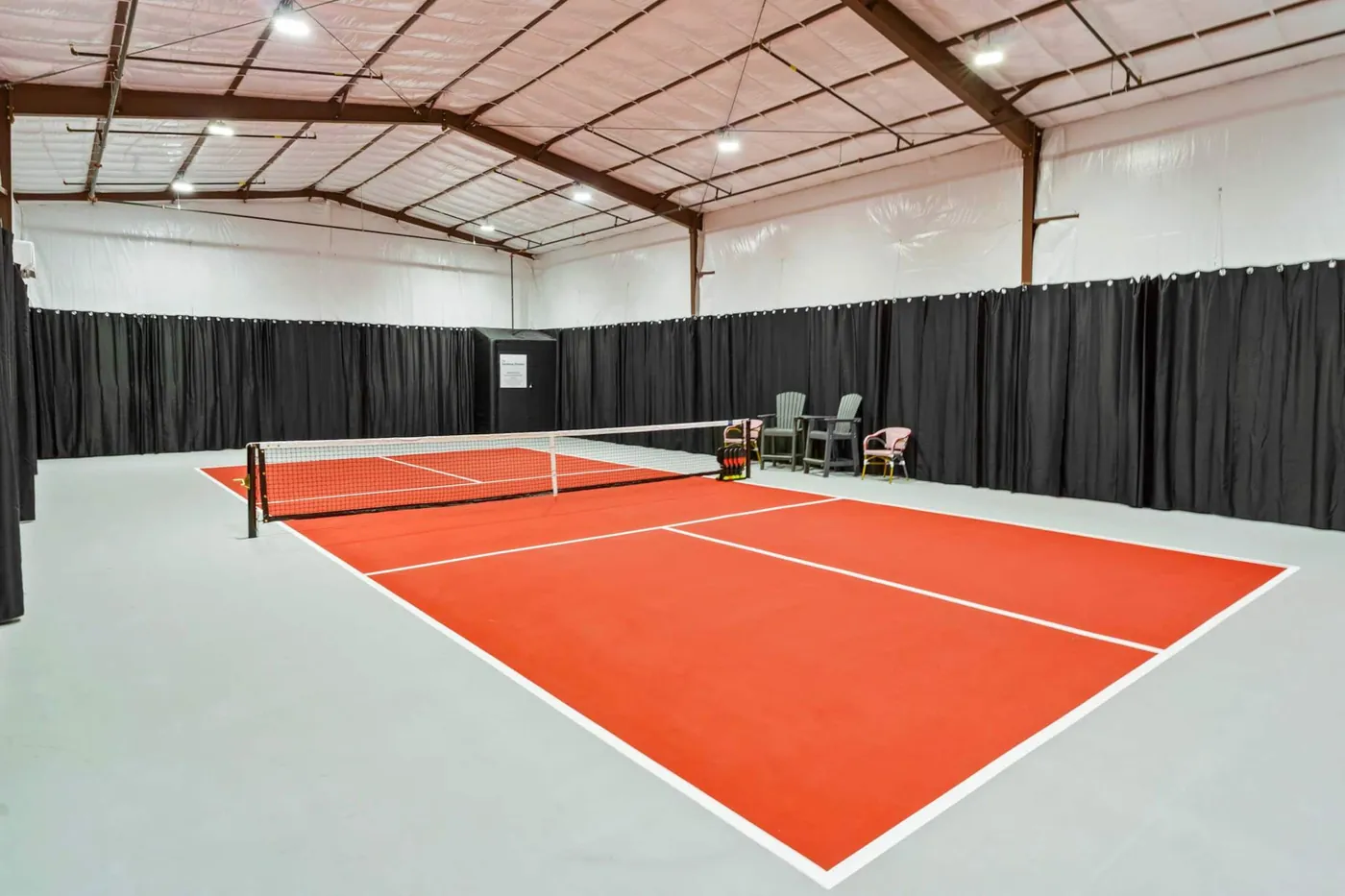
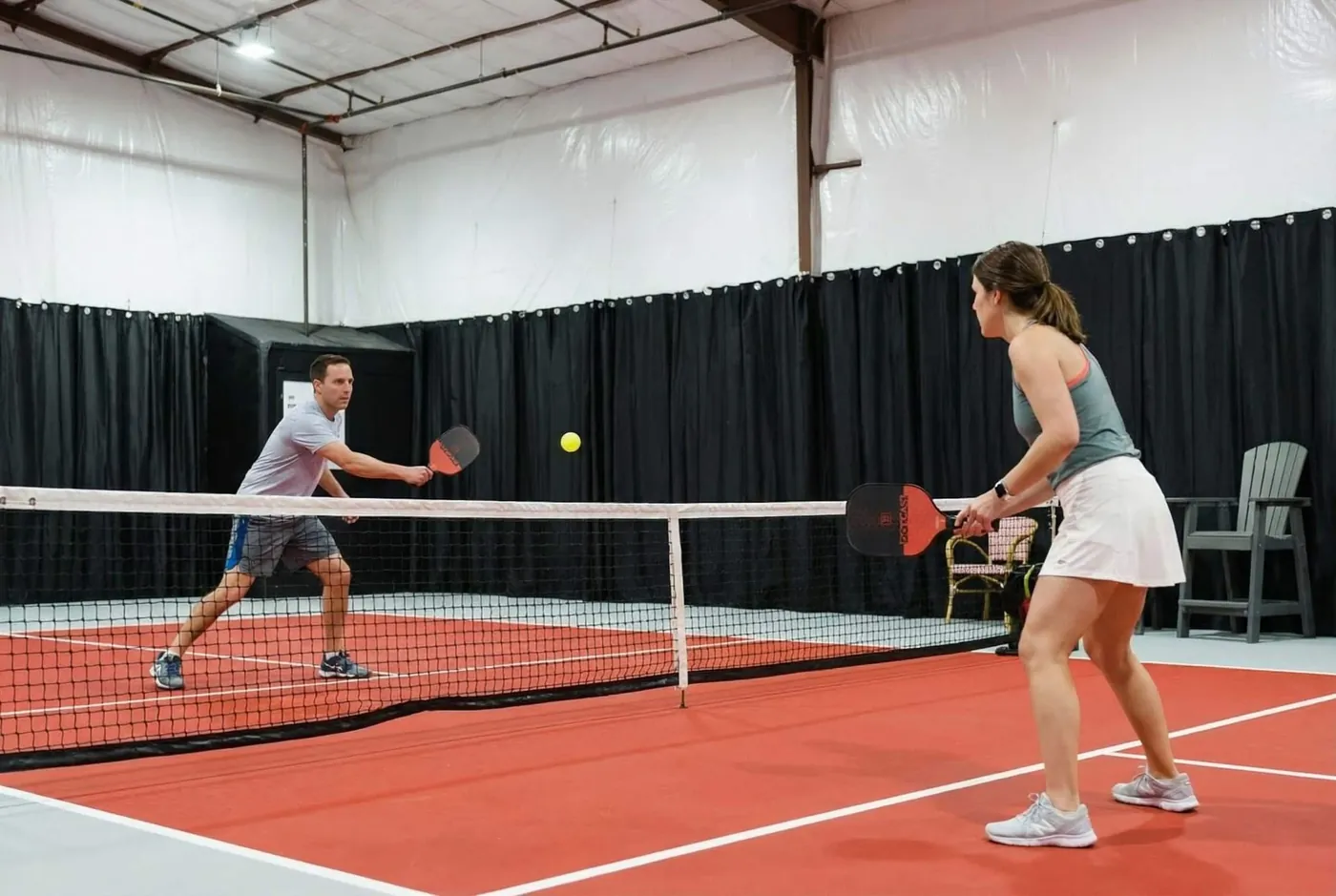
Yes. The house has a private indoor court in its own steel building on the property, air-conditioned, heated and lit, so a rotation can run in any weather and at any hour. Paddles and balls are provided, and guests bring their own court shoes. The house sleeps eight guests.
Sources
Facts in this story were checked in November 2026 against the sources below. Event dates, prices, hours and schedules change, so confirm anything you plan around.
- USA Pickleball - What is pickleball
- USA Pickleball - How to play
- USA Pickleball - Rules and the 2026 Official Rulebook
- Pickleball Union - How long does a pickleball game last
- Bounce - How long is a pickleball game
- Pickleball.com - Rally scoring vs traditional scoring
- Pickleheads - Complete round robin guide
- PicklePal - 5 players on 1 court
- Main Court - How to run a pickleball round robin
- PlayPickleball - 3-person pickleball rules
- Bounce - Skinny singles rules