
If you play most of your pickleball near sea level — or in Phoenix, which sits at about 1,086 feet — your first session in Sedona will feel slightly off. Drives you count on dying at the baseline land a foot deep. Lobs carry past your partner’s expectations. And somewhere in the second game, you notice you’re breathing harder than the rally deserved. None of this is in your head. Sedona sits at roughly 4,350 feet, high enough that the air is measurably thinner than what most visitors are used to, and thin air changes how a plastic ball with holes moves.
The good news: the effect is modest, predictable, and fixable in an afternoon. This is not Denver, where the elevation famously warps every ball sport played there. Sedona’s altitude is enough to notice, not enough to wreck your game. Here is the honest physics, what to adjust, and why an indoor court happens to be the best possible place to do the adjusting.
Why the ball flies farther in thin air
Every object moving through air pushes air out of its way, and the air pushes back. That pushback — drag — is proportional to air density. Less dense air, less drag, and the ball holds its speed longer and travels farther before it comes down.
Air density drops as you climb. Using the standard atmosphere model that aviation runs on, the air at Sedona’s 4,350 feet is roughly 12 percent less dense than at sea level. That number is the whole story in one figure: every shot you hit here faces about 12 percent less air resistance than the same shot at the beach.
This is well documented in sports that have had to deal with it longer than pickleball has. The International Tennis Federation writes altitude directly into its rules: above 1,219 meters — 4,000 feet — tournaments are permitted to use special high-altitude balls, including pressureless balls acclimatized at elevation for 60 days, specifically because standard pressurized balls fly and bounce differently up high. Sedona sits just above that 4,000-foot line. Golf has measured it too: Titleist’s testing puts the carry gain at roughly 1.2 percent per 1,000 feet of elevation, which is why a 250-yard sea-level drive plays about 6 percent longer in Denver.
Pickleball has no official altitude ball, but the physics does not care. If anything, a pickleball is unusually drag-dependent — it is light, it is plastic, and it is full of holes, which is exactly why it slows down so dramatically in flight at sea level. Take away a chunk of that drag and the ball keeps more of its pace deep into the court. The shots that rely on air resistance to die in the right place — drives, serves, lobs — are the shots that misbehave first.
One honest correction to the folk wisdom: the famous “livelier bounce” at altitude is mostly a tennis phenomenon. A pressurized tennis ball bounces higher up high because the pressure sealed inside it now exceeds the thinner air outside by a wider margin. A pickleball is a solid piece of non-pressurized plastic, so its bounce barely changes. In pickleball, altitude shows up in the flight, not the bounce.
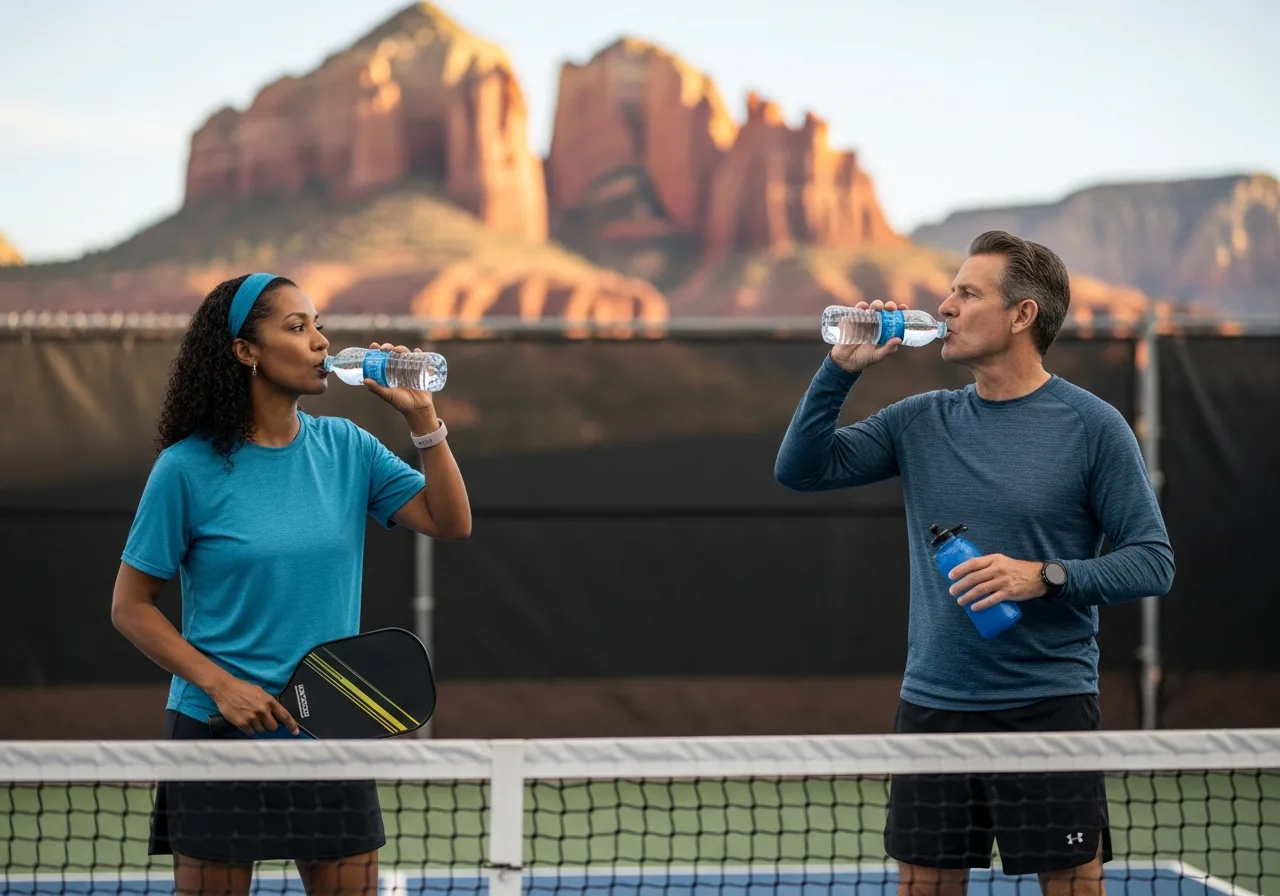
How big is the effect at 4,350 feet, honestly
Modest. Real, but modest. It helps to see the numbers side by side, because Arizona happens to stack its cities at wonderfully different heights:
| Place | Elevation | Air density vs. sea level (approx.) |
|---|---|---|
| Sea level | 0 ft | 100% |
| Phoenix | 1,086 ft | ~97% |
| Sedona | ~4,350 ft | ~88% |
| Denver | 5,280 ft | ~85% |
| Flagstaff | 6,909 ft | ~81% |
So a Phoenix player arriving in Sedona experiences about a 9-point drop in air density. That is most of the Denver effect, but not all of it — Denver players live with a few points more. If you have heard mile-high tennis or softball players talk about balls flying out of the park, scale that story back by about a quarter and you have Sedona.
In practical terms: expect drives that normally land a foot inside the baseline to land near or past it, lobs to carry two or three feet longer, and your third-shot drop to float a touch farther than the picture in your head. Dinks change the least — drag scales with the square of speed, so slow shots were never fighting much air to begin with. Your soft game travels here almost intact. It is the fast stuff that needs recalibrating.
What to adjust: five specific fixes
You do not need a new game. You need small margins in a few places.
-
Take some pace off your drive. Swing at about 90 percent of your usual effort for the first few games and watch where the ball lands. Add pace back gradually. Most players find their full sea-level drive is simply too long here until they build in more topspin or a lower target.
-
Shorten your backswing on drops. The third-shot drop is the shot Sedona punishes most, because it depends entirely on the ball dying in the kitchen. A shorter backswing takes energy out of the shot at the source, which is more reliable than trying to decelerate through contact. Aim your apex on your own side of the net, a touch lower than usual.
-
Use spin for control, but know its limits. Topspin pulls the ball down and shortens its flight, so brushing up the back of the ball helps bring drives back into the court. One honest caveat the physics requires: spin works through the air too, so the same thin air that weakens drag also slightly weakens the Magnus effect that makes topspin dip. Spin still helps — it just helps a little less than at home. The complete fix is spin plus margin: more net clearance on drops, more court in front of your target on drives.
-
Respect the lob, both ways. Your lobs will sail — shorten them. Their lobs will also sail, which means an overhead you would normally let bounce out might land in. Track deep balls a beat longer before conceding the point.
-
Re-test your serve depth early. Hit your first several serves at rally pace and note where they land. The serve is the easiest shot to recalibrate because nobody is moving you around while you do it.
If you want a structured way to work through all of this, the progression in our guide to pickleball drills on a private court maps neatly onto altitude adjustment — the drop-consistency and target drills are exactly the reps that reset your distance calibration. And if you are between paddles, a more controlled, softer-touch paddle is a friend up here; our paddle-choosing guide covers the control-versus-power tradeoff.
The cardio reality: day one is honest work
Altitude does not just thin the air your ball flies through — it thins the air you breathe. At 4,350 feet, each breath delivers less oxygen than the same breath at sea level, and your body’s first response is simple: breathe faster and pump the heart a bit harder to move the same oxygen around.
For a sport of short sprints and quick recoveries, that means the first day plays out predictably. The opening games feel normal. Then a long rally ends and your recovery takes a few seconds longer than usual. By the third game, flatlanders are typically breathing noticeably harder between points than they would at home.
Keep the framing proportionate: 4,350 feet is moderate elevation, well below the altitudes where serious adaptation issues start becoming a common topic. Most visitors feel close to normal within a day or two. Until then, a few practical moves make the first session smoother:
- Play games to 11, not marathon sets, and actually sit down between them.
- Rotate players more often if you have five or more — the game room and media lounge give the resting players somewhere to be.
- Schedule your hardest session for day two, not the hour after you arrive.
- Skip the temptation to open the trip with a hard hike and hard pickleball on the same day.
None of this is a medical protocol — it is the same pacing advice any coach gives for the first workout in a new environment. Listen to your body and let day one be a calibration day for your lungs as well as your drives.
Dry air: the adjustment nobody notices until dinner
Altitude gets the headlines, but Sedona’s dryness does more quiet damage to visiting players. Relative humidity here averages around 47 percent across the year and drops to roughly 24 percent in June — with plenty of afternoons dipping lower. If you are visiting from Houston, Florida, or the Midwest in summer, that is a fraction of the moisture your body is used to.
Dry air changes the feedback loop you rely on. At home, you know you are working hard because you are visibly sweating. Here, sweat evaporates almost instantly, so you lose water at a healthy clip while feeling relatively dry. Every exhale costs extra moisture too — breathing faster in thinner, drier air is a double withdrawal.
The fix is boring and effective: drink before you feel thirsty, and drink more than feels necessary. Bring a water bottle to the court and empty it every couple of games. Ease up on alcohol the first night, since it compounds dehydration. Lip balm and lotion earn their suitcase space. Our packing guide for a pickleball vacation has the full list, but water discipline is 90 percent of it.
The indoor court’s climate control keeps you out of the sun and wind, which cuts fluid loss compared with a July outdoor session — but conditioned air is still dry air. The bottle rule applies indoors too.
Phoenix climbs, Flagstaff descends: the two-way adjustment
Here is the part that makes mixed Arizona groups genuinely fun. Sedona sits almost exactly between the state’s two big player populations — and they arrive with opposite problems.
Phoenix players climb about 3,300 feet on the two-hour drive up I-17 (about 116 miles — see our Phoenix getaway guide). They arrive to find their drives suddenly long, their lobs ambitious, and the air 15 to 20 degrees cooler than the courts they left behind. Their first-day misses sail deep.
Flagstaff players descend about 2,500 feet in under an hour down 89A through Oak Creek Canyon (our Flagstaff getaway guide covers the drive). Flagstaff sits at 6,909 feet, where the air is about 19 percent thinner than sea level — they are the altitude veterans in the room. But that cuts the other way: in Sedona’s comparatively thicker air, their drives face more drag than they are calibrated for, so their first-day misses die short. They also arrive with fully acclimated lungs and a cardio edge for day one.
Put both groups on the same court and you get a genuinely level playing field for one evening only: everybody is recalibrating, just in opposite directions. It makes for an entertaining first-night round robin — and since the court is indoors and private, nobody has to book a public slot or worry about the noise carrying (the whole indoor-noise story is covered at our quiet pickleball page). If your group wants to test the difference for themselves, check dates and bring players from both ends of I-17.
The bottom line
Altitude at Sedona’s elevation is a tuning problem, not a crisis. The ball flies a little farther, your spin bites a little less, your lungs work a little harder, and the dry air quietly drains your water bottle. Every one of those has a same-day fix: softer drives, shorter backswings on drops, more margin, more rest between games, and more water than you think you need.
The recalibration goes fastest somewhere with no wind, no sun angle, and no waiting for an open court — which is exactly what a private indoor court is for. Come up from the desert or down from the mountain, and by the second morning the altitude is just the reason your winners feel a little more powerful than usual.
Frequently asked questions
Does altitude really make a pickleball fly farther?
Yes. Air density at 4,350 feet is roughly 12 percent lower than at sea level, and drag on the ball drops with it, so shots hold speed longer and land deeper. The same physics is documented in tennis, where the ITF permits special balls above 4,000 feet, and in golf, where Titleist measures about 1.2 percent more carry per 1,000 feet of elevation.
How long does it take to adjust to Sedona's elevation?
For your shots, usually a session or two of focused play — softer drives and shorter backswings on drops cover most of it. For your lungs, most visitors from low elevation feel close to normal within a day or two. Plan lighter play on arrival day and your hardest games for day two.
Do I need different balls or a different paddle at altitude?
No. Unlike tennis, pickleball has no official high-altitude ball, and the non-pressurized plastic ball behaves the same off the bounce. Paddles and balls are provided at the house. If you are shopping anyway, a control-oriented paddle is slightly friendlier up here than a power paddle.
Is an indoor court still affected by altitude?
Yes — altitude is about air density, not weather, and the air inside the court is the same thin Sedona air. What the indoor court removes is wind, sun glare, and temperature swings, which makes it much easier to isolate the altitude effect and adjust to it quickly.
Why do Phoenix and Flagstaff players adjust in opposite directions here?
Phoenix sits at 1,086 feet and Flagstaff at 6,909 feet, with Sedona in between at about 4,350. Phoenix players move into thinner air, so their shots fly long; Flagstaff players move into thicker air, so their shots die short. Both groups spend the first evening recalibrating toward the middle.
Will the dry air affect my game?
Mostly it affects your hydration. Sedona’s humidity averages around 47 percent annually and drops near 24 percent in June, so sweat evaporates before you notice it and fluid loss sneaks up on you. Drink on a schedule rather than by thirst, and bring lip balm.
Play year-round in red rock country
Sedona Pickler is a private Sedona home with its own indoor, climate-controlled pickleball court. Rally any season, any hour — heated, cooled and lit, with paddles and balls provided.
Check dates & book


