You can have the best third-shot drop in your group and still lose, over and over, to a team that never seems to hit a clean winner. They just stand in the right places. Balls that should be yours end up going between you. Shots you thought were put-aways come back low and fast. By the third game you feel like you’re playing four opponents. You’re not. You’re playing two people who understand court position, and that one advantage is quietly beating your better shots.
Here’s the encouraging part: positioning is the most learnable thing in pickleball. Your dinks and drives took months to groove. Where to stand, when to move, and who takes the middle can be fixed in an afternoon, and the payoff shows up in your very next game. Doubles is the version almost everyone plays, and at the recreational level most points are decided by geometry long before they’re decided by skill.
This is a guide to that geometry: where to stand, why, and how to move as a team. We’ll cover the single principle that explains nearly every positioning decision, how to open a point on serve and return, how to survive the most dangerous patch of court, who owns the middle, and how stacking really works once you’re ready for it. We’ll stay out of the weeds on individual shots, since the drop and the dink each have their own guide. This one is about the map.
Get both players to the kitchen line, together
If you remember nothing else, remember this: the team that gets both players to the kitchen line, standing there together, controls the point. Almost everything else in doubles strategy is in service of winning that race, or slowing down the other team’s version of it.
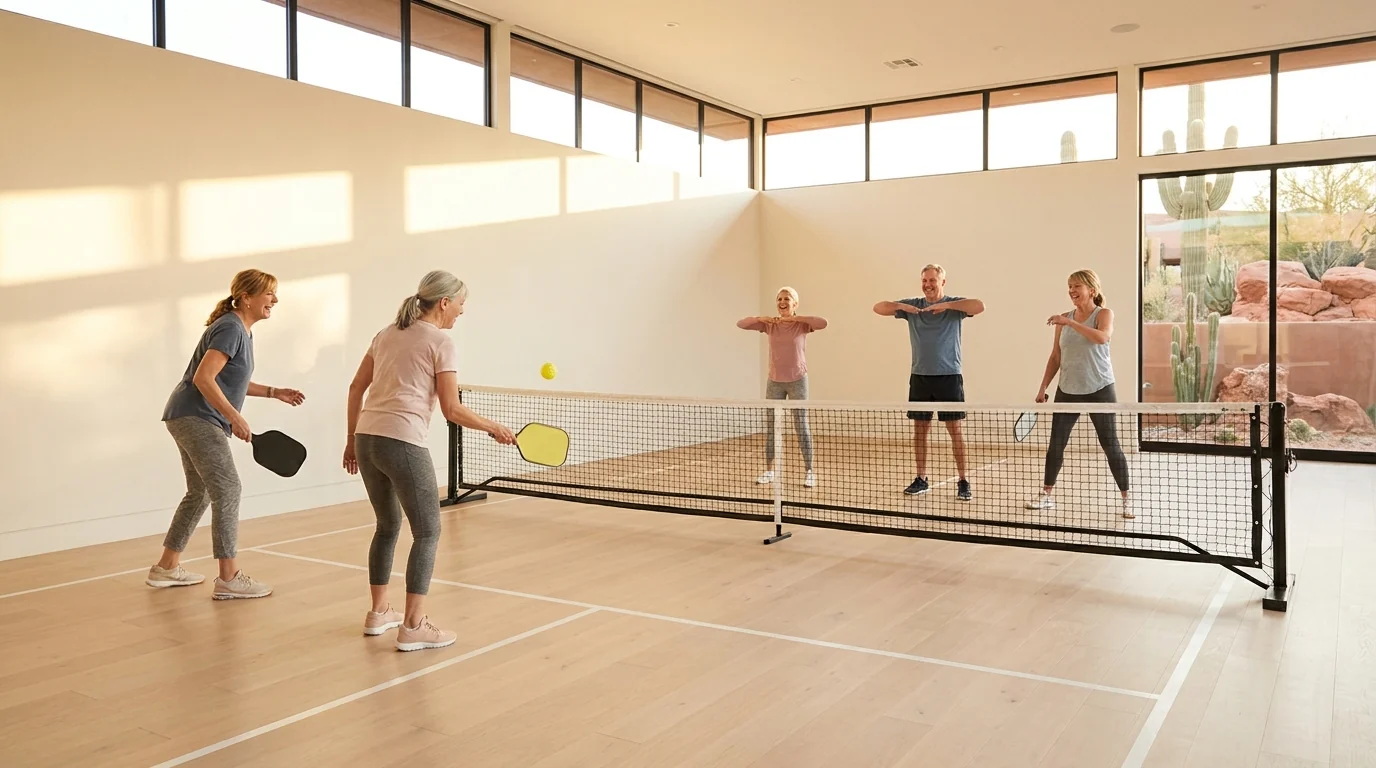
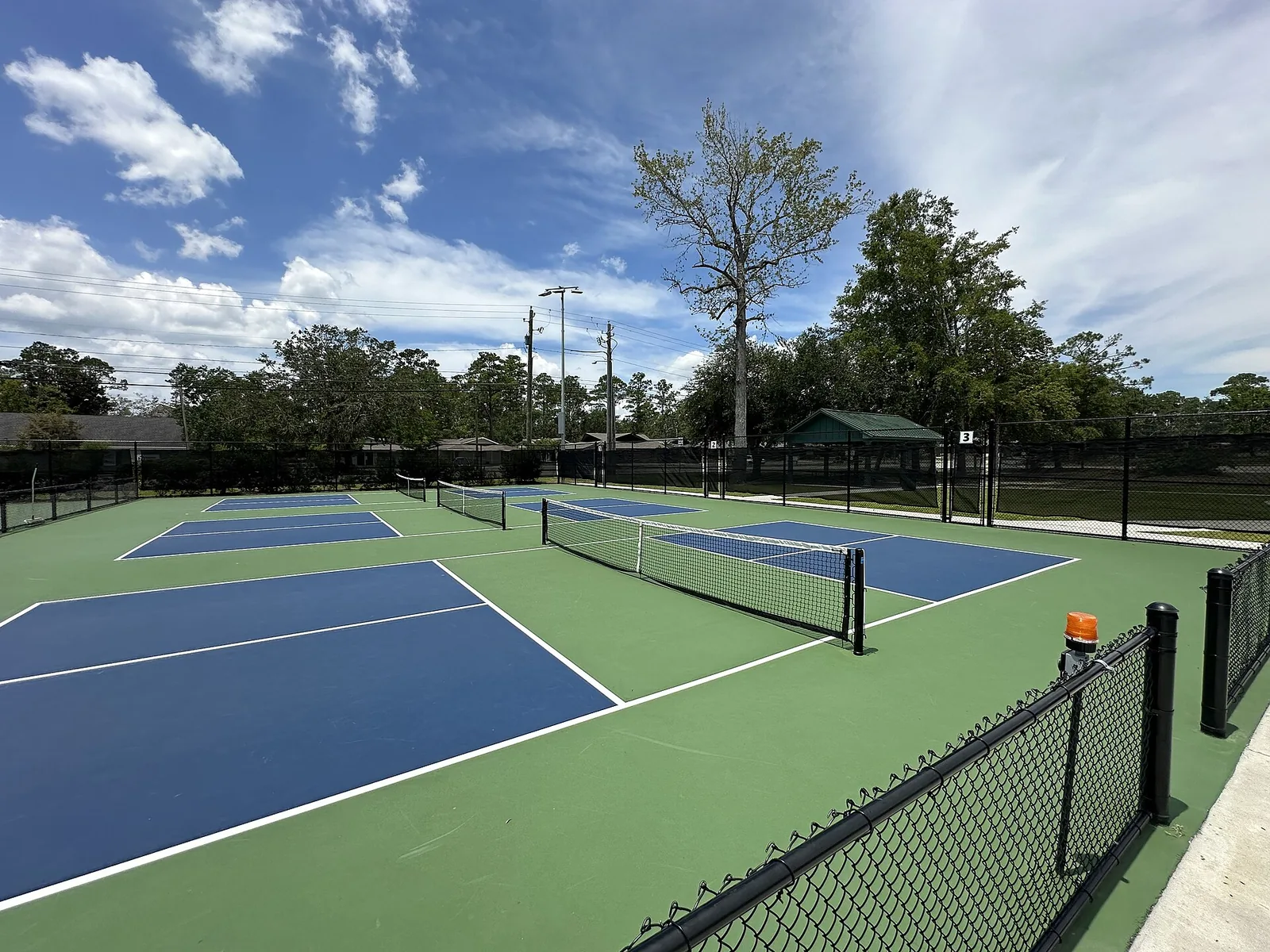
The kitchen, officially the non-volley zone, is the seven-foot strip on each side of the net where you can’t hit the ball out of the air. The line at the back edge of it, about fifteen feet in from the baseline, is the most valuable real estate on the court. A team parked there side by side can hit down on almost anything that floats up, cut off angles before they open, and end points at will. A team stuck behind the baseline is playing defense whether they know it or not.
So the whole point becomes a kind of migration. Both teams want to move from where they start up to that line, and get there together with their partner. The team that arrives first, intact, usually wins. The team that arrives split, one player up and one back, usually gets picked apart. Once you start watching rec games through this lens, the scores stop looking random. The team that’s better at reaching the line and staying connected is almost always the team that’s winning, and it often has nothing to do with who hits the ball harder.
Why height of contact decides the point
Underneath the race to the line sits one piece of physics, and it’s worth understanding because it explains why the line matters so much in the first place.
The net is 36 inches high at the sidelines and 34 in the middle. Every shot you hit has to clear it, and where you make contact decides whether that’s easy or dangerous. Standing at the kitchen line, when a ball comes to you above net height, you can hit down and forward. The net isn’t really in your way, and a downward ball is hard to answer. Stuck at the baseline, when a ball lands at your feet, you have to hit up just to clear the net, and a ball traveling upward is a gift to anyone at the line across from you. They get to hit down on it.
That’s the entire logic in one line: the team hitting up loses, and the team hitting down wins. Height of contact is the currency of doubles. Being at the kitchen line is valuable precisely because it lets you make contact high and send the ball down. Being pinned at the baseline is dangerous precisely because it forces you to hit up.
This is also why you can’t win the height battle by hitting harder from deep. Pace from a low contact point just hands your opponents a faster ball to hit down on. The answer is never “hit it harder from back here.” The answer is “get to the line so I can stop hitting up.” Keep that one idea straight and half of your positioning decisions make themselves. (If you play up at Sedona’s elevation, the thinner air carries the ball a little farther on top of all this, which is a separate wrinkle we cover in pickleball at altitude.)
Move as a unit: the 8-to-10-foot rope
Getting both players to the line is step one. Staying connected once you’re there is step two, and it’s the part most recreational teams miss.
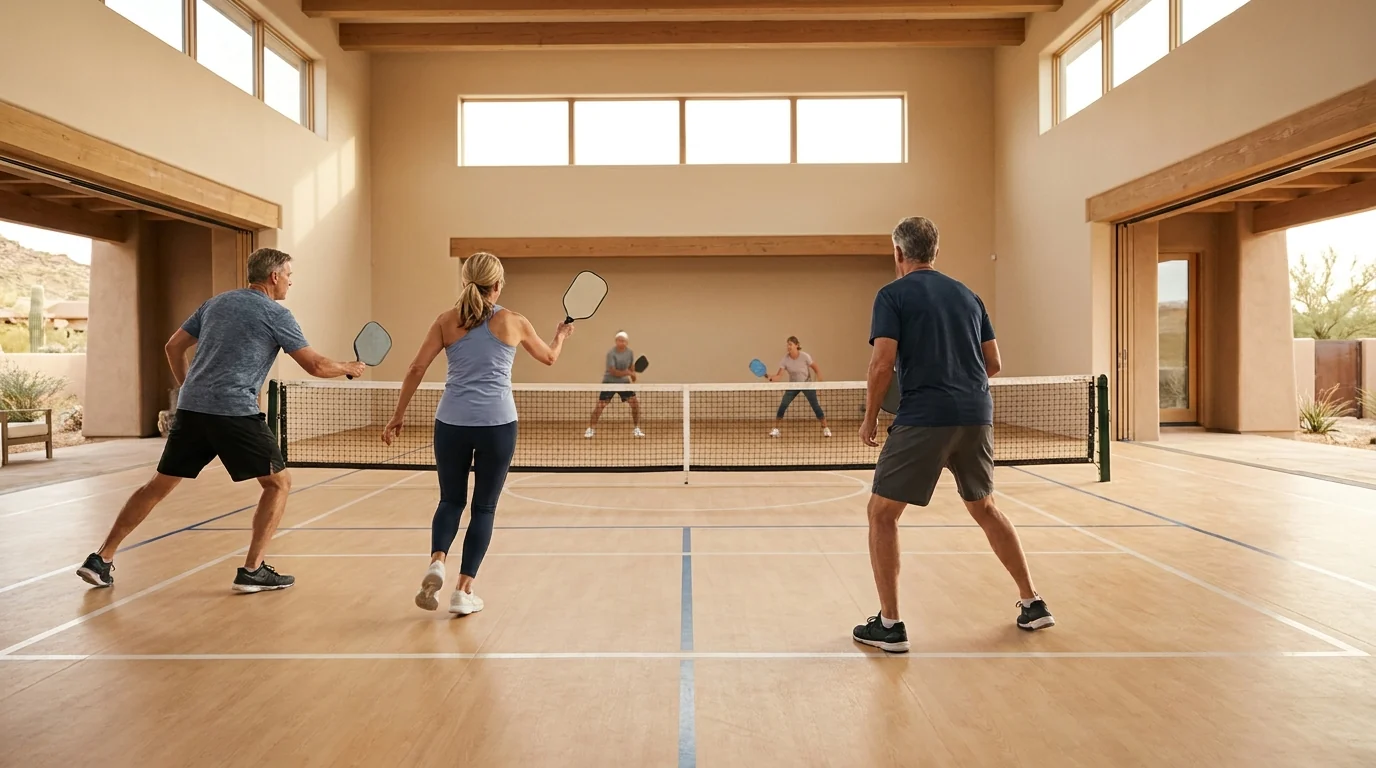
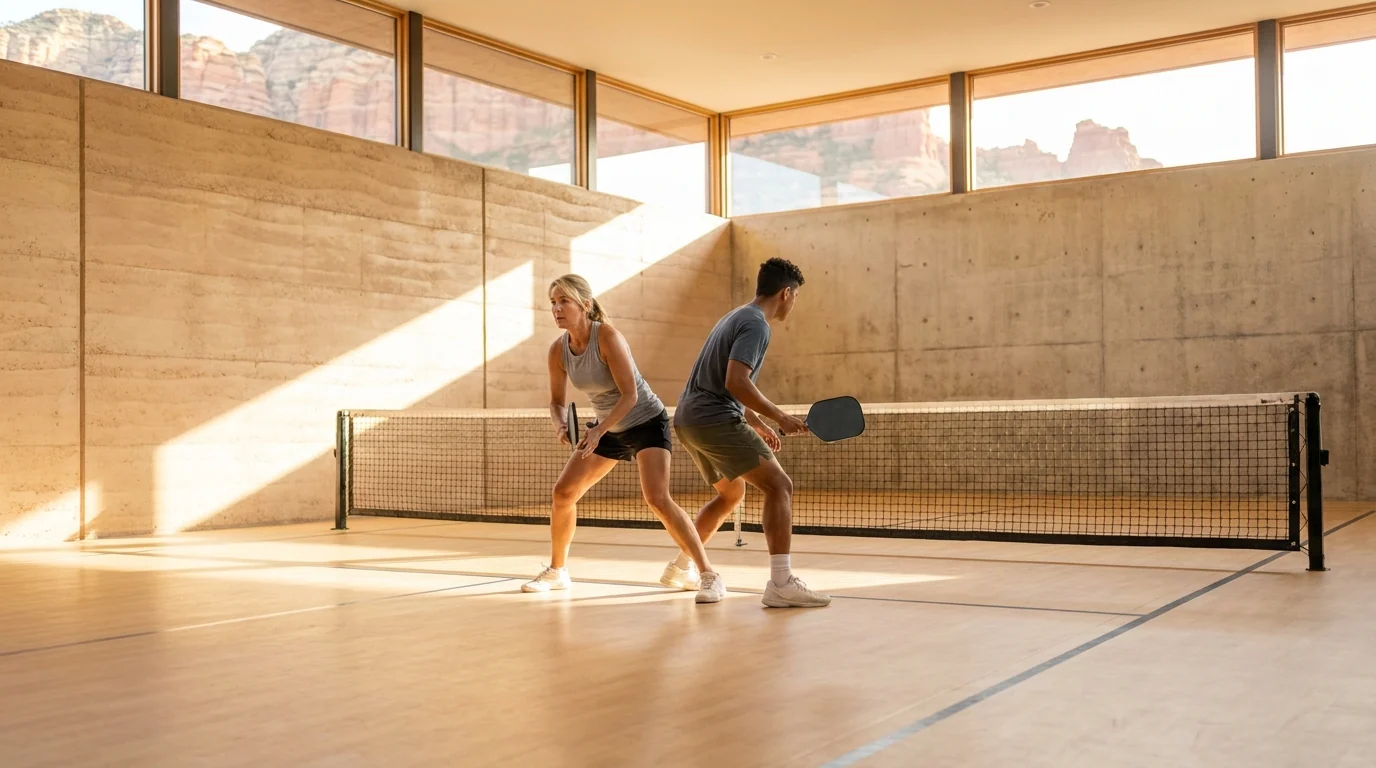
Picture a rope, eight to ten feet long, tied from your waist to your partner’s. On a court that’s twenty feet wide, that spacing lets the two of you cover the whole width with a little overlap in the middle and a step of reach toward each sideline. Now here’s the rule: the rope stays taut. When your partner slides right to chase a wide ball, you slide right too, the same distance, at the same time. When you shift left, they shift left. You move side to side as a pair, never independently.
The reason is the middle. If your partner lunges wide for a ball and you stay put, the rope goes slack and a gap opens between you, right down the center, the easiest place on the court to hit a winner. If you move with them, the gap never appears. You’ve simply shifted the whole two-player wall a few feet over. Good teams look almost like they’re sliding on the same rail. Struggling teams look like two people playing singles next to each other.
This applies front-to-back as well as side-to-side, and here’s the part beginners resist: if your partner gets pushed off the line, you generally come back with them. Two players at the line beats two at the baseline, but two at the baseline beats one up and one back every time. A staggered team has a seam running diagonally between the up player and the back player, and a decent opponent will find it all day. When in doubt, be wrong together rather than split apart.
Where to stand on serve and return
The first few shots of every point are governed by one rule that dictates where all four players begin: the two-bounce rule. The serve has to bounce before the returner hits it, and the return has to bounce before the serving team hits it. No volleys until the ball has bounced once on each side. (If the basic rules and scoring are still new, start with pickleball for beginners and come back.)
That single rule creates a lopsided starting grid, and it quietly hands the returning team an early advantage.
| Player | Where they start | Why |
|---|---|---|
| Server | Behind the baseline | Must serve from behind the baseline, and can’t move in until the return has bounced |
| Server’s partner | Back, beside the server | The two-bounce rule forbids volleying the return, so rushing the net is a trap |
| Returner | Behind the baseline, deep | Has to let the serve bounce, then hit; deep positioning buys time to move up |
| Returner’s partner | At the kitchen line | Isn’t hitting the return, so claims the line the moment the serve goes by |
Read the table and the logic falls out. The returning team gets one player to the line for free, because the returner’s partner has no ball to hit and can march up the instant the serve goes past. The returner hits the return and then has the length of that shot to jog forward and join them. Return deep, and come in behind it. A deep return pushes the servers back and buys the returner the extra second they need to reach the line. A short return does the opposite: it invites the servers in and leaves the returner stranded in the middle of the court.
The serving team has the harder job. Both of them start back, because the two-bounce rule won’t let them volley the return, and charging the net only to stop short and scoop a low ball off the bounce is a losing move. They have to earn their way forward with the third shot, either a soft drop into the kitchen that lets them walk in behind it, or a drive that forces a weak reply they can move up on. That shot has its own guide; see the third-shot drop for how the serving team actually earns the line. For positioning purposes, just hold the shape in your head: returners get to the line first, servers have to work for it, and the whole opening exchange is a fight over who controls that seven-foot line.
No-man’s-land and how to cross it
Between the baseline and the kitchen line sits a stretch of court that will lose you more points than any other: the transition zone, better known as no-man’s-land. It’s roughly the middle third of your side, and standing still there is the single most exploitable position in doubles.
Here’s why it punishes you. A ball that lands at your feet is the hardest ball in the game to handle. You can’t take it comfortably out of the air, and you can’t back up and let it bounce into a clean strike either. No-man’s-land is exactly where those foot-height balls land, and opponents at the line aim there on purpose. Camp in the transition zone and you’ll spend the point half-volleying low balls upward, which, as we covered, is how you lose.
The fix isn’t to avoid the zone. You have to pass through it every time you come forward. The fix is to move through it, not live in it. A few specifics:
- Come in under control, not at a dead sprint. You want to be balanced when your opponent makes contact, not caught mid-stride with your weight going the wrong way.
- Split-step as they hit. A small hop that lands you on the balls of both feet, right as the opponent strikes the ball, lets you push off in any direction. It’s the most useful footwork habit in the game, and it costs you nothing but a little attention.
- When you get caught with a ball at your feet, reset it. Don’t try to win the point from there. Block or lift a soft, low ball into the kitchen, take another step or two forward, and keep advancing. A good reset buys the time to finish your trip to the line.
- Keep moving forward whenever the ball lets you. Every soft ball you send over is another chance to close the last few feet. Standing still to “see what happens” is how you end up rooted in the worst spot on the court.
Think of the transition zone as a hallway, not a room. You walk through a hallway. You don’t set up a chair and sit in it.
Covering the middle
Once both teams are at the line, the smartest place to aim is often straight up the middle, which means the smartest thing you can do is have a plan for the middle when they do it to you.
A ball down the center between two opponents creates a beat of hesitation. Whose ball is it? Each player waits half a second for the other, and that half-second is often enough to produce a weak reply or a clean whiff. Coaches have a rhyme for it: middle solves the muddle. When you’re not sure where to aim, aim between them.
Which means you have to solve the muddle on your own side before it costs you. The default rule is simple and worth committing to memory: the middle ball belongs to the player whose forehand is in the middle. For two right-handed players, that’s the player on the left side of the court, whose right hand points toward the center. Forehands are stronger, steadier, and easier to hit under pressure than backhands, so the forehand-in-the-middle player takes the tweener by default.
That’s the default, not a law. If the left-side player gets pulled wide to their sideline, the middle suddenly belongs to whoever is now closer, which is the right-side player. That’s why the rule by itself isn’t enough. You need the second half: a called “mine” or “yours” on anything near the center. The pre-agreed default tells you who takes the ball ninety percent of the time; the call handles the other ten percent and stops the two of you from either both swinging or both watching. Both of those end the same way, with the ball on the floor between you and each of you sure the other had it.
If you play as a righty-lefty pair, you have a natural gift here. Put the lefty on the right side and the righty on the left, and both forehands meet in the middle. Protecting that arrangement is one of the main reasons teams stack, which we’ll get to.
Talk on every ball
Positioning is half where you stand and half what you say. The best rec teams are usually the loudest, and not because they’re arguing. They’re constantly handing each other information. A short vocabulary covers almost everything:
- “Mine” / “Yours.” The middle-ball call, and the most important one. Say it early and say it clearly. Late is almost as bad as never.
- “Switch.” You’ve crossed, or you need to. It tells your partner to take the side you just left. Essential during scrambles and stacking.
- “Bounce it” / “No” / “Out.” Called on balls sailing toward the baseline. If you’re at the line, you often have the best view of whether a deep ball is going long, so let your partner know before they volley a ball that was about to sail out.
- “Yes” / “In.” The opposite call. Play it, it’s landing in.
- A quick poach signal. If you plan to jump across and cut off the next ball, tell your partner first so they can slide over and cover the space you’re leaving.
The rhythm that matters most is talking between every single point, not just during them. Ten seconds of “let’s go at the guy on the left’s backhand” or “I’ll stack this one, you take the middle” is worth more than any single shot. Teams that plan out loud, point by point, routinely beat teams of stronger individual players who never say a word. Silence is a positioning error like any other.
One habit pays off more than the rest: because the player farther from a deep ball usually has the better view of the baseline, calling “out” for your partner is one of the most valuable things you can do from the line. It lets them keep their paddle up and their feet still instead of guessing on a ball that was never going to land in.
What to do once everyone’s at the line
Suppose everyone did their job and all four players are now at the kitchen line. This is where most rec points are actually decided, and the instinct that got you here, hit hard and move forward, is now the instinct that will beat you.
At the line, the soft game takes over. The full mechanics live in our guide to dinking and kitchen strategy, so we won’t re-teach the shots here, but the positioning principles are worth stating plainly:
- Keep the ball low. A ball that stays below the top of the net can’t be attacked. The moment you pop one up above net height, you’ve handed the other team a downward ball. Low is safe; high starts a countdown.
- Target feet and the middle. An opponent’s feet and the seam between the two of them are the two hardest spots to hit up from. You’re not trying to hit a winner on every ball. You’re trying to force them to hit up so you can hit down.
- Be patient. Dink rallies at the line can run ten or fifteen balls. That’s fine. Whoever gets impatient and attacks a ball that wasn’t attackable is usually the one who loses the point. Wait for the pop-up; don’t manufacture it.
- Reset instead of counter-attacking from a bad spot. If a hard ball pushes you off the line, don’t answer fire with fire from your heels. Absorb it, block it softly back into the kitchen, and reclaim your position. Trying to win the point from a bad position is the fastest way to lose it.
The through-line is this: your position earned you the right to play the high-percentage soft game. Don’t hand that back by getting bored. Once you’re both at the line and keeping the ball low, you’re the team that’s ahead in the point. Play like it.
How stacking works
Stacking is the strategy people find intimidating, and most of that fear is just unfamiliar vocabulary. The idea is simple: you arrange which partner ends up on which side of the court, regardless of where the score forces you to serve or return from.
Why bother? Three common reasons. To keep both forehands in the middle, which a righty-lefty pair can do permanently. To keep a lefty and righty in their best spots as the score shuffles them around. Or simply to keep your stronger, steadier player on the side where you want them. Normally the score dictates your position, since the server and returner have to stand in specific boxes depending on the score, and that can shove your pair into an arrangement you’d rather not have. Stacking is how you take the arrangement back.
Here’s the mechanic. Before the point, both partners line up on the same side of the court, “stacked.” The player who has to be in a particular box by the rules of the score stays there; the other stands beside or just behind them, often stepping off the court to the side. The instant the ball is served or returned, they cross, each moving to their preferred side. The rules only care where you stand at the moment of contact, not after, so the switch is completely legal.
Stacking on serve is the easier version and where most teams start. The server serves from the correct box; the partner stands off to the side, sometimes outside the sideline, and both slide to their chosen sides as the serve goes. Since the serving team is already back and has a moment to spare, the switch is relatively low-risk.
Stacking on return is harder. The returner has to hit a good return and then cross to their side while also getting to the line, and the partner has to cross the other way, all in the time it takes the return to travel out and come back. More can go wrong. Plenty of teams sensibly half-stack: they stack only on the serve, or only for certain scores, and play conventionally the rest of the time. Half-stacking keeps most of the benefit for a fraction of the risk and the mental load.
Because you’re crossing, you have to communicate the plan before the ball is live, and that’s where hand signals come in. The player at the net puts a hand behind their back where only their partner can see it. An open palm might mean “we switch,” a fist “we stay,” or fingers pointing which way to go. Signal, get a nod, then serve. Never guess and hope.
Now the honest part. Stacking has real costs. During the crossover there’s a moment when both players are moving and a lane of the court is briefly open, and a sharp opponent can hit behind the runners and catch you mid-switch. It adds mental load, and mental load causes the exact miscommunications, both players going the same way or nobody covering the middle, that hand back the points you were trying to protect. It genuinely earns its keep for a righty-lefty pair, for hiding a weak backhand on a key side, or at a competitive level where the forehand-in-the-middle edge decides tight games. But for most recreational teams, the plain fundamentals in this article, getting to the line together, moving as a unit, owning the middle, and talking, will win far more points than stacking ever will. Learn to stack situationally, once the basics are automatic. Don’t turn it into a complicated way to lose.
Five common positioning mistakes
If you’d rather fix problems than memorize principles, here are the five positioning errors we see most in recreational doubles, with the one-line fix for each.
| Mistake | Why it hurts | The fix |
|---|---|---|
| One partner up, one back | Opens a diagonal seam; the deep player gets picked on at the feet | Get to the line together, or retreat together; match your partner’s depth |
| Camping in no-man’s-land | Balls land at your feet and force you to hit up | Move through the zone; split-step, reset, and keep advancing to the line |
| Both chasing the same ball | Two paddles at one ball leaves the rest of the court wide open | Call “mine” or “yours” early; default the middle to the forehand player |
| Both vacating the middle | You each guard a sideline and the winner goes up the center | Hold the 8-to-10-foot spacing and protect the middle over the lines |
| Backing off the line you earned | Trades a winning position for a losing one | Hold your ground; block and reset hard balls instead of retreating |
Notice how many of these are the same error wearing different clothes. The middle opens up because two players stopped moving as one. The seam appears because one drifted back while the other held. Fix the connection between you and your partner, the rope, and three of the five disappear on their own.
The real cure for all five, though, is volume: enough games in a row that moving as a unit becomes a habit you don’t think about. A round robin is ideal for it, because it keeps everyone rotating and pairs you with different partners, so you practice communicating from scratch each round. If you’re building a getaway around the game, our group-trip planning guide covers the logistics, and our private-court drills guide has positioning-specific reps, shadow-the-rope movement and middle-ball calls, that build these habits faster than open play alone.
The bottom line
Doubles isn’t won by the team with the prettiest shots. It’s won by the team that gets to the kitchen line together, moves as one, covers the middle, crosses no-man’s-land instead of living in it, and talks on every ball. Those habits cost you nothing but attention, and they beat cleaner ball-striking almost every time at the recreational level.
Start with the two that matter most: get to the line together, and keep the middle covered by talking and by defaulting it to the forehand. Add stacking later, if you ever need it at all. Then find a court where you can play enough games in a row for the movement to turn into instinct, because that, more than any single tip, is what separates a team that knows the rules of positioning from a team that actually plays them. See availability if that court is going to be ours.
Frequently asked questions
Where should I stand in pickleball doubles?
Your goal is to get both you and your partner up to the kitchen line, the non-volley-zone line seven feet from the net, and stand there together, roughly eight to ten feet apart. The team at the line gets to hit down on the ball, while the team stuck back has to hit up, which loses points. Nearly all of doubles positioning is about winning the race to that line and staying connected once you’re there.
Who takes the middle ball in doubles?
By default, the player whose forehand is in the middle, which for two right-handers is the player on the left side of the court. Forehands are more reliable under pressure, so that player takes the ball down the center unless they’ve been pulled out wide, in which case whoever is closer takes it. Always back the default up with a quick “mine” or “yours” call so you don’t both swing or both freeze.
What is stacking in pickleball, and do I need it?
Stacking is lining both partners up on the same side before the serve or return and switching afterward, so you keep a preferred arrangement, often both forehands in the middle or a lefty and righty in their best spots. It’s a real edge at higher levels, but it adds complexity and opens brief gaps during the switch. Most recreational players are better off mastering basic together-at-the-line positioning first and stacking only in specific situations.
Why do I keep losing to less skilled teams?
It’s usually positioning, not shotmaking. Teams that get to the kitchen line together, move as a unit, and cover the middle will beat better ball-strikers who play one-up-one-back or camp in the transition zone. Fix your movement and communication before you worry about hitting the ball harder.
Should both partners move together?
Yes. Imagine a rope eight to ten feet long tied between you, so when your partner slides wide to chase a ball, you slide the same way and the rope stays taut, keeping the middle closed. This goes for depth too: if one of you gets pushed back, generally both retreat, because a staggered team with one player up and one back leaves a diagonal seam that opponents will attack all day.
What is no-man's-land in pickleball?
It’s the transition zone, the middle stretch of court between the baseline and the kitchen line, and it’s the worst place to be caught standing still because balls land at your feet and force you to hit up. You can’t avoid passing through it on the way to the net, so the trick is to move through it under control: split-step as your opponent hits, reset low balls into the kitchen, and keep advancing rather than setting up camp.
Play year-round in red rock country
Sedona Pickler is a private Sedona home with its own indoor, climate-controlled pickleball court. Rally any season, any hour — heated, cooled and lit, with paddles and balls provided.
Check dates & book