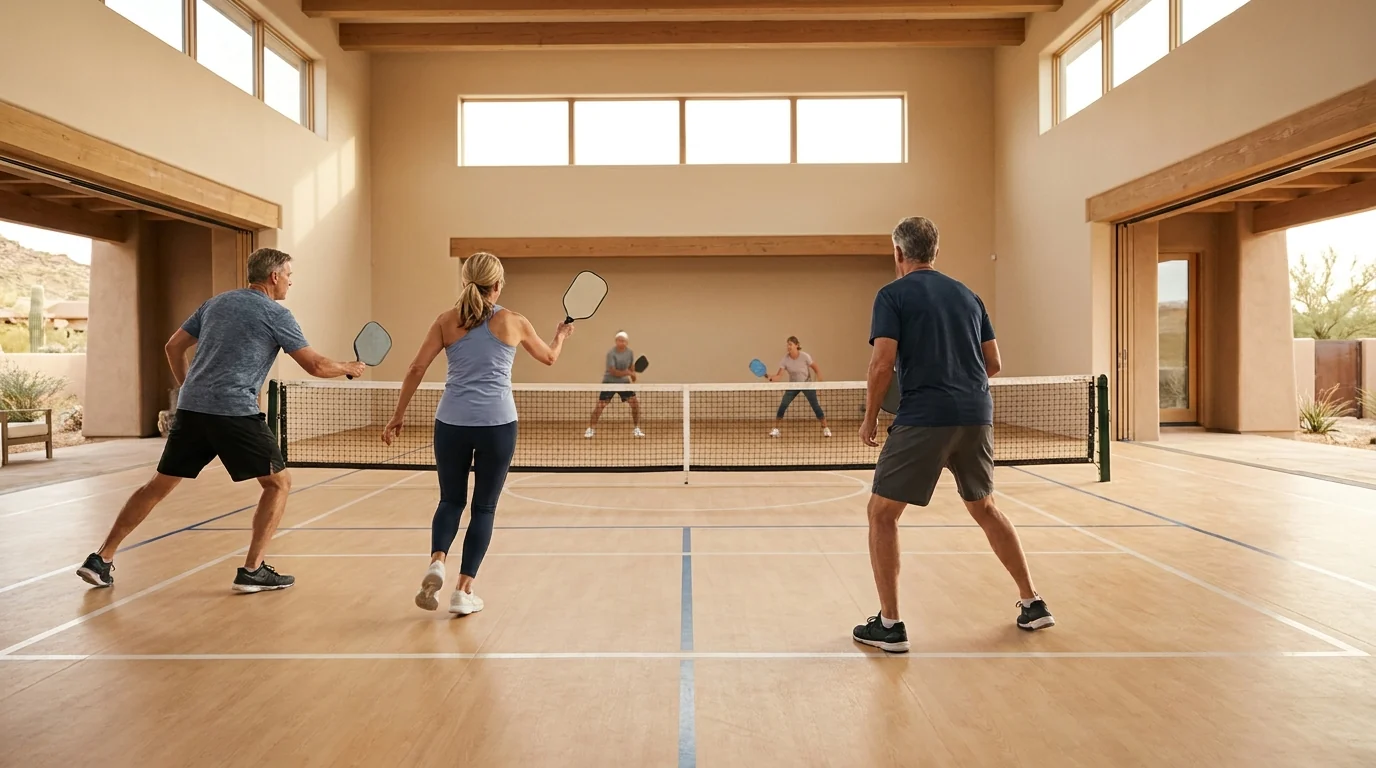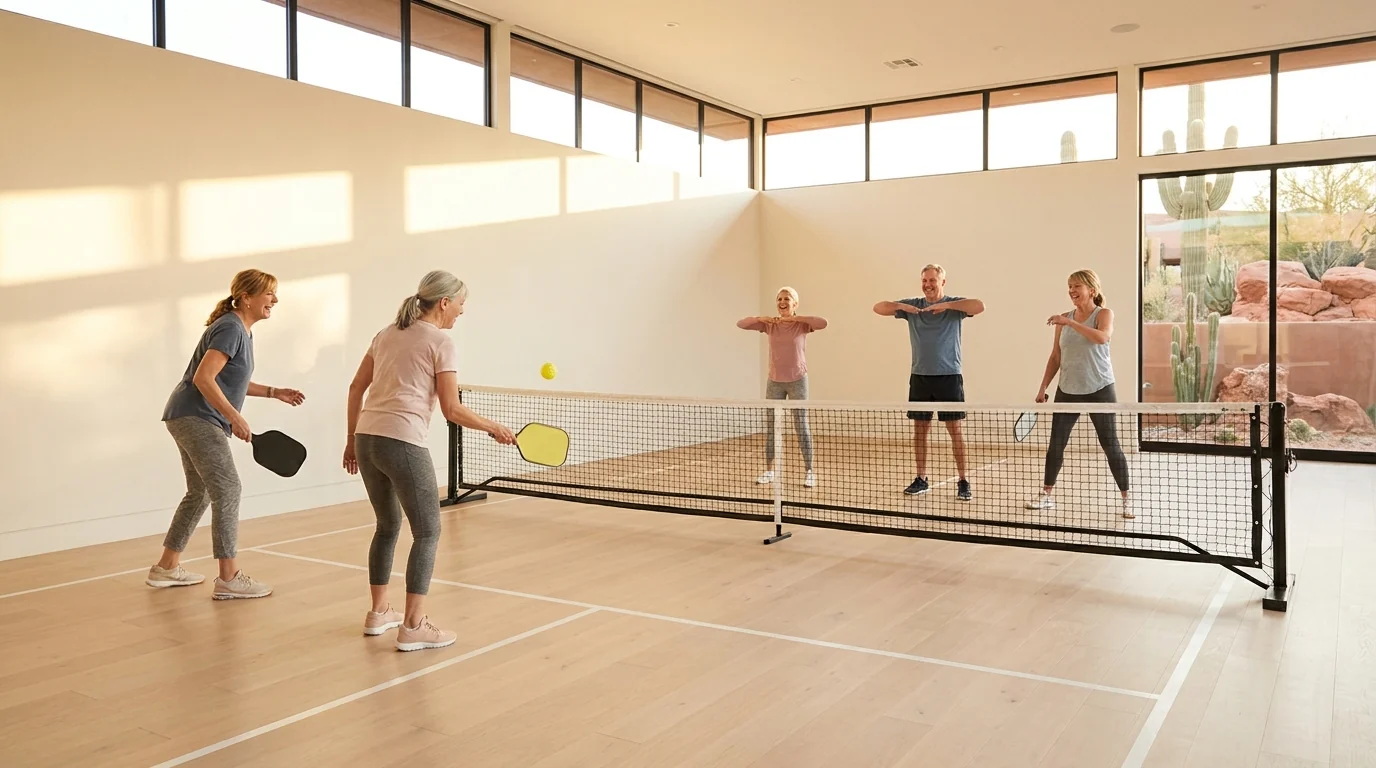
The most common way to ruin a pickleball weekend is to skip the first ten minutes of it. You arrive, you’re excited, the court is right there, and within ninety seconds of walking on you’re chasing a ball into the corner on legs that have been folded into a car or an airplane seat for hours. Cold muscle, a quick sideways scramble, a hard push off one foot — that combination is how a fun trip turns into an ice pack and an early night.
Pickleball injuries are real, and there are more of them every year. National emergency-department estimates for the sport climbed from about 1,313 visits in 2014 to roughly 24,461 in 2023. That number looks alarming until you remember why it moved: the sport exploded, so there are simply far more people playing, and more players means more visits. The part that rarely makes the headline is that most of those injuries are minor. Roughly 80 percent of injured players are treated and discharged the same day, according to published reviews of pickleball injuries — sprains, strains, and bruises, not surgeries.
This guide is about staying in that second category. It’s a warm-up you can finish in the time it takes the rest of your group to find their paddles, plus a handful of habits that head off the injuries that actually sideline people: the backward fall, the Achilles pop, the aching elbow. It leans toward players over 50, because the data does too — but the moves work for everyone, and none of them require you to be an athlete. One thing up front: this is general information, not medical advice, and there’s a fuller note on that below.
Why the first ten minutes matter
Pickleball asks your body for a specific and slightly unnatural combination of things. You stand nearly still, then explode sideways. You reach, twist, and plant. You push off hard to cover the kitchen line, then stop short and change direction. Running and cycling warm you up gradually; pickleball tends to go from zero to a full-speed scramble on the second or third point. That is the injury recipe in one sentence: cold muscle and tendon, asked to do fast lateral movement and a hard push-off, before either is ready for it.
Cold tissue is stiffer and less elastic than warm tissue. A warm muscle stretches and absorbs a sudden load; a cold one is likelier to strain or tear when you ask it to lengthen quickly under force — which is exactly what happens when you lunge for a wide ball or reverse direction for a lob. A warm-up is not a stretching ritual or a fitness badge. It’s the difference between tissue that gives and tissue that gives out.
Age is the honest variable here, and it deserves plain talk rather than tiptoeing around it. Players 50 and older account for the large majority of pickleball injuries. ESPN’s reporting on a study of U.S. medical data from 2000 to 2022 put that share near 90 percent; other datasets land around 87 percent over 50, with roughly 73 percent of injuries falling in the 60-to-79 range. Women over 60 carry the highest fracture risk of any group.
That is not a reason to play less. It’s a reason to warm up, wear the right shoes, and stop backpedaling for lobs — because the same body that has played beautifully for decades takes a little longer to warm up and is less forgiving of a bad fall than it was at 30. The players who get hurt are rarely the ones who respect that. They’re the ones who treat the first game like the tenth.
Here is what actually sends players to a doctor, from that same ESPN reporting on the 2000–2022 data:
| Injury type | Share of injuries | What it usually is |
|---|---|---|
| Strains & sprains | ~28.7% | Pulled muscles, rolled ankles, tweaked knees and shoulders |
| Fractures | ~27.7% | Broken bones — about 92% of them caused by falls, most to the arm |
Two figures in that table matter most. Fractures are nearly as common as strains, and about 92 percent of those fractures come from falls — most to the arm bones (the radius, humerus, and ulna), which is the classic signature of catching yourself on an outstretched hand. So the single worst category of pickleball injury is, at heart, a falling problem. And falling is more preventable than almost anything else on the court.
The 5-to-10-minute warm-up, step by step
Here is the whole thing. It takes five minutes if you’re pressed and ten if you’re smart, and it moves from gentle to sport-specific in the order your body wants. The rule that governs all of it: keep moving. This is a dynamic warm-up — motion that raises your heart rate and walks each joint through its range — not the sit-and-hold static stretching you might remember from gym class. Save the static stretches for after you play, when the muscle is warm. Cold static stretching before explosive movement does little to prevent injury and can leave you feeling loose in the wrong way.
Do this, in order:
- March or walk briskly, 1–2 minutes. Get blood moving before you ask any joint to do real work. Walk the length of the court a few times, or march in place lifting the knees. You want to feel slightly warmer, not winded.
- Leg swings, front-to-back, 10 per leg. Hold a wall or a partner’s shoulder. Swing one leg forward and back like a pendulum, loose and controlled, letting the range grow as it frees up. This wakes the hips and hamstrings you’re about to lunge with.
- Leg swings, side-to-side, 10 per leg. Same idea, swinging the leg across your body and out to the side. Pickleball is a lateral game, and these prep the inner and outer hip for the sideways scrambles that cause so many strains.
- Arm circles, 10 forward and 10 back. Big, slow circles with both arms, then reverse, then a few shoulder rolls. Your shoulder does a lot of overhead work on serves and put-aways, and it arrives cold.
- Torso rotations, 10 each side. Feet shoulder-width, arms relaxed, rotate your trunk gently left and right and let your arms swing with it. This loosens the spine and core you rotate through on every drive and dink.
- Ankle circles and a few calf raises, 10 each. Circle each ankle both directions, then rise onto your toes and lower slowly a handful of times. Ankles roll and calves tear when they’re stiff; ninety seconds here is cheap insurance.
- Slow lunges with a reach, or gentle hip openers, 5–6 per side. Step forward into an easy lunge and reach overhead, then step back. Or do “open the gate” hip circles. This rehearses, under control, the deep lunge you’ll make chasing a wide ball at full speed later.
- Shadow swings, about 1 minute. No ball. Mimic your forehand, backhand, serve, and a few volleys, gradually adding pace. You’re grooving the motion and warming the exact muscles each shot uses.
- Start with slow dinks and easy serves, 2–3 minutes. Before anyone calls the score (new to that? see our beginner’s rules and scoring guide), rally soft. Dink cross-court, hit gentle serves, trade easy drives. Let the competitive game begin only after your body has already done the movements at half speed.
That’s it. If your group is impatient, the honest minimum is steps 1, 2, 3, 6, and 9 — get the heart rate up, free the hips, wake the ankles and calves, and rally soft before you compete. The full sequence is better, but a rushed warm-up beats none at all.
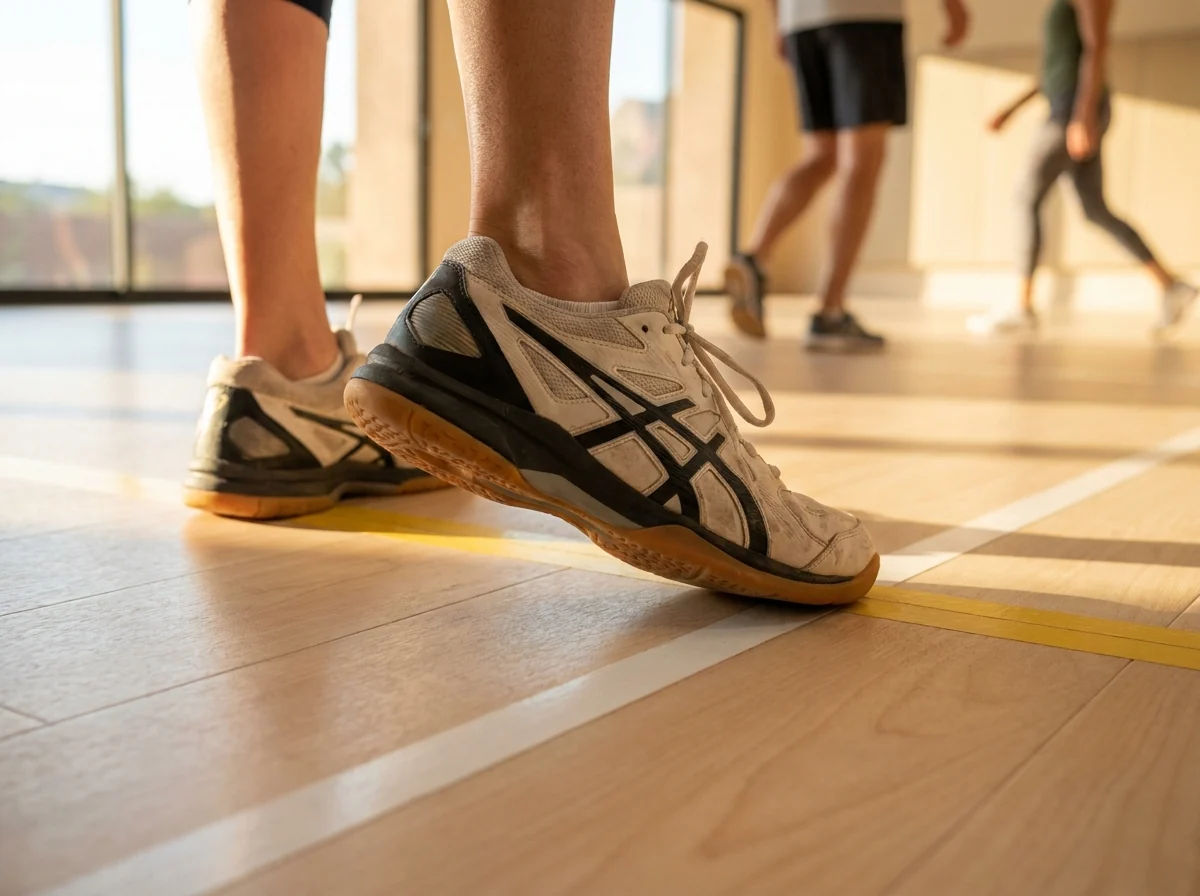
The fall that causes the worst injuries
The lob over your head is the most dangerous shot in recreational pickleball, and not because of the shot itself. It’s because of what people do in response to it. The instinct is to backpedal — shuffle backward with your eyes up, tracking the ball — and backpedaling is how players catch a heel, lose their balance, and fall backward. Put your hands out to break the fall and the force travels straight into your wrist and forearm. That is the mechanism behind a large share of pickleball fractures: about 92 percent come from falls, and most break the arm bones — the radius, humerus, and ulna — the classic result of landing on an outstretched hand.
So here is the single most valuable habit in this entire guide: do not backpedal for a lob. You have two safe options. Turn your body sideways and run back to the ball the way an outfielder chases a fly, then set your feet and hit — or, if it’s already past you, let it go and give up the point. A point is one number on a scoreboard. A broken wrist is weeks in a cast and months of rehab, and for a woman over 60 — the highest fracture-risk group — a fall can be more serious than that. Concede the lob. It’s the best trade in the sport.
The other fall risks are simpler to manage:
- Wear court shoes, not running shoes. Running shoes are built for moving forward and have tall, soft heels that lift you off the ground and roll under sideways load. Court shoes (tennis or pickleball) sit lower, grip laterally, and support the quick side-to-side cuts the game is built on. This one swap prevents a lot of rolled ankles. Our packing guide covers what to look for.
- Keep stray balls off the court. Stepping on a loose ball is a top cause of falls. Before every point, sweep the court with your eyes and send extra balls to the fence. On a shared public court, that also means watching for balls rolling in from the next court over.
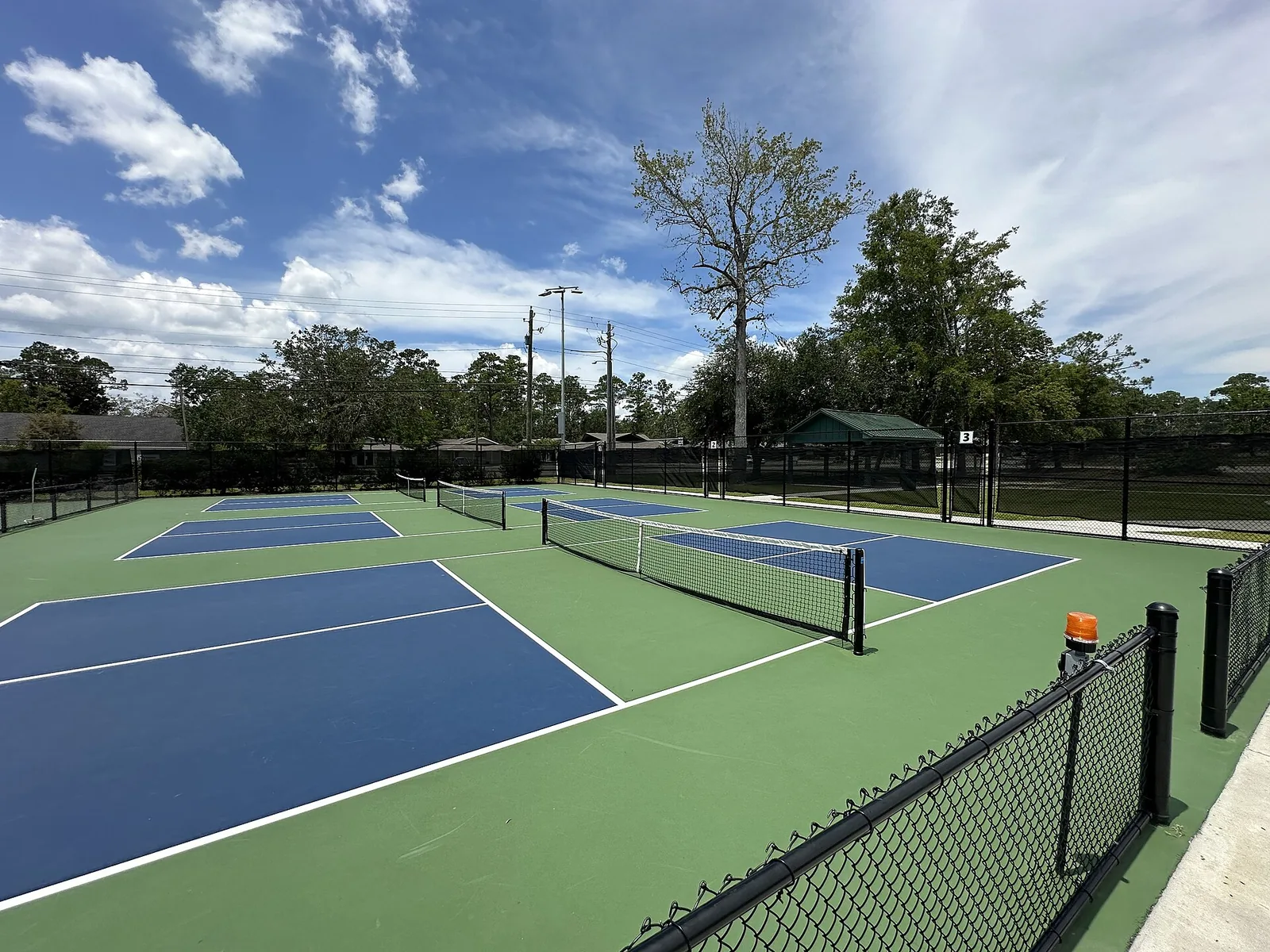
- Play on an even, dry, well-lit surface. Cracked outdoor courts, morning dew, and low sun in your eyes all raise the odds of a slip or a misjudged step. Indoors, you remove most of that: the surface is even and dry, and the light is consistent — a bigger safety factor than it sounds. We get into the tradeoffs in indoor versus outdoor courts; if you’d rather skip the variables entirely, the private indoor court here is even, dry-swept, and evenly lit.
Your calves and Achilles
The Achilles tendon rupture is the injury every serious pickleball player fears, and the one most worth preventing. It’s the thick cord that connects your calf to your heel, and when it goes, it goes suddenly and forcefully — usually on an explosive push-off: a hard first step toward a drop shot, a lunge, or the very backpedal we just told you to avoid. Players describe it the same way over and over. It feels like someone kicked them in the back of the leg, sometimes with an audible pop, and then they can’t push off. Recovery is long — often many months, whether it’s treated with surgery or without — and it’s the injury most likely to erase a whole season.
Two things load the Achilles and calf badly: being cold, and going from a standstill to maximum effort. You control both.
- Warm the calves specifically. The ankle circles and calf raises in the routine above are there for exactly this reason. Once you’re warm, add a gentle calf stretch and a few easy hops before your first hard sprint.
- Ease into explosive movement. Don’t make your first hard push-off of the day a full-speed lunge for a put-away. Build up over the first several points. If your legs feel tight or tired, back off the sprint-and-plant and play more patiently until they loosen.
- Respect the warning signs. Calf tightness or a nagging ache behind the ankle is your body asking for rest and attention, not a thing to push through. Tired, tight muscle is likelier to tear.
The honest line: nobody can promise you’ll never rupture an Achilles — it happens to warmed-up athletes too. But going in cold and cold-starting a max-effort push is the version you can actually prevent, and it’s the version that catches most recreational players.
Pickleball elbow
Pickleball elbow is the game’s most common overuse injury, and its real name is lateral epicondylitis — the same “tennis elbow” that shows up across racket sports. It’s irritation of the tendons on the outside of the elbow, and unlike a fall, it doesn’t happen in a single moment. It builds over days and weeks of repetitive strain, then announces itself as a sharp or burning ache on the outer elbow when you grip, lift, or hit a backhand.
Three things drive it, and all three are fixable:
- Technique. Muscling the ball with your wrist and forearm — instead of driving from your legs, core, and shoulder — puts the load right on those elbow tendons. This is where good mechanics pay off twice, in your shots and in your joints. Our guide to the third-shot drop is really a lesson in lifting the ball with your legs and shoulder rather than flicking it with your wrist, which is exactly the habit that spares your elbow.
- Grip size and paddle. A grip that’s too small makes you squeeze harder to hang on, and a paddle that’s too heavy or too stiff sends more shock into your arm on every hit. Getting these right is one of the highest-leverage comfort decisions in the sport. Our paddle-choosing guide walks through grip circumference, weight, and the control-versus-power tradeoff.
- Load management. Pickleball elbow is fundamentally a too-much-too-soon problem. Playing six hours a day for the first time on a vacation is a textbook trigger. Build up, take rest days, and if the ache starts, back off early — a few days of rest at the first twinge beats a month of rest once it’s entrenched.
If it does flare, the standard advice is rest, ice, and gentle strengthening once the pain settles; a counterforce brace helps some players. Elbow pain that persists is worth a visit to a physical therapist.
Water, heat, and Sedona’s thin, dry air
Warming up prevents the sudden injuries. Hydration and pacing prevent the slow, sneaky kind — the cramps, the fatigue that makes you sloppy, and the poor footwork that leads to a fall in the third game. Sedona makes this matter more than most places, for two reasons: it sits at roughly 4,350 feet, and the air is very dry.
Both pull water out of you faster than you’ll notice. At altitude you breathe faster, and every exhale carries moisture away. In dry desert air, sweat evaporates almost the instant it forms, so you can be losing fluid steadily while your skin feels dry and you never register how hard you’re working. We cover the full physics in pickleball at altitude, but the short version for injury prevention is a simple chain: a dehydrated muscle cramps and tires sooner, a tired player has bad feet, and bad feet fall down.
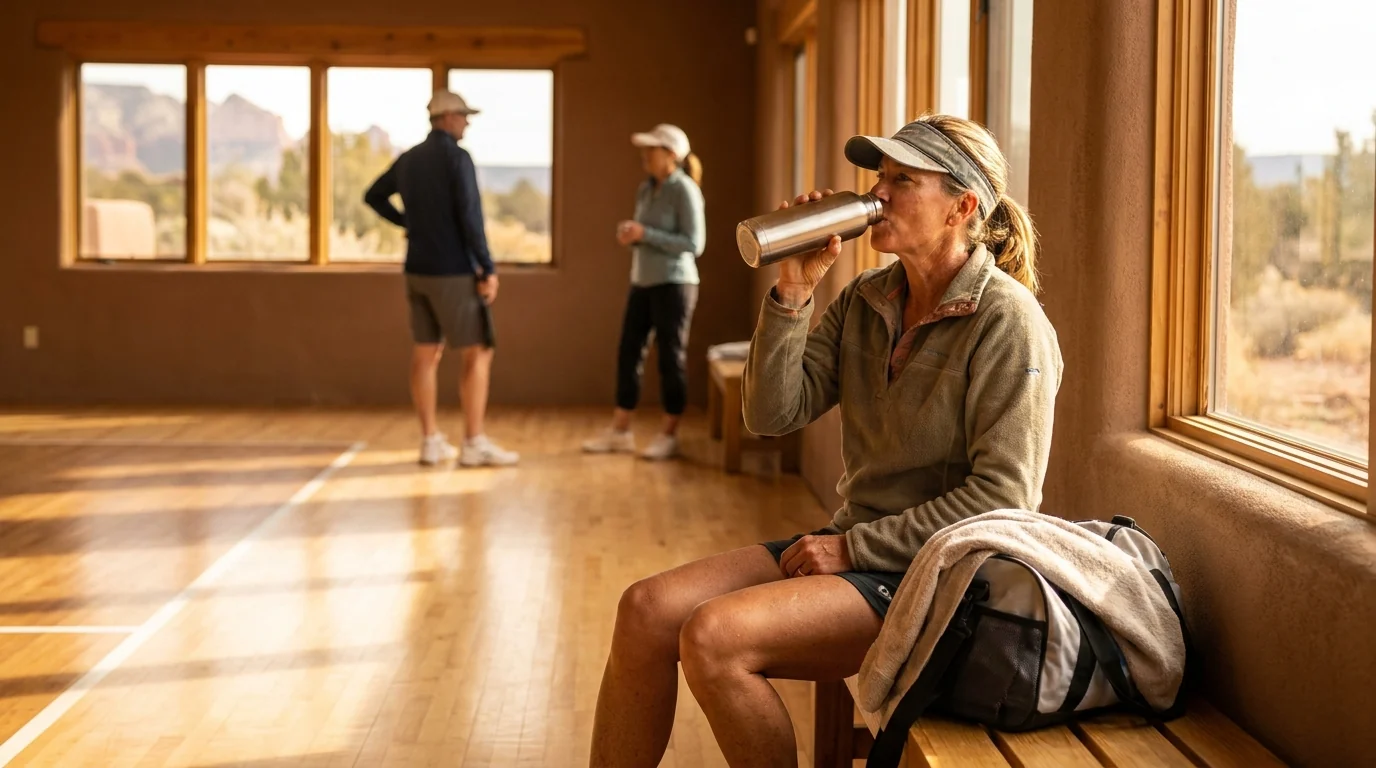
- Drink on a schedule, not by thirst. Bring a full bottle to the court and finish it every couple of games. If you’re flying in from somewhere humid, start hydrating the day before.
- Go easy on the first night’s alcohol. It compounds dehydration right when your body is already adjusting to the elevation.
- Respect the heat if you’re outdoors. In summer, play early or late and take shade breaks. Our beat-the-heat guide covers timing, and an indoor, air-conditioned court sidesteps the problem entirely.
- Cool down and stretch after, not before. This is when static stretching earns its keep. Walk for a minute to bring your heart rate down, then hold gentle stretches for the calves, hamstrings, hips, shoulders, and forearms while the muscle is still warm. It won’t prevent injury the way the warm-up does, but it eases the next-day soreness that otherwise tempts people to skip the warm-up on day two.
- Listen to soreness. Normal muscle soreness fades as you move; a sharp or one-sided pain that gets worse as you play is a signal to stop. The players who keep playing for decades are the ones who tell the difference and rest early.
The packing list for all of this — bottle, court shoes, eyewear, sun protection — lives in our pickleball vacation packing guide.
A quick word on your eyes
Eye injuries are less common than sprains and falls, but they earn thirty seconds here because they can be serious and they’re almost entirely preventable. A ball, or a paddle at the net during a fast hands battle, can strike the eye at close range with real force. One estimate counted more than 1,200 pickleball eye injuries in 2024. Wraparound protective eyewear — the kind that seals around the sides — prevents the large majority of them, weighs nothing in your bag, and doubles as sun protection outdoors. If you play a lot of aggressive net points, it’s an easy call.
Pacing a multi-day pickleball trip
Everything above applies double on a trip built around pickleball, because the failure mode changes. At home you play a couple of times a week. On a dedicated getaway you might play every day, sometimes twice, and the injuries that follow are usually about accumulated fatigue and too much too soon — not one unlucky step. A few rules keep the whole group on the court all weekend:
- Warm up every single session. Not just the first one. Day two’s cold muscles are still cold muscles, and the temptation to skip the routine because you “already warmed up yesterday” is exactly how the second-day tweak happens.
- Put your hardest play on day two, not arrival day. You’ll have driven or flown in, you won’t be acclimated to the altitude yet, and your body is at its stiffest. Make day one a lighter calibration day and save the competitive round-robin for when you’re loose and adjusted.
- Rest between games and rotate players. With five or more people, rotate so everyone gets a breather. A structured round robin does this automatically and keeps the resting players involved. Tired players get hurt.
- Let people stop when they’re tired. The most important rule, and the hardest to follow in a group. There’s no medal for the last game, and the injury that ends someone’s trip almost always happens in a game they were too tired to be playing.
This is one place a private indoor court quietly changes the math. There’s no clock on a reserved public slot pushing you to squeeze in one more game, no standing around getting cold between turns, and no uneven asphalt or low sun to trip you up. You warm up unhurried, play until you’ve had enough, and stop — which, for a group skewing over 50, is close to the whole point. If your trip lands in winter, our snowbird guide to wintering in Sedona covers how an indoor court keeps the season going when outdoor courts are cold and slick.
The bottom line
Pickleball injuries are rising because the sport is booming, but the ones that actually sideline people are remarkably predictable, and most are preventable with a few minutes and a few habits. Warm up dynamically before every session. Wear court shoes. Never backpedal for a lob — turn and run, or let it go. Warm your calves before you push off hard. Fix the technique and gear that irritate your elbow. Drink more water than feels necessary in Sedona’s thin, dry air. Cool down afterward. And on a multi-day trip, pace yourself, rest between games, and stop when you’re tired.
None of that requires being young or athletic. It requires ten minutes and a little discipline, and it buys you the thing everyone actually came for: to keep playing, all weekend, and to come back next year and do it again. If a private indoor court where you can play on your own schedule sounds like the right setting for that, see availability.
Frequently asked questions
How long should I warm up before pickleball?
Five to ten minutes is plenty for recreational play. Spend it on dynamic movement — marching, leg swings, arm circles, torso twists, ankle circles, easy lunges, and shadow swings — then start with slow dinks and easy serves before any competitive game. The goal is warm, mobile muscle, not a hard workout.
Should I stretch before or after playing pickleball?
After. Save static stretching, the sit-and-hold kind, for the cooldown when your muscles are warm — it helps with next-day soreness. Before you play, do dynamic movement instead; cold static stretching does little to prevent injury and can leave you feeling loose in the wrong way.
Why is backpedaling for a lob so dangerous?
Because it’s the leading way players fall backward and land on an outstretched hand, which is how most pickleball wrist and arm fractures happen — about 92 percent of fractures come from falls. Instead of backpedaling, turn sideways and run to the ball like an outfielder, or let it go. Giving up one point is far cheaper than a broken wrist.
What shoes should I wear for pickleball?
Court shoes made for tennis or pickleball, not running shoes. Running shoes have tall, soft heels built for forward motion that roll under the quick sideways cuts pickleball demands, which leads to rolled ankles. Court shoes sit lower and grip laterally. It’s one of the cheapest injury-prevention swaps you can make.
What is pickleball elbow and how do I prevent it?
It’s lateral epicondylitis — an overuse irritation of the tendons on the outside of the elbow, the same as tennis elbow. Prevent it by lifting the ball with your legs and shoulder rather than flicking with your wrist, using the right grip size and a paddle that isn’t too heavy or stiff, and building up your playing time gradually with real rest days.
Are pickleball injuries usually serious?
Usually not. Most are sprains, strains, and bruises, and roughly 80 percent of injured players are treated and discharged the same day. The serious ones — fractures from falls and Achilles ruptures from cold, explosive push-offs — happen to be the most preventable, which is the whole point of a warm-up and a few smart habits. Players over 50 account for the large majority of injuries, so warming up and pacing matter more with age.
Play year-round in red rock country
Sedona Pickler is a private Sedona home with its own indoor, climate-controlled pickleball court. Rally any season, any hour — heated, cooled and lit, with paddles and balls provided.
Check dates & book