
If you play pickleball outdoors in a residential area, there is a decent chance you have already lived some version of this story. New courts open. Word spreads. Within a few months there are morning regulars, an evening crowd, and a waiting paddle rack. Then a letter shows up at a city council meeting, or an HOA agenda item appears, and the conversation shifts from “how do we add more courts” to “should these courts exist at all.”
This is not a rare, unlucky outcome. It has repeated itself in towns across the country, and it usually follows the same script: neighbors complain about the sound, the city tries hours restrictions and fencing, the complaints continue, and the courts get cut back or closed. If you are a player, it helps to understand exactly why the sound of your sport is so uniquely hard to live next to — because the physics is real, the neighbors usually are not exaggerating, and the fixes on offer only go so far. We wrote a companion page on how an indoor court removes the problem entirely; this post is the player’s side of it — what you are up against and what you can actually do.
Why the pop is different from other sports noise
Tennis has been played next to houses for a century without triggering ordinance rewrites. Basketball is louder in raw decibels. So why does pickleball, of all things, generate lawsuits?
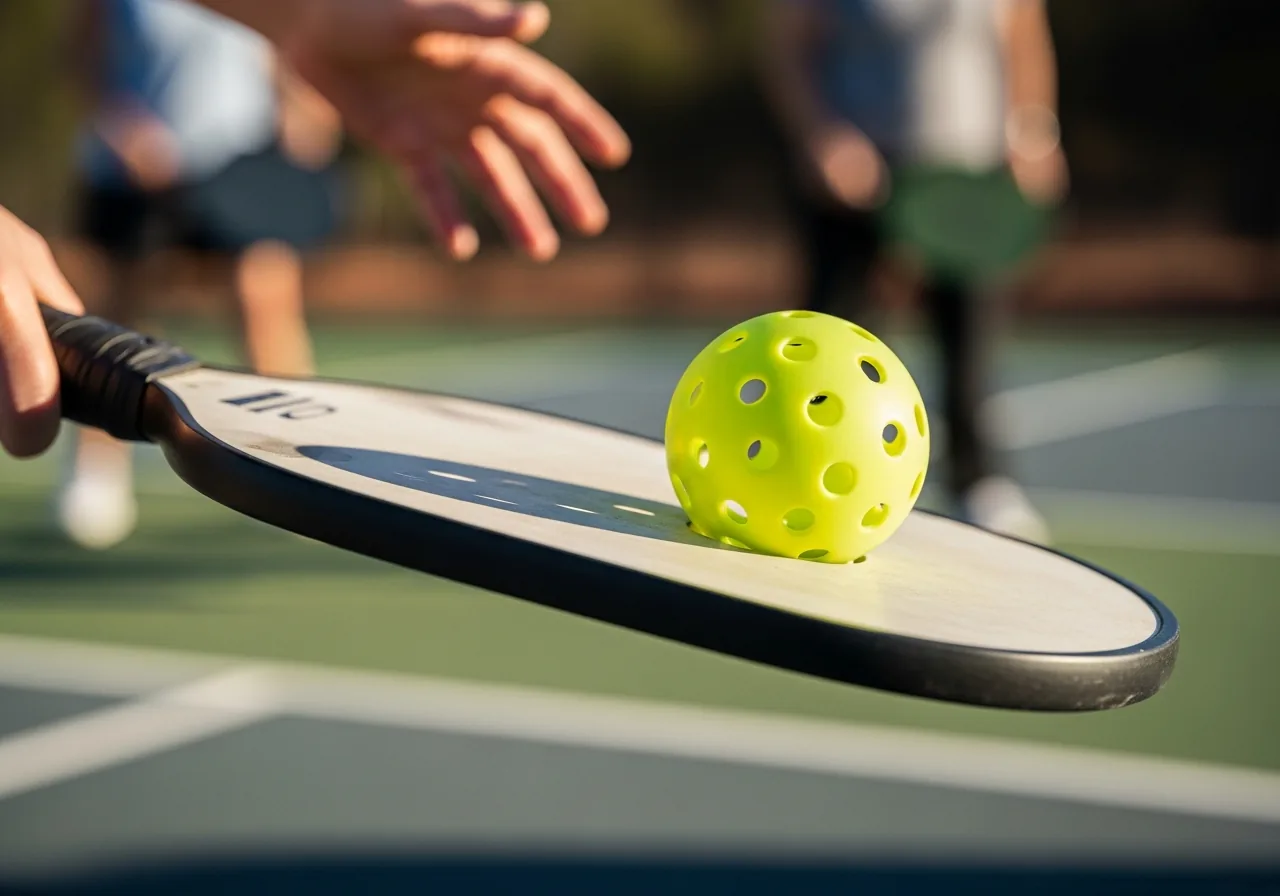
The answer is in the character of the sound, not just its volume. When a hard paddle face strikes a hard plastic ball, the impact produces an impulse — a burst of sound that lasts roughly 2 milliseconds. It starts and stops almost instantly, like a hand clap or a hammer strike. Acoustics researchers have measured the energy of that pop and found it concentrated between roughly 1,000 and 2,000 Hz, with a strong tonal spike near 1,200 Hz. That range matters because it sits close to the frequencies where human hearing is most sensitive. Research presented to the Acoustical Society of America traced the offending tone to a vibration mode of the paddle face itself — the paddle briefly rings like a small drumhead on every hit.
Two more findings explain why “it’s not that loud” never wins the argument. First, decades of acoustics research show that impulsive sounds are rated as significantly more annoying than steady sounds at the same decibel level. A 60 dB air conditioner hum fades into the background; a 60 dB pop every second and a half does not. Second, researchers studying pickleball noise specifically — work covered in detail by the Washington Post in 2025 — found that impulsive pickleball-like sounds at moderate volumes were enough to raise stress markers in listeners. The sound does not need to be loud to wear on the person hearing it for six hours a day.
Then multiply by the rhythm of the game. A doubles rally produces a pop every one to two seconds. Four courts running on a Saturday means an irregular, overlapping percussion track from 7 AM to dusk, punctuated by shouted scores and the occasional celebration. A tennis ball on strings produces a lower-frequency, softer thud, and tennis courts hold a quarter as many players per acre of asphalt. Pickleball’s density is part of its charm and part of its problem.
This is not hypothetical: courts have actually closed
Players sometimes assume the noise fight is a fringe complaint that goes away if everyone stays polite. The record says otherwise. A few documented examples, told neutrally, because both sides of these disputes are usually reasonable people:
Centennial, Colorado passed a temporary moratorium on new outdoor courts near homes in March 2023, then adopted a permanent ordinance later that year. The rules that emerged are telling: no permanent outdoor pickleball courts within 250 feet of a residential property line at all, and courts between 250 and 600 feet away require a permit and must keep sound at or below 47 decibels measured at the nearest residential property. Read that again — a city looked at the acoustics and concluded that a football field of distance is not enough separation without a permit.
Lake Oswego, Oregon closed the pickleball courts at George Rogers Park — the city’s only public pickleball courts at the time — after a 4–3 city council vote. Neighbors had begun raising concerns in early 2022, the city tried remedies, and the eventual answer was closure while officials searched for a different site. Players who had a home court lost it.
Carmel-by-the-Sea, California went further, becoming the first city in California to ban pickleball at its public courts. After roughly two years of trying to make play at Forest Hill Park work — restricted hours, consideration of quieter foam balls — the city council voted to end it.
And in 2025, Boise, Idaho closed pickleball courts at two parks and agreed to convert six pickleball courts back into two tennis courts as part of settling a noise lawsuit brought by a nearby couple.
Different states, different climates, different park layouts — same outcome. When an outdoor court sits close to homes, mitigation gets tried first, and closure is regularly what happens when mitigation is not enough.
What mitigation actually does — and where it stops
There are real tools for quieting an outdoor court, and if you are fighting to keep yours, you should know all of them. You should also know their honest limits, because overpromising is how player groups lose credibility with city councils.
Quieter equipment. USA Pickleball launched a Quiet Category in 2023 that certifies paddles and balls producing roughly half the acoustic footprint of the equipment commonly used in public parks, and the first certified paddles are now on the market. Foam-core and specially damped paddles genuinely reduce the sharpness of the pop, and some communities have made quiet-certified equipment mandatory during restricted hours. The limits: independent measurements of quiet-category paddles typically show single-digit decibel reductions versus standard paddles, the sound remains an impulse — quieter, but still a pop, not a hum — and compliance on a public court is nearly impossible to enforce. You cannot stop a visitor from pulling a standard paddle out of their bag. We cover paddle construction in more depth in our paddle buying guide.
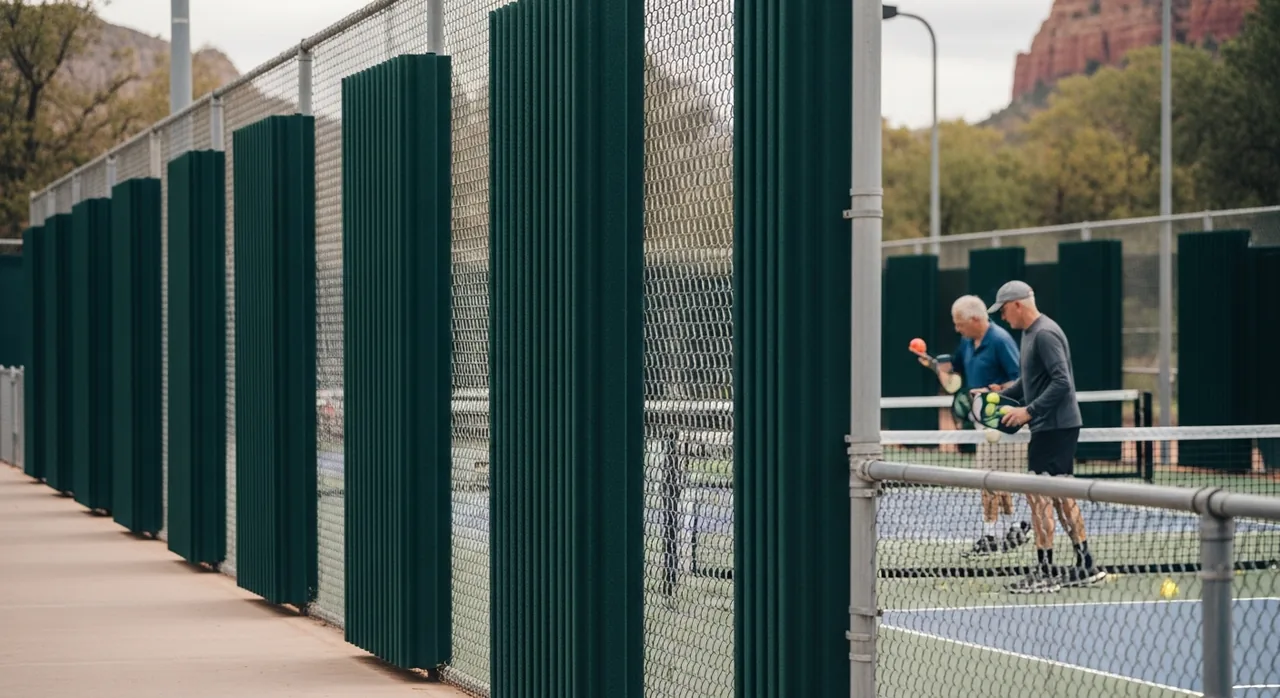
Acoustic barriers. Sound-absorbing panels mounted on court fencing are the most common retrofit. Done properly — dense, gap-free material tall enough to block the line of sight between paddle and window, usually 8 to 12 feet — barriers can cut noise at a neighboring property line by somewhere in the range of 8 to 16 decibels, which listeners perceive as roughly half as loud. The limits: barriers only protect what sits in their acoustic shadow. A second-story bedroom window looking down over a 10-foot fence gets little benefit. Gaps for gates undo much of the performance. And quality systems cost real money that a parks department has to find.
Distance. Sound falls off with distance, which is why setback rules are the backbone of most new ordinances. Acoustics consultants generally advise keeping courts at least a few hundred feet from homes, and some recent model ordinances recommend setbacks of several hundred feet or more. The limit is obvious: distance is not retrofittable. The courts most likely to draw complaints — the ones converted from tennis courts inside existing neighborhoods — are exactly the ones that cannot move.
Hours restrictions. Cheap and immediate, which is why cities reach for them first. Also the option that costs players the most: dawn and dusk are prime playing hours, especially in Arizona summers. And a court that is quiet before 9 AM is still popping the other twelve hours a day.
Stack every mitigation at once — quiet paddles, foam balls, full acoustic fencing, trimmed hours — and you get a court that is meaningfully better to live near. What you do not get is silence, and for a neighbor already sensitized by two summers of popping, “better” often is not the bar anymore. That is the honest state of the art, and it is why the disputes keep ending in closures.
The player’s playbook when your courts are under fire
If the noise fight has arrived at your local courts, a few moves consistently help:
Show up informed. Read your city’s noise ordinance before the meeting. Know the difference between a decibel limit and an impulsive-sound provision. Council members notice which side did homework.
Concede the acoustics. The science is not on the side of “it’s no louder than tennis.” Acknowledging that the sound is genuinely intrusive — and then pivoting to funded, specific mitigation — is the credible position.
Bring money and specifics. “We propose quiet-certified equipment before 9 AM, and our club will contribute toward acoustic fencing panels” beats “please don’t take our courts” every time.
Play the quiet gear now, not later. Voluntarily switching your regular group to quiet-category paddles before anyone forces the issue builds goodwill and buys time.
Have a backup plan. Know every court within driving distance, including indoor options at rec centers and clubs. If you are in northern Arizona, our rundown of where to play pickleball in Sedona maps the local options.
The only complete fix
Here is the uncomfortable conclusion the acoustics keeps pointing to: every outdoor mitigation reduces the problem, and none of them eliminates it. A quieter pop is still a pop. A barrier still leaks over the top. A setback cannot be added to a built neighborhood. The only version of pickleball with no neighborhood noise footprint at all is the version played inside a building, where walls and a roof contain the impulse completely.
That is why indoor courts keep coming up as the endgame in city after city — and it is why we built our whole quiet pickleball page around a court that has walls, a roof, heating, and air conditioning. We have also written before about why indoor play solves the noise issue and how indoor and outdoor courts compare on everything else — wind, sun, surface, and season. The short version: indoor play is not just the polite option, it is usually the better game.
For players in the Southwest, the indoor answer carries a bonus. Phoenix sits about two hours from Sedona, and from June through September its outdoor courts are unplayable most of the day at 105–115°F. An indoor, air-conditioned court at 4,350 feet of elevation stays playable at noon in July and at 7 AM in January. If your group has spent a season dodging both heat and noise restrictions, a few days where neither exists is a reasonable thing to plan a trip around — our group trip planning guide covers the logistics.
The noise wars are not going away. The sport is still growing faster than cities can zone for it, the acoustics are what they are, and the pattern of complaint, mitigation, and closure will keep repeating wherever hard paddles meet hard balls within earshot of a bedroom window. Understanding the problem honestly is the best thing a player can do — for their home courts, and for knowing where to go when the sign goes up.
Frequently asked questions
Why is pickleball noise so much more annoying than tennis?
The pickleball pop is an impulsive sound — a roughly 2-millisecond burst with energy concentrated near 1,200 Hz, close to where human hearing is most sensitive. Research shows impulsive sounds are rated far more annoying than steady sounds at the same decibel level, and a doubles rally produces one every second or two. A tennis ball on strings makes a softer, lower-frequency sound, and tennis generates far fewer impacts per hour per acre.
Have cities really closed pickleball courts over noise?
Yes, in multiple documented cases. Lake Oswego, Oregon closed its only public courts after a council vote. Carmel-by-the-Sea, California banned pickleball at its public park courts. Boise, Idaho closed courts at two parks and converted six pickleball courts back to tennis as part of a lawsuit settlement. Centennial, Colorado now prohibits permanent outdoor courts within 250 feet of homes.
Do quiet pickleball paddles actually work?
They help, with limits. USA Pickleball’s Quiet Category certifies paddles and balls with roughly half the acoustic footprint of standard park equipment, and measurements show real reductions. But the sound remains an impulsive pop, just a softer one, and enforcement on public courts is difficult since anyone can bring standard gear.
How far should pickleball courts be from houses?
There is no single national standard, but recent ordinances are instructive. Centennial, Colorado bans permanent outdoor courts within 250 feet of a residential property line and requires permits with a 47-decibel limit out to 600 feet. Acoustics consultants commonly recommend several hundred feet of setback, and some model ordinances suggest more.
Does acoustic fencing solve the problem?
It reduces it. Well-built acoustic barriers — dense, gap-free, tall enough to block the line of sight — typically cut noise at a neighboring property line by about 8 to 16 decibels, which sounds roughly half as loud. They protect poorly against elevated windows that see over the barrier, and they cannot make the sound disappear.
Is there any way to play pickleball with zero noise impact on neighbors?
One: play indoors. Walls and a roof contain the impulse completely, which no outdoor mitigation can do. That is exactly why the court at this house is fully indoor and climate-controlled — the noise question does not exist there, for players or for anyone nearby.
Play year-round in red rock country
Sedona Pickler is a private Sedona home with its own indoor, climate-controlled pickleball court. Rally any season, any hour — heated, cooled and lit, with paddles and balls provided.
Check dates & book


