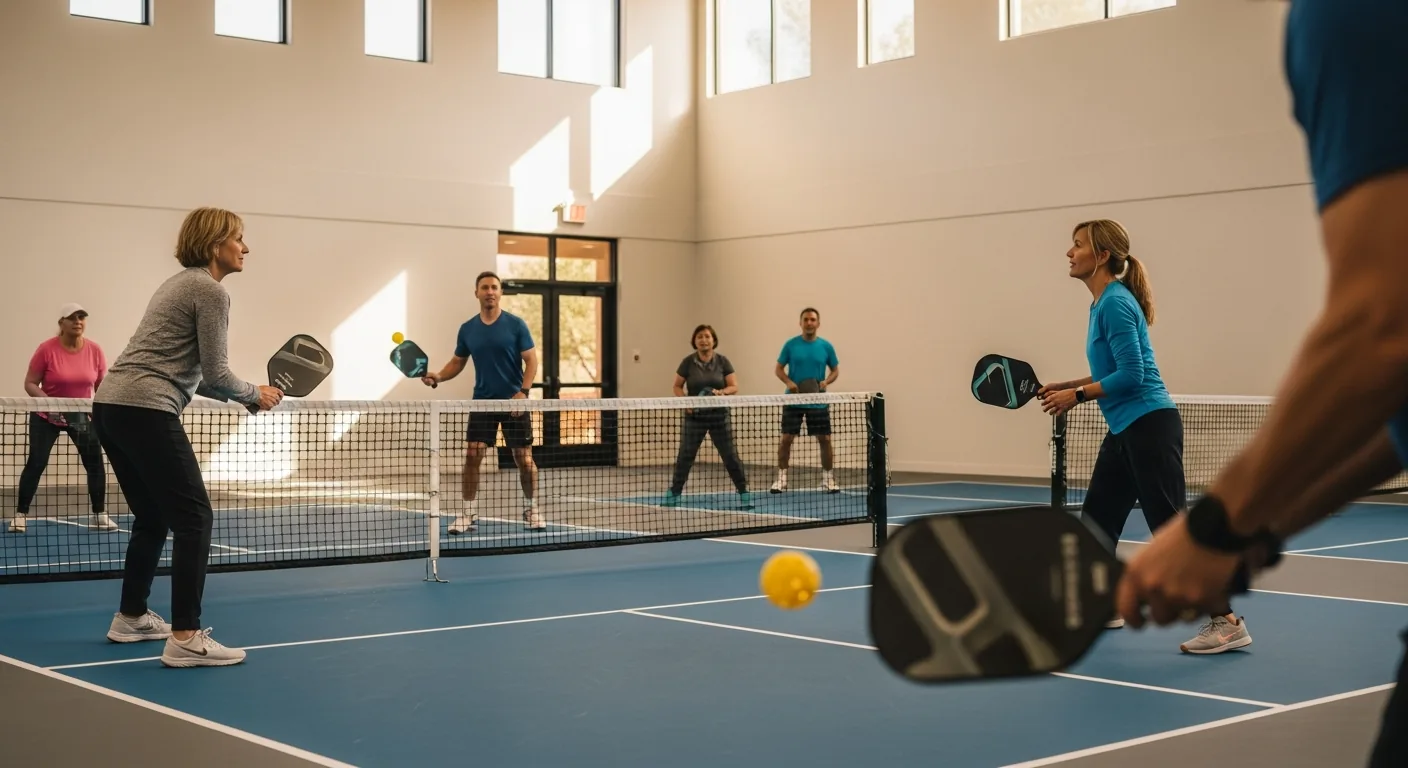
You served, the return came back deep, and both your opponents jogged up to the kitchen line before you had even reset your feet. Now the ball is bouncing somewhere around your ankles at the baseline, 44 feet of court is stretched out in front of you, and two paddles are waiting up at the net. Whatever you do next decides the point. This moment happens on nearly every rally in doubles, and it is the exact moment most recreational players lose.
Watch a 3.0 game and you will see two reflexes here, both of them losing plays. The first is the panic pop-up: a soft, high ball that floats over the net around chest height, which the net team calmly punches down at your feet for a winner. The second is the frustrated bash: a flat, hard drive aimed through two people standing seven feet away with their paddles already up. Sometimes the drive works. Usually it clips the net, sails long, or comes back faster than it left. Either way, you are still stuck at the baseline, and the other team still owns the net.
The shot that fixes this is the third shot drop: a soft, arcing ball hit from near the baseline that falls into the opponents’ kitchen too low to attack, buying you the seconds you need to move up and join the fight at the net. It is the single most important shot in doubles, and it is also the hardest one most players ever try to learn. This guide covers why the shot exists, exactly how to hit it, when to drop and when to drive instead, the five mistakes that wreck it, the footwork nobody teaches, and how to practice it until it holds up under pressure. If you are newer to the game and want the rules and scoring first, start with our beginner’s guide to pickleball rules and scoring and come back.
Why the third shot exists
To understand the third shot, you have to understand why the serving team starts every point at a disadvantage. It comes down to two rules and the shape of the court.
A pickleball court is 20 feet wide and 44 feet long, the same footprint as a doubles badminton court. The net stands 36 inches high at the posts and dips to 34 inches at the center. Seven feet back from the net on each side is the non-volley zone, universally called the kitchen. You cannot hit a volley — a ball out of the air — while any part of you is touching the kitchen or its line. That single restriction is the reason the whole game is built around getting to, and holding, the kitchen line. The net team hits down; the baseline team hits up. Standing at the line is worth more than any single shot.
Then there is the two-bounce rule, sometimes called the double-bounce rule. The serve has to bounce before the returning team can hit it, and the return has to bounce before the serving team can hit it. Only after those two bounces is either side allowed to volley. It is a simple rule with a large consequence, and it is worth saying slowly: the serving team is forbidden from hitting the third ball out of the air.
Here is how that plays out. You serve from behind the baseline. Your opponents let the serve bounce, then hit their return, and because they do not have to wait for anything, they follow that return straight up to the kitchen line. By the time the serve has traveled down and back, the returning team is already standing at the net in the strongest position in pickleball. You, meanwhile, are pinned at the baseline, because the two-bounce rule would not let you charge the net behind your serve even if you wanted to. The return is going to bounce in front of you, and you have to hit the third shot of the rally — the “third shot” — from about as far from the net as you can be.
So the serving team is stuck deep and the returning team owns the net. Hit that third shot hard and high, or short and floaty, and the net team simply steps in and hits it down at your feet or through the gap between you. The third shot is your one chance to fix that imbalance in a single swing. Get it right and you neutralize their advantage and walk up to join them. Get it wrong and you hand them the point.
What a third shot drop is
A third shot drop is a soft shot, hit from near the baseline, that lifts up in a gentle arc and falls into the opponents’ kitchen, ideally landing so low and so soft that they cannot do anything aggressive with it. That is the whole idea in one sentence: make the ball unattackable, then walk up behind it.
The value is in the height of the ball as it crosses the net and where it lands. A ball that arcs up on your side, peaks before the net, and is already falling as it crosses will land steeply and sit down fast. Because it is dropping into the kitchen — the seven feet where your opponents cannot volley — they have to either let it bounce or reach down and hit up on it. A ball struck from below net height cannot be smashed; the geometry will not allow it. That is the moment you have been fighting for. The net team’s advantage evaporates for one shot, and you use that shot to close the distance to the line.
A good drop lands roughly two to four feet past the net, inside the kitchen, with an arc that has it descending, not rising, as it clears the tape. You are not trying to skim the ball over as low and flat as possible. You are trying to hit the top of a soft rainbow so that gravity, not your opponent, controls what happens next.
Compare that with the two losing options from earlier. The pop-up lands in the same kitchen area but arrives high, still rising or flat at net height, so the opponent takes it out of the air and hits down. The hard drive stays low but keeps its pace, so even if it beats the net it is a fast ball the net team can block or redirect, and it does nothing to let you move up. The drop is the only third shot that both survives contact with a good net team and earns you the trip to the kitchen line. That is why coaches obsess over it, and why the ability to hit it on demand is the clearest line between a 3.0 player and a 4.0 one.
Drop or drive: choosing your third shot
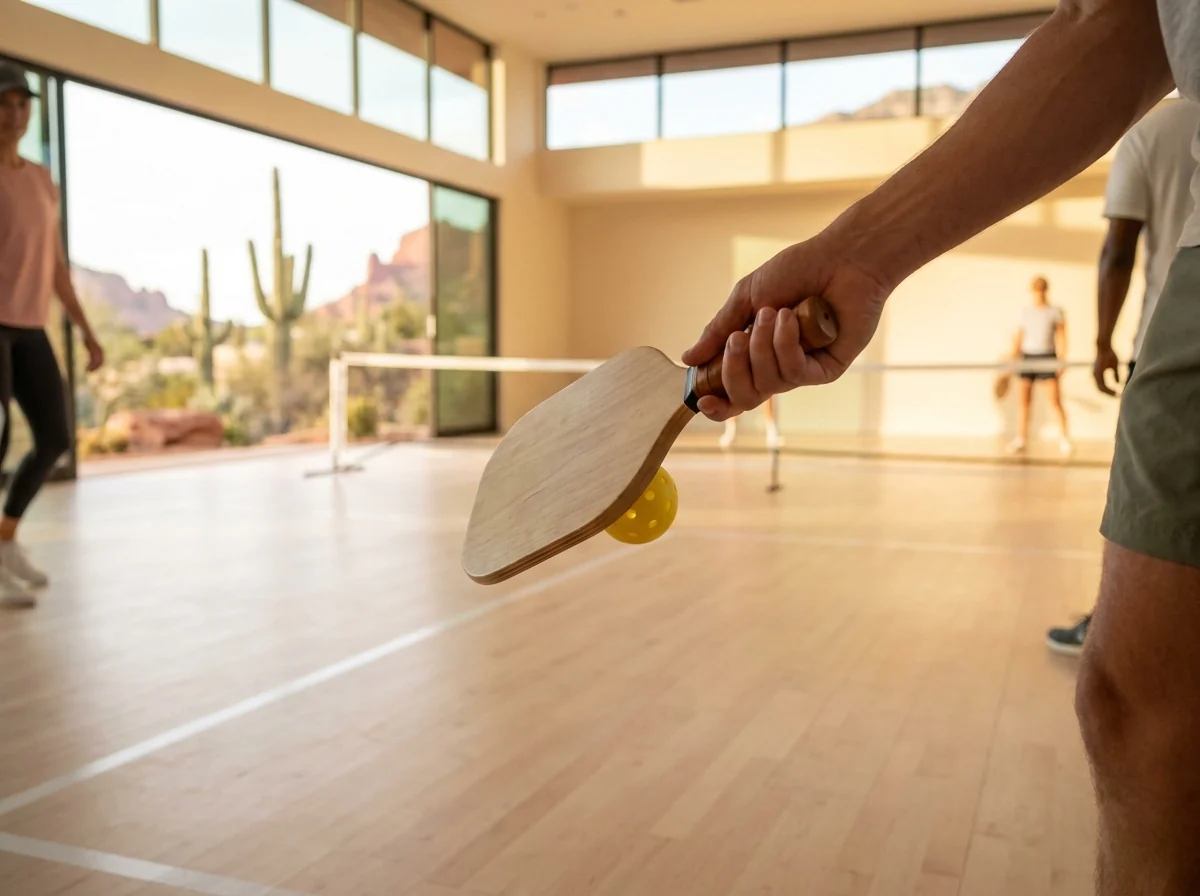
The drop is the highest-value third shot, but it is not the only one, and the best players do not hit it every single time. The other option is the third shot drive: a hard, low ball hit with pace, aimed at a body, a foot, or a gap. Knowing which one to choose is its own skill.
Hit the drop when the returning team is set at the kitchen line and volleys well. Against players with quick hands and clean put-aways, a drive is a gift; you are handing them a fast ball at the net, exactly what they want. The drop takes their pace away and forces them to generate their own, from a ball dying at their feet. Also hit the drop when you are contacting a low ball, down around your knees or lower. Low contact suits the lifting motion a drop needs, and it is hostile to a drive, which tends to sail long or find the net when you swing hard from below.
Hit the drive when your opponents cannot handle pace, when they are still moving up and have not set their feet, or when the return lands short and sits up around waist height where you can step in and hit through it. A hard ball at a scrambling opponent forces a rushed, floaty reply. It is also the right call against a specific weakness — a shaky backhand volley, say, or two opponents with a big gap between them.
The most useful pattern for intermediate players is the drive-then-drop, and it is worth learning as a two-shot idea rather than a single choice. You drive the third shot hard and low, not to win the point outright but to force a defensive, floaty reply. That weak reply, usually a soft ball that pops up a little, is far easier to drop than a firm, low return would have been. So you drive on three and drop on five, and by shot five you are already a step or two up the court. Plenty of players who cannot yet drop a firm return consistently find they can drop the softer ball a drive draws out. The drive becomes the setup; the drop becomes the finish.
One honest caveat: the drive-then-drop only works if your drive actually pressures someone. A drive that floats or lands short just becomes the net team’s put-away. If your drive is not sharp yet, you are better off drilling a plain drop until it is.
| Situation | Best third shot | Why |
|---|---|---|
| Opponents set at the kitchen line, volley well | Drop | A drive feeds their put-away; the drop makes them hit up from their feet |
| You are contacting a low ball around your knees | Drop | Low contact suits the lift; a hard drive from down there sails or nets |
| Opponents dislike pace or are still moving up | Drive | A fast, hard-to-handle ball forces a rushed, weak reply |
| The return lands short and sits up | Drive | Step in and hit through it; save the drop for deeper returns |
| You want to open the point up | Drive, then drop | The drive draws a floaty reply you can drop on the fifth shot |
The mechanics of a drop that lands
The third shot drop feels like a touch shot, and it is, but touch is built on repeatable mechanics, not feel that comes and goes. Here is what a reliable drop is made of, piece by piece.
- Loose grip. Hold the paddle lighter than you think, somewhere around a 3 or 4 out of 10. A tight grip transfers more speed to the ball and kills your feel for how hard you are hitting. A loose grip absorbs pace and lets the ball come off softly. This matters even more on the softer ball a drive-then-drop draws out, when you have to supply a gentle, controlled lift instead of just redirecting pace.
- Low-to-high swing path. The paddle starts below the ball and finishes higher, brushing up and forward. That upward path is what produces the arc. Think of lifting the ball onto a high shelf a few feet past the net, not hitting it there.
- Lift with your legs and shoulder, not your wrist. This is the big one. Bend your knees, get low, and lift the ball with a smooth push from your legs and shoulder while your wrist stays quiet and firm. A wristy flick is the number-one destroyer of drops. It adds speed you cannot control and makes the contact point inconsistent from shot to shot. The stroke should feel like a small, calm push, powered from the ground up.
- Contact out in front, and low. Meet the ball in front of your body, not beside or behind it, and take it low. Contacting out front lets you see the shot and control the face; taking it low fits the upward lift you are trying to produce. Let the ball get behind you or catch it high and the drop turns into a pop-up.
- Keep the stroke compact. No big backswing. A long backswing loads power you then have to bleed off, which is hard to do consistently. A short, compact stroke starts with less speed to manage, so your misses are smaller. This is exactly why more experienced players make the drop look effortless; they have taken all the unnecessary motion out of it.
- Aim the apex on your side of the net. Picture the highest point of the ball’s arc happening before the net, on your side, so the ball is already falling when it crosses. If the apex is on your opponents’ side, the ball is still rising at the net, and it will land deep and sit up, attackable. Apex early, land soft.
- Target two to four feet past the net. Aim into the kitchen, a couple of feet beyond the tape, toward the middle more often than the lines. The middle is the safest target: it lowers your error margin, cuts the angles your opponents can hit back, and can cause a moment of confusion about who takes the ball.
A little topspin helps. Brushing up the back of the ball pulls it down faster after the apex, which lets you clear the net with margin and still bring the ball into the kitchen. But topspin is a refinement, not the foundation. The core of the shot is a gentle lift with a slightly open paddle face and a quiet wrist. Add spin once the plain version is reliable, not before.
Your equipment plays a quiet role here too. A control-oriented paddle — softer, more touch, less raw power — makes the drop more forgiving, because it takes some pace off the ball for you. A powerful, poppy paddle fights you on soft shots. If you are weighing your next paddle, our guide to choosing a pickleball paddle walks through the control-versus-power tradeoff, which matters more for the drop than for any other shot.
Five ways the drop breaks down, and how to fix each
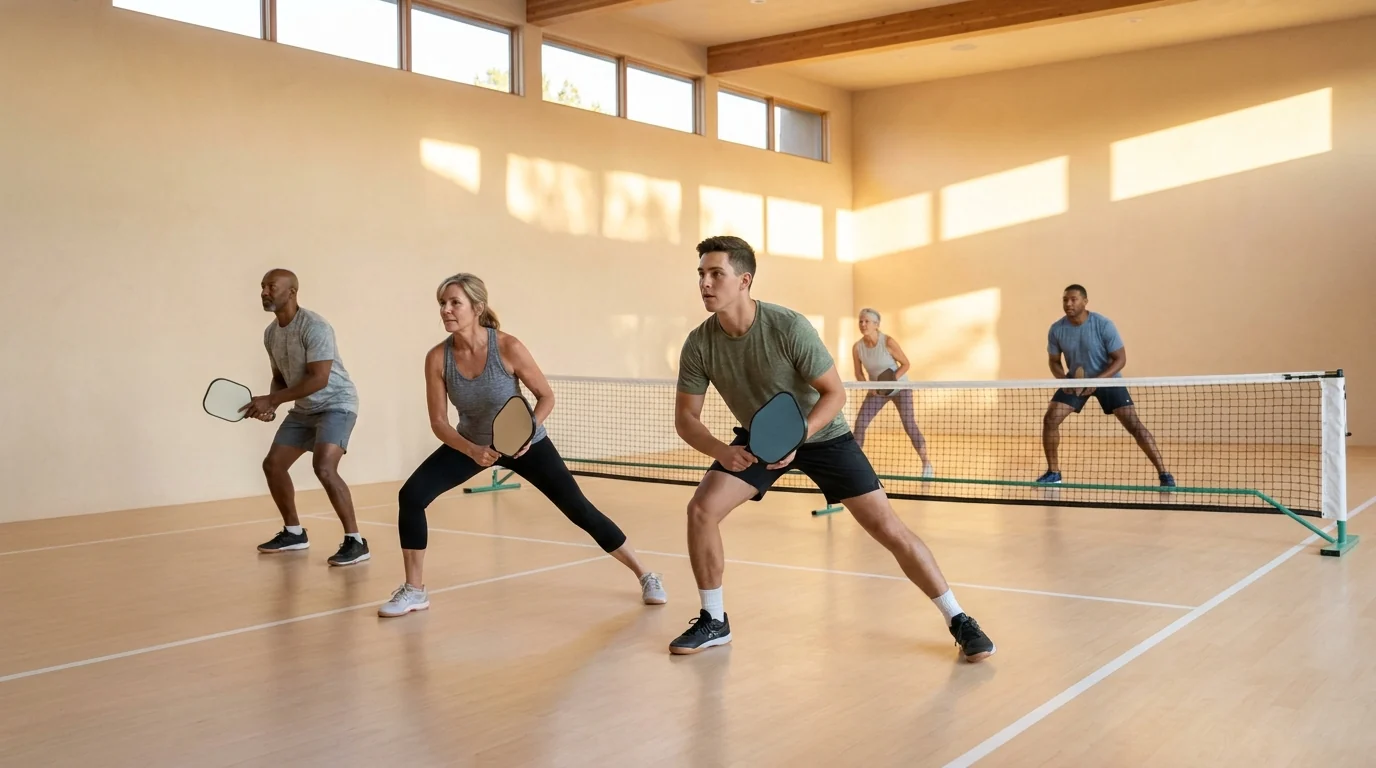
Almost every bad drop traces back to one of five habits. Here is how each one fails, and the fix.
- Too much wrist. A wristy flick adds uncontrolled speed and moves your contact point around, so one drop nets and the next sails. The fix is to quiet the wrist entirely, keep it firm, and lift with your legs and shoulder instead. It helps to practice a few dozen drops thinking only “no wrist” until the calm, pushed feel becomes normal.
- Hitting it flat or too hard, so it sails. If your drop clears the net with pace and lands deep and high, you are hitting through it instead of lifting it. Take pace off at the source by shortening your backswing rather than trying to decelerate through contact, aim the apex on your side of the net, and add a touch of topspin to bring it down.
- Dropping from a bad, off-balance position. A delicate shot needs a stable base, and trying to drop while lunging, reaching, or falling backward almost never works. If you are stretched or out of position, do not force the drop. Either drive that ball, or hit a higher, safer reset, give up the trip to the net for that one shot, and reset the point. The drop is a shot you hit when you are balanced.
- Rushing forward before the ball lands. Sprinting to the net the instant you hit, then getting caught in the middle of the court by a ball at your feet, undoes a perfectly good drop. The fix is to hit, watch, then move. Advance in stages and be ready to stop and hit again, which the footwork section below covers in full.
- Aiming too fine and hitting the net. Trying to drop the ball two inches over the tape and onto a line leaves no margin, and the net wins that battle most days. Aim for the middle of the kitchen with real net clearance and accept a deeper, safer drop. Precision comes from repetition, not from cutting your margins to zero.
Footwork: the drop is only half the job
A perfect drop with bad footwork still loses points. The entire reason you hit the drop is to get to the kitchen line, so what you do with your feet after contact matters as much as the swing.
The sequence is hit, read, move, in that order. After you hit the drop, read it. Is it good? Is it going to land low in the kitchen, or did you leave it a little high? A good drop earns you the right to move up. A bad one means you should hold, because charging in behind a floaty drop just gets you caught at your feet.
Do not sprint the whole 22 feet from the baseline to the kitchen line in one go. Run flat out and you will almost certainly still be moving when your opponent contacts the next ball, and a ball hit at a running player’s feet is nearly impossible to handle. Instead, advance in controlled stages, and split-step — a small hop that lands you balanced and ready — every time your opponent is about to hit. Move, split-step, read the ball, move again.
This means you will often stop somewhere in the middle of the court, in the area players call the transition zone or no-man’s-land, roughly the stretch between the baseline and the kitchen line. It has a bad reputation because it is where you are most exposed to a ball at your feet, and the goal is never to stand there and rally. But you will pass through it on almost every point, and you have to be able to hit from it while you move through.
That is where the fifth-shot drop, or reset, comes in. Your third-shot drop gets you partway up. Your opponent hits again while you are in the transition zone. Rather than panic, you hit another soft drop — a reset — from mid-court, landing it in the kitchen just like the third shot, and you use it to move up the rest of the way. Good players will hit two or even three resets in a single point, patiently working toward the line one soft ball at a time. The third shot drop is just the first of that family of shots. Once you can hit it, the fifth-shot reset is the same swing from a few feet closer.
The mental shift that makes this click: getting to the net is a process, not a single dash. You are trading patient soft shots for court position, a few feet at a time, until you and your partner are both at the line and the point resets to even. The team that gets there first usually wins the point, and the drop is how you get there.
How to groove it: drills that transfer to games
The drop is a feel shot, and feel is just a memory your body builds through repetition. There is no shortcut. You groove it with reps, ideally hundreds of them, in conditions calm enough that you can tell a good one from a bad one. Here are the drills that transfer to real games, roughly in the order you should build them.
- Static drop targets. Stand at the baseline with a bucket of balls. Feed yourself a bounce and drop it into the kitchen, over and over. Put a towel or a couple of paddle covers in the kitchen as targets. You are not counting winners; you are counting how many land soft in the zone. This is the rawest version of the shot, with every variable stripped out except your swing.
- Consistency counting. Turn it into a number. Hit ten drops and count how many land in the kitchen unattackably. Get to seven of ten before you make it harder. Then chase that same seven of ten with a partner feeding you live returns instead of self-feeds, which is far closer to a real point.
- Progressive distance. Start closer than the baseline, say mid-court, where the drop is easy, and hit until you are consistent. Then take a step or two back and repeat. Keep backing up until you are hitting good drops from behind the baseline. Working from easy to hard builds the motion without burning you out on misses.
- Partner feeds and cross-court drops. Have a partner at the kitchen line feed you returns while you drop from the baseline. Drop straight ahead, then drop cross-court — the longer, safer diagonal, which gives you more court and the lower center of the net to clear. Live feeds add the timing and movement a self-feed cannot.
- Drop and advance. This is the one that ties it all together. Drop from the baseline, then move up behind it in stages, split-stepping, hit a fifth-shot reset from the transition zone, and finish at the kitchen line. Now you are not just practicing a swing; you are practicing the whole job the drop exists to do. Our full private-court drill guide lays out sets, counts, and progressions for these in more detail.
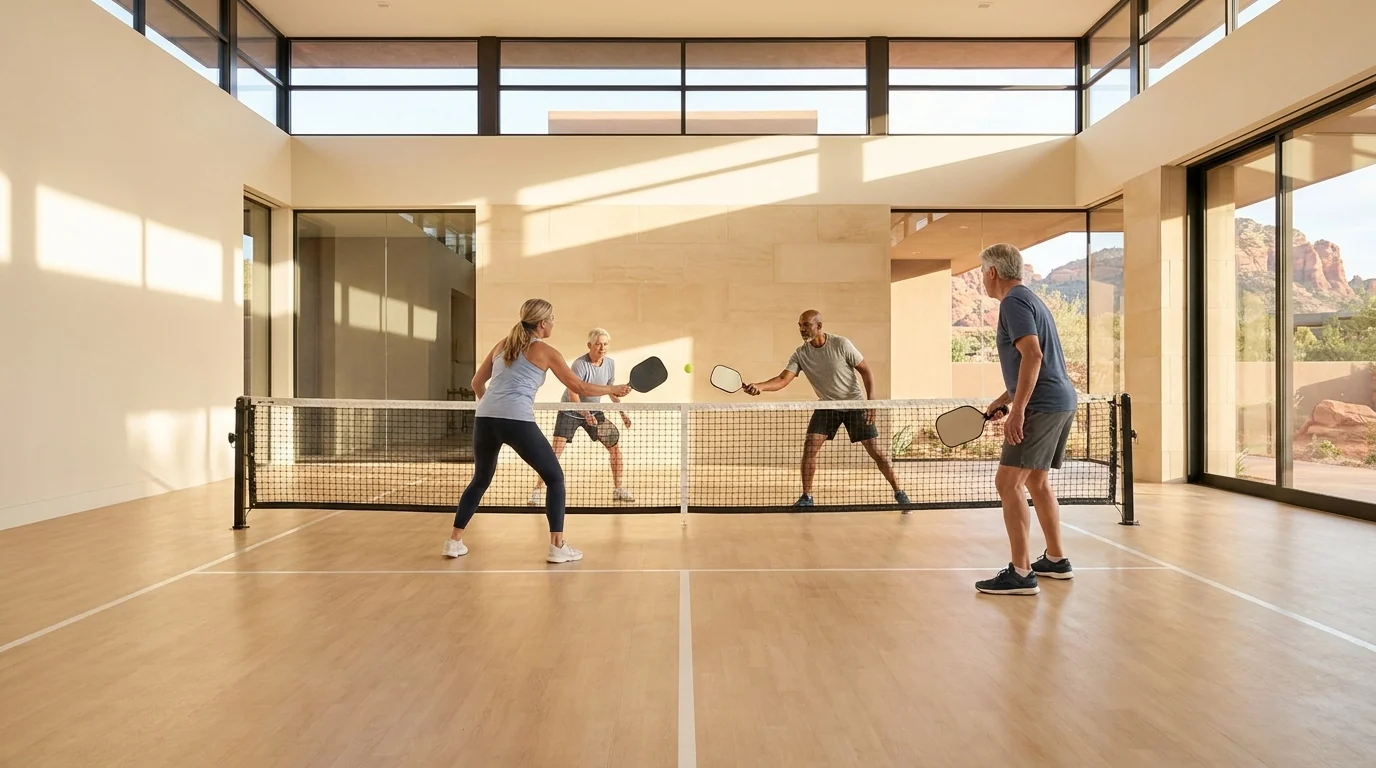
The thing every one of these drills needs is repetition without interruption: no chasing balls across three courts, no waiting for a public court to open, no wind pushing your soft shots around. Wind is the enemy of drop practice; a five-mile-per-hour breeze turns a grooved drop into a guess, which is one reason indoor and outdoor courts play so differently. Grooving a soft shot is exactly the kind of work that rewards a controlled, private space.
The thin-air wrinkle: why drops sail in Sedona
If you are bringing your drop to Sedona, there is one local quirk worth knowing: the thin air. Sedona sits at roughly 4,350 feet, and the air up here is about 12 percent less dense than at sea level. Less dense air means less drag on the ball, so shots hold their pace and carry farther than they do down low.
Of all the shots in pickleball, the drop is the one this affects most, and the reason is exactly what makes the drop the drop: it depends entirely on the ball dying in the right place. A drive that flies a foot longer still might land in. A drop that carries a foot longer sails out of the kitchen and sits up at an attackable height, and the whole shot fails. The soft, precise shots that live or die by a few feet of distance are the ones thin air punishes hardest. Your dinks change the least, because slow shots were never fighting much drag in the first place; your drop changes the most.
The fix is the same one that makes you better anywhere: shorten the backswing, take a little pace off, aim the apex on your side, and give yourself margin. It is also a reason to groove the shot somewhere the only variable is the air. Take away wind, sun glare, and temperature swings, and a long drop becomes information you can adjust to rather than a mystery. We wrote a whole piece on how 4,350 feet changes your game — the short version is that the drop is the shot that needs the most recalibration, and a few focused sessions fix it. If Sedona is on your calendar, check dates and plan to spend your first session dialing your distance back in.
The bottom line
The third shot drop is the shot that turns a serve into a fair fight. The two-bounce rule hands the returning team the net; the drop is how the serving team takes it back. It is a legs-and-shoulder lift, not a wrist flick — a soft, compact push that arcs up, peaks on your side, and falls into the kitchen too low to attack, buying you the walk to the line.
None of it is complicated, and all of it is hard, because soft precision under pressure only comes from reps. Drill it plain before you dress it up with spin, know when to drive instead, move up in stages rather than sprinting, and give the ball margin over the net. Do that and you will stop losing the point the moment you serve, which, for most players stuck at 3.0, is most of the game. If you want a weekend to actually put in the reps, a private indoor court with no wind and no waiting is about the best drop lab there is. See dates and bring a bucket of balls.
Frequently asked questions
What is the third shot drop in pickleball?
It is a soft shot hit from near the baseline on the serving team’s third shot of the rally. It arcs up and drops into the opponents’ kitchen — the non-volley zone — too low to attack, which lets the serving team move up from the baseline toward the net. It exists because the two-bounce rule strands the serving team deep while the returning team gets to the net first.
Why is the third shot so important?
Because of the two-bounce rule, the serving team has to let the return bounce and hit the third ball from near the baseline, while the returning team has already run up to the net. The third shot is the serving team’s one chance to neutralize that disadvantage. A good drop makes the ball unattackable and buys time to advance; a poor one gets attacked and usually loses the point.
Should I hit a third shot drop or a third shot drive?
Drop when the opponents are set at the kitchen line and volley well, or when you are contacting a low ball, because a drive there just feeds their put-away. Drive when opponents struggle with pace, are still moving up, or when the return sits up short. Many players combine the two as a drive-then-drop: drive the third shot to force a weak reply, then drop the softer ball on the fifth.
Why does my third shot drop keep going into the net?
Usually you are aiming too fine and too low, or bleeding off pace by decelerating through contact instead of shortening your swing. Aim for the middle of the kitchen with real net clearance, and remember that a drop landing a little deep is still unattackable, while a drop in the net is just a lost point. When in doubt, hit it higher, not lower.
How do I practice the third shot drop?
Start with self-fed drop targets from the baseline into the kitchen, counting how many land soft — aim for seven of ten before making it harder. Then add a partner feeding live returns, work cross-court as well as straight ahead, and finish with a drop-and-advance drill where you move to the net behind your drop. Reps without wind or interruption matter most, which is why a controlled indoor court is ideal.
Does altitude change the third shot drop?
Yes, more than any other shot. Sedona’s roughly 4,350-foot elevation makes the air about 12 percent thinner, so the ball carries farther and a drop grooved at sea level tends to sail past the kitchen and sit up. Shorten your swing, take off a little pace, and give the shot margin. See our full guide to playing pickleball at altitude for the details.
Play year-round in red rock country
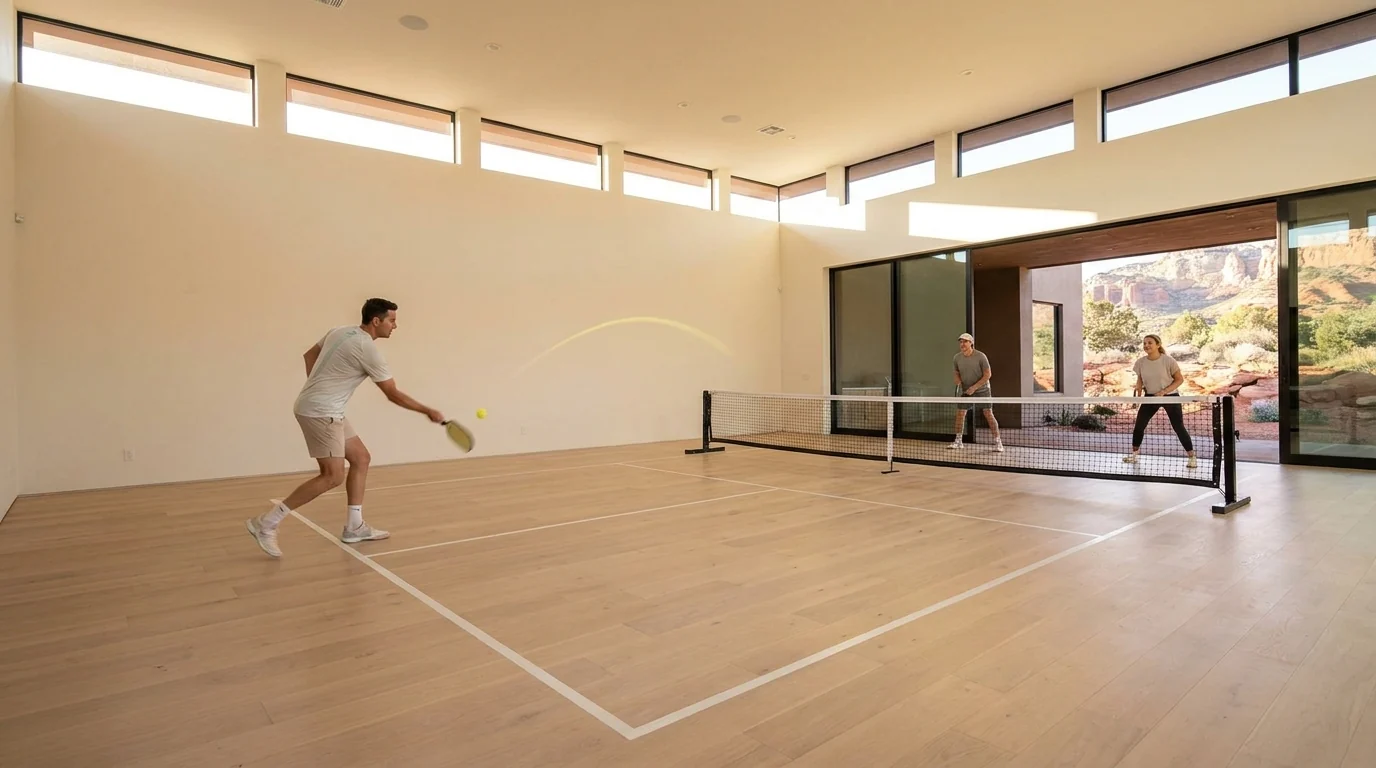
Sedona Pickler is a private Sedona home with its own indoor, climate-controlled pickleball court. Rally any season, any hour — heated, cooled and lit, with paddles and balls provided.
Check dates & book