
Rain in Sedona feels like a betrayal. You booked the trip for red rock and blue sky, checked the forecast twice, and now water is running off the roof and the trail you planned is a sheet of wet slickrock. Here’s the thing most first-time visitors don’t know: locals like these days. Storms are rare enough here that when one arrives, it changes what the place looks like — clouds snag on the buttes, short-lived waterfalls pour off rock faces that are bone dry 350 days a year, and the red in the red rocks goes about two shades deeper when it’s wet. A rainy day in Sedona is not a lost day. It’s a different day, and this guide covers how to use it.
How often does it actually rain here?
Not often, and not for long. Sedona averages about 17 inches of precipitation a year — the NOAA 1991–2020 climate normals put it at 17.1 inches, though individual years have ranged from under 14 inches to about 26. For comparison, that’s roughly a third of what Seattle gets, concentrated into two windows.
The first window is the summer monsoon. Arizona’s monsoon season officially runs June 15 through September 30, and most of the action lands between mid-July and mid-August. Monsoon storms are afternoon events: the morning is usually clear, clouds build over the rim around midday, a hard 30-to-90-minute downpour rolls through mid-afternoon, and the sky often clears again in time for sunset. If you’re visiting in monsoon season, the fix is mostly scheduling — hike early, plan something indoors for mid-afternoon, and go back out for the evening.
The second window is winter. Pacific storm systems come through between roughly December and March, and these behave differently: slower, colder, and capable of lasting a full day or two. This is when Sedona gets its snow — a few inches in a typical year, mostly in December and January. At 4,350 feet, Sedona sits below the heavy snow zone (Flagstaff, 2,000 feet higher, measures its snow in feet), and what falls here rarely stays. Snow on the red rocks usually starts melting by mid-morning on sunny slopes and is often gone within a day or two, which is exactly why photographers scramble when it happens.
Why photographers pray for exactly this weather
Before you write off the day, look outside. Sedona in a storm is the version of Sedona that ends up in galleries, and there are two reasons.
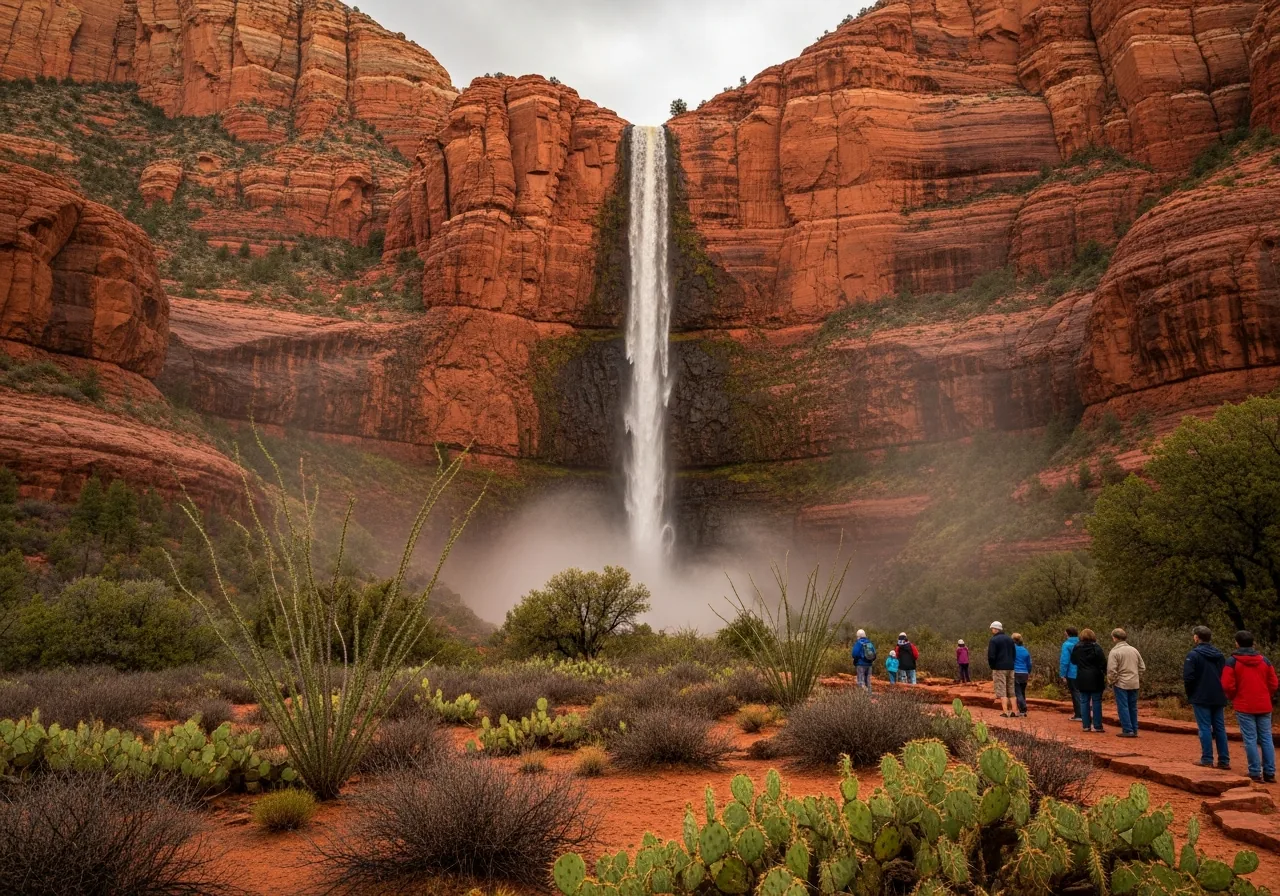
The first is the waterfalls. Sedona has no permanent waterfalls to speak of — but after heavy rain or during a fast snowmelt, ephemeral falls appear all over the rock faces. Water sheets off the mesas and finds the same pour-offs it has used for a few million years, and for a few hours the cliffs run with white ribbons. The best-known spot is Seven Sacred Pools on the Soldier Pass trail, where a chain of carved sandstone basins spills from one pool into the next after a good storm. In Fay Canyon, a thin waterfall shows up at the canyon headwall after significant rainfall. These are genuinely rare sights — most visitors never see Sedona’s water running because most visitors are here on the dry days. Wait for the rain to ease, give the trails an hour, and go look. (Do not hike a narrow canyon while a storm is still active — more on that below.)
The second is the light. On a clear day, midday light in Sedona is flat and harsh. On a storm day, clouds wrap the formations, shafts of sun punch through between cells, and wet sandstone saturates to a deep rust-red that dry rock never shows. Monsoon storms regularly hang rainbows over the buttes as they pull away. If you have any interest in photography, a breaking storm is the single best condition this landscape offers — our photography spots guide covers the overlooks and angles, and almost all of them are drive-up or short walks, so you can shoot between showers without committing to a soaked hike.
Take the drive you were saving for later
Rain rules out slickrock hiking, but it makes Sedona’s scenic drives better, not worse. The Oak Creek Canyon drive north on State Route 89A is the obvious pick: the road follows the creek up a forested canyon, and in wet weather the canyon walls hold fog, the creek runs loud and full, and low clouds drift through the pines at windshield level. It’s a different landscape from the open red rock country and arguably shows better in weather than in sun. Drive it slowly, use the pullouts, and treat the switchbacks near the top with respect — in winter storms this stretch can hold ice and snow longer than town does, so check conditions before heading up if it’s a cold storm.
The move is to treat the car as a viewing platform: heater on, pullout to pullout, camera on the passenger seat.
The indoor circuit: museum, village, galleries
Sedona’s indoor options are compact — this is a town of 10,000 people, not a city — but they’re good, and they cluster conveniently.
Start with the Sedona Heritage Museum at 735 Jordan Road in Uptown, set in Jordan Historical Park on the site of the Jordan family farmstead. This is the story of Sedona before the tourists: the homesteaders, the orchard years, and the stretch when Hollywood used these rocks as a backdrop for dozens of Westerns — the museum covers the movie history in detail, which is a genuinely fun rabbit hole on a wet afternoon. It’s open daily 11 AM to 3 PM, closed major holidays; admission runs $10 for adults with kids under 13 free (confirm current hours and pricing before you go — the window is short, so plan around it).
From Uptown it’s a five-minute drive to Tlaquepaque Arts & Shopping Village, which is the closest thing Sedona has to a purpose-built rainy-day venue. It’s modeled on a traditional Mexican village — courtyards, fountains, sycamores — but the galleries, shops, and restaurants are all indoors, and the walkways between them are short. You can spend two or three hours moving between working art galleries, craft shops, and a long lunch without ever really being out in the rain. It’s also simply pleasant in a storm; the courtyards empty out and the place feels like it belongs to you.
If the galleries at Tlaquepaque get you started, keep going. Sedona has one of the denser art gallery scenes of any small town in the Southwest, with a concentration along Gallery Row on SR 179 and more in Uptown. Gallery browsing was never a weather activity to begin with — and on a slow rain day, the staff have time to actually talk, which is when it gets interesting.
Spas, tasting rooms, and the long lunch
The other indoor track is the slow one. Sedona has a deep spa and wellness scene — day spas, resort spas that take outside bookings, massage and bodywork studios — and a rainy day is the least guilty you will ever feel about spending three hours in one. Book ahead if you can; you will not be the only person in town with this idea when the forecast turns.
Wine is the same logic. The Verde Valley below Sedona is a legitimate wine region, and there are tasting rooms in and around Sedona plus more in Cottonwood’s Old Town, about 30 minutes away, where several sit within walking distance of each other. A tasting flight while rain hits the windows is not a consolation prize — it’s what half the people at the bar would have chosen anyway. Designate a driver or book a tour; the point of a rainy day is that nobody is in a hurry.
Round it out with food. Sedona’s restaurants are far easier to get into when the weather chases the crowds off the trails — the tables with the big red-rock windows, which are usually the hardest seats in town, are suddenly available, and storm light through those windows beats sunny-day glare.

The one plan that ignores the forecast entirely
Everything above is a workaround. Here’s the exception.
This is worth being plain about, because it changes how you plan a Sedona trip. Most visitors build their itinerary around weather risk: they front-load the hikes, keep a nervous eye on the monsoon forecast, and accept that a winter storm might wipe out a day. A group staying at a house with an indoor court doesn’t carry that risk. The rainy afternoon that costs other visitors their plans becomes the best court session of the trip — and when the storm breaks, you walk off the court and drive out to watch the waterfalls run. The game room, media lounge, and hot tub cover the non-players (a hot tub in a light rain, for the record, is better than a hot tub in sunshine).
If you’re weighing seasons, our guide to the best time to visit Sedona for pickleball breaks down the calendar — the short version is that an indoor court makes every month a good month, which is not something the outdoor-court towns can say.
If it snows, drop everything
A rain day is a schedule adjustment. A snow day is a jackpot.
Snow on the red rocks is one of the rarest and most photographed conditions in Arizona — white powder on rust-red sandstone under a clearing blue sky — and the window is brutally short. Because Sedona sits at 4,350 feet, snow that falls overnight typically starts melting by mid-morning as sun hits the south-facing rock, and most accumulations are gone within a day or two. That’s the whole strategy: if you wake up to snow, skip the slow breakfast. Get to an overlook — Airport Mesa is close to everything and faces the big formations — shoot while the snow is still on the rock, and count yourself lucky. By afternoon you’ll likely have regular Sedona back, with waterfalls running off the melt as a bonus.
A sample rainy day, start to finish
Here’s how the pieces fit, assuming a full-day winter soaker rather than a passing monsoon cell:
| Time | Plan |
|---|---|
| Morning | Slow start. Coffee, big breakfast, first pickleball session while the rain settles in. |
| 11 AM | Sedona Heritage Museum — history and Hollywood, about an hour or two. |
| 1 PM | Lunch and gallery wandering at Tlaquepaque, all under cover. |
| 3 PM | Split the group: spa appointments for some, wine tasting for others. |
| 5 PM | If the rain breaks — drive to a pullout and look for waterfalls on the rock faces. |
| Evening | Hot tub in the drizzle, dinner in, more court time. Nobody checks the forecast. |
The quiet advantage of the indoor court shows up here too: it’s not just weatherproof, it’s noiseproof. Evening and night play doesn’t bother anyone, because there are no neighbors within earshot of an enclosed, insulated court — a real consideration anywhere else, as anyone who’s dealt with pickleball noise complaints knows.
Rain in Sedona is short, rare, and — if you play it right — the most memorable weather of your trip. Waterfalls that exist for one afternoon, storm light that photographers wait years for, empty galleries, open restaurant tables, and a court where the score is the only thing anyone’s tracking. Bring a rain shell and don’t change your dates.
Frequently asked questions
Does it rain a lot in Sedona?
No. Sedona averages about 17 inches of precipitation a year (NOAA 1991–2020 normals), concentrated in two windows: the summer monsoon from mid-June through September, which brings short afternoon thunderstorms, and Pacific winter storms from roughly December through March. Most days of the year are dry.
Does Sedona get snow?
Yes, a few inches in a typical year, mostly in December and January. At 4,350 feet Sedona is high enough to catch snow but low enough that it melts fast — usually starting by mid-morning on sunny slopes and mostly gone within a day or two. Snow on the red rocks is rare and worth rearranging your morning for.
Are there waterfalls in Sedona?
Only temporarily. Sedona has no significant permanent waterfalls, but after heavy rain or during snowmelt, ephemeral waterfalls pour off the rock faces around town. Seven Sacred Pools on the Soldier Pass trail and the headwall of Fay Canyon are two reliable spots to see water running after a storm.
Is it safe to hike in Sedona right after rain?
Wait for the storm to fully pass, then use judgment. Avoid narrow canyons, washes, and creek crossings during and immediately after rain because of flash flood risk, and be careful on steep slickrock, which is slippery when wet. Flatter trails are usually fine within an hour or two, and slickrock dries quickly once the sun returns.
What indoor things are there to do in Sedona?
The Sedona Heritage Museum (open daily 11 AM–3 PM; confirm current hours), the galleries and shops at Tlaquepaque, Sedona’s art galleries along SR 179 and in Uptown, day spas, and wine tasting rooms in Sedona and nearby Cottonwood. It’s a small town, but that list fills a day comfortably.
What happens to a pickleball trip if it rains all weekend?
On outdoor courts, it’s cancelled. At this house, nothing changes — the private court is indoors, heated, air-conditioned, and lit, so a full-weekend storm just means more court time between museum trips and spa bookings. Weather doesn’t reach it.
Play year-round in red rock country
Sedona Pickler is a private Sedona home with its own indoor, climate-controlled pickleball court. Rally any season, any hour — heated, cooled and lit, with paddles and balls provided.
Check dates & book


