
Every summer, somebody asks whether Sedona is “too hot to visit in July.” Fair question — it’s Arizona, and the news out of Phoenix every summer sounds like a broiler setting. But Sedona sits at about 4,350 feet, and elevation changes the math. The town’s July average high is 97°F, and nights drop to 68°F. Phoenix averages 107°F in July and only falls to 85°F overnight. That is a ten-degree gap in the afternoon and a seventeen-degree gap at night, which is the difference between a warm evening on a deck and stepping into a parking lot at 10 PM that still feels like a hair dryer.
So no, summer Sedona isn’t cool. But it’s workable — genuinely pleasant, even — if you run your day the way locals do. There’s a rhythm to it: trail at dawn, water after lunch, indoors from noon to four, outside again when the sun drops. This post lays out that rhythm hour by hour, plus the one thing most first-time summer visitors don’t plan for: monsoon season.
The actual numbers, so you can plan around them
Here’s Sedona’s summer, from NOAA’s 1991–2020 climate normals:
| Month | Average high | Average low |
|---|---|---|
| June | 94°F | 61°F |
| July | 97°F | 68°F |
| August | 94°F | 67°F |
July is the peak. June is slightly cooler by day and noticeably cooler at night — it’s also the driest of the three, since the summer rains usually haven’t organized yet. August matches June’s daytime numbers but keeps July’s humidity.
For comparison, Phoenix’s July normals are 107°F for the high and 85°F for the low. The daytime gap matters, but the nighttime gap matters more. In Phoenix, the heat never really releases; in Sedona, it does, every night. Mornings here start in the 60s, which means the first three or four hours of daylight are legitimately comfortable — and that’s the foundation of the whole playbook.
One more number worth knowing: the sun at this elevation is strong even when the air temperature reads reasonable. Shade, water, and a hat aren’t suggestions in July.
Dawn belongs to the trail
The single biggest summer mistake visitors make is hiking on a desert schedule that would work in October. In July, the window for exposed trails is roughly first light to about 10 AM. After that, the red rock radiates heat back at you and shade gets scarce.
So flip your day: alarm early, coffee in hand, trailhead by 6. The light at that hour is the best of the day anyway — low, warm, and raking across the formations — and you’ll have parking that simply doesn’t exist at 9:30. Our list of easier Sedona hikes is a good starting point for summer, because short and early beats long and lethal this time of year. If you want a longer walk, West Fork of Oak Creek is the classic summer choice: the canyon walls throw shade most of the day and the trail crosses the creek a dozen times, so your feet stay cool even when the mesa tops are baking.
A few dawn-hike ground rules for July:
- Carry more water than feels reasonable. A liter per person for anything over an hour, more for longer.
- Be heading back down, not up, by mid-morning.
- Check the forecast for afternoon storms before you commit to anything exposed — more on that below.
Afternoons are for water
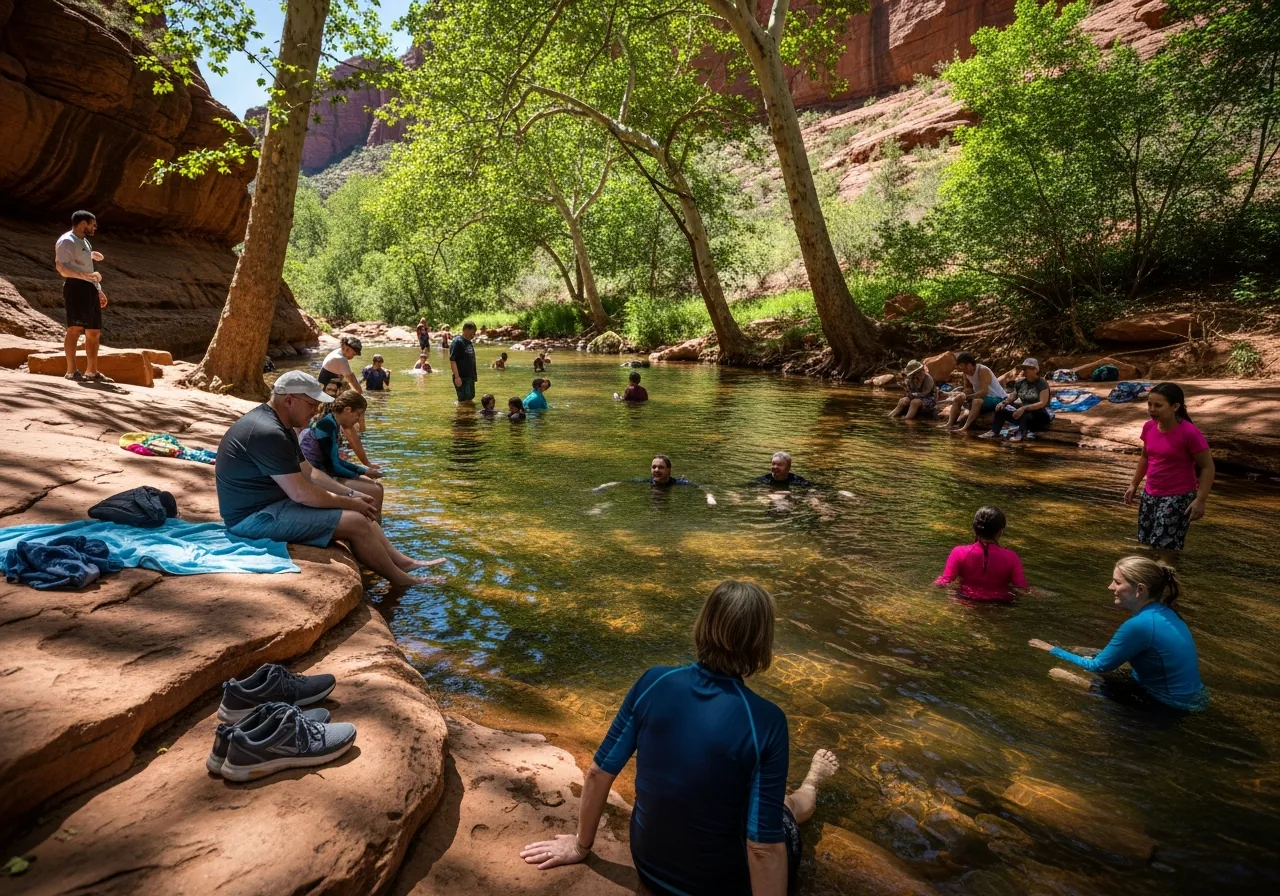
By 1 PM the smart move is to be wet. Sedona has real options here, which surprises people who picture Arizona as uniformly dry.
The famous one is Slide Rock State Park, seven miles north of town in Oak Creek Canyon. The park is named for a natural sandstone chute about 80 feet long, worn smooth by Oak Creek, and about a half mile of the creek is open for swimming and wading. It’s been called one of America’s top swimming holes, and in July the rest of Arizona agrees with that assessment — the park drew over a quarter million visitors in 2024, and summer weekends are the crush. The parking lot regularly fills by late morning on hot Saturdays. If Slide Rock is on your list, go on a weekday, arrive when the gates open, or treat it as a morning activity and do your hiking the next day. Entry is charged per vehicle; confirm current fees and hours on the Arizona State Parks site before you go.
If you’d rather paddle than slide, the Verde River runs about 30 minutes southwest of Sedona near Cottonwood and Clarkdale. It’s a Class 1 river — calm, family-friendly, no whitewater experience needed — and several local outfitters run guided kayak trips and rentals along the Verde River Greenway. Our Verde River kayaking guide covers the launch points and outfitters. Floating a shaded, spring-fed river through cottonwood galleries in the middle of an Arizona July is one of those things that sounds made up until you do it.
And if you just want to cool your feet without a plan, Oak Creek runs right through the area — picnic spots and swimming holes line Oak Creek Canyon along 89A. Bring water shoes; the creek bottom is rocky everywhere.
The 12-to-4 problem, solved indoors
Even with a creek afternoon, there’s usually a stretch of midday where the best version of Sedona is air-conditioned. Locals don’t fight this. Noon to four is for lunch, galleries, and anything with a roof.
The obvious anchor is Tlaquepaque Arts & Shopping Village, the arts village on Oak Creek along SR 179. It’s been there since 1973, built by hand in the style of a Mexican village — cobblestones, tiled fountains, ironwork — and today it holds roughly 45 shops and 18 galleries, plus restaurants. The sycamores and courtyards do real work against the heat, and you can wander it for two or three hours without noticing the clock. Sedona’s gallery scene extends well beyond Tlaquepaque too, and gallery-hopping is about the most heat-proof activity the town offers.
Monsoon season: what the afternoon sky is going to do
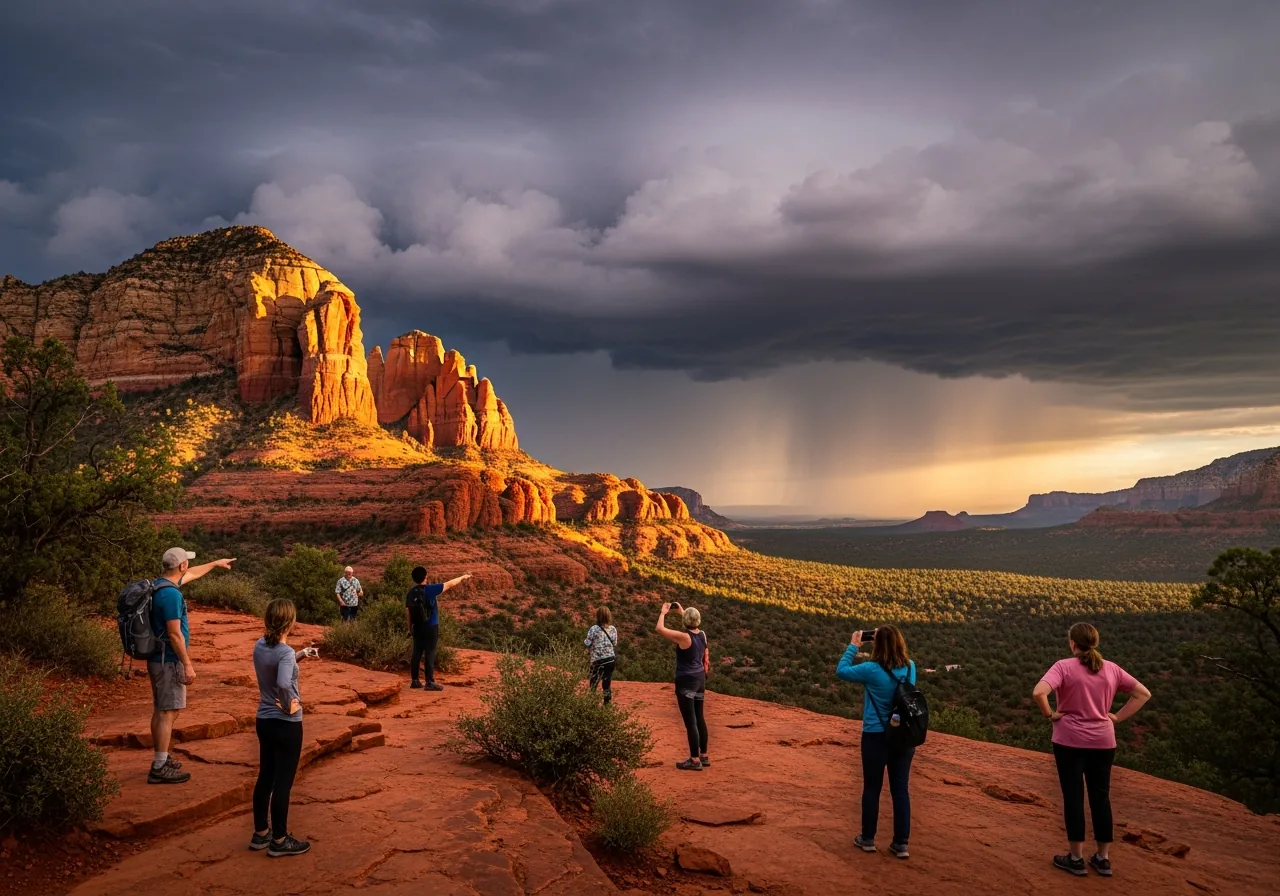
Here’s the part of summer Sedona that catches people off guard. Arizona’s monsoon season officially runs June 15 through September 30 — the National Weather Service fixed those calendar dates in 2008 — and the active heart of it is July through early September. The pattern is predictable: clear mornings, clouds building over the high country by early afternoon, then scattered thunderstorms with lightning, gusty wind, and brief heavy rain in the late afternoon and evening. Some days nothing happens. Some days the sky opens for an hour and then clears.
What this means for your plans:
- Morning hikes are doubly smart in monsoon season. You’re beating both the heat and the storms.
- Don’t be on an exposed ridge or summit when storms build. Lightning is the real hazard, and the high, open slickrock around Sedona is exactly where you don’t want to be when it arrives. If clouds are stacking up dark by noon, save the mesa-top trail for tomorrow.
- Stay out of narrow canyons and washes when storms are around. Flash floods can arrive from rain that fell miles upstream — this applies to creek crossings and slot-like drainages, and rangers close Slide Rock’s swimming area when the creek runs high or fast.
- Build slack into the schedule. A monsoon day often gives you a perfect morning, a dramatic 4 PM storm, and then a rinsed, cooled-off evening with the best clouds of the trip.
That last point is worth underlining: locals mostly like monsoon season. The storms knock the temperature down, the smell of wet juniper and dust is its own reason to be here, and the post-storm skies produce the kind of light photographers plan whole trips around. It’s not a season to avoid — it’s a season to schedule around.
Evenings: sunset first, then stars
Around 6 PM, summer Sedona pays you back for the midday exile. The heat breaks, the light goes long, and the two best free shows in town start back to back.
First, sunset. The red rock formations do their color shift in the last hour of light, and where you stand matters — some spots face the glowing rocks, others face the sun itself. Our sunset spots guide breaks down the reliable ones, from easy pull-offs to short walks. In July, sunset lands late enough that you can finish dinner first and still make it.
Then, the stars. Sedona was designated an International Dark Sky Community in August 2014 — the eighth in the world at the time — thanks to a citywide outdoor lighting ordinance that keeps the night sky legitimately dark. On a clear summer night away from Uptown’s lights, the Milky Way is plainly visible to the naked eye. Monsoon clouds can interfere in July and August, but storm systems often clear out after sunset, and the washed atmosphere afterward makes for some of the sharpest sky of the year. The stargazing guide covers where to set up and what you’ll see by month.
Evenings at the house follow the same logic: firepit, hot tub, and a night sky you can actually see from the deck. At 68 degrees, nobody’s rushing inside.
Summer is also the value season
Here’s the practical footnote to all of this: because most travelers assume Arizona summer is unlivable, summer is when Sedona lodging is easiest to book and most reasonably priced. Spring and fall are the high seasons here; summer weekdays in particular are quiet by Sedona standards. Same trails, same creek, same sky — thinner crowds and softer rates. If your dates are flexible, that trade is worth taking seriously, and our month-by-month guide to visiting Sedona lays out how the seasons compare for both sightseeing and court time.
It’s also why summer Sedona has become the standing escape for the state’s big cities. Phoenix sits about two hours south, and when it’s 107°F down there, a weekend at 4,350 feet is the closest real relief that doesn’t involve an airport. If you’re coming up from the Valley, the Phoenix getaway guide covers the drive and how to make a short summer trip count.
A summer day that actually works
Put it all together and a July day here looks something like this:
| Time | The move |
|---|---|
| 5:30–10 AM | Trail time — short hike, big views, empty parking |
| 10–12 | Breakfast in town, slow morning back at the house |
| 12–4 | Indoors: Tlaquepaque, galleries, a nap, or indoor court time |
| 2–5 PM | Alternative: Oak Creek or a Verde River paddle (watch the storm forecast) |
| 6–8 PM | Dinner, then a sunset spot |
| 9 PM+ | Firepit, hot tub, stargazing |
The short version: Sedona in summer is not Phoenix in summer. It asks you to rearrange your day, not cancel your trip. Hike early, get wet in the afternoon, respect the storm clouds, and take the evenings outside. Do that, and July here is less something to survive than a schedule to settle into.
Frequently asked questions
How hot does Sedona actually get in July?
The average July high is 97°F, with overnight lows around 68°F, based on NOAA 1991–2020 climate normals. Individual days can run hotter, but Sedona’s 4,350-foot elevation keeps it roughly ten degrees cooler than Phoenix by day and about seventeen degrees cooler at night.
Is Sedona cooler than Phoenix in summer?
Yes, meaningfully. Phoenix’s July normals are 107°F for the high and 85°F for the low, versus Sedona’s 97°F and 68°F. The nighttime difference is the one you feel most — Sedona evenings are comfortable outdoors, while Phoenix stays in the 90s well after dark.
When is monsoon season in Sedona?
Arizona’s monsoon season officially runs June 15 through September 30, with the most active storms from July through early September. The pattern is clear mornings and scattered afternoon or evening thunderstorms, so plan hikes for the morning and keep afternoon plans flexible.
Can you swim in Sedona in the summer?
Yes. Slide Rock State Park, seven miles north of town, has a natural 80-foot sandstone water chute and about a half mile of Oak Creek open for swimming. It’s extremely popular in summer — go early or on a weekday. There are also swimming holes along Oak Creek Canyon and calm Class 1 kayaking on the Verde River about 30 minutes away.
Is summer a bad time to visit Sedona?
No — it’s the value season. Spring and fall draw the biggest crowds, so summer means easier bookings, thinner trails, and the same scenery. The trade-off is rearranging your day: outdoor activities in the morning and evening, indoor or water activities midday.
Can you play pickleball in Sedona in July?
Outdoors, only in the early morning — public courts are rough going by midday. This house sidesteps the problem entirely with a private indoor court that’s air-conditioned, so games run at any hour in any month.
Play year-round in red rock country
Sedona Pickler is a private Sedona home with its own indoor, climate-controlled pickleball court. Rally any season, any hour — heated, cooled and lit, with paddles and balls provided.
Check dates & book


