Jeep, ATV & UTV Rentals in Sedona (Self-Drive)
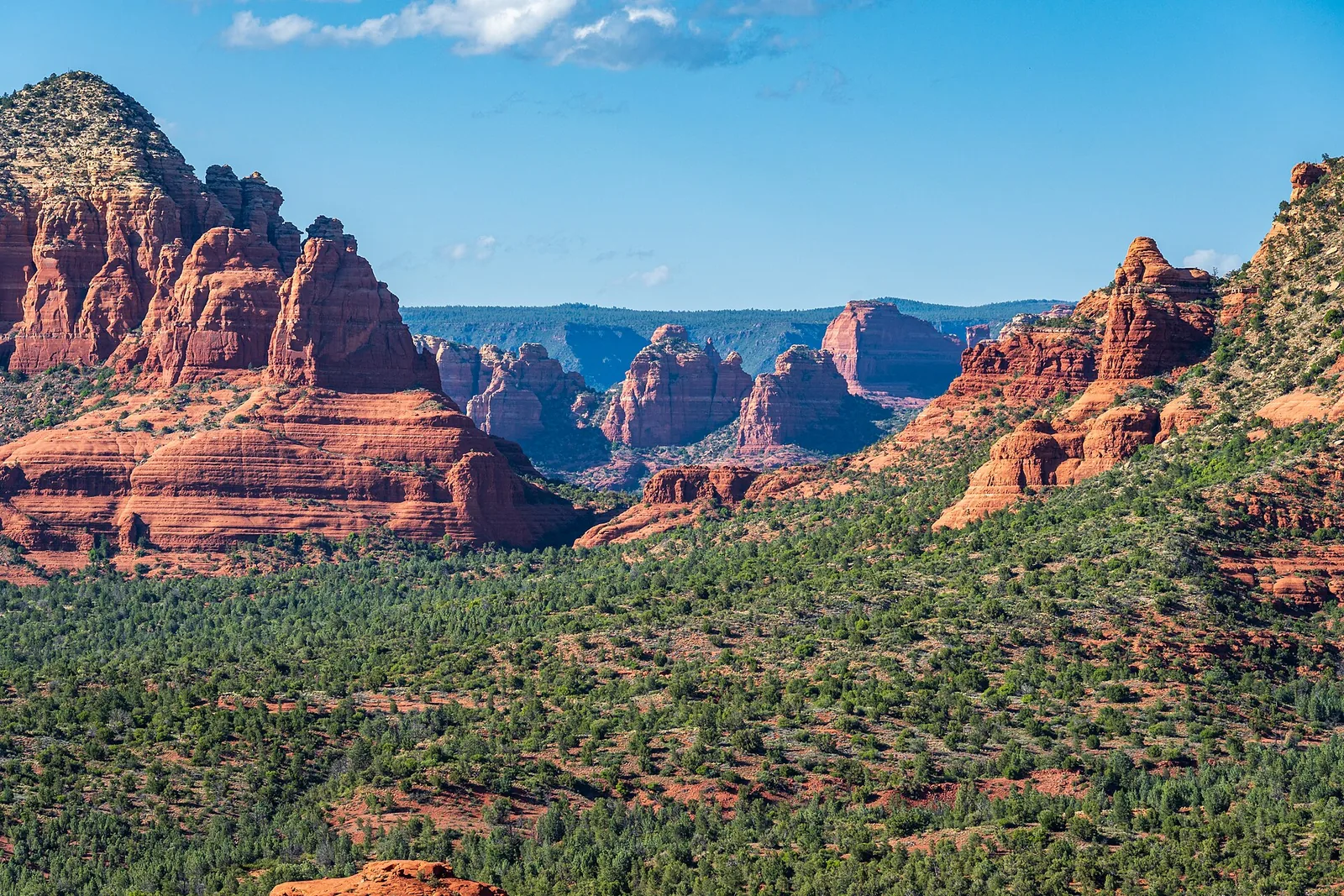
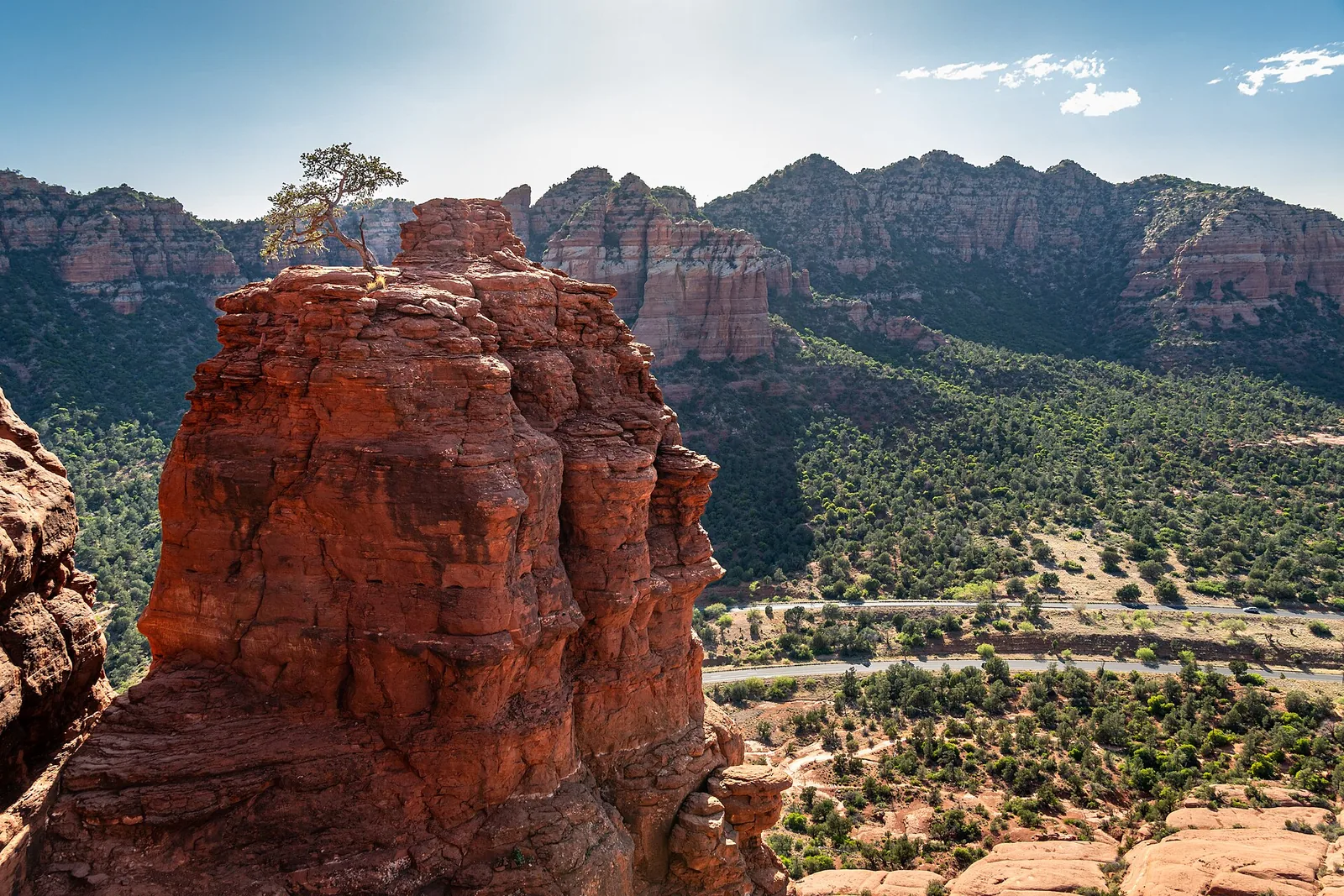
Sedona’s red rock backcountry is laced with old wagon roads and slickrock trails, and one of the most fun ways to see it is from behind your own wheel instead of a tour-company bench seat. Renting a Jeep, an ATV, or a side-by-side UTV gives you the freedom to set your own pace, stop where you want, and pick how hard you push it. It also hands you full responsibility for the vehicle, the navigation, and your own safety on roads that are genuinely rough, so it pays to know what you’re signing up for before you put a deposit down.
This guide walks through who rents what, which trails you can actually self-drive, what Arizona requires of you (yes, there’s a decal), and the honest difference between driving yourself and booking a guided tour. If you’d rather someone else handle the technical parts, that’s a real and reasonable choice, and I’ll cover it.
Self-drive rental vs. guided tour: which one is for you?
The first decision isn’t which Jeep to rent. It’s whether to rent at all.
A self-drive rental means you get the keys, a map, a quick orientation, and the rest is up to you. You choose the trail, the timing, and how far you go. You stop for as many photos as you like, eat lunch on a rock with nobody hurrying you, and you don’t share a vehicle with strangers. The trade-off: you do the driving on rough terrain, you do the navigating, and if you get in over your head, you’re the one who has to back down a ledge or call for help.
A guided tour (Pink Adventure Tours, formerly Pink Jeep Tours, is the best-known operator and has been running since 1960) puts a trained driver behind the wheel and a guide who knows the geology, the movie history, and the safe lines. You sit back, listen, and take pictures. It’s the right call if you’re nervous about off-road driving, traveling with people who don’t want to white-knuckle a descent, or you just want the stories.
Here’s the honest math:
- Choose self-drive if you’re comfortable driving, you want flexibility and privacy, and you have a full day to spend. Renting can also be cheaper per person for a group of four or more.
- Choose a guided tour if you want zero stress, you’re short on time, you have kids or hesitant passengers, or you specifically want to do Broken Arrow (more on that below — there’s a catch).
One thing worth knowing up front: Pink Adventure Tours is the only commercial outfitter permitted to run trips on the Broken Arrow trail. That does not mean you can’t drive Broken Arrow yourself. Private vehicles and rentals can use the trail. It only means no other tour company is allowed to take paying passengers down it. So if you want a guide on Broken Arrow specifically, Pink is your option; if you want to drive it yourself, you can — just respect how serious it is.
Who rents Jeeps in Sedona
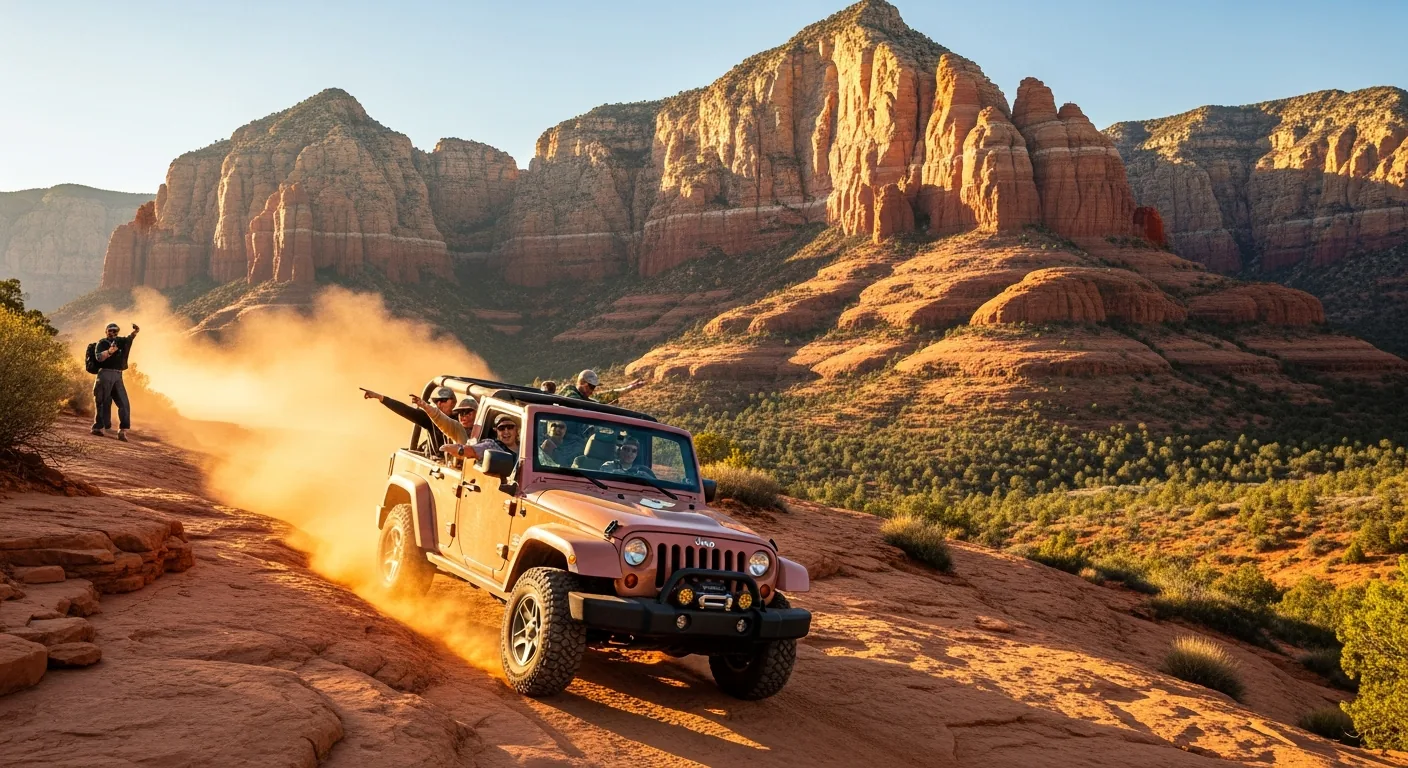
Sedona has a small handful of established Jeep rental outfits. These rent street-legal, lifted Jeep Wranglers (usually Rubicons) that you can drive straight from town onto the trails.
Barlow Adventures (Barlow Jeep Rentals)
Barlow is the long-running name in self-drive Jeep rentals here, located at 3009 W State Route 89A on the west side of Sedona. They rent late-model Jeep Wrangler Unlimited Rubicons — automatic transmissions, air conditioning, suspension lifts, and aggressive off-road tires — and they’re set up specifically for self-guided trips. Their staff sends you off with trail maps, driving tips, area info, and operating instructions, plus little extras like an ice chest. Beyond rentals, Barlow also runs 4x4 driver training, which tells you they take the “you’re actually driving this thing” part seriously.
Sedona Jeep Rentals
Sedona Jeep Rentals offers a similar self-drive model: lifted Wranglers with automatics, A/C, suspension lifts, and heavy-duty tires, along with trail maps and orientation. They publish a clear trail list with difficulty ratings and durations, which is handy for matching your nerve to the route before you arrive. They also lean into responsible-recreation messaging — staying on designated routes, respecting the fragile desert — which is worth taking to heart no matter who you rent from.
Both of these put you in a full-size, street-legal 4x4 that’s comfortable on pavement and capable on the trail. That’s the key difference from the ATV/UTV crowd below: a rented Jeep you can drive to dinner; an ATV you generally cannot.
Who rents ATVs and UTVs (RZRs and side-by-sides)
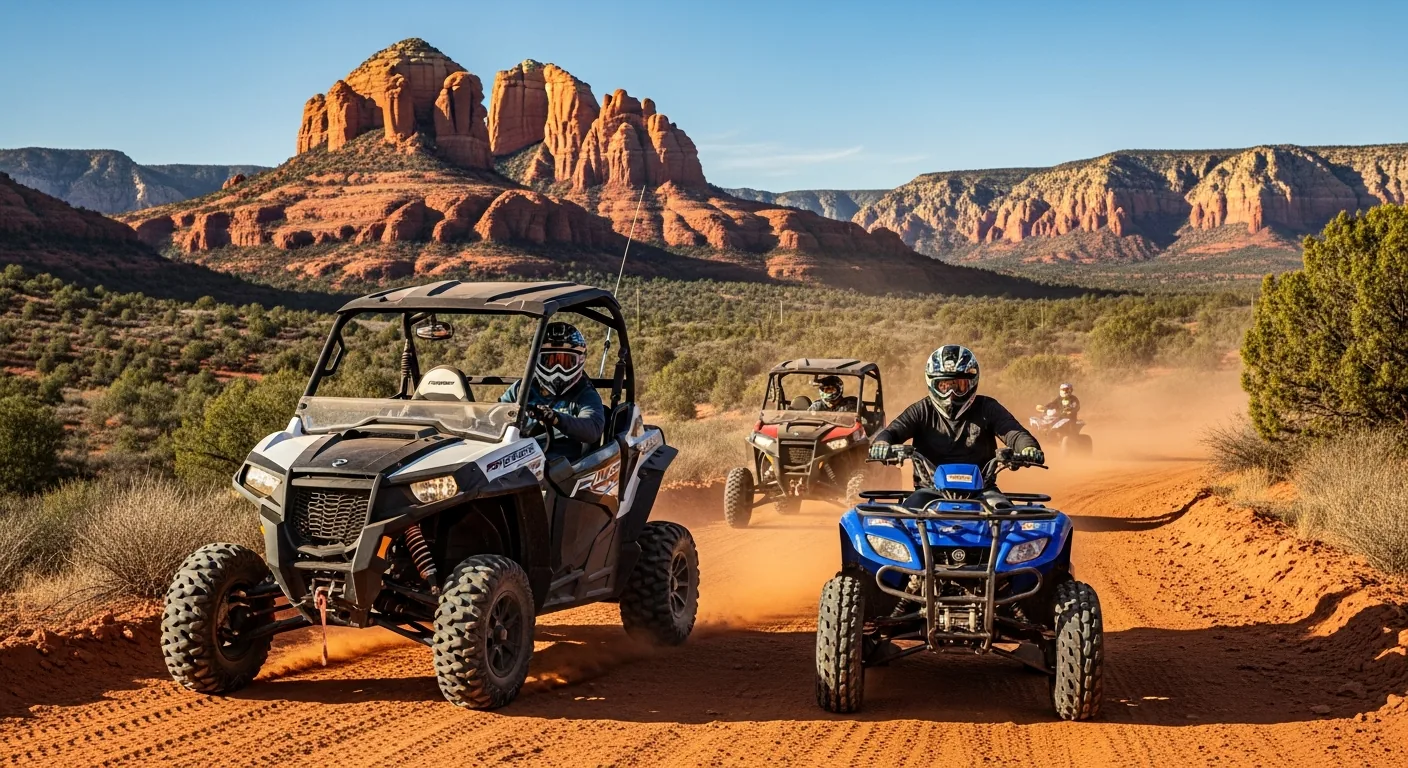
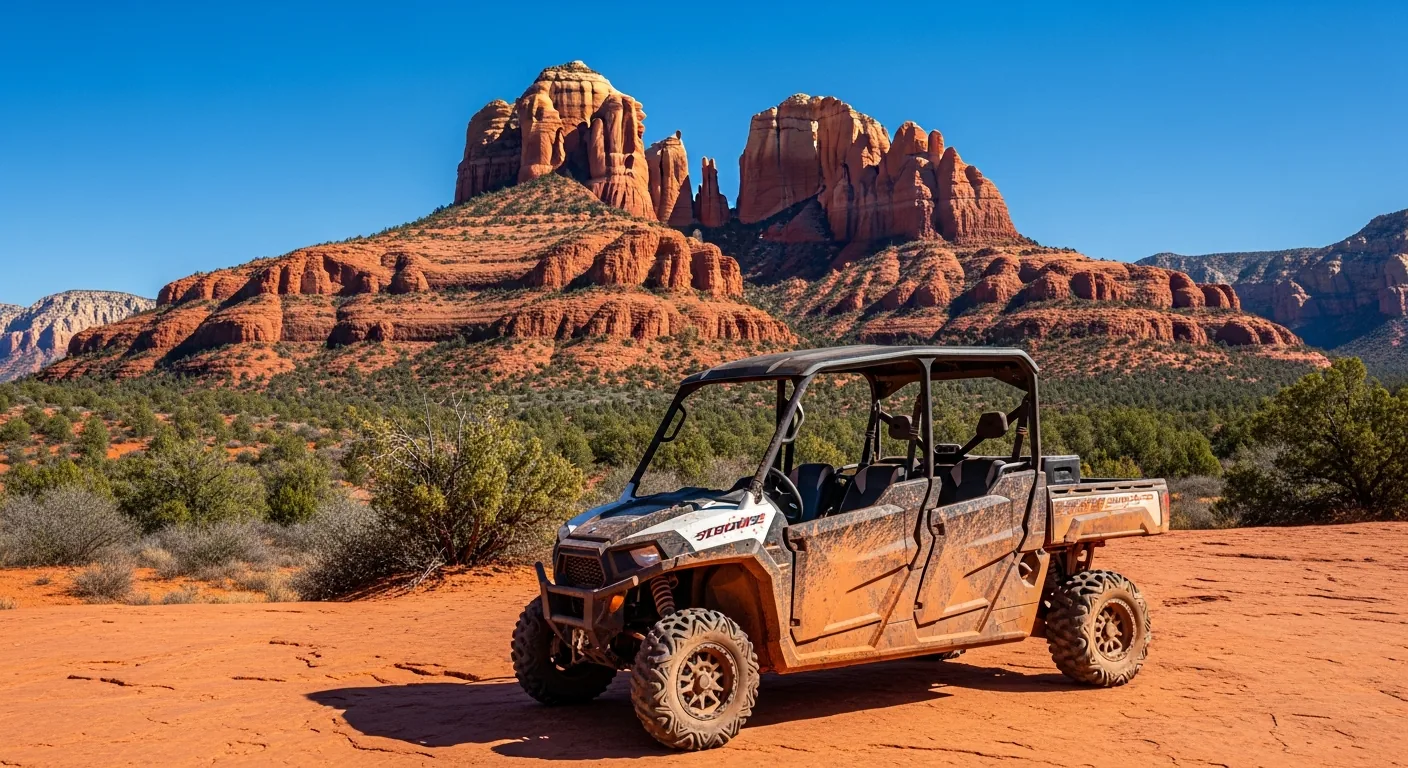
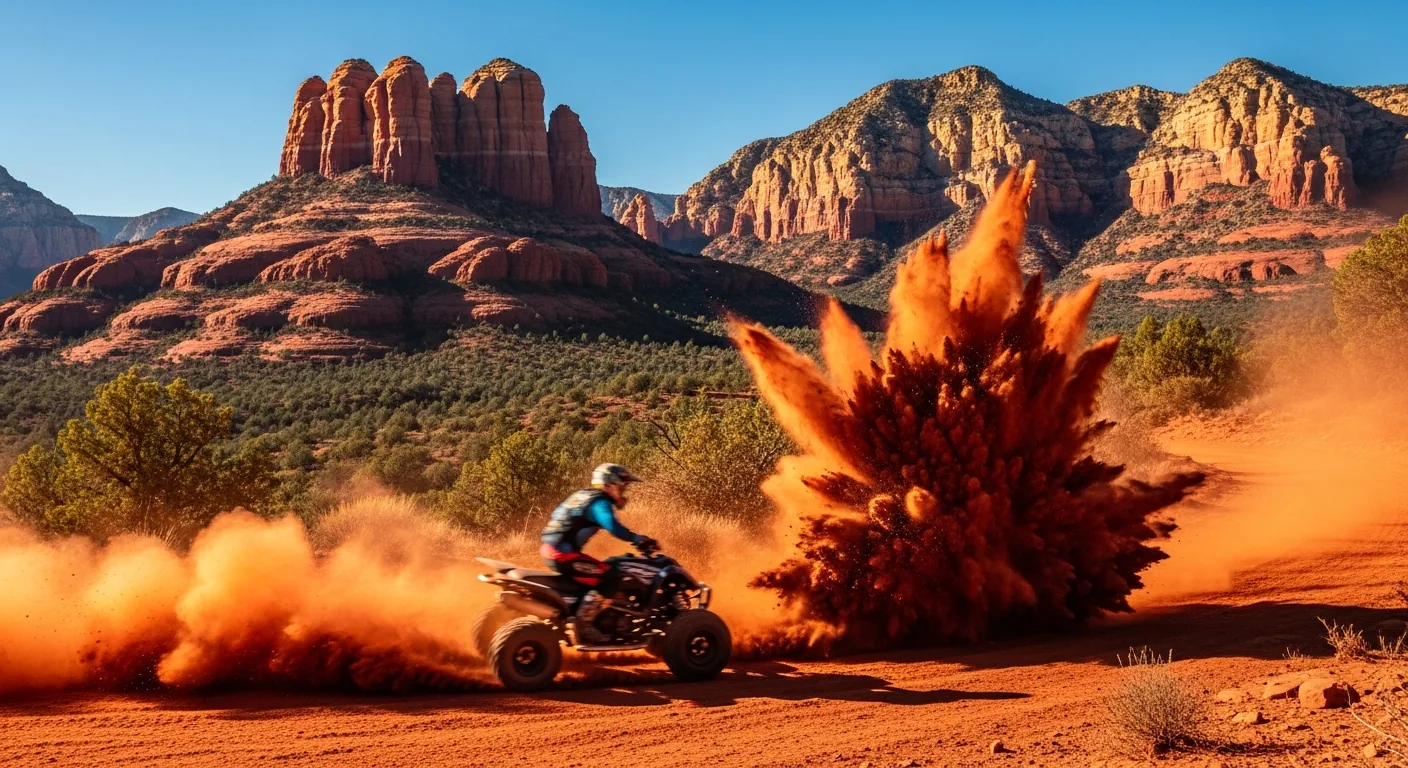
If you want something smaller, more open, and frankly more of a thrill, the ATV and UTV outfits are the other half of Sedona’s self-drive scene. A UTV — also called a side-by-side, an RZR (Polaris’s brand), or a Talon (Honda’s) — has a steering wheel, seatbelts, a roll cage, and bench or bucket seats for two, four, or even six people. An ATV is the smaller quad you straddle like a motorcycle. Most visitors end up in a side-by-side because it’s easier for first-timers and you can bring the family.
Established Sedona-area operators include:
- Sedona Off-Road Center — self-guided Honda Talon side-by-sides in 2-hour, half-day, and full-day blocks, with a clear FAQ on requirements.
- Sedona ATV Rental — Polaris side-by-sides in two-, four-, and six-seat configurations, with 2-, 4-, and 8-hour options.
- Outback ATV Rental — maintained side-by-sides with GPS mapping tools provided.
- Red Rock ATV Rentals — newer Polaris side-by-sides with trail maps, gear, and water included; this outfit also runs through the Polaris Adventures network.
- Arizona ATV Adventures — RZR/side-by-side rentals marketed as self-guided.
A real limitation to plan around: most of these machines are not street-legal, so you typically can’t just drive them from the shop through town to a trailhead. Many outfits stage you onto the OHV trail system on the west side of Sedona (the Cottonwood/Dry Creek area) or shuttle/trailer you to a starting point. Ask exactly where you can and can’t legally ride before you book — riding an unregistered OHV on a paved Sedona street is a good way to meet a city officer.
Local tip: UTVs kick up a lot of fine red dust, and so does every other rig on the trail. Wear sunglasses or the goggles they hand you, bring a bandana or buff for your face, and don’t wear your nicest white shirt. You’ll come back the same color as the rocks. A quick rinse-off back at the house is glorious — and if you’ve rented Pickler House, the indoor court is a fine place to shake off the adrenaline with a few games once you’re clean.
The Arizona OHV decal — don’t skip this
Here’s the rule that trips up a lot of visitors. In Arizona, any off-highway vehicle (think ATVs, UTVs, dirt bikes — vehicles built for unimproved terrain that weigh 2,500 pounds or less) must display a valid Arizona OHV decal to operate on public and state trust lands. As of recent rules, the decal costs $25 and is valid for one year, and there’s a nonresident version for visitors.
A few things to understand:
- Rented ATVs and UTVs should already carry a valid OHV decal as part of the rental — but confirm it when you pick up. It’s the operator’s responsibility to have the machine legal, and a reputable shop will have it sorted.
- A standard street-legal Jeep Wrangler is not an OHV under this rule, so a rented Wrangler driven on Forest Service roads doesn’t need the OHV decal the way a side-by-side does. That’s another reason the Jeep route is simpler for casual visitors.
- Arizona also rolled out a free OHV safety education course (about 10 minutes online). Some shops show it to you at check-in and enforce it; others ask all drivers to watch it ahead of time. It’s quick and genuinely useful.
If you’re bringing your own OHV from out of state to ride here, budget the time and the $25 for the nonresident decal before you hit the trail. Rangers do check.
Age, license, deposit, and insurance — the fine print
Requirements vary by company and by vehicle, so treat the following as typical rather than universal, and confirm with your specific operator:
| Item | Jeep rentals (typical) | ATV/UTV rentals (typical) |
|---|---|---|
| Minimum age (primary renter) | 25 in many cases | Often 21+ for the signer; additional drivers 18+ |
| Driver’s license | Required, valid | Required, valid (some allow non-licensed passengers only) |
| OHV decal | Not needed for street-legal Jeep | Should be included on the machine — confirm |
| Safety course | Recommended | Often required (free AZ online course) |
| Security deposit | Held on card; amount varies | Held on card; amount varies |
| Damage deductible | Varies | Can run to ~$3,000; some let you buy it down for a fee |
A couple of honest notes on the money side. Side-by-side rentals commonly carry a hefty damage deductible — some operators quote figures around $3,000 — with the option to buy it down (for example, to $1,500) for a small fee. If you’re new to off-roading, that buy-down can be worth it for peace of mind. Always read what counts as “damage,” including tires, undercarriage, and rollover. And check whether your own auto insurance or credit card travel coverage does anything for a rented off-road vehicle — often it does not cover off-pavement use, so don’t assume.
Prices change constantly and depend on vehicle, season, and duration, so I’m not going to quote you a dollar figure that’ll be wrong by the time you read this. Call or check the operator’s website for current rates and hours before you go, and book ahead in spring and fall — the popular shops sell out.
Which trails you can actually self-drive
This is the fun part, and also where honesty matters most. Sedona’s off-road routes range from genuinely easy gravel roads to slickrock obstacles that will scare you. The Coconino National Forest manages a designated set of Sedona-area OHV routes on the west side, and there are classic 4x4 roads scattered around town. Here’s the realistic rundown.
| Trail | Roughly | Difficulty | Honest take |
|---|---|---|---|
| Outlaw | ~10.5-mile loop | Easy–Moderate | Great first trail; scenic red rock, few real obstacles |
| Diamondback Gulch / “Greasy Spoon” | ~6-mile loop | Moderate–Adventurous | “Nature’s roller coaster” — steep gulch descents, tight turns |
| Soldier Pass Road | ~1 mile (FR 9904) | Moderate | Permit required; short but rough; Devil’s Kitchen & Seven Sacred Pools |
| Schnebly Hill Road | ~7.5 miles | Moderate (rough) | Famous views, brutally washboarded; seasonal winter closure up top |
| Broken Arrow | ~3 mi round trip area | Adventurous / Hard | Sedona’s signature slickrock; Devil’s Staircase is no joke |
Outlaw Trail — the friendly one
If you’ve never done this before, start here. Outlaw is a roughly 10.5-mile loop through old ranch country in the west canyons — scenic, rocky in spots, but without the white-knuckle obstacles. It’s the trail rental shops point beginners toward, and for good reason. You get the red-rock-from-a-Jeep experience without anything that’ll make your passengers gasp.
Diamondback Gulch (Greasy Spoon) — the roller coaster
Locals call Diamondback Gulch the “Greasy Spoon” after a water tank along the way. It’s about a 6-mile loop known for tight turns and a steep, story-tall descent in and out of the largest gulch in Sedona’s western canyons. It’s a step up from Outlaw — moderate to adventurous — and it’s a blast in a side-by-side. Take it slow on the descents.
Soldier Pass Road — short, rough, and permitted
Soldier Pass is one of Sedona’s most popular spots, and access for motor vehicles is tightly controlled. The drivable part is Forest Road 9904, roughly a mile of rough unpaved road that gets you close to the Devil’s Kitchen sinkhole and the Seven Sacred Pools. To drive it you need a Soldier Pass Motorized Use Permit from Recreation.gov, and the details matter:
- Only 12 permits per day, one per vehicle, first-come first-served.
- Reserve 72 hours to 90 days in advance; there’s a small (around $6) non-refundable reservation fee.
- The permit is for road access only, 8:00 a.m. to 6:00 p.m. — it does not let you park at the Soldier Pass trailhead and hike.
- A high-clearance 4x4 is required.
Plan this one ahead. If you want to hike Soldier Pass rather than drive it, that’s a separate thing — take the city shuttle to the trailhead instead (see our Soldier Pass guide).
Schnebly Hill Road — the famous, punishing one
Schnebly Hill Road is a historic wagon route with some of the most photographed views in Arizona, climbing roughly 7.5 miles from near town up toward the I-17 rim. The catch: it’s sealed for less than a mile and then turns into relentless rocky washboard. It’s not technical so much as brutal — you’ll be sore. A high-clearance 4x4 with good tires is genuinely needed, low-clearance cars get damaged, and the upper section closes in winter (roughly December through April) and during bad weather. Recent reports say it’s gotten rougher, so check current conditions. Our Schnebly Hill Road guide goes deeper.
Broken Arrow — the one everyone wants, and the one to respect
Broken Arrow is Sedona’s signature off-road trail: slickrock climbs, the Submarine Rock and Chicken Point overlooks, Mushroom Rock, and the infamous Devil’s Staircase (a near-vertical descent down a natural staircase of rock that’s earned the nickname “Road of No Return”). It is also, by every honest account, adventurous to hard — not a beginner trail.
Let me be blunt: if you’ve never driven a 4x4 trail before, Broken Arrow is the wrong place to learn. The obstacles demand real clearance, careful line choice, and a steady nerve, and there’s frequent oncoming traffic on narrow sections where one of you has to back up. Plenty of confident drivers in capable rented Rubicons do it and love it. Plenty of others get partway down the Devil’s Staircase and wish they’d booked Pink instead. If you want Broken Arrow without the stress, Pink Adventure Tours is the only outfitter permitted there — let their driver handle it.
Best time of day and season to go
Sedona’s high desert sits around 4,300 feet, so it’s milder than Phoenix, but timing still matters.
- Spring (March–May) and fall (September–November) are the sweet spots: comfortable temperatures, big skies. They’re also the busiest, so book early and start early.
- Summer (June–August) brings real heat and afternoon monsoon storms (typically July–September). Go in the morning, be off exposed slickrock and out of washes before storms build, and carry extra water. Flash flooding in gulches is a genuine hazard — never drive into a running wash.
- Winter can be lovely and quiet, but cold snaps, mud, and snow happen, and parts of Schnebly Hill close. Trails can be slick.
For light and crowds, early morning is king. You’ll get softer light for photos, cooler air, fewer rigs ahead of you on narrow trails, and a better shot at one of those scarce Soldier Pass permits. Late afternoon delivers beautiful golden light but more traffic and, in summer, storm risk.
What to bring
Self-driving means you’re your own support crew. Pack like it:
- Water — more than you think. A gallon per person per day in summer isn’t crazy.
- Sun protection: hat, sunglasses, high-SPF sunscreen, lip balm. The desert sun is relentless.
- A bandana or buff for dust, especially in open UTVs.
- Closed-toe shoes for scrambling at stops like Submarine Rock or the Seven Sacred Pools.
- Snacks, a small first-aid kit, and any meds you need.
- Layers — mornings and the higher rim are cooler than town.
- A paper map or downloaded offline map. Cell service drops out fast in the canyons; don’t rely on live navigation.
- A phone mount and a charged battery pack for photos and emergencies.
- Patience and a light foot. Speed is what breaks vehicles and bones out here.
Accessibility
Honest answer: self-drive off-roading is not very accessible. Getting into a lifted Jeep or a side-by-side requires a meaningful step up and some upper-body pull, and the rides themselves are rough, bouncy, and jarring — hard on backs, necks, and anyone prone to motion sickness. Most of the scenic stops involve walking on uneven slickrock.
If mobility is a concern but you still want the red rocks from a 4x4, a guided tour is the better bet — operators can sometimes accommodate specific needs if you call ahead and explain. For a gentler, fully paved alternative to seeing the same country, the Red Rock Scenic Byway and Oak Creek Canyon drive deliver world-class views from a normal car.
How to avoid the crowds
Off-roading is popular, and the good trails get busy. To dodge the worst of it:
- Go early. First rigs out have the trail to themselves and the best light.
- Skip weekends and holidays if you can; midweek is markedly quieter.
- Book Soldier Pass permits the moment your window opens — they vanish.
- Pick a less-famous trail. Outlaw and the western OHV loops see fewer crowds than Broken Arrow and Schnebly Hill.
- Avoid spring break and the big fall weekends for rentals — shops sell out and trails clog.
Safety — read this part
People get hurt off-roading in Sedona every year, usually from going too fast or driving beyond their skill. Keep it boring and you’ll keep it fun:
- Match the trail to your experience. Beginners: Outlaw, not Broken Arrow.
- Stay on designated routes. Going off-trail damages fragile desert and can get you cited.
- Buckle up, helmets on where the operator provides them, and keep arms and legs inside.
- Go slow on descents and obstacles. The Devil’s Staircase has humbled a lot of overconfident drivers.
- Watch for oncoming traffic on narrow, blind sections; uphill traffic generally has the right of way.
- Never drive into a flowing wash. Monsoon flash floods are deadly.
- Tell someone your plan and carry water, since service is spotty.
- Mind heat. Hydrate, rest in shade, and know the signs of heat illness.
- If an obstacle scares you, it’s fine to turn around. No view is worth a rollover.
What to pair it with nearby
A half-day on the trail leaves room for more. A few natural combinations:
- After a morning rip on the western OHV loops, cool off in the natural water chute at Slide Rock State Park up Oak Creek Canyon.
- Pair a Schnebly Hill or Soldier Pass morning with an easy walk later — the Bell Rock pathway or one of the easy hikes — to stretch out the bounce.
- Cap the day with dinner and a view, or curious about the difference between renting and riding along? Our Jeep tours guide breaks down the guided options.
And of course, the best pairing is going back to a place where you can clean up, rest your rattled spine, and play. If a dusty day out has the group fired up, you can book the house and settle the day’s bragging rights on Pickler House’s private indoor pickleball court — climate-controlled, no red dust, and no waiting for a court.
However you do it — your own hands on the wheel or a guide doing the hard parts — Sedona’s backcountry rewards people who show up prepared, drive within their limits, and take their time. Confirm current prices, hours, and permit rules with each operator before you go, respect the land and the other folks on the trail, and you’ll come home with the good kind of sore.
Frequently asked questions
Do I need a special permit or decal to off-road in Sedona?
Can I drive the Broken Arrow trail in a rental?
What's the difference between renting a Jeep and renting an ATV or UTV?
How old do I have to be and what do I need to rent?
When is the best time to go off-roading in Sedona?
Is self-driving safe for beginners?
Stay where you can rally any season
Sedona Pickler is a private West Sedona vacation home with its own indoor, climate-controlled pickleball court — a short drive from the trailheads, viewpoints and restaurants in this Sedona guide. Play at sunrise or after dark, in any weather.
Check availability on Airbnb