
A women’s pickleball trip works when two things are true: everyone actually plays, and the trip is about more than pickleball. Get the first one wrong and the weakest player spends the weekend on a bench. Get the second one wrong and you have flown or driven to one of the most photographed places in Arizona to stare at a net for three days. This is a plan for 6 to 8 players that handles both — the rotation format that keeps every paddle moving, the spa-hike-wine-dinner half of the trip, and the practical stuff nobody wants to sort out in the group chat: splitting costs, the 25+ booking rule, and when to go.
It assumes you are staying in a house rather than hotel rooms, and there is a specific reason for that, covered below. The short version: one kitchen, one living room, one hot tub, and nobody has to drive anywhere after the wine comes out.
The format that works: round-robin, short games, nobody sits
A pickleball court holds four players. With 6 or 8 people, that means 2 to 4 people are off the court at any moment — and how you handle those off-court minutes decides whether the trip feels like a group of friends playing or an audition.
The fix is a round-robin rotation with short games. Play to 11, win by 1 instead of win by 2, and rotate every game. A game to 11 runs roughly 10 to 15 minutes, so even with 8 players, nobody waits more than one game to get back on. Over a two-hour session, everyone logs close to the same court time.
Two rotation patterns cover almost every group:
| Group size | Format | How it works |
|---|---|---|
| 6 players | Rotating pairs | 4 play, 2 rest. Losers sit, resters split up and come in with new partners. |
| 8 players | Mixer round-robin | Fixed schedule so everyone partners with everyone once. 7 rounds covers all pairings. |
The 8-player mixer is the one to print out before the trip. Everyone partners with every other player exactly once, which does two useful things: it stops the two strongest players from teaming up all weekend, and it means the final standings reflect individual play, not who grabbed the best partner first. If you want the full schedules, scoring options, and a printable grid, the round-robin guide walks through formats for 5 to 12 players.
Two rules worth agreeing on before the first serve: short games only (long deuce battles wreck the rotation), and keep one running score sheet for the weekend if your group likes a champion — or none at all if it doesn’t. Decide before, not during.
One logistical note that shapes everything else: if you book a house with its own court, the rotation runs on your schedule. No reserved time slots, no waiting for a public court to clear. You play until the group is done, then move on to the rest of the day.
Structure the trip in halves
The schedule that works for almost every group: pickleball in one half of the day, Sedona in the other. Two hours of round-robin is plenty for one block — more than that and the third-day soreness sets in, especially for players who don’t play three days in a row at home.
Sedona sits at about 4,350 feet and runs roughly 15 to 20 degrees cooler than Phoenix in summer — and with an indoor, air-conditioned court, the temperature question disappears entirely. You can schedule play at 2 p.m. in July or 7 a.m. in January without checking a forecast, which is what makes the half-and-half structure reliable: the pickleball block never gets rained out or heat-canceled, so the rest of the day can be planned with confidence.

The non-pickleball half
This is the half that makes it a trip instead of a tournament. Five pieces, roughly in order of how often groups actually do them.
A spa morning
Sedona has a deep bench of spas and wellness studios, from full resort spas to small independent massage and facial studios in West Sedona. The move for a group of 6 to 8: book two or three people into staggered appointment times at the same place, and let the rest sleep in or take the coffee-and-deck shift at the house. Trying to book eight simultaneous treatments usually fails or forces you into the most expensive option. The spas and wellness guide lists the options by type and area, with notes on which ones handle groups.
One hike everyone can finish
Skip the group debate about Devil’s Bridge. For a mixed-fitness group of 6 to 8, you want a trail that is genuinely easy, short enough to leave the afternoon open, and scenic enough that nobody feels shortchanged. Two that fit:
- Fay Canyon — about 2.4 miles round trip, shaded, nearly flat, with canyon walls on both sides. Most groups finish in about an hour and a half at a talking pace.
- Bell Rock Pathway — about 3.6 miles round trip on a wide, mostly flat path with open views of Bell Rock and Courthouse Butte the whole way. Easy to turn around early if half the group is done at the halfway point.
Both trailheads require a Red Rock Pass or an America the Beautiful pass for parking — buy it online before you go and carpool, since trailhead lots fill by mid-morning most of the year. More options, including which trails handle big groups and which don’t, are in the easy hikes guide.
Wine in the Verde Valley
The Verde Valley is Arizona’s wine region, and it starts about 20 minutes from West Sedona. Two ways to do it with a group:
- Page Springs Cellars in Cornville — about a 20-minute drive, a working vineyard on Oak Creek with a tasting room and deck. This is the sit-down-for-the-afternoon option.
- Old Town Cottonwood — about 25 minutes away, with seven tasting rooms within walking distance along Main Street. Park once, walk between pours, and nobody has to be the sober shuttle between stops.
For a group of 6 to 8, decide the driving question before anyone tastes anything: either two designated drivers, or book a wine tour van that handles pickup and drop-off. Several operators run group tours out of Sedona and Cottonwood. The wineries guide covers the tasting rooms, the tour options, and typical tasting fees.
Long dinners
Book dinner reservations before the trip, not from the trailhead. A table for eight is a different ask than a table for two — many of the better rooms cap standard reservations at six and route bigger parties through a large-party form. Two big dinners out over a three-night trip is the right number; more than that and the group starts missing the house. The restaurant guide flags which spots take large parties.
Hot tub and firepit nights
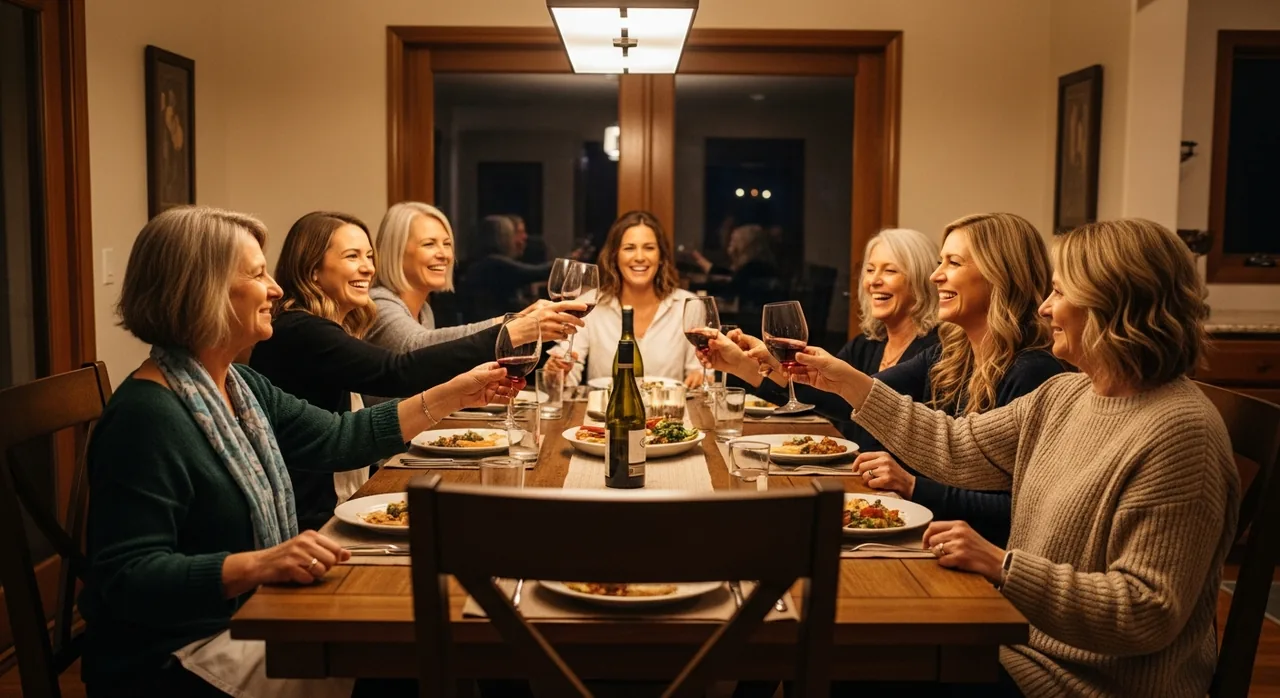
The nights are the part groups remember, and they require zero planning: hot tub after the afternoon session, firepit after dinner. This is also the strongest argument for the house over the hotel — there is no version of a hotel stay where eight friends end up around one fire with nobody holding a room key and nobody calling it a night because the lobby bar closed.
Why a house beats hotel rooms for this trip
For a couples’ weekend, hotels are fine. For 6 to 8 women traveling as one group, the math and the logistics both point at a house:
- One kitchen. Group breakfasts happen around one counter, not eight room-service trays. One grocery run on day one covers coffee, breakfasts, snacks, and the wine-night spread.
- One living room. The default gathering space is the whole point of the trip. In a hotel, the group’s shared spaces are the lobby and a restaurant table with a time limit.
- Nobody drives after wine night. When the tasting-room haul comes back to the house, the evening happens on the deck and around the firepit — no splitting into cars, no one volunteering to stay dry.
- One check-in, one door code. Free driveway parking for four cars covers a group of 6 to 8 arriving in two or three vehicles.
The full comparison — costs, privacy, and what hotels still do better — is in why a vacation home beats a hotel in Sedona. For this specific trip type, the deciding factor is usually the court itself: a house with a private indoor court replaces the drive to public courts, the reservation apps, and the wait, and it means the group plays in a closed room with no audience.
The practical part
Three things to settle before anyone books anything.
Splitting costs fairly
The even split feels simple but breeds quiet resentment when two people get kings and two get bunk beds. A fairer structure that takes five minutes:
- Weight the lodging split by room. King and queen rooms pay a full share; bunk-room beds pay a reduced share — something like 60 to 70 percent each. Agree on the weights before rooms are claimed, then assign by who paid what or by drawing names.
- Put shared costs on one card. Groceries, firewood, the wine tour van — one person pays, everyone settles through a tracking app like Splitwise. Do not try to split a grocery receipt eight ways at the register.
- Dinners out: separate checks or rotate who pays. Tell the restaurant which one when you book the table for eight.
The broader version of this — deposits, cancellations, and handling the friend who commits late — is covered in the group trip planning guide.
The 25+ booking rule
This home, like many vacation rentals, requires guests to be 25 or older to book, with firm no-party, no-smoking, no-pet rules. For a women’s pickleball group this is rarely an obstacle — but a bachelorette-style blowout is the wrong fit for this house, while a group of friends playing round-robin by day and sitting around a firepit by night is exactly the right one. Check-in is 4 p.m., checkout is 10 a.m.; plan the last morning’s session to end by about 9 so nobody is packing a bag in court shoes.
Choosing dates
Three variables: weather, crowds, and price.
- March through May and September through November are Sedona’s high seasons — the best hiking weather and the biggest crowds. Book the house and the dinner tables 2 to 3 months out.
- Summer is the sleeper pick for this trip. Sedona runs 15 to 20 degrees cooler than Phoenix, the crowds thin, rates drop, and an air-conditioned indoor court makes midday play comfortable in a month when Phoenix and Tucson outdoor courts sit empty from breakfast to sunset.
- Winter works because the court is heated. A December or January trip trades shorts weather for quiet trails, easier reservations, and the best hot-tub conditions of the year.
- Midweek beats weekends on every axis: house availability, restaurant tables, trailhead parking, and tasting-room elbow room.
The month-by-month breakdown, including what each season means for court scheduling, is in the best time to visit guide. One more date note for drive-market groups: Sedona is about 2 hours from Phoenix, which makes a Thursday-afternoon arrival realistic for working friends — beat the Friday traffic and get a full evening session in before the weekend starts.
A three-night shape that works
You don’t need an hour-by-hour itinerary — you need a shape. Here is the one most groups land on:
- Thursday: arrive by late afternoon, grocery run, first court session before dinner at the house. Hot tub.
- Friday: morning round-robin block, spa appointments staggered through midday, long dinner out. Firepit.
- Saturday: easy hike in the morning, Verde Valley wine in the afternoon with a driver or tour van sorted, dinner back at the house with the day’s bottles. Firepit, again.
- Sunday: last court session at 7 or 8 a.m., winner of the weekend crowned, out by 10.
Swap the blocks freely — the structure holds as long as each day has one pickleball block and one Sedona block, and the evenings stay at the house.
Frequently asked questions
How many people should we invite on a pickleball trip?
Six or eight are the clean numbers — both divide evenly into doubles rotations, and this house sleeps exactly 8. Seven works with a rotating sit-out but the schedule is clunkier. Beyond 8 you need a second house and the trip splits in two.
What if our group has very mixed skill levels?
Use a rotating-partner round-robin so every player partners with every other player once. Strong and newer players end up together as often as opposed, which keeps games close. Short games to 11 also mean a lopsided game is over in ten minutes, not thirty.
Do we need to bring paddles and balls?
No — paddles and balls are provided at the house. Bring non-marking court shoes and whatever you like to play in. If someone in the group is particular about her paddle, she should bring her own, but nobody needs to buy gear for the trip.
Can we do a wine day without a designated driver?
Yes, two ways. Book a wine tour with pickup and drop-off, or focus on Old Town Cottonwood, where seven tasting rooms sit within walking distance on Main Street — you still need a driver for the roughly 25-minute trip each way, but not between pours.
Is there an age requirement to book?
The guest who books must be 25 or older, and the house has firm no-party, no-smoking, no-pet rules. A group of adult friends playing pickleball and sharing dinners fits squarely within the rules.
What's the best season for a women's pickleball trip to Sedona?
Spring and fall have the best hiking weather but the biggest crowds and highest rates. Summer and winter are underrated here specifically because the court is indoors — heated in winter, air-conditioned in summer — so play is guaranteed year-round and you can trade peak-season prices for quieter trails and easier dinner reservations.
Play year-round in red rock country
Sedona Pickler is a private Sedona home with its own indoor, climate-controlled pickleball court. Rally any season, any hour — heated, cooled and lit, with paddles and balls provided.
Check dates & book


