Most Sedona trip-planning starts with the wrong question. People ask which hotel or which rental first, then work backward. The better opening question is where in Sedona you want to wake up, because Sedona is not one place. It’s a small town spread across a wide valley, split by two highways, with the red-rock sights scattered from the canyon in the north to the big formations in the south. Where you base yourself decides how far you drive each morning, how your evenings feel, what you pay, and how much of the trip you spend in the car versus out on the rocks.
The town runs on two roads. State Route 89A crosses east to west; State Route 179 runs south toward the interstate. They meet at a junction locals call the Y, and almost every area worth knowing sits along one of those two arms. Get the geography straight and the lodging decision mostly makes itself.
This guide walks through the five areas people actually choose between — Uptown, West Sedona, the Village of Oak Creek, Oak Creek Canyon, and the quiet residential pockets — with the real tradeoffs for each. Then it covers the choice underneath all of them: a hotel room or a whole-home rental, and which one fits your group. We’ll tell you where we sit and why, but the aim is a guide that earns its keep even if you never book with us.
Uptown Sedona: walkable, lively, and crowded
Uptown is the Sedona most first-timers picture. It’s the compact tourist core strung along 89A just north of the Y, wedged between Capitol Butte and the mouth of Oak Creek Canyon, and it’s the one part of town built for walking. Galleries, gift shops, ice cream, jeep-tour kiosks, and patio restaurants line both sides of the street for a few busy blocks. Park once and you can spend a whole evening on foot.
That walkability is the real draw, and it’s a good one. If you want to step out of your room, walk to dinner, browse a gallery, book a jeep tour at a sidewalk counter, and never touch your car again after check-in, Uptown does that better than anywhere else in Sedona. The energy is part of the appeal, too. This is where the town feels most alive at night, and the red-rock backdrop rising over the shops is the postcard for a reason.
The costs are just as real. Uptown is the busiest, most touristy, and generally priciest corner of Sedona. In peak season — spring and fall weekends especially — the main drag clogs with traffic, and parking gets tight enough that circling the lots becomes its own activity. Lodging here tends to sit at the top of the range because you’re paying for the location. And the same crowds that make it lively can make it feel packed if you came to Sedona for space and quiet.
Uptown suits a specific traveler well: couples and small groups on a short stay who value walkability over square footage, don’t mind crowds, and would rather pay a premium to skip the drive to dinner. For a big group cooking meals together, or anyone who wants room to spread out and a slow morning, the tradeoffs start working against you. If you’re timing a visit to dodge the worst of the crush, our guide to the best time to visit Sedona breaks the seasons down.
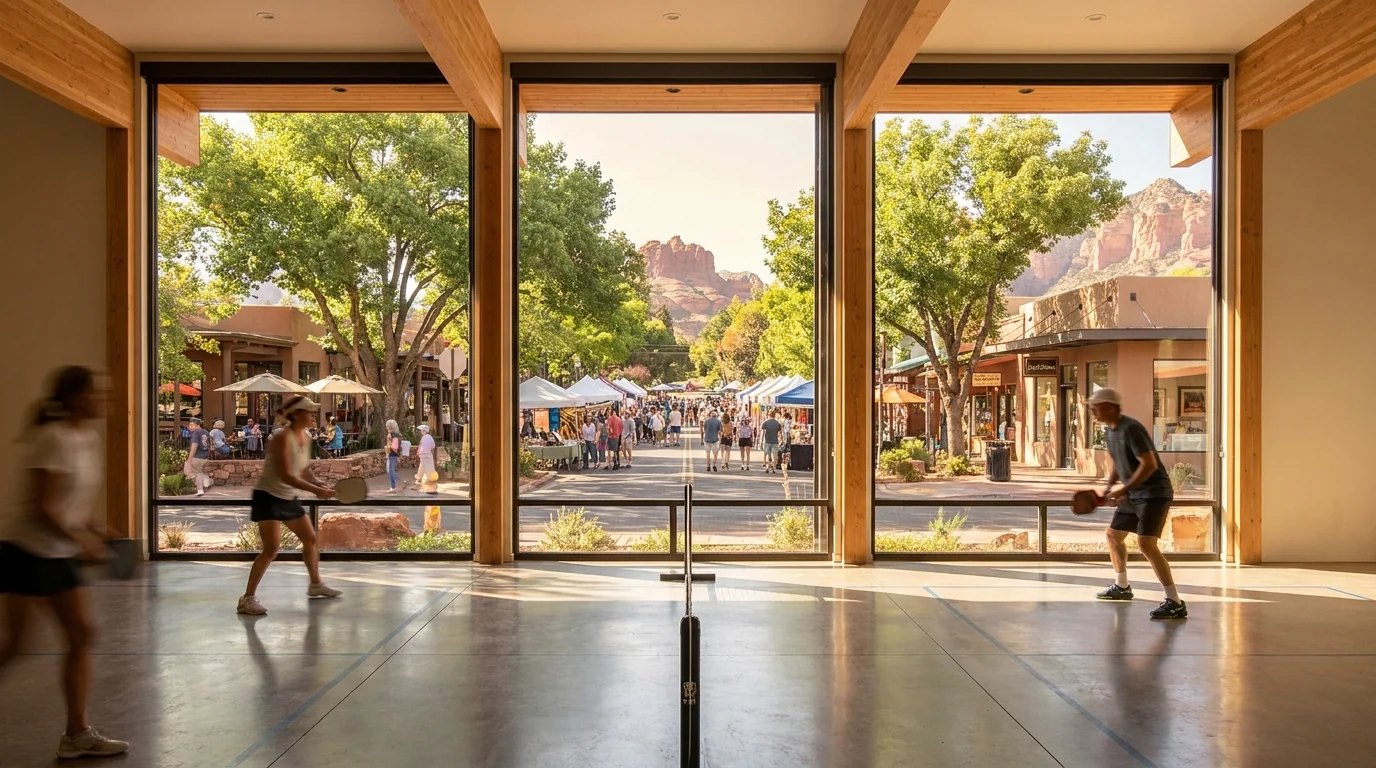
West Sedona: the practical middle
Head west from the Y on 89A and the crowds thin within a minute or two. This is West Sedona, where most of the people who actually live in Sedona make their home. It’s roughly a five-minute drive from Uptown, and it trades the tourist strip for something more useful day to day: the town’s main grocery stores, a wide spread of everyday restaurants, gas, coffee, and the ordinary errands that make a longer stay comfortable.
What West Sedona gives up in walkable buzz it makes up in position. It’s arguably the most central base in the whole area. The big northern trailheads — the Dry Creek area that leads to Devil’s Bridge and a cluster of well-known hikes — are a short drive up the road. The southern formations along 179 are a quick hop back through the Y. Oak Creek Canyon is minutes north through Uptown. From a West Sedona base you’re rarely more than fifteen or twenty minutes from anything, in any direction, which is hard to say about the edges of town.
It’s also where the value tends to live. Lodging in West Sedona generally runs friendlier than Uptown for comparable space, and because groceries and casual restaurants are close, you can cook in and eat out on your own terms instead of paying tourist-core prices three times a day. For a group, cooking a few meals at the house is one of the biggest cost savings on the whole trip, and West Sedona is set up for exactly that.
The tradeoff: West Sedona has no single walkable dining-and-shopping strip the way Uptown does. Its restaurants are good and varied, but they’re spread along 89A, so you drive between them rather than stroll. If your dream is stepping out the door into a lively street scene, that’s Uptown’s job, not West Sedona’s. What you get instead is breathing room, a central location, and a calmer end to the day.
This is where we are, so we’ll say it plainly and let you weigh it.
Village of Oak Creek: calm, open, and better value
Drive south from the Y on 179 for ten to fifteen minutes, past the long line of Bell Rock and Courthouse Butte, and you reach the Village of Oak Creek — VOC, or just “the Village” to locals. It’s a separate community from Sedona proper, more spread out and open, with the red rocks standing right at the edge of town.
The Village earns its fans on three counts. First, calm: it’s quieter and less congested than Uptown, with room to breathe and easy parking. Second, access to some of the most famous formations in the area — Bell Rock and Courthouse Butte are right there, and the trailheads for Cathedral Rock are a short drive back up 179. Third, price: lodging in the Village usually costs less than the equivalent in Uptown, and the restaurants are solid without the tourist-core markup. There are golf courses down here too, which pull a certain kind of traveler.
The tradeoff is distance from the north side. From the Village, Uptown’s restaurants and the mouth of Oak Creek Canyon are a ten-to-fifteen-minute drive each way, and the big Dry Creek trailheads on the north end are farther still. That’s not far by city standards, but it adds up over a few days of back-and-forth. If your itinerary leans heavily on the northern sights and Uptown’s nightlife, you’ll spend more time in the car from a Village base. If it leans on the southern formations, golf, and a quiet home to come back to, the Village is excellent and often the best value in the area.
Oak Creek Canyon: forest, creek, and a winding road
North of Uptown, 89A leaves the open valley and climbs into Oak Creek Canyon, a forested gorge with the creek running alongside the road. This is the green, shady Sedona: pines and sycamores, cooler temperatures, cabins tucked among the trees, and swimming holes, including the natural rock water slide at Slide Rock State Park. In the heat of summer, the canyon can run noticeably cooler than the valley floor, and the shade is a genuine relief.
Staying up here is a different kind of trip. It’s beautiful, quiet, and close to nature in a way no in-town base can match. Creekside cabins are the classic choice, and for travelers who want to fall asleep to running water and wake up under trees, nothing else around Sedona compares. The drive up the canyon is one of the most scenic in the state on its own.
The tradeoffs are real and worth taking seriously. The canyon road is winding, and some lodgings sit well up it, so you’re a slower drive from town amenities — groceries, the spread of restaurants, and the trailheads out in the valley all mean a trip back down 89A. Some spots are genuinely remote, with limited services nearby. And in winter, the canyon road can slow with weather and occasionally ice up, since it climbs toward Flagstaff’s elevation. Oak Creek Canyon rewards travelers who prize forest and creek over convenience, and who don’t mind driving into town for the rest of the trip. It’s less ideal as a group’s all-purpose base if half your plans sit on the south side of Sedona.
Quiet residential pockets
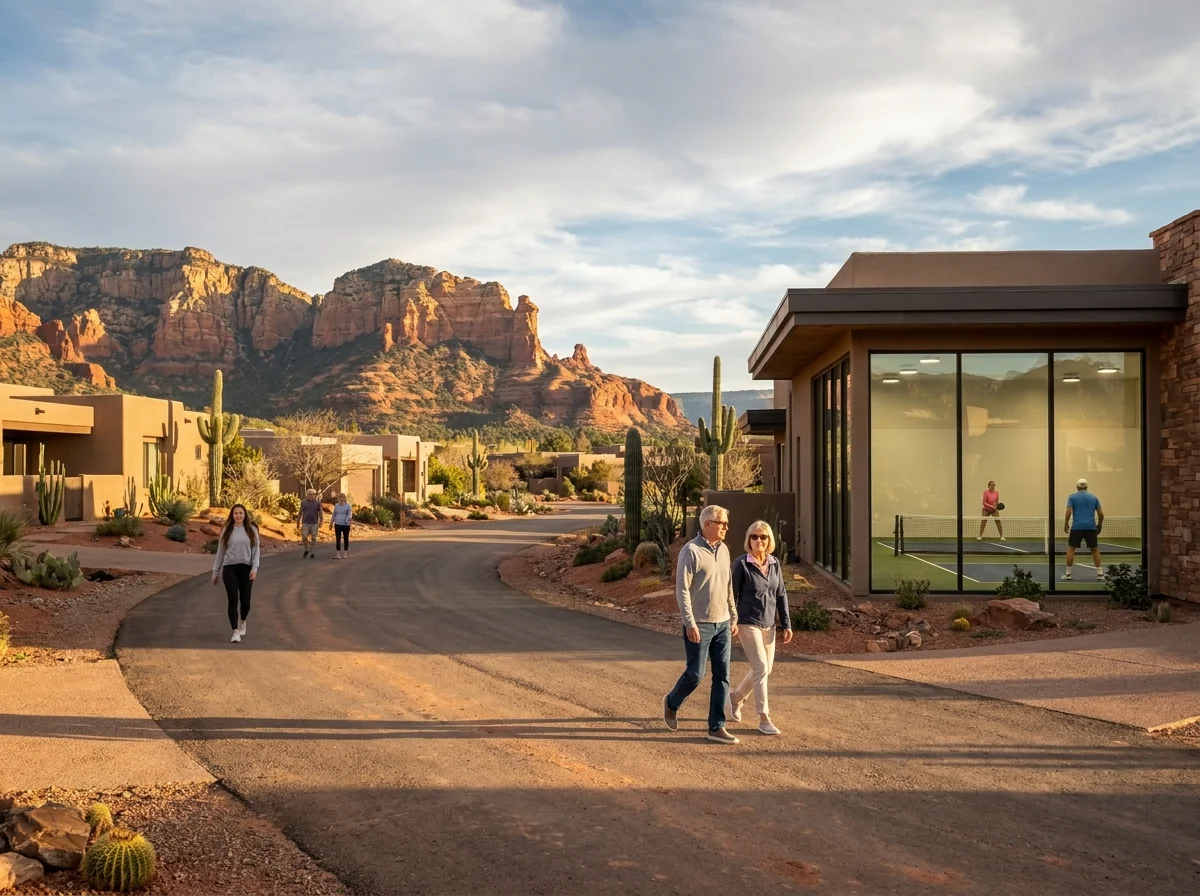
Beyond the four main areas, Sedona has a scattering of quiet residential neighborhoods that show up in rental listings — the area near the Chapel of the Holy Cross, the Broken Arrow area, and other pockets set into the rocks around town. These are mostly homes and vacation rentals rather than hotels, and their appeal is straightforward: privacy and big views. Some of these streets sit right under the red rocks with sightlines you simply can’t get from a hotel parking lot.
What they don’t have is a walkable strip. There are no shops or restaurants within strolling distance, so you drive to everything. For travelers who want a private home with a standout view and don’t mind that every outing starts with the car, these pockets can be the best of all worlds: a quiet, scenic base a short drive from whichever part of town you’re headed to that day. Just go in knowing the location is about the house and the view, not the neighborhood around it.
The neighborhoods side by side
Here’s the whole picture in one place. Drive times are approximate and depend on exactly where in each area you land and the season’s traffic.
| Area | Vibe | Best for | Main tradeoff | Drive to Uptown |
|---|---|---|---|---|
| Uptown | Lively, touristy, walkable | Couples, short stays, car-light strolling | Crowds, tight parking, higher prices | You’re there |
| West Sedona | Relaxed, local, central | Groups, families, cooking in, trailhead access | No walkable dinner strip of its own | ~5 min |
| Village of Oak Creek | Calm, open, spread out | Golf, budget, Bell Rock / Cathedral Rock | A drive from Uptown’s buzz and the north side | ~10–15 min |
| Oak Creek Canyon | Forested, creekside, cool | Summer shade, cabins, Slide Rock | Winding road, far from stores | ~5–20+ min |
| Chapel / residential | Quiet, view-heavy | Privacy, big views, private homes | No shops or restaurants nearby | ~10 min |
A quick note on that last column: “drive to Uptown” is a useful yardstick because Uptown anchors the north-side sights and the densest cluster of restaurants. But if your trip centers on the southern formations — Bell Rock, Cathedral Rock, the 179 corridor — the Village’s numbers flip in its favor, and West Sedona stays short in both directions. Match the table to your actual plans, not to Uptown by default.
Hotel or whole-home rental?
Underneath the where question sits a what question: a hotel room or a whole-home rental. Both are right for different trips, and the answer depends mostly on your group size and how many nights you’re staying.
A hotel or resort makes the most sense for couples and solo travelers, short stays, and anyone who prizes walkability and service over space. In Uptown especially, a hotel puts you steps from dinner with no cooking, no cleanup, and a front desk to sort out the small stuff. For two people in for two nights, that convenience is hard to beat, and the per-night math is reasonable when you only need one room. Resorts bring their own draw, too — a pool, a spa, and a front desk that can line up your tours — which is sometimes the whole point of a couples’ escape.
The math changes fast with group size and length of stay. Once you’re a family or a group of friends, booking multiple hotel rooms adds up quickly, and everyone scatters into separate rooms at the end of the day. A whole-home rental flips both problems. You get a kitchen — which turns three-meals-out into cook-a-few-in and saves real money over a few days — plus shared living space, often a yard or deck, and one roof for the whole group instead of a hallway of doors. For groups, families, and anyone staying three nights or more, a whole home usually wins on both cost-per-person and togetherness.
We’ve written the long version of this comparison in two places worth reading before you book. Sedona vacation rental vs. hotel runs the tradeoffs side by side, and why rent a vacation home in Sedona makes the case for the whole-home approach in detail. If you’re a couple after a walkable weekend, don’t let anyone talk you out of a good Uptown hotel. If you’re a group, do the per-person arithmetic before you book four rooms — it usually points at a house.
One more factor that never shows up in the nightly rate: what the space lets you do. A hotel gives you a room; a house gives you a place to actually be together — to cook, to spread out a board game, to sit around a firepit, to keep playing after dark. That’s the part of a group trip people remember, and it’s the part a rental is built for.
How to choose by trip type
Areas are easier to pick once you know what kind of trip you’re running. Here’s where each type of traveler tends to land.
Couples. For a romantic weekend or a short getaway with no car-free ambitions, Uptown’s walkability is worth the premium: dinner, a gallery, and a nightcap all on foot. If you’d rather trade some of that buzz for a view and a slow morning, a small rental in West Sedona or one of the residential pockets keeps you calm and still central. Couples are the one group for whom an Uptown hotel is often genuinely the right call.
Families with kids. Space and a kitchen matter more than a walkable bar scene. A whole-home rental with room to spread out, a yard or deck, and somewhere to feed picky eaters on their own schedule beats a cramped double-queen room. West Sedona is a strong home base for families: it’s central, it’s calm, and the grocery store is close for snacks, breakfasts, and the inevitable forgotten item. The Village works well too, especially if you’re drawn to the southern formations and want easy parking.
Big friend groups. This is where a whole home pulls clearly ahead. One house with a full kitchen, shared living space, and enough beds keeps everyone together and splits the cost across the group instead of stacking up hotel rooms. Central location matters most here, because you’ll be coordinating outings for a crowd, so West Sedona’s position — close to trailheads, the 179 sights, and Uptown alike — earns its keep. Do the per-person math and a house almost always wins for a group.
Pickleball or activity groups. If the trip is built around a shared activity, the base needs to be more than a place to sleep — it needs to be part of the fun. A central home with the activity built in means no booking public courts, no fighting for a time slot, and no piling into cars every time you want to play. A calm, central location lets you mix active mornings out on the rocks with easy evenings at the house. If you’re organizing a group around a sport, our pickleball group trip planning guide covers the logistics of feeding, rotating, and entertaining a crowd. And if you want the court on-site, check dates early, because a good group base gets booked well ahead in season.
Budget-minded travelers. The Village of Oak Creek is usually the best value among the areas, with lower lodging costs and restaurants that don’t carry the tourist-core markup. West Sedona is the next-best value and more central. The single biggest budget lever, though, isn’t the area — it’s the kitchen. A group that cooks even half its meals at a rental saves more than it would by shaving a few dollars off the nightly rate. Base yourself where you can cook, and the trip gets cheaper everywhere else.
First-timers. If it’s your first trip and you’re not sure yet what you’ll want, West Sedona is the safe, central pick: close to everything, locked into nothing. From there you can drive ten minutes in any direction, see what draws you, and base somewhere more specific next time. First-timers who want to be in the thick of it from the start should look at Uptown; those who want calm and value should look at the Village. When you can’t decide, the middle wins.
Getting around, parking, and passes
One practical truth shapes every lodging decision here: you need a car. Sedona’s sights are spread across miles of valley and canyon, and public transit is limited, so getting between trailheads, restaurants, and viewpoints on your own schedule means driving. Plan on a rental car, and factor the drive times above into your days. Most visitors fly into Phoenix and drive up, which takes roughly two hours; the small airport near Flagstaff is closer but has far fewer flights, so most people land in Phoenix and rent there. Our getting around Sedona guide covers the specifics.
Because you’ll be driving to trailheads, learn the parking rules before you go. Many Forest Service trailheads around Sedona require a Red Rock Pass to park. As of 2026, a day pass runs about $5, a weekly pass about $15, and an annual pass about $20 — but treat those as ballpark figures and check the current rate, since fees change. If you already hold an America the Beautiful interagency pass, it covers most of these Forest Service sites, so you can skip the Red Rock Pass at those trailheads. Keep whichever pass you’re using visible on the dash.
A couple of exceptions are worth flagging. Slide Rock is a state park, not a Forest Service site, so it charges its own separate per-vehicle entrance fee that neither the Red Rock Pass nor America the Beautiful covers. And the most popular trailheads — the Dry Creek area for Devil’s Bridge, and Cathedral Rock among them — fill their small lots early, especially on weekends and in peak season, so an early start saves you from circling or parking far down the road. Where you stay changes how long that first drive is, but the parking crunch is the same for everyone; the fix is timing, not location.
Season matters here too. Spring and fall bring the biggest crowds and the tightest parking, summer brings heat that pushes everyone to early starts, and winter quiets things down but can send weather to the higher roads like the canyon. Whichever area you choose, an early morning out and an easy afternoon back at the house is the rhythm that beats the traffic.
The bottom line
Pick the geography first, then the lodging. If you want to walk to dinner and don’t mind crowds and higher prices, base in Uptown. If you want calm, value, and the southern formations at your doorstep, look at the Village of Oak Creek. If you want forest, creek, and cooler summer air and don’t mind driving into town, Oak Creek Canyon is special. And if you want one central, calm base that keeps every part of Sedona within a short drive — with room for a group and a kitchen to cook in — West Sedona is the middle that works for the most trips.
That last line is where we sit, and it isn’t an accident. For a group that wants to stay together, cook together, and reach the whole valley without a long drive, West Sedona is the practical answer, and a whole home beats a stack of hotel rooms. Line up your dates, match the area to your real plans, and you’ll spend less time driving and more time out on the rocks. When you’re ready, see availability and build the trip around a base that fits your group.
Frequently asked questions
What's the best area to stay in Sedona?
There’s no single best area — it depends on your trip. Uptown is best for walkability and nightlife, the Village of Oak Creek for calm and value, and Oak Creek Canyon for forest and creek. For most trips, and especially for groups, West Sedona is the most flexible pick because it’s central to the whole area, calmer than Uptown, and close to groceries for cooking in.
Is West Sedona a good place to stay?
Yes, especially for groups, families, and longer stays. It’s about five minutes from Uptown, close to the town’s grocery stores and everyday restaurants, and central to both the northern trailheads and the southern formations. The tradeoff is that it has no walkable dining strip of its own — you drive between restaurants — but you get more space, better value, and a location that reaches everything quickly.
Do I need a car in Sedona?
Effectively, yes. The sights are spread across miles of valley and canyon and public transit is limited, so a car is the practical way to get between trailheads, restaurants, and viewpoints on your own schedule. Plan on a rental car for the trip.
Uptown or the Village of Oak Creek — which is better?
Uptown is walkable, lively, central to the north-side sights, and the priciest and most crowded. The Village of Oak Creek is calmer, more spread out, usually cheaper, and right by Bell Rock and Cathedral Rock, but it’s a ten-to-fifteen-minute drive from Uptown’s restaurants and farther from the northern trailheads. Pick Uptown for buzz and walkability; pick the Village for quiet, value, and the southern formations.
Is it cheaper to rent a house or book hotel rooms in Sedona?
For one or two people on a short stay, a hotel room is often the simpler and cheaper choice. For families and groups, or any stay of three nights or more, a whole-home rental usually wins on cost-per-person — you split one nightly rate across the group, and the kitchen lets you cook instead of eating every meal out. Do the per-person math for your group before booking multiple rooms.
Do I need a Red Rock Pass?
For many Forest Service trailheads around Sedona, yes. As of 2026 a Red Rock Pass runs roughly $5 a day, $15 a week, or $20 a year, though fees change, so check the current rate. An America the Beautiful interagency pass covers most of those same sites, so you won’t need a separate Red Rock Pass at those trailheads. Note that Slide Rock is a state park with its own separate vehicle fee that neither pass covers.
Play year-round in red rock country
Sedona Pickler is a private Sedona home with its own indoor, climate-controlled pickleball court. Rally any season, any hour — heated, cooled and lit, with paddles and balls provided.
Check dates & book